
NCERT Solutions Class 8 Science Chapter 8: Nature of Matter: Elements, Compounds, and Mixtures
Answers to every question in Chapter 8, Nature of Matter: Elements, Compounds, and Mixtures, of Curiosity, the Class 8 Science textbook (Reprint 2026-27): Probe and ponder, the questions in all five activities and the text, the A step further boxes, all twelve questions of Keep the curiosity alive, and Discover, design, and debate. Page numbers follow the book (pages 116–133). Short notes: Chapter 8 notes.
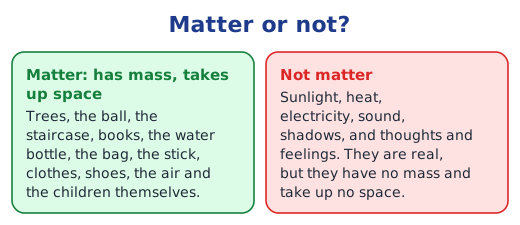
Probe and ponder (page 116)
Which things in the picture are matter? The trees, grass and flowers, the ball, the staircase and railing, books, the water bottle, bags, the walking stick, clothes and shoes, the air and the children themselves are matter, because they have mass and take up space. Sunlight, warmth, the sound of the game, shadows, and the children’s thoughts and feelings are not matter.
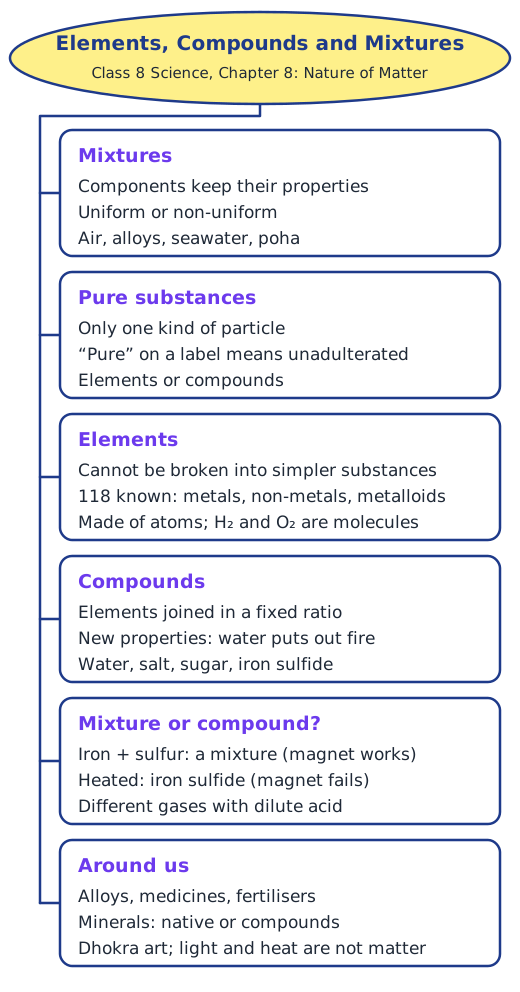
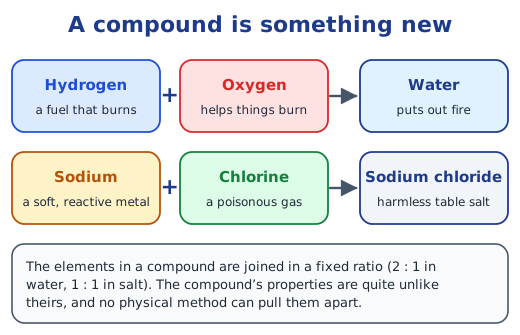
Combining elements into a compound. It takes a chemical reaction, often helped by heat or electricity: iron and sulfur heated together form iron sulfide, hydrogen and oxygen form water, and sodium and chlorine form sodium chloride, each in a fixed ratio.
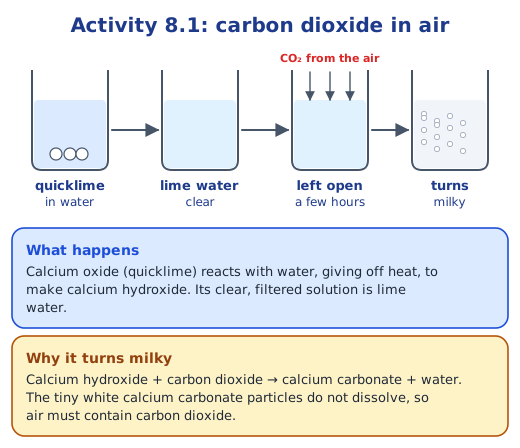
How could a compound that absorbs carbon dioxide help the environment? It could take carbon dioxide out of the air or out of factory chimneys, reducing the greenhouse gas that warms the planet and slowing climate change. Lime water already does this on a small scale: calcium hydroxide absorbs carbon dioxide and forms calcium carbonate (Activity 8.1).
Mixtures and air (pages 117–120)
Non-uniform mixtures around you: sand and pebbles, muddy water, fruit salad, a bowl of mixed nuts, oil floating on water. Uniform mixtures: salt water, lemonade, vinegar, soda water, air, brass and stainless steel.
Activity 8.1. Quicklime reacts vigorously with water, hissing and giving off heat, to form calcium hydroxide; the filtered solution, lime water, is clear and colourless. Left in the open for a few hours, with stirring, it turns milky. Why? Carbon dioxide from the air reacts with calcium hydroxide to form tiny white particles of insoluble calcium carbonate: calcium hydroxide + carbon dioxide → calcium carbonate + water. So air contains carbon dioxide.
The shining particles in a sunbeam, and Activity 8.2. They are dust. A black sheet left near a window collects tiny particles, easily seen with a magnifying glass. Dust is suspended in air but is not part of it; it is a pollutant whose amount and nature change with time and place.
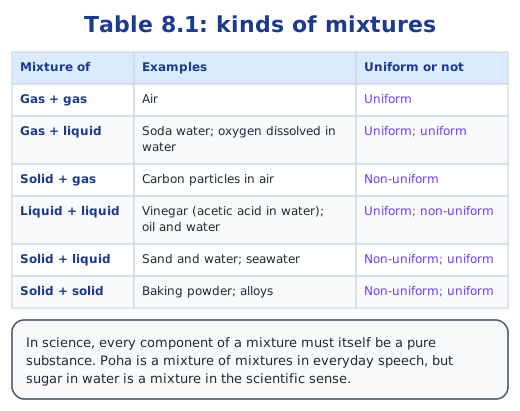
Table 8.1, third column. Air: uniform. Aerated water: uniform; oxygen dissolved in water: uniform. Carbon particles in air: non-uniform. Vinegar: uniform; oil and water: non-uniform. Sand and water: non-uniform; seawater: uniform. Baking powder: non-uniform; alloys: uniform.
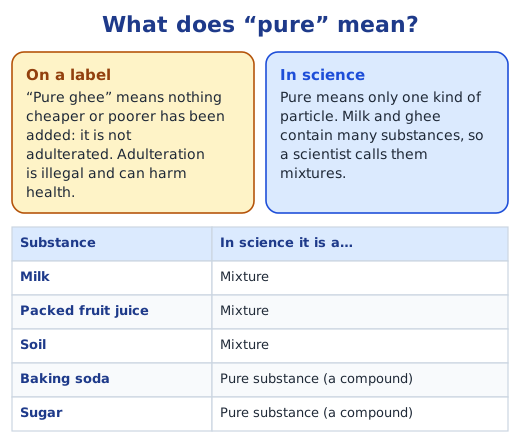
A step further (page 121). Milk, packed fruit juice and soil are mixtures; baking soda and sugar are pure substances (compounds).
Activities 8.3 and 8.4: elements and compounds (pages 121–125)
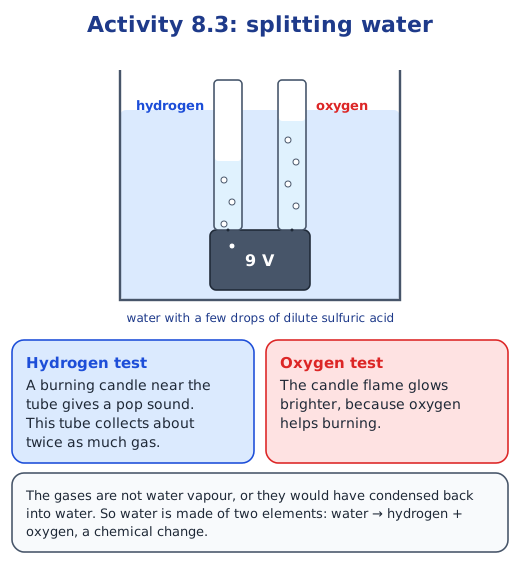
Activity 8.3. Gas bubbles form at both terminals. The volumes are not the same: one tube collects about twice as much gas as the other. A burning candle gives a pop at the first tube, so it holds hydrogen; at the second the flame glows brighter, so it holds oxygen. Can the gases be water vapour? No; vapour would condense back into water. Physical or chemical change? Chemical: water breaks into new substances, hydrogen and oxygen.
Can sodium chloride be split into its elements by physical processes? No. Evaporation only separates dissolved salt from water; sodium and chlorine are joined chemically and can be separated only by a chemical change.
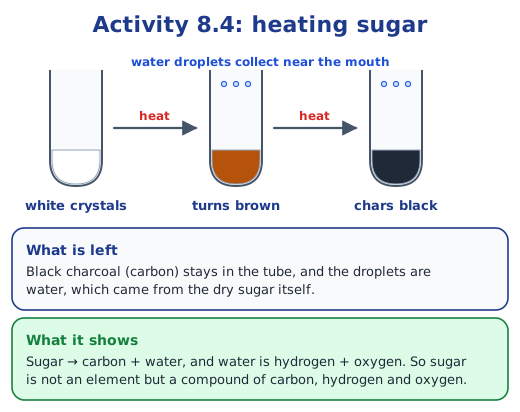
Activity 8.4. The sugar melts, turns brown and then chars black, and water droplets form near the open end of the boiling tube. The water came from the sugar, not from the air, since the tube was being heated. Carbon (charcoal) is left behind, and it glows and burns like coal when heated in a flame. So sugar is a compound of carbon, hydrogen and oxygen.
Activity 8.5: iron and sulfur (pages 125–128)
Is Sample A uniform? No, it is non-uniform: the grey-black iron and yellow sulfur can still be seen as separate substances. Table 8.2 is filled in below.
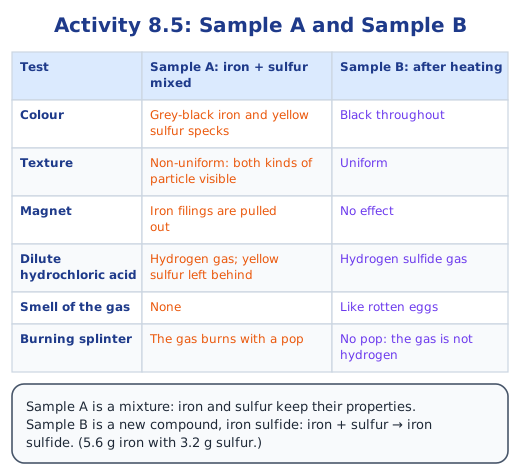
Discussion points. The samples do not look the same. Only Sample A is magnetic. Sample A’s components can be separated with a magnet; Sample B’s cannot. Gases form with both, but they differ: Sample A gives hydrogen, which has no smell, and Sample B gives hydrogen sulfide, which smells of rotten eggs. Categories: iron, sulfur and hydrogen are elements; iron sulfide, iron chloride and hydrogen sulfide are compounds; Sample A and dilute hydrochloric acid (hydrogen chloride dissolved in water) are mixtures. Why Sample B ignores the magnet: the iron in it is chemically joined to sulfur in a new compound.
Keep the curiosity alive (pages 131–132)
1. (iv): A and B are elements, while C is a compound with a fixed composition.
2. (i): the Assertion and the Reason are both true, and the Reason correctly explains the Assertion.
3. Hydrogen is a gas that burns, with a pop, and is used as a fuel; oxygen is a gas that helps things burn. Water, made from them, is a liquid at room temperature that does not burn and is used to put out fires. So the compound’s properties are completely different from those of its elements.
4. Only (iii) is correctly matched: carbon dioxide, iron, oxygen and sugar each contain one kind of particle. (i) is wrong because water is a compound and air a mixture. (ii) is wrong because a mineral has a fixed composition, so it is not a mixture. (iv) is wrong because air and brass are uniform mixtures.
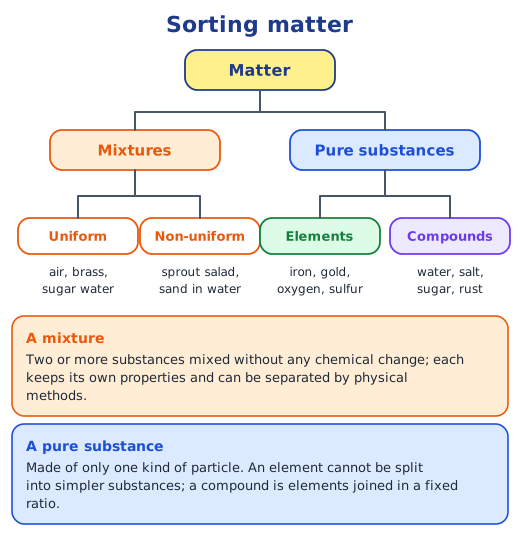
5. Elements: iron, magnesium and oxygen, which cannot be broken into simpler substances. Compounds: iron oxide and magnesium oxide, elements joined chemically in fixed ratios with new properties; the water vapour in moist air is also a compound. Mixture: moist air itself, gases and water vapour mixed in no fixed ratio.
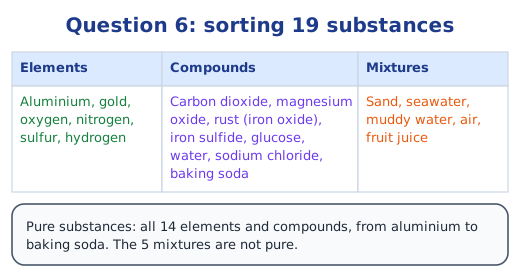
6. Elements: aluminium, gold, oxygen, nitrogen, sulfur, hydrogen. Compounds: carbon dioxide, magnesium oxide, rust (iron oxide), iron sulfide, glucose, water, sodium chloride, baking soda. Mixtures: sand, seawater, muddy water, air, fruit juice. Pure substances: all the elements and compounds, fourteen in all.
7. Iron sulfide. Unlike the mixture, it is black and the same throughout, a magnet does not attract it, its iron and sulfur cannot be separated physically, and with dilute hydrochloric acid it gives hydrogen sulfide, which smells of rotten eggs, instead of hydrogen. Word equation: iron + sulfur → iron sulfide.
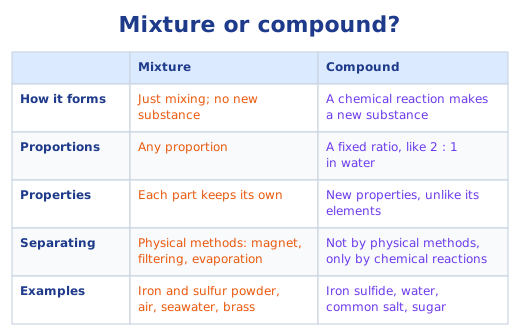
8. No. An element cannot be broken into simpler substances, while a compound is made of two or more elements joined chemically and can be broken down by a chemical change. No substance can be both.
9. Water would be a mixture of two gases, not a liquid. It would burn or even explode near a flame, because hydrogen is a fuel and oxygen helps burning, so it could not put out fires. We could not drink it, cook or wash with it, its make-up would vary, and life as we know it could not exist.
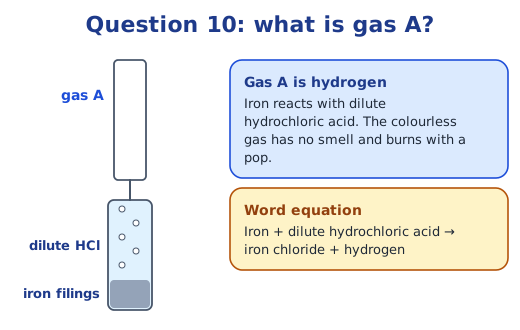
10. Gas A is hydrogen. Word equation: iron + dilute hydrochloric acid → iron chloride + hydrogen.
11. Water (hydrogen and oxygen): drinking and cooking; putting out fires. Carbon dioxide (carbon and oxygen): plants use it to make food; it is used in fire extinguishers and to make soda water fizzy.
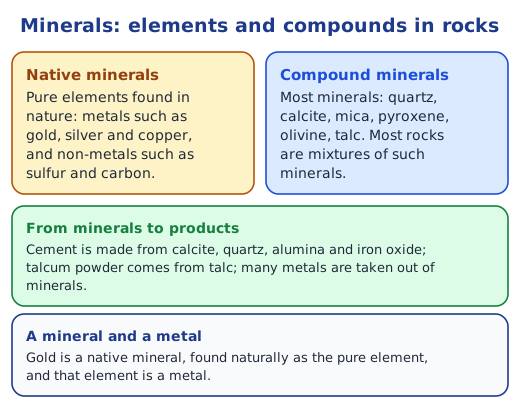
12. Gold is found in rocks as the pure element, so it is a native mineral; and that element is a metal: shiny, easy to beat into sheets and a good conductor of electricity.
Discover, design, and debate (page 133)
Comic strips: for example, iron and sulfur as two friends who stay themselves when they stand together (a mixture) but become a new character, iron sulfide, after a ‘heated’ meeting (a compound). Discoveries: phosphorus was found by Hennig Brand in 1669, sodium was first isolated by Humphry Davy in 1807 using electricity, penicillin was discovered by Alexander Fleming in 1928, bronze has been made for over 5,000 years, and stainless steel was developed in the early 20th century. Labels: snacks list mixtures such as spice blends and edible oil, and compounds such as salt (sodium chloride) and sugar; detergents list compounds such as washing soda. Debate: each category matters; elements build everything, compounds such as water and medicines keep us alive, and mixtures such as air, alloys and food surround us every day.
Practice
-
A and B cannot be broken down further and combine to form C. Which is correct?
Show answer
Answer: (c) A and B are elements and C is a compound with a fixed composition
-
Which list contains only pure substances?
Show answer
Answer: (b) carbon dioxide, iron, oxygen, sugar
-
Iron filings in dilute hydrochloric acid give:
Show answer
Answer: (b) hydrogen
-
Magnesium burning in oxygen gives magnesium oxide. Classify the three substances.
Show answer
Answer: Magnesium and oxygen are elements: neither can be broken into simpler substances. Magnesium oxide is a compound: the two elements are joined chemically in a fixed ratio and the white powder has new properties.
-
Why does a magnet not attract iron sulfide?
Show answer
Answer: In iron sulfide the iron is chemically joined to sulfur, forming a new compound with its own properties. The separate particles of iron that a magnet attracts are no longer there.
Stuck on a question?
Take a photo and Lagnever AI explains it step by step. Try it for 7 days for ₹2.
Get it on Google Play Open in browser
For parents: after the trial, the plan renews monthly by UPI or card autopay. You can cancel anytime in the app.