
Class 8 Science Chapter 8: Nature of Matter: Elements, Compounds, and Mixtures Notes
This chapter in five lines
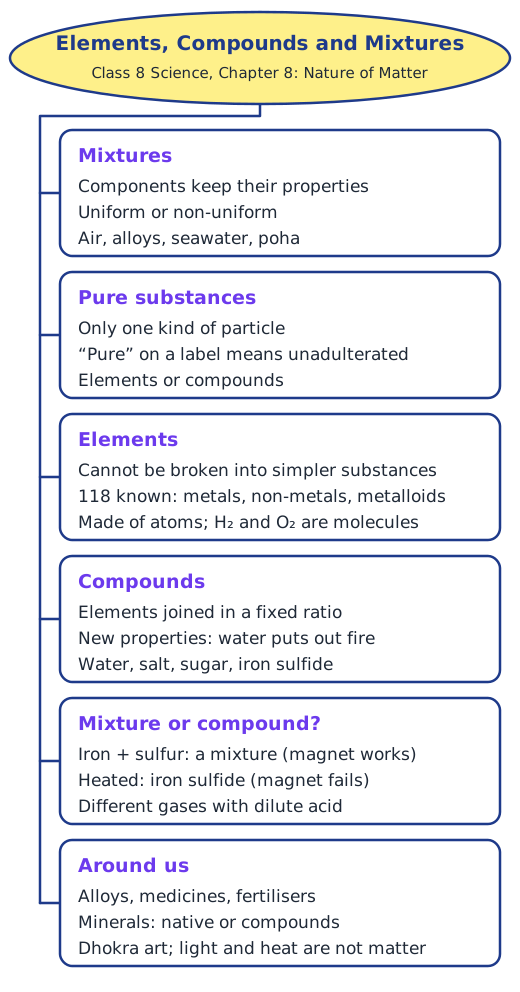
Nature of Matter: Elements, Compounds, and Mixtures sorts the matter around us. A mixture is two or more substances mixed without any chemical change, each keeping its own properties; it can be uniform or non-uniform. A pure substance has only one kind of particle: an element cannot be broken into simpler substances, while a compound is elements joined chemically in a fixed ratio, with new properties.
What is this chapter about?
The staircase, the air, the water in a bottle, lunch, clothes and trees are all matter, made of tiny particles. But most things are not one substance; they are several substances together. The chapter sorts matter into mixtures and pure substances, splits pure substances into elements and compounds, and shows how to tell a mixture from a compound.
Mixtures
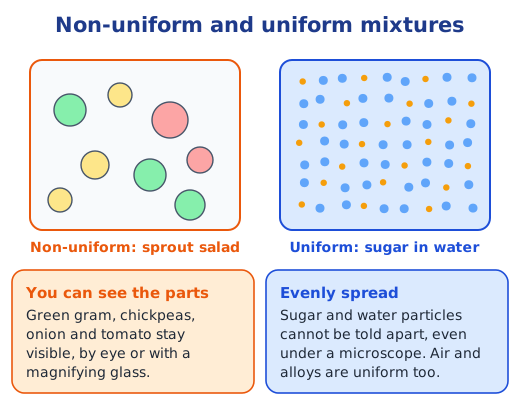
Poha and sprout salad are made by mixing ingredients, and so are lemonade and sugar water. In a mixture, each substance, or component, keeps its own properties, and the components do not react. In a sprout salad the green gram, chickpeas, onion and tomato are easy to see, so it is a non-uniform mixture. In sugar water the particles cannot be told apart even with a microscope, so it is uniform. Alloys are uniform mixtures of metals: stainless steel (iron, nickel, chromium and a little carbon), brass (copper and zinc) and bronze (copper and tin). Ancient Indian texts called them mishraloha. Read mixtures and pure substances.
Air is a mixture
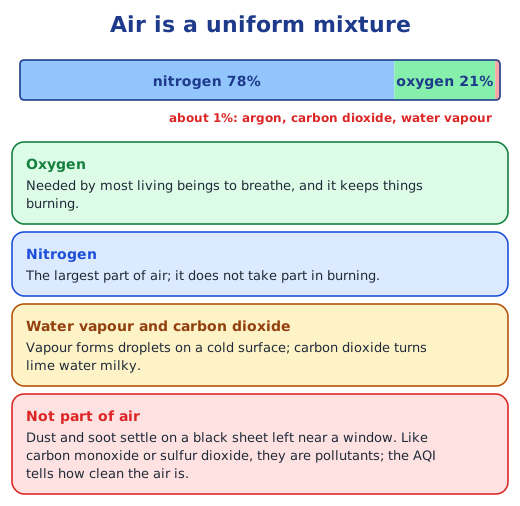
Air is a uniform mixture, mostly nitrogen (about 78%) and oxygen, with argon, carbon dioxide and water vapour. Lime water left open turns milky, because carbon dioxide from the air forms insoluble calcium carbonate. A black sheet left near a window collects dust, but dust and soot are not part of air; they are pollutants, along with gases such as carbon monoxide and sulfur dioxide, and the air quality index (AQI) describes how clean the air is.
Pure substances
‘Pure ghee’ on a pack means nothing cheaper has been added; adding it would be adulteration, which is illegal and can be harmful. In science, pure means something stricter: a pure substance contains only one kind of particle, and no physical method can split it into other kinds of matter. Milk and fruit juice are mixtures, while sugar and baking soda are pure substances. Pure substances are of two kinds: elements and compounds.
Elements
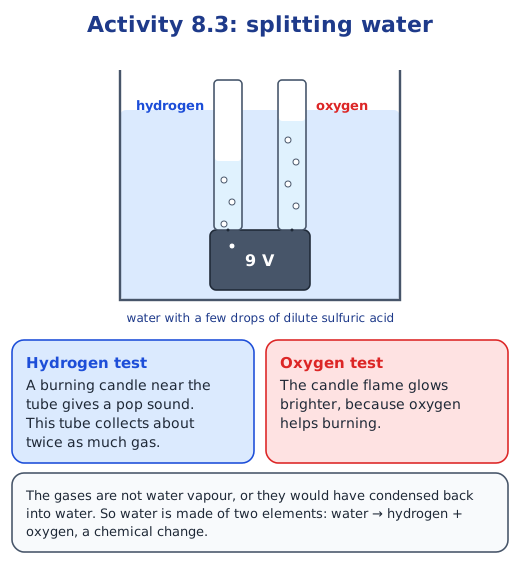
When electricity from a 9 V battery passes through water with a little dilute sulfuric acid, bubbles rise at both terminals. One gas burns with a pop: hydrogen. The other makes a flame glow brighter: oxygen. Hydrogen and oxygen are elements, substances that cannot be broken into anything simpler. Each is made of its own identical atoms, and most atoms join into molecules, such as a hydrogen molecule of two hydrogen atoms. Of the 118 known elements most are solids; eleven are gases and only mercury and bromine are liquids. Elements are metals, non-metals or metalloids. Read elements and compounds.
Compounds
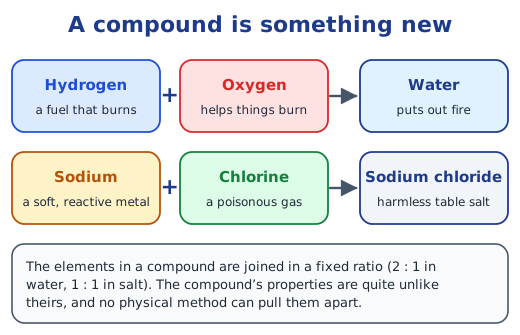
Water cannot be separated into hydrogen and oxygen by any physical method, because their particles are joined chemically in a fixed ratio of two hydrogen atoms to one oxygen atom. Such a substance is a compound, and its properties are new: hydrogen is a fuel and oxygen helps burning, but water puts out fire. Soft, reactive sodium and poisonous chlorine form harmless table salt. Heating sugar leaves black carbon and gives off water, so sugar is a compound of carbon, hydrogen and oxygen.
Mixture or compound?
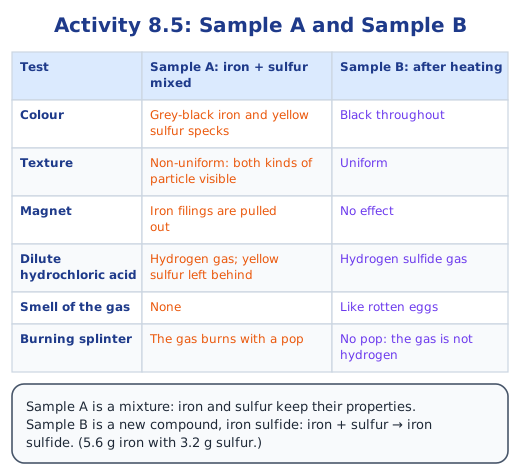
Mix iron filings with sulfur powder: you can still see both, and a magnet pulls the iron out. With dilute hydrochloric acid the iron gives hydrogen and the sulfur is left behind. Now heat the mixture: it becomes a black mass, iron sulfide, that a magnet cannot separate and that gives foul-smelling hydrogen sulfide with the acid. Heating made a new compound. Read difference between mixtures and compounds.
Using elements, compounds and mixtures
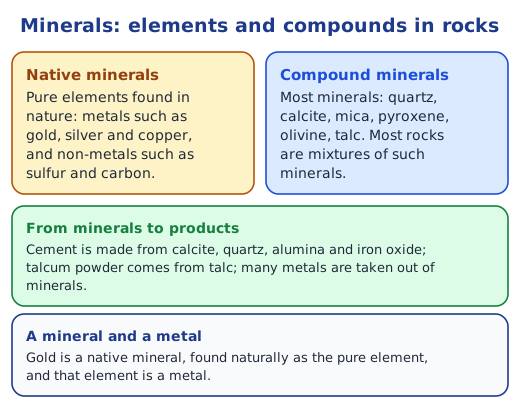
Iron and aluminium build bridges and vehicles; chemists combine elements into medicines, vaccines and fertilisers; alloys such as stainless steel are stronger than pure iron; and wood, steel and concrete are all mixtures. Graphene aerogel, made from carbon, is so light that grass can hold it and may help clean oil spills. Most rocks are mixtures of minerals; native minerals such as gold are pure elements, but most, like quartz and calcite, are compounds. Dhokra artists of Bihar and Odisha cast brass or bronze figures in clay moulds made from beeswax models.
Before we move on
Anything with mass that occupies space is matter, made of elements and compounds, alone or mixed. Light, heat, electricity, thoughts and feelings are real but are not matter. Answers to every question are in the NCERT solutions for Chapter 8.
Key terms
| Term | Meaning |
|---|---|
| Mixture | Two or more substances mixed together, each keeping its own properties, with no chemical reaction between them. |
| Components | Each separate substance present in a mixture; in science, each one must be a pure substance. |
| Uniform mixture | A mixture whose components are spread evenly and cannot be told apart, such as sugar water, air or brass. |
| Non-uniform mixture | A mixture whose components can be seen separately, by eye or with a magnifying glass, such as sprout salad or sand in water. |
| Alloy | A uniform mixture of metals, sometimes with a non-metal, such as stainless steel, brass or bronze; called mishraloha in old Indian texts. |
| Adulteration | Illegally adding cheaper or poorer substances to a product, which lowers its quality and can harm health. |
| Pure substance | Matter made of only one kind of particle, which no physical method can split into other kinds of matter. |
| Element | A pure substance that cannot be broken down into simpler substances; the building blocks of all matter, such as iron, oxygen and gold. |
| Atom | The tiny identical particle that makes up an element; atoms of one element differ from those of every other element. |
| Molecule | A stable particle formed when two or more atoms join, such as a hydrogen molecule (two hydrogen atoms). |
| Compound | A pure substance formed when two or more elements combine chemically in a fixed ratio, with properties different from theirs. |
| Metalloid | An element whose properties lie in between those of metals and non-metals, such as silicon and boron. |
| Mineral | A natural solid with a fixed chemical composition; most are compounds, but native minerals such as gold are pure elements. |
Topics in this chapter
Practice
-
Which of these is a uniform mixture?
Show answer
Answer: (c) Sugar dissolved in water
-
Brass is a mixture of:
Show answer
Answer: (b) copper and zinc
-
In Activity 8.3, the gas that burns with a pop is:
Show answer
Answer: (c) hydrogen
-
The ratio of hydrogen atoms to oxygen atoms in water is:
Show answer
Answer: (c) 2 : 1
-
Which element is a liquid metal at room temperature?
Show answer
Answer: (b) Mercury
-
A mineral that is a pure element is called a:
Show answer
Answer: (a) native mineral
Questions students ask
What are the main topics of Class 8 Science Chapter 8?
Mixtures and their components; uniform and non-uniform mixtures, alloys and air; the kinds of mixtures; what pure means in daily life and in science; elements, atoms and molecules; compounds and their fixed ratios; the difference between a mixture and a compound shown with iron and sulfur; and how elements, compounds, mixtures and minerals are used.
Is Nature of Matter: Elements, Compounds, and Mixtures in the new NCERT Class 8 Science book?
Yes. It is Chapter 8 of Curiosity, the Class 8 Science textbook (Reprint 2026-27), on pages 116 to 133. It follows Particulate Nature of Matter, which showed that all matter is made of tiny particles.
What is the difference between an element and a compound?
An element, such as hydrogen or iron, is made of one kind of atom and cannot be broken into simpler substances. A compound, such as water, is two or more elements joined chemically in a fixed ratio; it can be broken down only by a chemical change, as electricity splits water into hydrogen and oxygen.
Is air a mixture or a compound?
Air is a uniform mixture. Its gases, mainly nitrogen and oxygen, keep their own properties, are not joined in any fixed ratio, and the amounts of water vapour and dust can change from place to place, which a compound’s composition never does.
Stuck on a question?
Take a photo and Lagnever AI explains it step by step. Try it for 7 days for ₹2.
Get it on Google Play Open in browser
For parents: after the trial, the plan renews monthly by UPI or card autopay. You can cancel anytime in the app.