
Mixtures and pure substances
Answer in short
A mixture is two or more substances mixed without any chemical change, so each keeps its own properties, as in poha, sugar water or air. It may be uniform or non-uniform. A pure substance contains only one kind of particle and cannot be separated by physical methods; elements and compounds are pure substances.
Stuck on a question? Take a photo and Lagnever AI explains it step by step. Try it for 7 days for ₹2. Get it on Google Play
What is a mixture?
Poha and sprout salad seem very different, but both are made by mixing several ingredients, and so are soup, lemonade and sugar water. When two or more substances are put together and each keeps its own properties, the result is a mixture. Each substance in it is a component, and the components do not react chemically with one another. That is why the sweetness of sugar is still there in sugar water, and why the chickpeas in a salad still look and taste like chickpeas.
Uniform and non-uniform mixtures
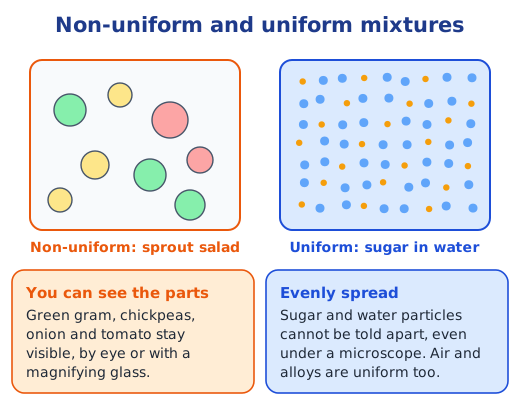
In some mixtures the components are easy to see. In a sprout salad, the moong sprouts, chickpeas, onion and tomato stay visible, with the eye or a magnifying glass, so it is a non-uniform mixture; sand in water is another. In others, the components are spread so evenly that they cannot be told apart even under a microscope. Sugar and water particles look like one liquid, so sugar water is a uniform mixture, and so are seawater, vinegar and air.
Alloys: uniform mixtures of metals
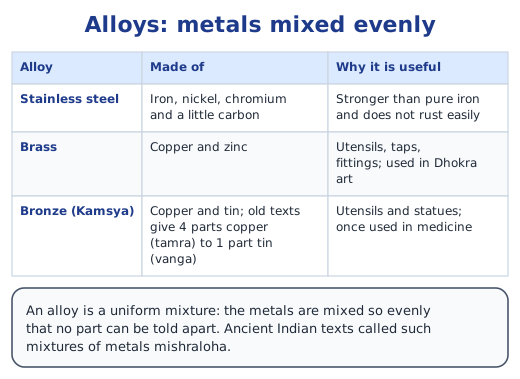
Stainless steel looks like one metal, but it is a mixture of iron, nickel, chromium and a little carbon, blended so evenly that no part can be told apart. Such uniform mixtures of metals are alloys. Brass is copper and zinc, and bronze is copper and tin. Old Indian works like the Charaka Samhita and the Susruta Samhita called alloys mishraloha and described their use in medicine; bronze, or kamsya, was made of four parts copper (tamra) to one part tin (vanga).
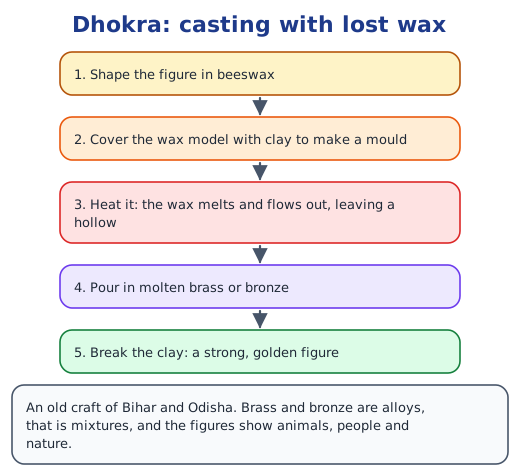
Alloys are also art. In Dhokra, an old craft of Bihar and Odisha, a figure shaped in beeswax is covered with clay, the wax is melted out, and molten brass or bronze is poured into the hollow to make strong, golden figures of animals, people and nature.
Kinds of mixtures
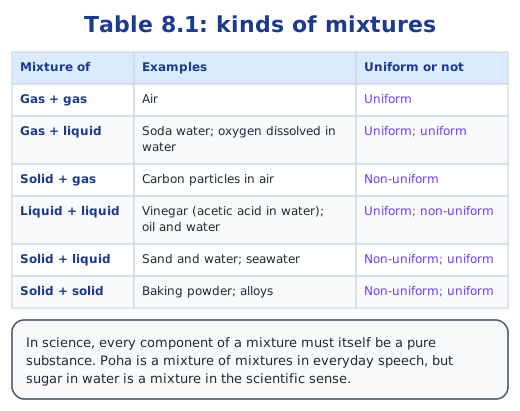
Mixtures can also be sorted by the states of their components. Air is gas in gas; soda water is gas in liquid; carbon particles in air are a solid in a gas; vinegar is a liquid in a liquid, and so is oil with water, though that one separates into layers; sand in water and seawater are solids in a liquid; and baking powder and alloys are solids mixed with solids. Some of each kind are uniform and some are not. In everyday speech, a mixture can contain other mixtures, as poha does; in science, every component of a mixture must be a pure substance.
What does ‘pure’ mean?
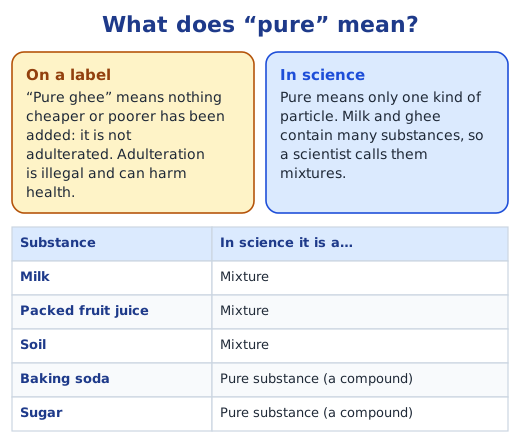
Packs of milk, ghee and spices often say ‘pure’. In everyday use this means unadulterated: nothing cheaper or of poorer quality has been added to increase the amount or cut the cost. Adulteration is illegal, spoils the quality and can make food harmful. In science, the word is stricter. A pure substance has only one kind of particle, and no physical method can split it into other kinds of matter. By this test, milk, packed fruit juice and soil are mixtures, while sugar and baking soda are pure substances.
Why separate mixtures?
In daily life we separate a mixture to keep the part we want, such as picking stones out of rice. In science, mixtures are separated so that pure substances can be studied on their own. Pure substances come in two kinds, elements and compounds: see elements and compounds and the difference between mixtures and compounds. The whole chapter is in the Chapter 8 notes, with every answer in the NCERT solutions.
Practice
-
Which is a non-uniform mixture?
Show answer
Answer: (c) Sprout salad
-
Bronze is an alloy of:
Show answer
Answer: (a) copper and tin
-
Which of these is a pure substance in science?
Show answer
Answer: (d) Baking soda
-
Is seawater uniform or non-uniform? Give a reason.
Show answer
Answer: Uniform. The salt is dissolved and spread evenly through the water, so it cannot be seen separately, even though it can be recovered by evaporating the water.
-
Why do scientists separate mixtures?
Show answer
Answer: In everyday life we separate a mixture to keep the part we want and throw away the rest. In science, the goal is to get pure substances out of the mixture.
Questions students ask
What is a mixture in Class 8 Science?
When two or more substances are put together and each keeps its own properties, we get a mixture. The substances, called components, do not react chemically with each other. Poha, sprout salad, lemonade, soup, sugar water, seawater and air are all mixtures.
What is the difference between uniform and non-uniform mixtures?
In a uniform mixture the components are spread evenly and cannot be told apart, even with a microscope, as in sugar water, air or brass. In a non-uniform mixture the components can be seen separately with the eye or a magnifying glass, as in sprout salad or sand and water.
What is a pure substance?
In science, a pure substance is matter made of only one kind of particle. No physical method can split it into other kinds of matter. Elements, such as iron and oxygen, and compounds, such as water and sugar, are pure substances.
Stuck on a question?
Take a photo and Lagnever AI explains it step by step. Try it for 7 days for ₹2.
Get it on Google Play Open in browser
For parents: after the trial, the plan renews monthly by UPI or card autopay. You can cancel anytime in the app.