
Difference between mixtures and compounds
Answer in short
A mixture forms by simply mixing substances in any proportion; each keeps its properties and can be separated by physical methods such as a magnet. A compound forms by a chemical reaction, has its elements in a fixed ratio, shows new properties and cannot be separated physically. Iron and sulfur powder is a mixture; heated together, they form iron sulfide.
Stuck on a question? Take a photo and Lagnever AI explains it step by step. Try it for 7 days for ₹2. Get it on Google Play
Two ways to put substances together
Substances can come together in two very different ways. They can simply be mixed, like sugar stirred into water or sand into gravel, with no new substance formed. Or they can react, joining chemically into something new, as hydrogen and oxygen do in water. The first gives a mixture, the second a compound. They can look alike, since both may seem uniform, so we need tests to tell them apart.
Five differences
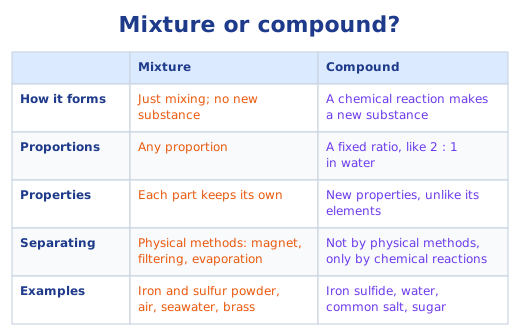
A mixture forms by mixing alone, while a compound forms by a chemical reaction. A mixture can contain its parts in any proportion: a little or a lot of sugar in water. A compound always has the same fixed ratio: water is always two hydrogen atoms to one oxygen atom. In a mixture each part keeps its properties, but a compound has new ones. Mixtures can be separated by physical methods such as a magnet, filtering or evaporation; compounds cannot. Air, seawater and brass are mixtures; water, common salt and sugar are compounds.
The iron and sulfur test
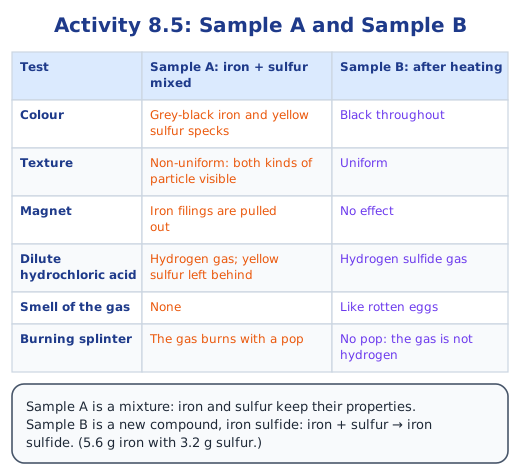
Activity 8.5 shows the difference with two familiar substances. About 5.6 g of grey-black iron filings and 3.2 g of yellow sulfur powder are mixed well on a watch glass: this is Sample A. Half of it is heated gently in a china dish, with stirring, until it forms a black mass, which is cooled and ground: this is Sample B. Because hot sulfur gives off fumes, the teacher shows this step where the fumes can escape safely, under a hood or beside open windows. The two samples are then compared step by step.
Reading the results
In Sample A, black and yellow specks are both visible, so it is a non-uniform mixture, and a magnet pulls the iron filings out. With a few drops of dilute hydrochloric acid, the iron gives hydrogen, a colourless gas with no smell that burns with a pop, while the sulfur stays as a yellow solid at the bottom: iron + dilute hydrochloric acid → iron chloride + hydrogen. Sample B is black throughout, and the magnet has no effect on it. With dilute hydrochloric acid, iron sulfide gives iron chloride and hydrogen sulfide, a gas that smells like rotten eggs. Heating made a new compound: iron + sulfur → iron sulfide. Smell such gases only by wafting them gently towards your nose, never directly. The two different gases are the clearest sign that Sample B is no longer iron and sulfur side by side, but a single new substance.
Mixtures and compounds around us
The same oxygen can be in a mixture or a compound. In air it is mixed with nitrogen and keeps its properties; in water it is joined to hydrogen, and the compound puts out fire instead of feeding it. If water were only a mixture of hydrogen and oxygen, it would burn and explode instead of quenching thirst and fires. Alloys like brass and bronze are mixtures; rust and iron sulfide are compounds. See mixtures and pure substances, elements and compounds, the Chapter 8 notes and the NCERT solutions.
Practice
-
Which can be separated by a magnet?
Show answer
Answer: (b) A mixture of iron filings and sulfur
-
With dilute hydrochloric acid, iron sulfide gives a gas that:
Show answer
Answer: (c) smells like rotten eggs
-
In a compound, the elements are present:
Show answer
Answer: (b) in a fixed ratio
-
Write the word equation for heating iron with sulfur.
Show answer
Answer: Iron + sulfur → iron sulfide. The black iron sulfide is a new compound: it looks the same throughout and is not attracted by a magnet.
-
Air and water both contain oxygen. Why is one a mixture and the other a compound?
Show answer
Answer: In air, oxygen is simply mixed with nitrogen and other gases, keeps its properties and can vary in amount, so air is a mixture. In water, oxygen is chemically joined to hydrogen in a fixed 1 : 2 ratio of atoms with new properties, so water is a compound.
Questions students ask
What are the main differences between a mixture and a compound?
A mixture forms by mixing, with no chemical change; its parts can be in any proportion, keep their own properties and can be separated by physical methods. A compound forms by a chemical reaction; its elements are in a fixed ratio, it has new properties, and it cannot be separated into its elements by physical methods.
Is an alloy a mixture or a compound?
An alloy is a mixture, a uniform one. Stainless steel, brass and bronze are metals mixed evenly, not joined chemically, so their makeup can be varied, and the metals keep many of their own properties.
What does Activity 8.5 prove?
It shows that iron and sulfur mixed together (Sample A) remain a mixture, because both can still be seen and a magnet separates the iron. After heating, the black substance (Sample B) is iron sulfide, a compound with new properties: it is not magnetic and gives a different gas with dilute hydrochloric acid.
Stuck on a question?
Take a photo and Lagnever AI explains it step by step. Try it for 7 days for ₹2.
Get it on Google Play Open in browser
For parents: after the trial, the plan renews monthly by UPI or card autopay. You can cancel anytime in the app.