
Elements and compounds
Answer in short
Elements and compounds are the two kinds of pure substances. An element, such as hydrogen, oxygen or iron, is made of one kind of atom and cannot be broken into simpler substances. A compound, such as water, salt or sugar, forms when elements combine chemically in a fixed ratio, and it has properties quite different from theirs.
Stuck on a question? Take a photo and Lagnever AI explains it step by step. Try it for 7 days for ₹2. Get it on Google Play
Splitting water
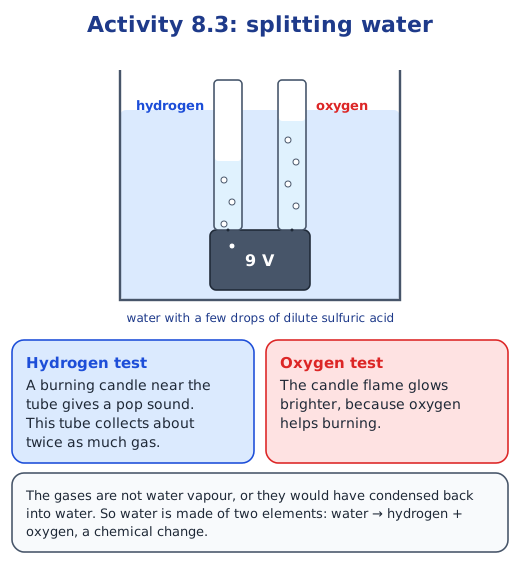
Heating or cooling water only changes its state; the particles stay water. Passing electricity through it is different. In Activity 8.3, two water-filled test tubes are placed over the terminals of a 9 V battery in water with a few drops of dilute sulfuric acid. Bubbles rise at both terminals, and one tube collects about twice as much gas as the other. A burning candle held near the first tube gives a pop: the gas is hydrogen. Near the second, the flame glows brighter: the gas is oxygen. So water is made of two different substances, and splitting it is a chemical change.
Elements, atoms and molecules
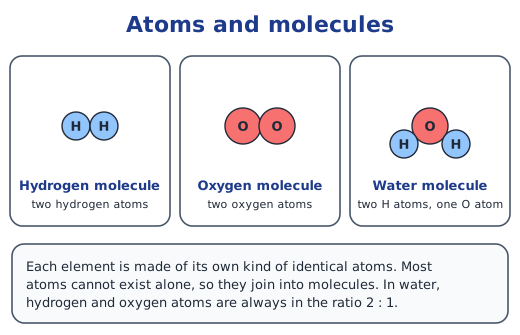
Hydrogen and oxygen cannot be broken down any further. Such pure substances are elements, the building blocks of all matter; gold, silver, sulfur and carbon are others. Each element is made of identical particles called atoms, different from the atoms of any other element. Most atoms do not exist alone: two or more join to form a stable molecule, so a hydrogen molecule is two hydrogen atoms and an oxygen molecule two oxygen atoms.
How many elements are there?
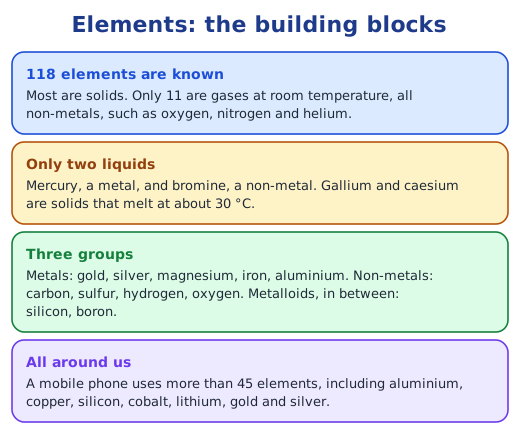
Scientists know 118 elements, and most of them are solids. Eleven are gases at room temperature, all non-metals, such as oxygen, nitrogen and helium. Only two are liquids: mercury, a metal, and bromine, a non-metal; gallium and caesium are solids that melt at about 30 °C. Elements are grouped as metals (gold, silver, magnesium, iron, aluminium), non-metals (carbon, sulfur, hydrogen, oxygen) and metalloids, such as silicon and boron, whose properties lie in between. A single mobile phone uses more than 45 elements.
Compounds: a fixed ratio and new properties
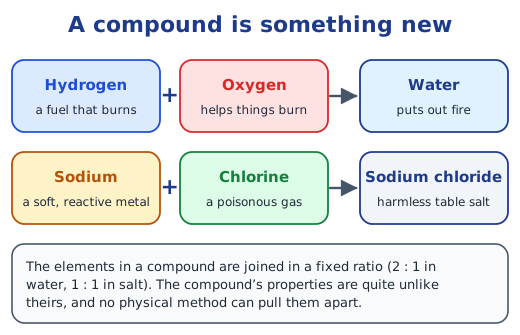
In water, hydrogen and oxygen particles are held so tightly that no physical method can pull them apart. Water is a compound: elements joined chemically in a fixed ratio, here two hydrogen atoms for every oxygen atom. A compound’s properties are its own. Hydrogen is a fuel and oxygen helps things burn, yet water puts out fire. Sodium, a soft metal, and chlorine, a dangerous gas, join one to one as sodium chloride, the common salt that flavours food. Dissolved salt can be recovered from water by evaporation, but no physical process splits salt itself into sodium and chlorine.
Is sugar an element?
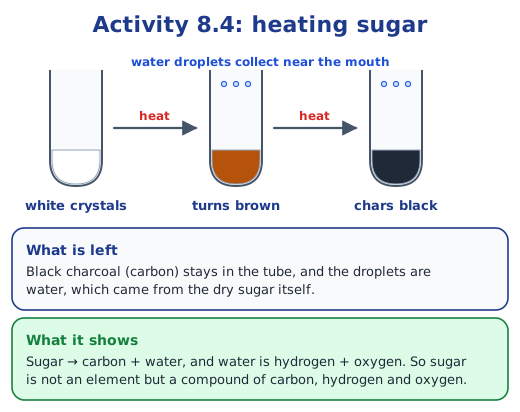
Heat a teaspoon of sugar gently in a boiling tube. It turns brown and then chars black, and droplets of water appear near the open end. The tube is being heated, so the water cannot come from the air; it comes from the sugar. Black carbon, or charcoal, is left behind. Since sugar breaks down into carbon and water, and water is hydrogen and oxygen, sugar is a compound of carbon, hydrogen and oxygen.
Elements and compounds in rocks
Most rocks are mixtures of minerals. A few minerals, called native minerals, are pure elements: metals like gold, silver and copper, and non-metals like sulfur and carbon. That is why gold counts as both a mineral and a metal. Most minerals, however, are compounds. Compare mixtures with compounds in the difference between mixtures and compounds, revise mixtures and pure substances, or read the Chapter 8 notes and NCERT solutions.
Practice
-
Which of these is an element?
Show answer
Answer: (c) Sulfur
-
How many elements are known at present?
Show answer
Answer: (c) 118
-
Silicon and boron are:
Show answer
Answer: (c) metalloids
-
What does heating sugar show about it?
Show answer
Answer: Sugar turns brown, then chars to black carbon, and water droplets form near the mouth of the tube. Since water is hydrogen and oxygen, sugar must be a compound of carbon, hydrogen and oxygen, not an element.
-
Can a substance be both an element and a compound?
Show answer
Answer: No. An element cannot be broken into simpler substances, while a compound is made of two or more elements and can be broken down by a chemical change. A substance cannot be both at once.
Questions students ask
What is an element?
An element is a pure substance that cannot be broken down into simpler substances. It is made of identical particles called atoms, which differ from the atoms of every other element. Gold, silver, sulfur, carbon, hydrogen and oxygen are elements; all matter is built from them.
What is a compound?
A compound forms when two or more elements combine chemically in a fixed ratio. Its properties are different from those of its elements, and it cannot be separated into them by any physical method. Water (hydrogen and oxygen, 2 : 1), sodium chloride (sodium and chlorine, 1 : 1) and sugar are compounds.
What is the difference between an atom and a molecule?
An atom is the smallest particle of an element. Most atoms cannot exist on their own, so two or more join to form a molecule. Two hydrogen atoms make a hydrogen molecule, and two hydrogen atoms with one oxygen atom make a molecule of water, a compound.
Stuck on a question?
Take a photo and Lagnever AI explains it step by step. Try it for 7 days for ₹2.
Get it on Google Play Open in browser
For parents: after the trial, the plan renews monthly by UPI or card autopay. You can cancel anytime in the app.