
NCERT Solutions Class 8 Social Science Chapter 1: Natural Resources and Their Use
Answers to the Big Questions, every Don’t Miss Out, Think About It and Let’s Explore box, and all five Questions and activities in Chapter 1, Natural Resources and Their Use, of Exploring Society: India and Beyond, Grade 8 Part 1. Page numbers follow the book (pages 1–19). Short notes: Chapter 1 notes.
The Big Questions (page 1)
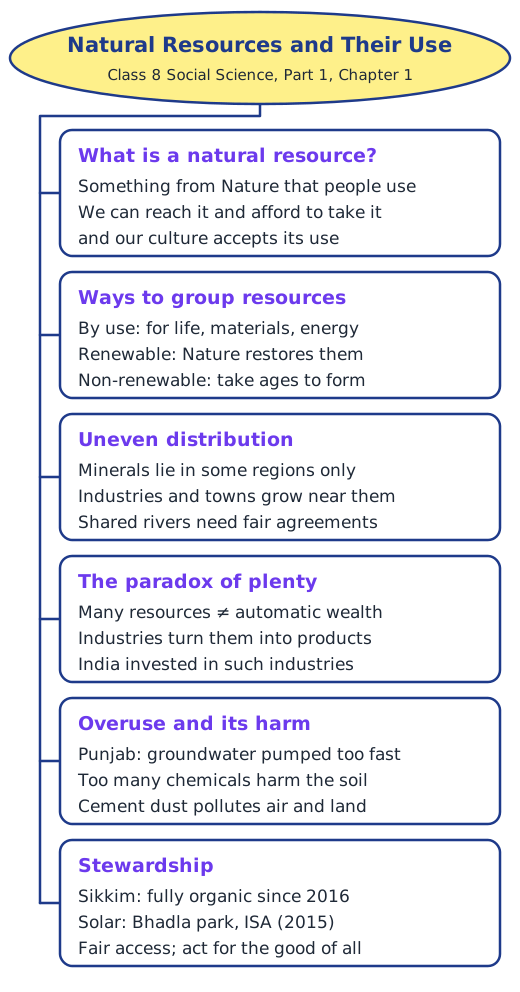
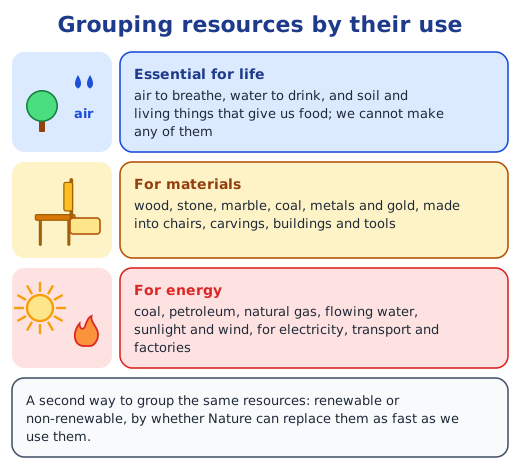
1. In what ways can we group natural resources? By their use: resources essential for life (air, water, soil), resources for materials (wood, marble, metals) and resources for energy (coal, petroleum, sunlight, wind). And by whether Nature can renew them: renewable resources, such as sunlight, forests and flowing water, and non-renewable ones, such as coal, petroleum and metals.
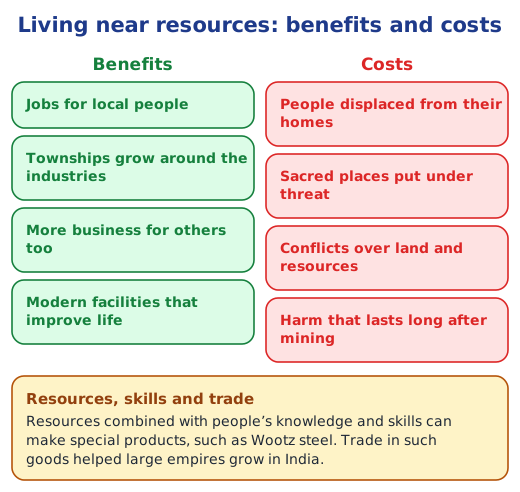
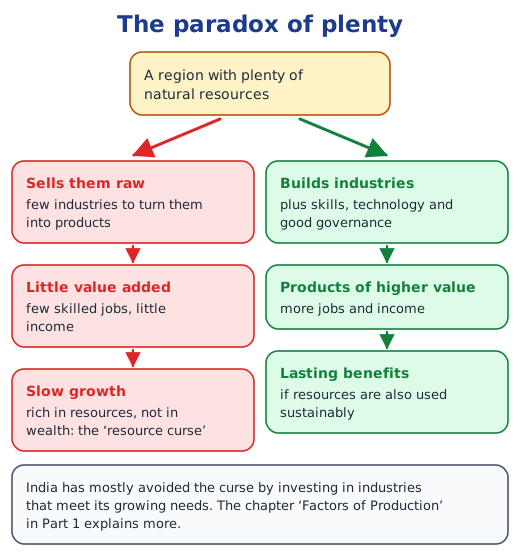
2. How is the spread of resources linked to people’s lives? Resources are found unevenly, so they shape where people settle and work, which industries and towns grow, what is traded, and how States and countries get along. Mines and factories near resources bring jobs and facilities but may displace people. Shared rivers, such as the Kaveri, need fair agreements, and many wars have been fought to control resources. Plenty alone does not make a place rich: that depends on industries, skills and good governance.
3. What happens when resources are used unsustainably or overused? Renewable resources stop renewing: forests shrink, fish decline, glaciers melt faster than they refill, and groundwater falls, as in Punjab. Soil and water are poisoned by chemicals and factory waste, cement dust harms lungs and crops, and pollution, biodiversity loss and climate change get worse. Non-renewable resources such as coal run out sooner, leaving less for future generations.
Don’t Miss Out, Think About It and Let’s Explore (pages 3–11)
Practices that treat Nature as sacred (page 3). Many Indian homes perform tulasī puja; people offer water to the sun as arghyam; trees such as the peepal and banyan are worshipped; rivers are honoured with prayers and festivals; and in many villages, sacred groves are protected and no tree in them is cut. Extra: the Bishnoi community of Rajasthan is known for protecting khejri trees and wild animals such as the blackbuck.
Where does each thing come from? (page 3). A cotton shirt comes from the cotton plant; its plastic button is made from petroleum; a wooden pencil comes from trees, and its ‘lead’ is graphite dug from the ground; a steel spoon comes from iron ore; glass is made from sand; paper is made from wood pulp. Everything, traced back far enough, comes from Nature.
Criteria for grouping natural resources (page 4). We can group them by their use (for life, materials or energy), by whether they can be renewed (renewable or non-renewable), by whether they come from living things or non-living things, by where they are found (almost everywhere, like air, or only in some places, like coal), or by who owns them (a family, a village, the country). Extra: the last three are criteria used in many geography books; the chapter itself explains the first two.
Traditional practices that keep ecosystems in balance (page 6). Not fishing in the breeding season, so that fish numbers recover; protecting sacred groves; leaving some land fallow so the soil can rest; growing mixed crops and rotating them; and sharing and cleaning village ponds and tanks together before the rains.
Human actions that stop Nature restoring itself, and what can be done (page 7). A sample from a town: (1) Garbage and sewage dumped into a pond or stream. Fix: collect waste separately, treat sewage, and clean the pond with the community. (2) Trees cut for new roads and buildings. Fix: plant native trees and protect old ones. (3) Too many borewells. Fix: rainwater harvesting on rooftops and recharge pits. (4) Plastic thrown on open land. Fix: carry cloth bags and recycle plastic. (5) Too much chemical spray on farms. Fix: natural manure and pest repellents such as neem.
A study of renewable resources in your region (page 8). A sample outline for a short report. Area: our block or district (agree on it with your teacher). Renewable resources: groundwater, a lake or pond, a patch of forest or grassland, farm soil, sunlight and wind. Change over time: ask elders and look at old photos and newspaper reports; for example, wells may now have to go much deeper, a pond may have shrunk, a forest may be thinner. Reasons: more borewells, building over ponds, waste dumping, felling of trees, too many chemicals. What may be done: rainwater harvesting, desilting and protecting ponds, planting native trees, organic manure, and rules agreed by the community.
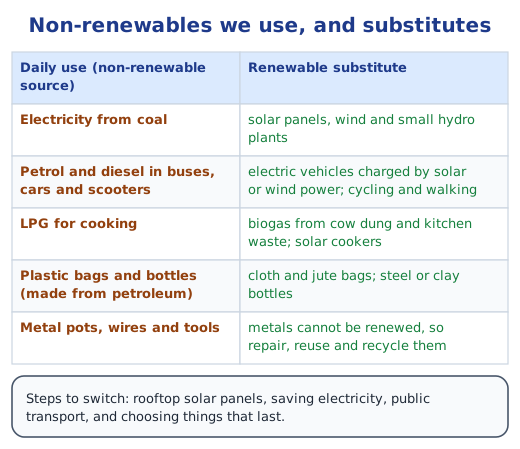
Non-renewable resources we use every day (page 8). Directly: petrol and diesel in buses and scooters, LPG for cooking, coal-based electricity, plastic items made from petroleum, and metal utensils and wires. Indirectly: the coal and oil used to make cement, steel, fertilisers and almost every factory product we buy. Renewable substitutes are in the table below. Steps to make the switch: rooftop solar panels, public transport, cycling and walking, saving electricity, biogas, and buying things that last and can be repaired.
Resources on the map of minerals (page 9). The map shows that minerals are bunched in some regions and missing in others: most of the coal and bauxite marked lie in the east and centre of India, oil in Gujarat, off Mumbai and in Assam, and iron ore in the east and the south-west. To answer for your region, find your State on the map and note which of the four symbols lie in or near it. For example, a student in Odisha would find coal at Talcher, iron ore at Keonjhar and Mayurbhanj, and bauxite at Koraput. Other resources of your region, such as forests, rivers, fertile soil or fish, matter too.
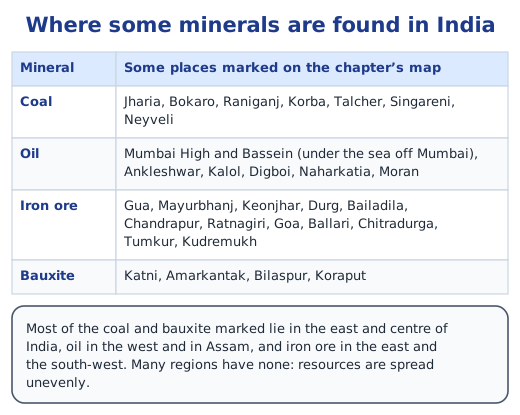
Two resources across India (page 10). A sample with coal and iron ore. Availability: coal at Jharia, Bokaro, Raniganj, Korba, Talcher, Singareni and Neyveli; iron ore at Gua, Keonjhar, Mayurbhanj, Durg, Bailadila, Chandrapur, Goa, Ballari, Chitradurga, Tumkur and Kudremukh. Mark them on an outline map of India. What you notice: both are found mostly in the east and centre of India, with iron ore also in the south-west and coal also at Singareni and Neyveli in the south, while the northern plains and the north-west have neither. Economic activities: mining, coal-based power stations, steel plants, railways and trucks that carry ore and coal, and townships with shops and services for the workers. For today and tomorrow: mining brings jobs and steel for building, but it can clear forests, pollute air and water, displace communities and use up resources that future generations will also need. Responsible use: mine only what is needed, restore the land and replant forests afterwards, recycle scrap steel, make power plants cleaner, share benefits with local people, and switch from coal to solar and wind power.
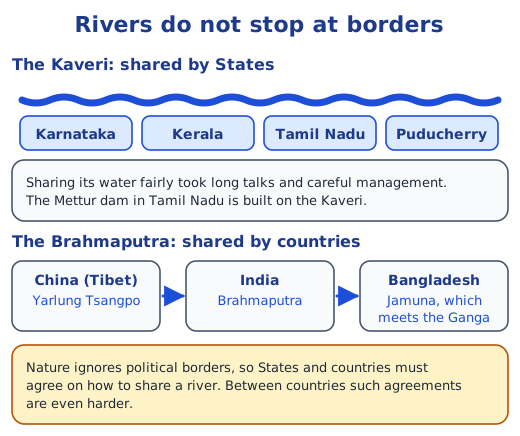
A conflict over a shared resource in another part of the world (page 10). The chapter’s own example is the Brahmaputra, which flows from Tibet in China into India and then Bangladesh, so dams or water use upstream worry the countries downstream. Extra, beyond the chapter: the Nile flows through several countries of Africa. Ethiopia has built a very large dam on the Blue Nile to produce electricity, while Egypt and Sudan, downstream, fear that they will get less water. The countries have held talks for many years without a full agreement. Discuss in class how fair sharing could be worked out.
Inputs needed to use natural resources (page 11). Technology and machines to find and extract them; skilled workers and engineers; money to invest; energy and water; roads, railways and ports to move them; industries that process them into finished goods; research to find better and cleaner methods; markets to sell in; and good governance, with fair laws and care for the environment and for local people. The chapter Factors of Production, later in Part 1, explains these inputs.
Is it time to act for the good of all? (page 19). Yes. Groundwater, clean air and forests are shared, and if each of us takes as much as we want, everyone, including future generations, loses. Lokasangraha asks us to think of the wellbeing of all when we use water, electricity, fuel and goods.
Questions and activities (page 19)
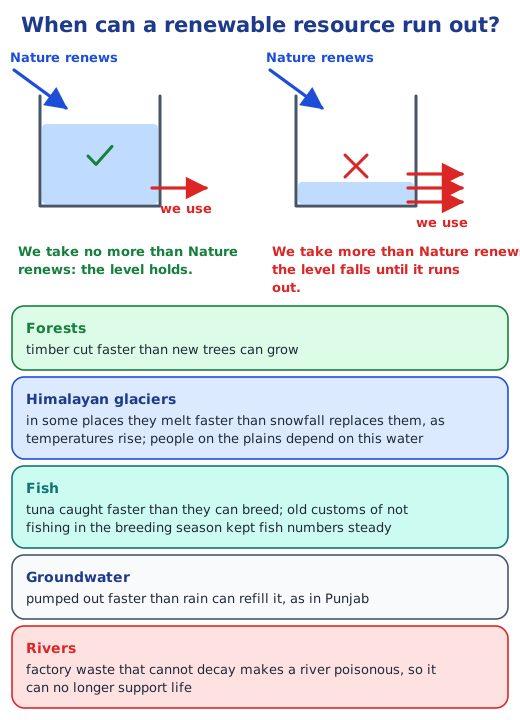
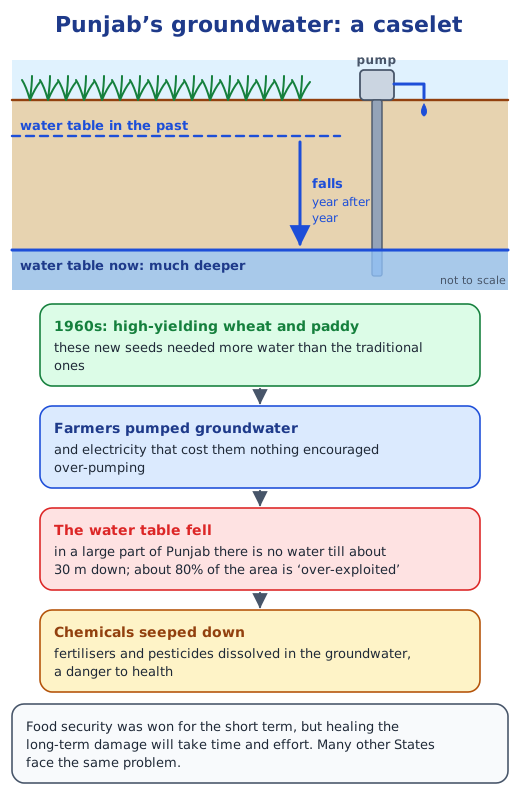
Q1. “What can make what is today a renewable resource non-renewable tomorrow? Describe some actions that can prevent this from happening.” A renewable resource lasts only while Nature can restore and regenerate it. It can become, in practice, non-renewable if (1) we use it faster than it renews: cutting trees faster than forests grow, catching fish faster than they breed, or pumping groundwater faster than rain refills it, as in Punjab, where about 80 per cent of the area is ‘over-exploited’; (2) pollution breaks Nature’s cycle: factory waste that cannot decay can poison a river until it supports no life, and too many chemicals degrade the soil; (3) rising temperatures upset the cycle: some Himalayan glaciers now melt faster than snowfall replaces them; (4) we destroy its base, by clearing forests or building over lakes. Actions that prevent this: harvest timber and fish only within limits and allow time to regrow, such as no fishing in the breeding season; plant native trees; harvest rainwater, revive ponds and tanks, waste less water and reuse treated water; treat factory waste before it reaches rivers; use natural manure, mulching and crop rotation; and cut the burning of fossil fuels by switching to solar and wind power.
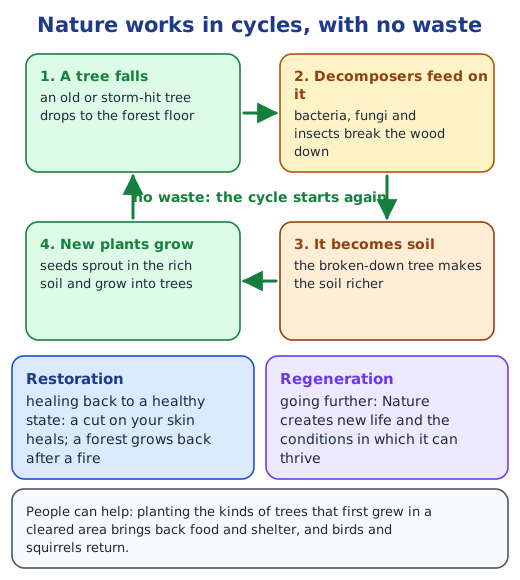
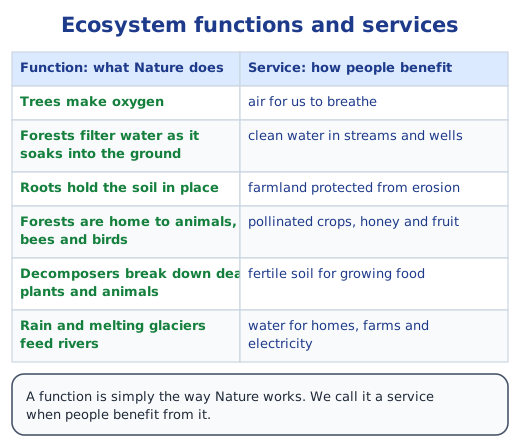
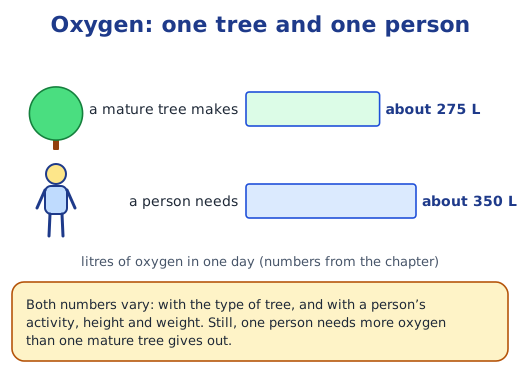
Q2. “Name five ecosystem functions that serve humans.” (1) Trees and plants produce oxygen, which we breathe. (2) Forests filter water as it soaks into the ground, giving us clean water. (3) Roots hold the soil and prevent erosion, which protects farmland. (4) Forests provide habitat for animals, including bees, birds and other pollinators, which pollinate our crops. (5) Decomposers such as bacteria, fungi and insects break down dead plants and animals into rich soil, in which our food grows. Rain and melting glaciers that keep rivers flowing are another example.
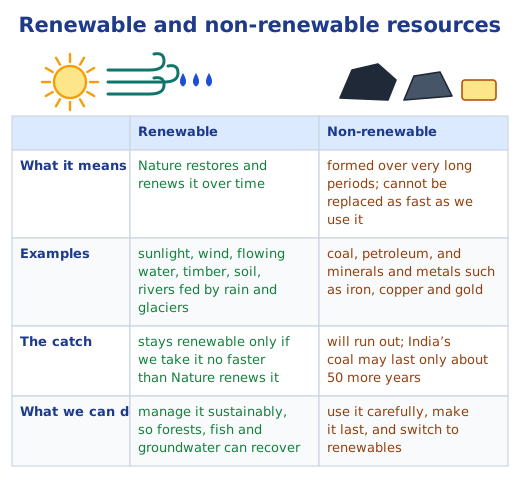
Q3. “What are renewable resources? How are they different from non-renewable ones? What can people do to ensure that renewable resources continue to be available for our use and that of future generations? Give two examples.” Renewable resources are those that Nature restores and regenerates over time, such as sunlight, wind, flowing water, forests and soil. They differ from non-renewable resources, such as coal, petroleum, iron, copper and gold, which formed over very long periods and cannot be replaced as fast as we use them, so they will run out; India’s coal, for example, may last only about another 50 years. Renewables can last forever if we use them no faster than they renew; non-renewables cannot. To keep renewables available, people must use them sustainably and let Nature’s rhythm continue. Example 1, forests: cut only as many trees as can regrow, replant native species and protect sacred groves and young trees. Example 2, groundwater: harvest rainwater, revive ponds and tanks, grow crops that need less water where water is short, avoid wasting water and reuse treated water.
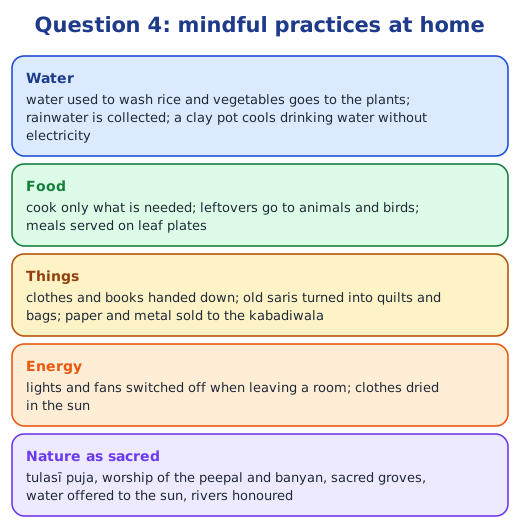
Q4. “Identify cultural practices in your home and neighbourhood that point to mindfulness in the use of natural resources.” A sample from a home and neighbourhood: water used to wash rice and vegetables is poured on plants; rainwater is collected in drums or tanks; drinking water is kept cool in a clay pot without electricity; food is cooked in the right amount and leftovers are given to animals and birds; meals are served on leaf plates at festivals; clothes and books are passed down to younger children, and old saris become quilts and bags; paper, bottles and metal are sold to the kabadiwala for recycling; lights and fans are switched off and clothes are dried in the sun. Practices that treat Nature as sacred, such as tulasī puja, offering water to the sun, worshipping the peepal and protecting sacred groves, also teach respect for natural resources.
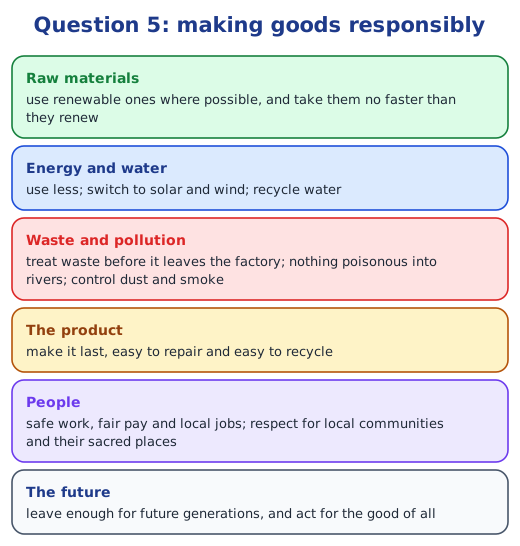
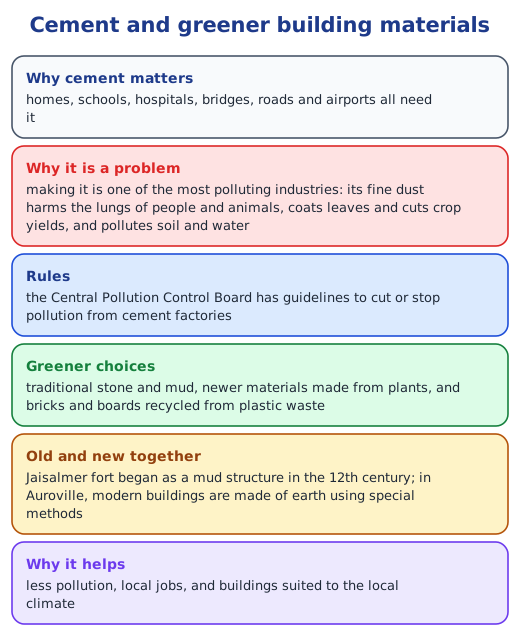
Q5. “What are some considerations to keep in mind in the production of goods for our current use?” (1) Raw materials: use renewable materials where possible and take them no faster than Nature renews them; use non-renewables carefully and recycle. (2) Energy and water: use less, switch to solar and wind power, and reuse water. (3) Pollution and waste: treat waste before it leaves the factory, so that nothing poisonous reaches rivers or soil, and control dust and smoke, as the Central Pollution Control Board’s guidelines for cement factories require. (4) Materials and design: choose less polluting materials, such as stone, mud, plant-based or recycled ones, and make goods that last, can be repaired and can be recycled. (5) People: provide safe work, fair pay and local jobs, and respect local communities and their sacred places. (6) Place and future: design for the local climate, leave enough for future generations, and act for the good of all, not only for profit today.
Practice
-
Petroleum lies deep under the ocean, but we lack the tools to reach it. Which condition for a resource is missing?
Show answer
Answer: (a) technologically accessible
-
The Mettur dam is built on which river?
Show answer
Answer: (b) Kaveri
-
On the chapter’s map, bauxite is marked at:
Show answer
Answer: (a) Koraput
-
Why is a forest growing back after a fire an example of restoration?
Show answer
Answer: Restoration means returning to a healthy state after damage. New plants grow from the seeds and roots left behind, animals return, and in time the forest is healthy again.
-
Why does the chapter say that access to resources is often unfair?
Show answer
Answer: Many parts of cities do not get enough regular drinking water, and polluted air from industries and fossil fuels harms most those who cannot protect themselves from it.
Stuck on a question?
Take a photo and Lagnever AI explains it step by step. Try it for 7 days for ₹2.
Get it on Google Play Open in browser
For parents: after the trial, the plan renews monthly by UPI or card autopay. You can cancel anytime in the app.