
Class 8 Social Science Chapter 1: Natural Resources and Their Use Notes
This chapter in five lines
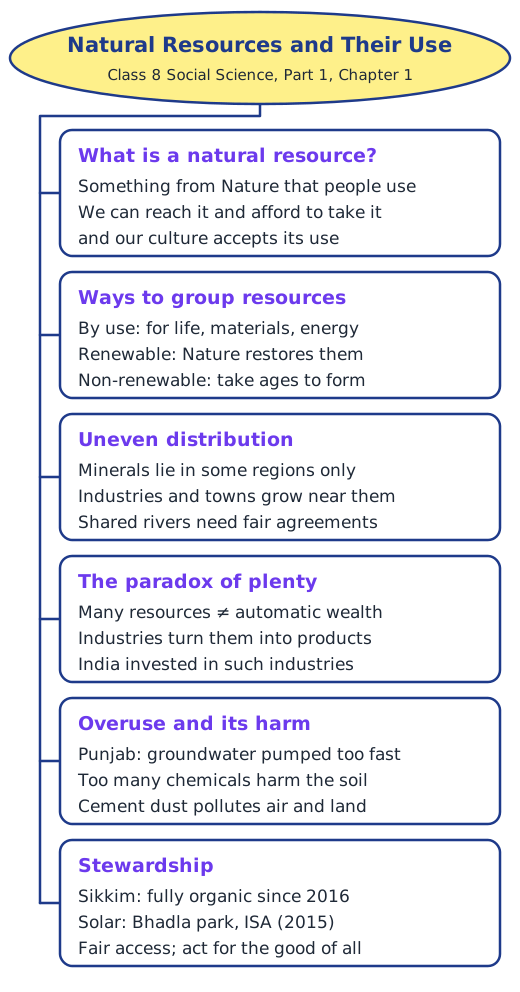
Natural Resources and Their Use explains when something in Nature becomes a resource and how we group resources: by use, and as renewable or non-renewable. Resources are spread unevenly, which shapes work, trade and even conflicts, and plenty alone does not make a place rich. Overuse, as with Punjab’s groundwater, harms Nature, so we must use resources as careful stewards.
What is this chapter about?
This is the first chapter of Part 1, in the theme India and the World: Land and the People. It opens with a thought from two writers on climate, Christiana Figueres and Tom Rivett-Carnac: our economy should live in harmony with Nature and learn from the way Nature recycles everything. The chapter’s Big Questions ask how natural resources can be grouped, how the way they are spread across the Earth affects people’s lives, and what happens when we use them faster than they can recover.
When does Nature become a resource?
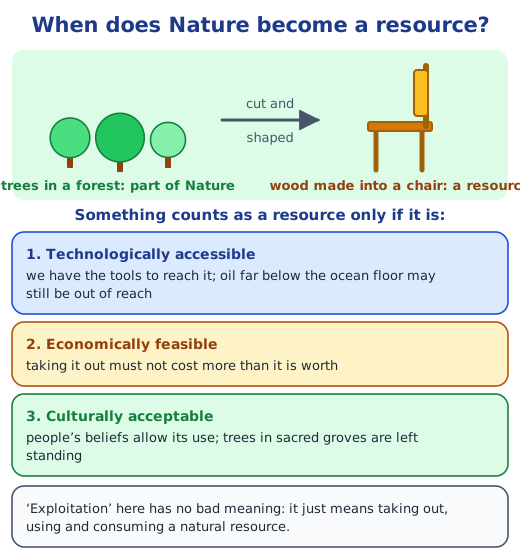
Nature is everything around us, living and non-living, that people did not make. When we use part of it to live, or make new things from it, it becomes a resource. A tree in a forest is part of Nature; when its wood is made into furniture, we see it as a resource. Even a plastic shirt button leads back to Nature in the end. But something counts as a resource only if three things are true: we have the technology to reach it, taking it out is worth the cost, and people’s culture accepts its use. Oil far beneath the ocean floor may be beyond our tools, and trees in a sacred grove are left uncut. The chapter uses ‘exploitation’ in a plain sense: taking out, using and consuming a resource.
How can we group natural resources?
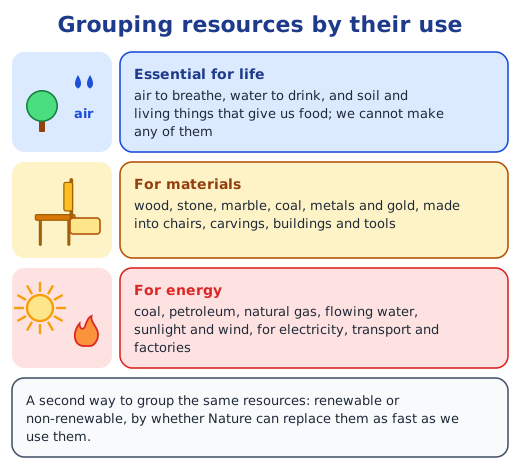
Grouping things by shared features, as we do with living and non-living things in Science, lets us talk about them in a word or two. One way is by use: resources essential for life (the air, water and soil we cannot make), resources for materials (wood, marble, coal, gold) and resources for energy (coal, petroleum, natural gas, flowing water, sunlight and wind). India’s varied geography gives it a wide range of all three. Read types and distribution of natural resources.
Renewable or non-renewable?
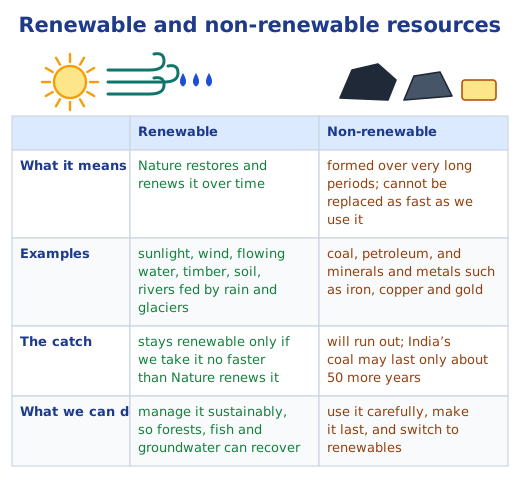
A second way is to ask whether Nature can renew a resource. Nature heals itself (restoration) and creates new life (regeneration), and it works in cycles with no waste: a fallen tree is broken down by bacteria, fungi and insects into soil in which new trees grow. Renewable resources, such as sunlight, rivers fed by rain and glaciers, forests and soil, last only if we leave this rhythm undisturbed. Cut timber faster than forests grow, and the forest is used up; as temperatures rise, some Himalayan glaciers melt faster than snowfall can replace them, which threatens water for the plains. Non-renewable resources, such as coal, petroleum, iron, copper and gold, took very long to form. India has large coal reserves, but they may last only about another 50 years, so we must use them carefully. Read renewable and non-renewable resources.
Nature also does useful work for us. A forest filters water, holds the soil and shelters animals: these are ecosystem functions. The clean water, protected farms and pollinated crops we enjoy because of them are ecosystem services. A mature tree gives out about 275 litres of oxygen a day, while a person needs about 350 litres.
Why does the uneven spread of resources matter?
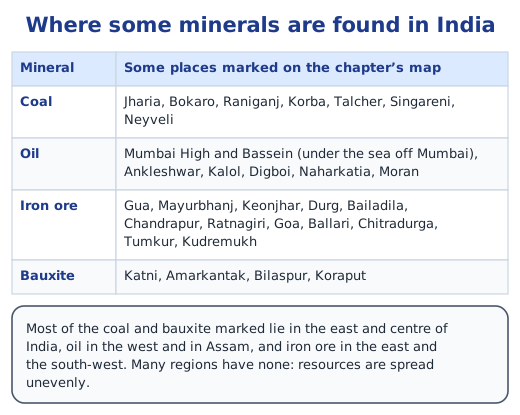
Resources are not spread evenly across the planet, or even within a country. On the chapter’s map, coal appears at places such as Jharia, Korba and Neyveli, oil at Mumbai High, Ankleshwar and Digboi, iron ore from Keonjhar to Ballari, and bauxite at Katni and Koraput. This uneven spread shapes where people settle, what they trade, how countries deal with each other and even why wars are fought. Industries near resources bring jobs, townships and better facilities, but people may also lose their homes or see their sacred places threatened. Resources joined with skill can create special products, such as Wootz steel, and trade in them helped large empires grow in India.
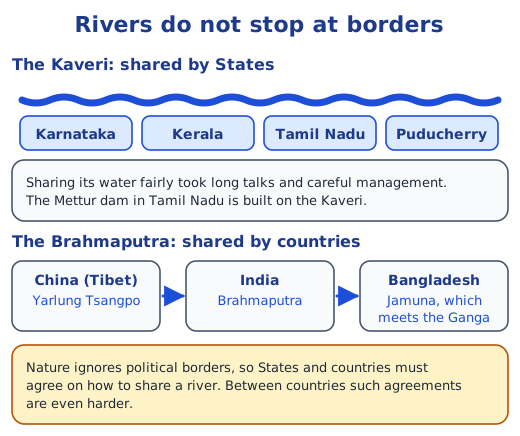
Nature ignores political borders. The Kaveri’s water is shared by Karnataka, Tamil Nadu, Kerala and Puducherry, and keeping the sharing fair and peaceful needed long talks and careful management. The Brahmaputra flows through China, India and Bangladesh, and agreements between countries are even harder.
What is the paradox of plenty?
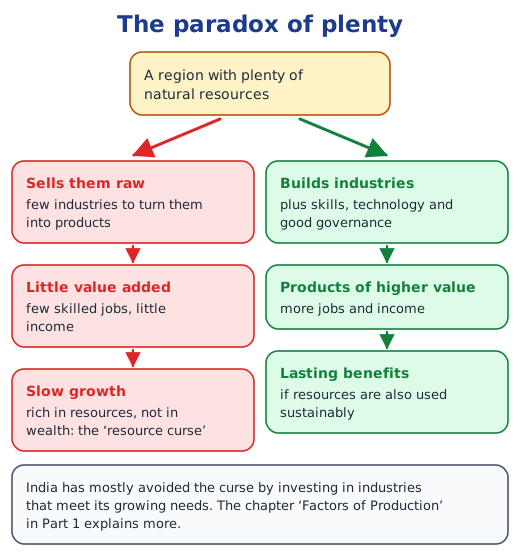
Owning lots of natural resources does not by itself make a country rich. Economists call it the paradox of plenty or the resource curse when resource-rich regions grow slowly, often because they cannot build industries that turn raw resources into more valuable goods. India has mostly steered clear of this curse by putting money into such industries for its growing needs. Even so, knowledge, good governance and careful planning decide whether resources bring lasting benefits or only a short burst of wealth.
What happens when we overuse resources?
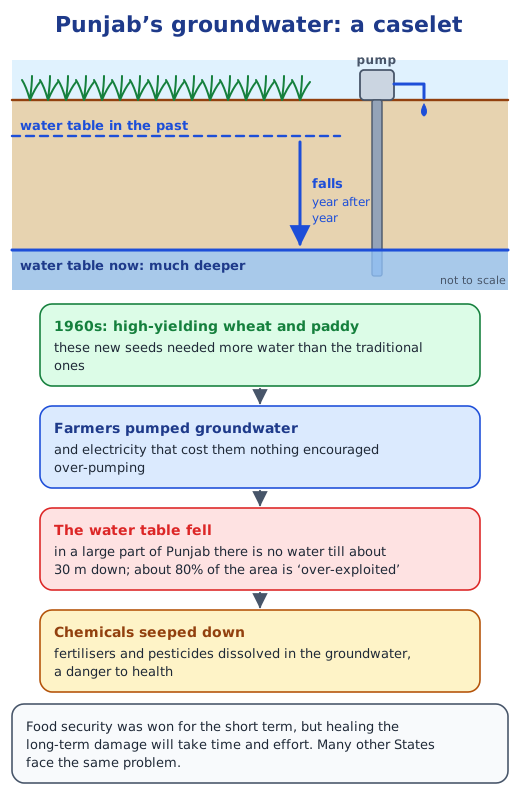
Scientists warn that careless use of resources has led to pollution, a loss of biodiversity and a changing climate. In most States, farmers draw groundwater faster than rain refills it, so pumping grows costlier and some growing cities may soon run short. In Punjab, home of the Green Revolution, high-yielding wheat and paddy from the 1960s needed more water, and electricity that cost farmers nothing encouraged over-pumping. Now, in a large part of the State, there is no water till about 30 metres down, about 80 per cent of the area is ‘over-exploited’, and farm chemicals have seeped into the groundwater. Wrong use of fertilisers and pesticides has also degraded the soil, and making cement, which we need for nearly every building, is one of the most polluting industries. Read using resources wisely.
How can we use resources wisely?
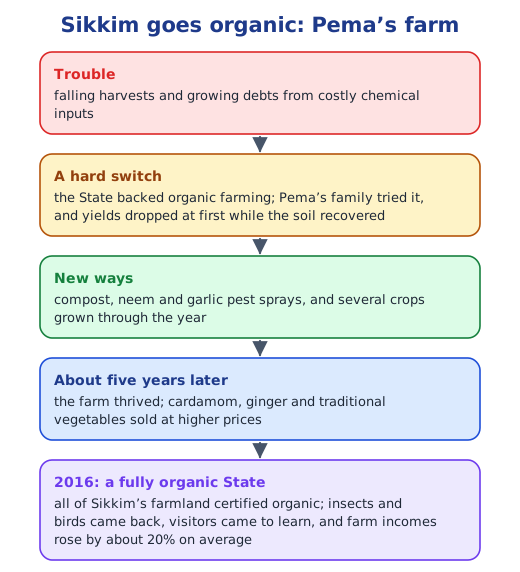
Being a steward means letting renewable resources restore and regenerate, and using non-renewable ones carefully until better options are found. Traditional practices help: harvesting rainwater, reviving ponds and tanks, natural manure, mulching and mixed crops, as described in the old Indian science of Vṛikṣhāyurveda. Sikkim shows the way: in 2016 all its farmland was certified organic, birds and insects returned, visitors came to learn and farm incomes rose by about 20 per cent on average. Builders are mixing traditional materials, such as mud and stone, with new ones. And India is switching to the sun: a giant solar park in Rajasthan can meet about 15 per cent of the State’s present electricity needs, and India and France launched the International Solar Alliance in 2015.
Wise use is also fair use. Many parts of our cities do not get enough clean drinking water, and polluted air hurts most those who cannot protect themselves from it. The Bhagavad Gītā speaks of lokasangraha, acting for the wellbeing of all instead of only for ourselves, and the chapter asks whether it is time to take that idea seriously.
Before we move on
In short, natural resources are the gifts of Nature that we can reach and use. We can group them in many ways; renewable and non-renewable is one of the most useful. Plenty of resources helps only when knowledge, skills and industries put them to good use, and renewables last only if we do not overuse them, while non-renewables must be stretched as far as possible. Answers to every question are in the NCERT solutions for Chapter 1.
Key terms
| Term | Meaning |
|---|---|
| Natural resource | Anything from Nature that people find useful and can actually obtain and use, such as water, soil, timber, coal or metal ores. |
| Exploitation | In this chapter, simply taking out, using and consuming a natural resource; here it does not mean misuse. |
| Renewable resource | A resource that Nature restores over time, such as sunlight, wind, flowing water, forests and soil, as long as we do not use it faster than it renews. |
| Non-renewable resource | A resource that formed over very long periods and cannot be replaced as fast as we use it, such as coal, petroleum, iron, copper and gold. |
| Fossil fuels | Fuels such as coal and petroleum that formed underground over a very long time; they are non-renewable. |
| Restoration | Nature bringing something damaged back to a healthy state, as a cut on the skin heals or a forest grows back after a fire. |
| Regeneration | Nature’s power to bring forth new life and the conditions in which it can thrive; it goes beyond restoration. |
| Ecosystem function | A natural process, such as trees making oxygen or a forest filtering water. |
| Ecosystem service | The benefit people get from an ecosystem function, such as clean water, pollinated crops or farmland protected from erosion. |
| Paradox of plenty (resource curse) | When a region rich in natural resources grows slowly, because it cannot turn its resources into products of higher value. |
| Groundwater | Water held under the ground in soil and rock, drawn up through wells, tube wells and pumps. |
| Biodiversity loss | A drop in the variety of living things on Earth. |
| Vṛikṣhāyurveda | An old Indian science of caring for plants and trees; vṛikṣha means tree and ayurveda the science of life. |
| Stewardship | Looking after natural resources responsibly, so that they can be restored and last for the future. |
| Lokasangraha | An idea from the Bhagavad Gītā: rising above our own wants and acting for the wellbeing of all. |
Topics in this chapter
Practice
-
Which of these is a non-renewable resource?
Show answer
Answer: (c) Coal
-
For something to be called a resource, it must be technologically accessible, economically feasible and:
Show answer
Answer: (b) culturally acceptable
-
India’s coal reserves may last about another:
Show answer
Answer: (b) 50 years
-
The ‘paradox of plenty’ means that:
Show answer
Answer: (b) plenty of resources does not by itself make a place rich
-
Which State became fully organic in 2016?
Show answer
Answer: (c) Sikkim
-
The International Solar Alliance was launched in 2015 by India and:
Show answer
Answer: (b) France
Questions students ask
What are the main topics of Class 8 Social Science Chapter 1?
When something in Nature becomes a resource; grouping resources by use and as renewable or non-renewable; Nature’s restoration and regeneration, and ecosystem services; the uneven distribution of resources and its effects; the paradox of plenty; and wise use of resources, with the caselets of Punjab’s groundwater and Sikkim’s organic farms, cement, and solar power.
Is Natural Resources and Their Use in the new NCERT Class 8 Social Science book?
Yes. It is Chapter 1 of Exploring Society: India and Beyond, Grade 8 Part 1 (Reprint 2026-27), and the only chapter in the theme India and the World: Land and the People, on pages 1 to 19.
What is the difference between renewable and non-renewable resources?
Renewable resources, such as sunlight, wind, flowing water, forests and soil, are restored by Nature over time, as long as we do not overuse them. Non-renewable resources, such as coal, petroleum and metals, formed over very long periods and cannot be replaced as fast as we use them.
What is stewardship of natural resources?
It means caring for resources like a trustee: using renewable ones in a way that lets them restore and regenerate, using non-renewable ones carefully so that they last until better options are found, and making sure everyone gets a fair share.
Stuck on a question?
Take a photo and Lagnever AI explains it step by step. Try it for 7 days for ₹2.
Get it on Google Play Open in browser
For parents: after the trial, the plan renews monthly by UPI or card autopay. You can cancel anytime in the app.