
How can we use natural resources wisely?
Answer in short
Using resources wisely, or stewardship, means letting renewable resources restore and regenerate, and using non-renewable ones carefully until better options exist. Overuse brings pollution, biodiversity loss and climate change, as Punjab’s falling groundwater shows. Sikkim’s organic farms, greener building materials and solar power show how we can do better, with a fair share for everyone.
Stuck on a question? Take a photo and Lagnever AI explains it step by step. Try it for 7 days for ₹2. Get it on Google Play
What does it mean to be a steward of resources?
A steward looks after something that is not only theirs, so that it stays healthy for others and for the future. For natural resources, this means two things. Renewable resources should be used in a way that lets Nature restore and regenerate them. Non-renewable resources should be used responsibly, so that they last long enough for people to find better options.
Scientists who study these questions warn that careless use of resources is causing pollution, biodiversity loss (a drop in the variety of life) and climate change, and that all three have sped up in recent years.
What happens when we take too much water?
Many farmers in India irrigate their fields with groundwater, the water stored under the ground. In most States, they pump it out faster than rain can refill it. Year after year the shortfall adds up: wells must go deeper, pumping costs more, and in the end the water may run out. Experts expect several fast-growing cities to run short of groundwater soon. To raise water levels again, people are reviving old ways of harvesting rainwater, cleaning up ponds and tanks, cutting waste and treating water so that it can be used again.
The story of Punjab’s groundwater
Punjab’s fertile plains were home to the Green Revolution, which fed a large part of India and helped the country grow enough food for itself. In the 1960s, farmers began growing new high-yielding kinds of wheat and paddy, and these thirsty seeds needed more water than the old ones. They pumped up groundwater to supply it, and electricity that cost them nothing encouraged over-pumping, as it still does in much of India. Modern farming also brought chemical fertilisers and pesticides.
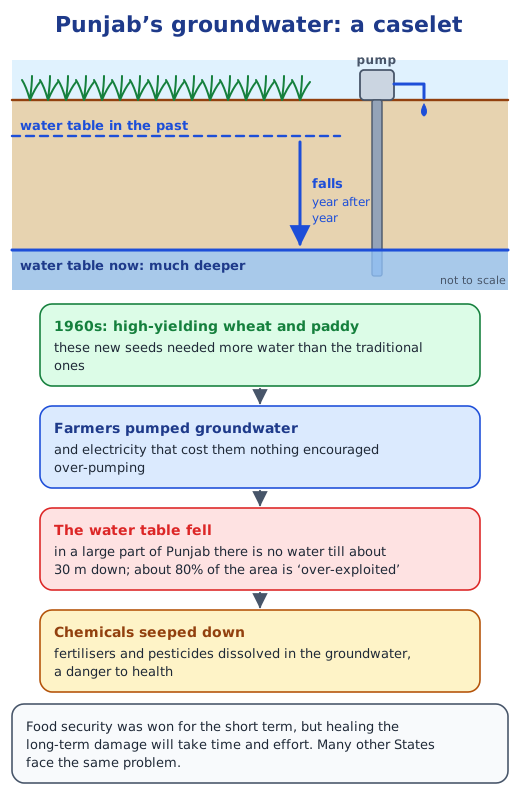
The result: in a large part of Punjab there is no groundwater till a depth of about 30 metres, and about 80 per cent of the State’s area is classed as ‘over-exploited’, meaning water is drawn far faster than it can be restored. Chemicals from the fields have dissolved in the groundwater and become a health hazard. Food security was won for the short term, but healing the long-term damage will take time and effort. Punjab is not alone; many other States face the same problem.
How can we care for the soil?
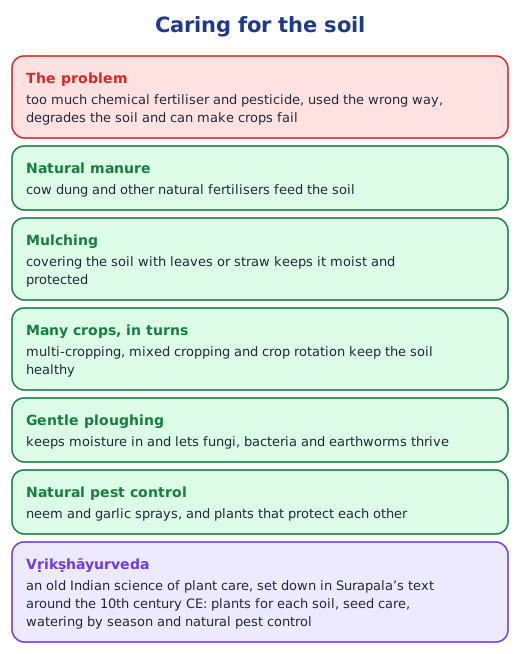
Using chemical fertilisers and pesticides the wrong way has also degraded the soil, and crops can fail. Traditional farming treated the soil as part of Mother Earth and looked after it as a whole: cow dung and other natural manures, mulching (covering the soil with leaves or straw), growing many crops together, and gentle ploughing that keeps moisture in and protects life underground. The old Indian science of Vṛikṣhāyurveda (vṛikṣha means tree), set down in Surapala’s text around the 10th century CE, describes which plants suit which soils, how to care for seeds, how to water plants by season, natural pest control, crop rotation and mixed cropping. Read more in traditional and modern farming from Class 7.
How Sikkim went organic
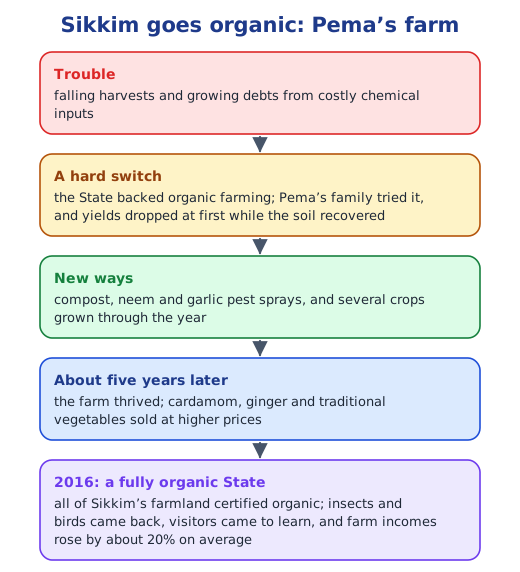
Pema’s family, who farm in Sikkim, were in trouble: harvests were falling and debts for costly chemicals were rising. When the State government began promoting organic farming, the family decided to try. At first yields dropped while the soil recovered. They switched to compost, made pest sprays from neem and garlic, and grew several crops through the year. About five years later the farm was thriving, and their cardamom, ginger and traditional vegetables sold at good prices. In 2016 all of Sikkim’s farmland was certified organic. Insects and birds came back, visitors came to see the model, and farm incomes rose by about 20 per cent on average.
Can we build with less pollution?
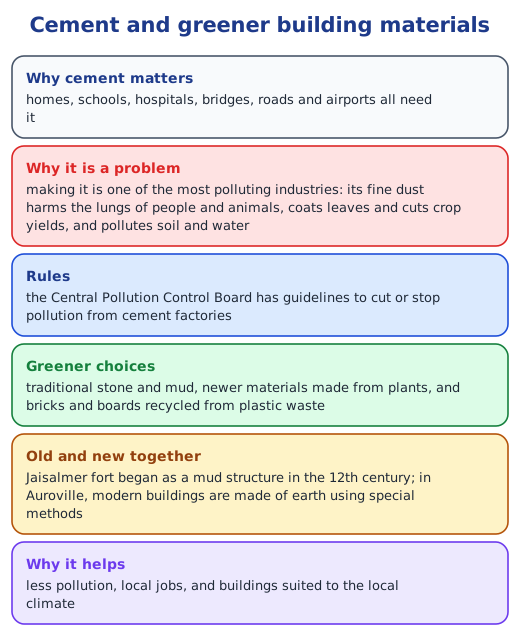
Homes, schools, hospitals, bridges, roads and airports all need cement, yet making it is one of the most polluting industries. Its fine dust damages the lungs of people and animals, coats leaves and lowers crop yields, and pollutes soil and water. The Central Pollution Control Board has set guidelines for cement factories. Builders are also trying traditional stone and mud, newer materials made from plants, and bricks and boards recycled from plastic waste. Jaisalmer fort began as a mud structure in the 12th century, and in Auroville modern buildings are made of earth using special techniques. Such materials pollute less, give local people work and suit the local climate.
Making non-renewables last
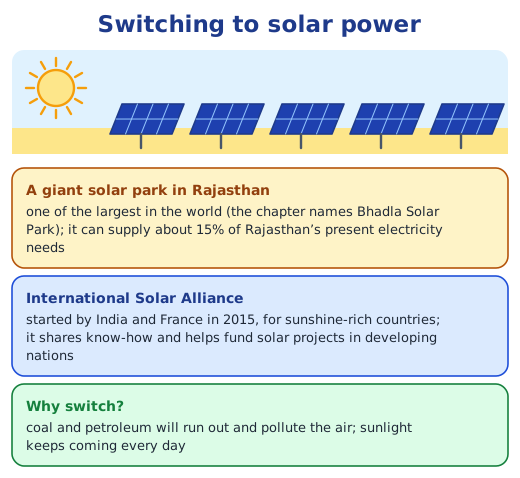
For non-renewable resources, the aim is to make them last until better options are found, mainly by switching to renewable energy wherever we can. A solar park in Rajasthan, one of the largest in the world, can produce about 15 per cent of the State’s present electricity needs. In 2015, India and France launched the International Solar Alliance for countries rich in sunshine. Through it, India has helped developing countries find money for solar projects, and shares its know-how and ways to make solar power affordable.
A fair share for everyone
Using resources wisely also means using them fairly. Many city neighbourhoods do not get enough clean drinking water regularly, and polluted air from industries and too much burning of fossil fuels hurts most those who cannot protect themselves. The Bhagavad Gītā speaks of lokasangraha: rising above our own wants and acting for the good of all. The chapter asks whether it is time we took that idea seriously.
Read on: renewable and non-renewable resources, types and distribution of natural resources, the chapter notes and the NCERT solutions.
Practice
-
About what share of Punjab’s area has been classed as ‘over-exploited’ for groundwater?
Show answer
Answer: (d) 80%
-
Which of these is a traditional way to keep soil healthy?
Show answer
Answer: (b) mulching
-
Which natural pest repellents did Pema’s family in Sikkim prepare?
Show answer
Answer: (a) neem and garlic
-
Why did groundwater fall so fast in Punjab after the 1960s?
Show answer
Answer: High-yielding wheat and paddy needed more water, so farmers pumped up groundwater, and electricity that cost them nothing encouraged over-pumping. Water was drawn out much faster than rain could refill it.
-
Why is making cement a problem, and what can replace it in some buildings?
Show answer
Answer: Its fine dust harms the lungs of people and animals, settles on leaves and lowers crop yields, and pollutes soil and water. Stone, mud, plant-based materials and recycled plastic waste can be used instead.
Questions students ask
What is stewardship of natural resources?
It means looking after resources the way a trustee looks after something precious. We use renewable resources so that Nature can restore and regenerate them, use non-renewable ones carefully so they last until better options are found, and make sure everyone gets a fair share.
What happened to groundwater in Punjab?
From the 1960s, high-yielding wheat and paddy needed more water, and farmers pumped groundwater with electricity that cost them nothing. In a large part of Punjab there is now no water till about 30 metres down, about 80 per cent of the area is ‘over-exploited’, and farm chemicals have seeped into the groundwater.
How did Sikkim become an organic State?
The State government encouraged organic farming. Farmers switched to compost, natural pest sprays such as neem and garlic, and several crops a year. Yields fell at first, then recovered, and in 2016 all of Sikkim’s farmland was certified organic.
What is the International Solar Alliance?
It is a group of sunshine-rich countries working together on solar power, launched by India and France in 2015. India has helped developing countries find money for solar projects and shares technical know-how with them.
Stuck on a question?
Take a photo and Lagnever AI explains it step by step. Try it for 7 days for ₹2.
Get it on Google Play Open in browser
For parents: after the trial, the plan renews monthly by UPI or card autopay. You can cancel anytime in the app.