
Traditional and modern farming
Answer in short
Indian farmers mix old and new ways. Traditional farming treats soil and plants as one living system and uses terraces, manure, saved seeds and water systems such as phad canals and bamboo drip. Modern farming, boosted by the Green Revolution, uses high-yielding seeds, irrigation, chemicals and machines. It raised harvests but harmed soil and water, so sustainable farming combines both.
Stuck on a question? Take a photo and Lagnever AI explains it step by step. Try it for 7 days for ₹2. Get it on Google Play
Water: rain-fed or irrigated?
Crops cannot grow without water. Rain-fed farming depends only on rain. It is common where the monsoon is good, but droughts and late rains can ruin it, so farmers choose crops that survive dry spells and harvest rainwater. Irrigated farming brings water to the crops, which raises harvests and lowers the risk from a weak monsoon.
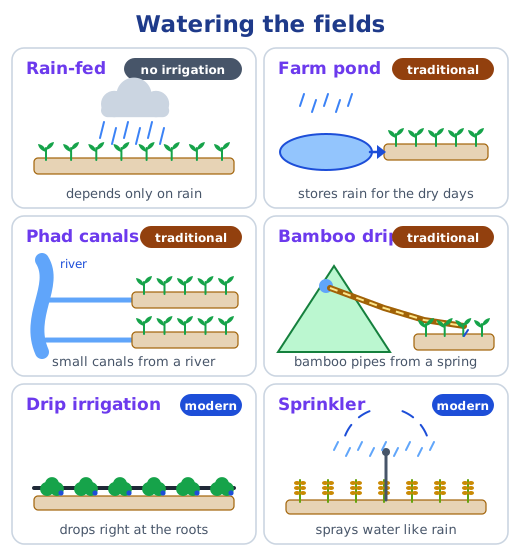
India has built water structures since the Indus civilisation, and many regions have their own names for them, such as kund, ahar, pokhar, khadin and eri. Phad systems in Maharashtra are run by the community and use small canals to divert river water to fields. In the Northeast, farmers use bamboo pipes to carry spring water to their fields. Farm ponds keep the soil moist for longer. Kallanai, built by Karikala across the Kaveri about 1,800 years ago, still irrigates thousands of hectares. Modern drip irrigation drips water at the roots through tubes, and sprinklers spray it like rain. Both save water, which matters because groundwater is falling fast in many parts of India.
Seeds
Seeds have long been saved in families, kept by communities and shared; women sometimes carry them as gifts to their new home. Farmers kept the seeds of their highest-yielding plants for the next season. The Arthashastra explains how to prepare different seeds, and ancient Indian farmers invented a seed drill that prepared the soil, planted the seed and closed the furrow in one step. ICAR has developed ways of coating seeds with beejamrit, a paste of cow dung and urine with other materials, before planting; it protects the seeds and helps them sprout sooner. Many farmers now buy high-yielding, pest-resistant seeds from companies, but the seeds from those plants are often not good for the next season, so farmers must keep buying.
Traditional farming systems
Traditional farming sees the plant, the soil and the living things in it as one system: bacteria and fungi make nutrients easy for plants to take up, and plants feed them through their roots. It uses farmyard manure, small-scale methods and local resources. Terrace farming cuts steps into hillsides to make flat land, stop soil erosion and save water. Kulagar is a homestead system of the Konkan in which families grow food crops, cash crops, fruits, spices and medicinal plants around their homes. In gokrishi, cows give manure and bullocks plough. ICAR has recorded almost 5,000 traditional practices and found that over 85% of those it tested are backed by modern science.
The Green Revolution
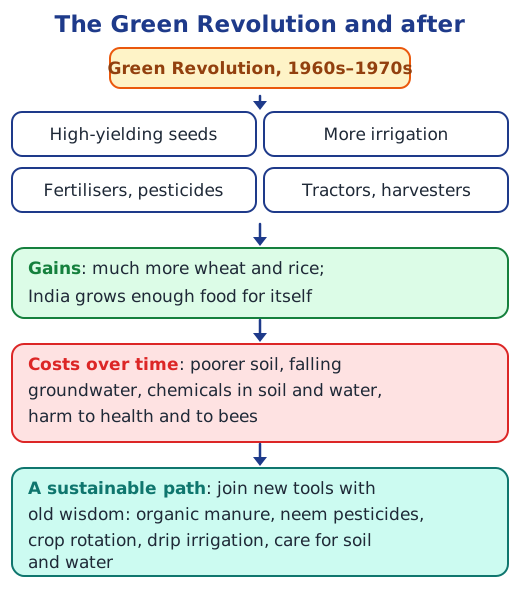
The Green Revolution of the 1960s and 1970s brought high-yielding varieties (HYV) of seeds, more irrigation, chemical fertilisers and pesticides, and machines such as tractors and harvesters. Food grain production, especially of wheat and rice, rose sharply, and India became self-sufficient in food. M.S. Swaminathan, the scientist called its architect, received the Bharat Ratna.
Over the decades its limits have become clear: soil that grows poorer, groundwater that keeps falling, soil and water polluted by chemicals, and harm to the health of people and animals. Chemicals also kill bees, which crops need for pollination.
Sustainable pathways
Sustainable farming tries to keep the high output of modern methods while protecting nature, drawing on Indian Knowledge Systems. Organic farming uses compost, seed cake and animal manure instead of chemicals, and neem-based pesticides are much less harmful. Sikkim became the world’s first fully organic state after banning chemical fertilisers and pesticides in 2014. The FAO recognises three Indian farming systems as global heritage: saffron farming in Kashmir, forest-linked farming in Odisha, and below-sea-level rice farming with fishing in Kerala.
Why it matters
Modern methods give large harvests quickly; traditional ones are gentler on the soil but may give less. Farming that lasts needs both. To see how crops follow the seasons, read what grows where and when; for soil care, read soils of India. Answers to the textbook questions are in the NCERT solutions for Part 2 Chapter 1; see all of Part 2 Chapter 1 notes.
Practice
-
Phad irrigation systems are found mainly in:
Show answer
Answer: (b) Maharashtra
-
Which method waters only the roots of plants through tubes?
Show answer
Answer: (b) Drip irrigation
-
Which state became the world’s first fully organic state?
Show answer
Answer: (a) Sikkim
-
Give two gains and two costs of the Green Revolution.
Show answer
Answer: Gains: much larger harvests of wheat and rice, and India grew enough food for itself. Costs: poorer soil over the years, and falling groundwater with soil and water polluted by fertilisers and pesticides.
-
What is beejamrit, and why is it used?
Show answer
Answer: A paste made of cow dung and urine with other materials, used to coat seeds before planting. ICAR has developed methods for its use; it protects seeds from spoiling and helps them sprout sooner.
Questions students ask
What is the difference between traditional and modern farming?
Traditional farming uses local knowledge, manure, saved seeds, animals and the cycle of seasons, and works with the soil as a living system. Modern farming uses high-yielding seeds, chemical fertilisers and pesticides, irrigation, and machines such as tractors, harvesters and drones.
What was the Green Revolution?
A big rise in food grain production, especially wheat and rice, in the 1960s and 1970s. It came from high-yielding seeds, more irrigation, chemical fertilisers and pesticides, and machines. M.S. Swaminathan is called its architect.
What is sustainable agriculture?
Farming that meets today’s food needs while keeping soil, water, animals and people healthy for the future, for example with organic manure, neem-based pesticides, crop rotation and water-saving irrigation.
Stuck on a question?
Take a photo and Lagnever AI explains it step by step. Try it for 7 days for ₹2.
Get it on Google Play Open in browser
For parents: after the trial, the plan renews monthly by UPI or card autopay. You can cancel anytime in the app.