
NCERT Solutions Class 7 Social Science Part 2 Chapter 1: The Story of Indian Farming
Answers to the “Questions and activities” of Chapter 1, The Story of Indian Farming, in Exploring Society: India and Beyond Grade 7 Part 2 (2026-27), together with the Big Questions and the Think About It and Let’s Explore boxes. The page numbers match the Part 2 book. Tasks that depend on where you live have sample answers that you can change for your own state. Short notes: Part 2 Chapter 1 notes.
The Big Questions (page 1)
1. What are the main characteristics of Indian agriculture? It mixes traditional and modern methods; it grows a huge variety of crops because India has many climates and soils; it follows three seasons (kharif, rabi and zaid) set by the monsoons; most farms are small family farms, about three-fourths of a hectare on average; women do much of the work; and farming families also rear animals, grow trees and keep fish or bees. It gives work to about 46% of India’s workers.
2. How are farming, climate, soil and water interrelated? Climate decides when crops grow: kharif crops need the hot, rainy monsoon and rabi crops the cool winter. Soil decides which crops do well and how much water stays for them; black soil holds moisture, so it suits cotton. Water, from rain or irrigation, decides what can be grown at all; Tamil Nadu grows rice through the year because it gets two monsoons and irrigation. Each affects the others: too much pumping lowers groundwater, and heavy rain on bare slopes washes soil away.
3. How can traditional practices and contemporary ones complement each other? Traditional practices such as manure, crop rotation, terraces, farm ponds and saved seeds keep soil and water healthy at low cost. Modern tools such as high-yielding seeds, drip irrigation, drones and weather forecasts add output and precision. Together they work well: drip pipes fed by a farm pond, neem-based pesticides made on a large scale, or traditional practices such as beejamrit tested and improved by ICAR scientists.
Think about it: who is a farmer? (page 2)
Many people picture a man when they hear “farmer”. In fact, in rural India more than 75% of the people working in agriculture are women (2025), and they do most of the work, from sowing to harvesting and threshing. A true picture of an Indian farmer should include women.
Let’s Explore: the food on your plate (page 3)
Sample answer for a family in Uttar Pradesh:
| Food group | Examples |
|---|---|
| Grains | wheat (roti), rice |
| Pulses | arhar, moong, chana |
| Oils | mustard oil |
| Vegetables | potato, peas, cauliflower, spinach |
| Fruits | mango, guava, banana |
Most of these grow in and around Uttar Pradesh, because the Ganga plain has fertile alluvial soil, a cool winter for rabi crops such as wheat, mustard and peas, and monsoon rain or irrigation for kharif crops such as rice. Coconut, tea, cardamom and cashew come from other places. They need a warm, humid coast or rainy hill slopes and different soils, which the plain does not have.
Let’s Explore: two weak monsoons in a row (page 7)
Kharif crops would suffer most, so these items could vanish from meals or become costly: rice, pulses such as arhar, moong and urad, groundnut and other cooking oils, millets such as bajra and jowar, sugar (from sugarcane), and many vegetables. With less fodder, milk could cost more. Ponds, reservoirs and groundwater would fall too, making the winter rabi crop harder to water.
Let’s Explore: the crops of your state (page 9)
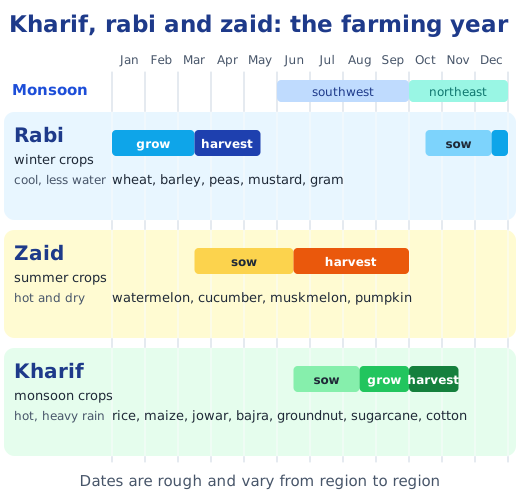
Sample answer for Uttar Pradesh:
| Season | Crops |
|---|---|
| Kharif | rice, maize, bajra, jowar, arhar, urad, sugarcane |
| Rabi | wheat, barley, gram, peas, masoor (lentil), mustard, potato |
| Zaid | watermelon, muskmelon, cucumber, pumpkin, moong |
Don’t Miss Out: the Arthashastra on a good rainy season (page 10)
Why was the statement made? It describes rain spread through the season in a way that suits the kharif crop cycle. Some rain at the start (July to August) softens the soil for ploughing and sowing. The heaviest rain in the middle months (August to October) comes when the crops grow fastest and need the most water. Some rain at the end (October to November) helps the grain fill and leaves the soil moist for sowing the next crop. Too much rain at once, or a dry spell in the middle, would damage the harvest.
Let’s Explore: soils near you (page 11)
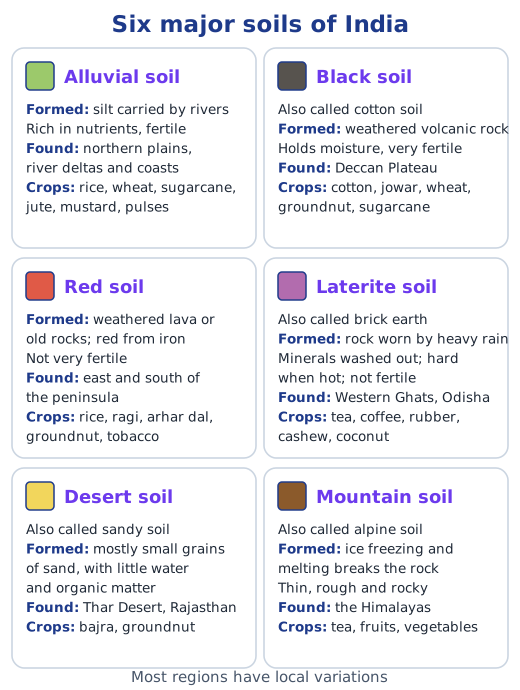
Name at least two states in each soil zone. From the soil map in the book:
| Soil | States, for example |
|---|---|
| Alluvial | Punjab, Uttar Pradesh, Bihar, West Bengal, Assam |
| Black | Maharashtra, Gujarat, Madhya Pradesh |
| Red | Tamil Nadu, Karnataka, Odisha, Jharkhand |
| Laterite | Kerala, and parts of Karnataka and Odisha |
| Desert | Rajasthan, and parts of Gujarat |
| Mountain | Himachal Pradesh, Uttarakhand, Sikkim, Arunachal Pradesh (and the union territories of Jammu and Kashmir and Ladakh) |
Which soil is found mainly in your state? For example, mostly alluvial in Uttar Pradesh, mostly black in Maharashtra, laterite in much of Kerala and desert soil in western Rajasthan. Check your state on the map.
Examine soil samples from your neighbourhood. Look for sand (gritty), silt (smooth like flour) and clay (sticky when wet); a dark colour from humus or a red colour from iron; roots, leaves, small stones, earthworms and insects. Smooth, fine soil may have been laid down by a river; stony soil may come from broken local rock. Signs of human activity can include plastic, glass, bits of brick, ash or fertiliser grains, and soil packed hard by feet or vehicles. Over time, plastic does not rot and blocks air and water, chemicals can harm the living things in the soil, and hard-packed soil soaks up less rain, so more of it runs off and carries soil away.
Let’s Explore: soil, crops and your food (page 11)
Group project: plants that grow in different soils. For example: alluvial soil: potato, cauliflower, mango, guava; black soil: cotton, onion, grapes, oranges; red soil: groundnut, millets, mango; laterite soil: cashew, coconut, rubber, jackfruit; desert soil: bajra, ber (jujube), guar; mountain soil: apples, apricots, tea.
Family food flowchart (sample):
- Dal-chawal → rice (alluvial or laterite soil) and arhar dal (red or black soil)
- Roti and aloo sabzi → wheat and potato (alluvial soil), cooked in mustard oil (alluvial soil)
- Idli with coconut chutney → rice and urad dal (alluvial or black soil) and coconut (laterite coastal soil)
- Bajra roti → bajra (desert soil)
- A cup of tea → tea leaves (mountain and laterite soils), sugar from sugarcane (alluvial or black soil)
Let’s Explore: traditional ideas in modern farming (page 22)
Modern solutions inspired by traditional practices include neem-based pesticides; beejamrit, a seed coating of cow dung and urine developed by ICAR; panchagavya used as a biofertiliser; compost and farmyard manure in organic farming; mulching and ploughing crop leftovers back into the soil; crop rotation and intercropping recommended by scientists; drip irrigation, which, like bamboo drip, takes water straight to the roots; and farm ponds that store rainwater.
Let’s Explore: farm programmes on radio and TV (page 25)
A sample report can list what was heard under headings such as: the weather forecast and rain alerts; advice on sowing, seeds and how much fertiliser to use; warnings about pests and diseases; market prices of crops; government schemes such as crop insurance; care of animals; and stories of farmers who tried new methods. (Extra: DD Kisan on television and the farm programmes of All India Radio are examples of such programmes.) Questions that may come up: does the advice suit farmers with very small fields, how do farmers without a radio or TV get it, and how often are the forecasts right?
Questions and activities (pages 27–28)
1. Why do farmers in Kerala grow rice while farmers in Punjab grow mostly wheat? What would happen if they swapped? Kerala has a tropical wet climate: it is warm all year and gets heavy rain from both the southwest and the northeast monsoons, so there is plenty of water for flooded paddy fields, and rice is the main food there. Punjab lies in the subtropical northern plains: its cool winter suits wheat, a rabi crop, and it has fertile alluvial soil and canal and tube-well irrigation. If they swapped, wheat in Kerala would do poorly, because there is no proper cool winter and the heavy rain and damp air bring disease. Rice in Punjab would need far more water than its rain gives, so even more groundwater would have to be pumped. (Extra: Punjab does grow a lot of rice in the monsoon season with heavy irrigation, and its groundwater has been falling.) Crops grow well where the climate, soil and water suit them.
2. Match the following.
| Column A | Column B |
|---|---|
| (a) Kharif crops | (ii) Crops grown during the monsoon |
| (b) Rabi crops | (i) Crops during the winter |
| (c) Alluvial soil | (v) Soil rich in nutrients deposited by rivers |
| (d) Terrace farming | (vi) Method of farming on hillsides |
| (e) Alpine soil | (iii) Thin, rough and rocky soil found in mountainous regions |
| (f) Zaid crops | (iv) Crops grown in summer |
3. Why do certain crops thrive in specific regions? Each crop needs particular conditions, and it thrives where a region provides them:
- Climate: wheat needs a cool winter, so it grows in the northern plains; rice needs heat and plenty of rain, so it grows in Kerala, West Bengal and the coasts.
- Soil: cotton grows on black soil, which holds moisture; tea, coffee and rubber grow on the laterite soils of rainy hills.
- Water: bajra survives the dry Thar Desert, while sugarcane and rice need a lot of rain or irrigation.
- Terrain: on hill slopes, farmers grow crops on terraces.
Farmers’ knowledge, irrigation and markets matter too, which is why some crops can be grown outside their ideal areas with efficient irrigation.
4. How has modern technology helped farmers? Tractors, harvesters, threshing machines and transplanters make ploughing, planting and harvesting faster and easier. High-yielding seeds, fertilisers and pesticides raised harvests, especially of wheat and rice. Drip and sprinkler irrigation let farmers grow crops with less water, even where rainfall is low. Drones check soil moisture, greenhouses and hydroponics grow plants in controlled conditions, and careful use of fertilisers keeps soil healthy. Weather forecasts, crop insurance, cold storages and digital information about markets help farmers plan and sell at better prices. Technology must be used carefully, though: too many chemicals and too much pumping have harmed soil and water.
5. Why is sustainable agriculture important? Write a short note. Sustainable agriculture means growing enough food today without spoiling the soil, water and living things that farming will need tomorrow. It matters because the methods of the Green Revolution, used for decades, have left poorer soil, falling groundwater, chemicals in soil and water, harm to human and animal health, and fewer bees to pollinate crops. Sustainable farming joins modern science with traditional wisdom: organic manure and compost, neem-based pesticides, crop rotation, mixed crops, trees on farm bunds and water-saving drip irrigation. It also helps farmers cope with climate change and keeps their costs down. Sikkim, the world’s first fully organic state, shows that it can work on a large scale.
6. Name some challenges that farmers face today. What might be their impact for people?
- Small landholdings: the average farm is about three-fourths of a hectare, so incomes are low and big machines are hard to use.
- Costly machines and inputs: many farmers cannot buy or rent modern equipment, and bought seeds must be bought again every season.
- Climate change: untimely rain, droughts and floods destroy crops.
- Water stress: falling groundwater and a stressed Ganga basin threaten irrigation.
- Debt and market problems: loans taken in hard times become a trap, and by some estimates about 2,300 farmers leave farming every day.
The impact on people: food can become costly or scarce, farming families lose income and may move to cities for work, and the whole country’s food supply is put at risk.
7. Hold a debate on “Traditional irrigation methods are better than modern ones.” Points for each side:
| For the motion | Against the motion |
|---|---|
| Ponds, phad canals and bamboo drip use local materials and cost little | Drip and sprinklers save much more water and suit dry areas |
| Communities build and share them, as in phad systems | They give each plant a measured amount of water |
| Ponds help water soak back into the ground | They can be used on farms of many sizes and kinds of land |
| They have lasted for centuries; Kallanai still works after about 1,800 years | They help raise harvests to feed a growing population |
A fair conclusion is that the two work well together, for example a farm pond that feeds a drip system.
8. Write a short essay on what farming might be like when you are 60. A sample: “When I am 60, around the 2070s, farming will look very different, but some old ideas will be back. Fields will have sensors that tell farmers when to water, and solar pumps will run drip pipes fed by village ponds. Drones will spot pests early, and neem sprays will replace most chemicals. Seeds bred to survive heat and floods will help farmers face a warmer climate, and millets will be popular again because they need little water. Small farmers will share machines through their groups, and women farmers will lead many of them. In cities, vegetables will grow on rooftops and in water-based hydroponic farms. If we protect our soil and rivers now, my grandchildren will still eat food grown in Indian fields.”
9. Discuss the issues affecting the Ganga basin and propose solutions. A presentation could cover:
- The issues: global warming is melting Himalayan glaciers faster than ever; much river water is taken for irrigation; farms and industries pump out huge amounts of groundwater; and hundreds of dams change the river’s natural flow. As a result the Ganga cannot refill itself, and some stretches are too shallow for boats in summer.
- Why it matters: the basin has fed more than 500 million people with its fertile alluvial soil, so its decline threatens livelihoods and India’s food production.
- Solutions and reasons: use drip and sprinkler irrigation so less water is taken from the river; grow crops that need less water, such as millets, in dry areas; collect rainwater in ponds so groundwater is refilled and feeds the river; let enough water flow past dams to keep the river alive; plant trees along the banks and hills to hold soil and water; and cut the pollution that warms the planet, to slow the melting of glaciers.
10. Which crops from “Echoes from the Past” do you find in use at home? What conclusion can you draw? In many homes you will find rice, wheat, barley (as sattu or jau), millets such as bajra, jowar and ragi, sesame (til), mustard oil, green gram (moong), black gram (urad), fenugreek (methi), cotton clothes, and fruits such as mango, grapes, dates, jackfruit and jamun (black plum). The conclusion: much of the food we eat today has been grown and eaten in India for thousands of years, since Harappan and Vedic times, so our meals carry a very old farming tradition.
Practice
-
Which pair is correct?
Show answer
Answer: (b) Kharif – cotton Cotton is sown with the monsoon rains, so it is a kharif crop. Rice is kharif, wheat and mustard are rabi.
-
Laterite soil is also called:
Show answer
Answer: (b) brick earth
-
Kallanai, the grand anicut, was built across which river?
Show answer
Answer: (b) Kaveri
-
Why do farmers in north India need irrigation in the months between the two monsoons?
Show answer
Answer: The northeast monsoon brings rain mainly to the east and south, so in north India those months are dry. Farmers there depend on groundwater, rivers, canals, ponds and the moisture left in the soil.
-
How does multiple cropping help a farmer?
Show answer
Answer: Growing several crops in one field lowers the risk from pests, makes it likely that at least one crop succeeds, and gives harvests at different times from the same field.
Stuck on a question?
Take a photo and Lagnever AI explains it step by step. Try it for 7 days for ₹2.
Get it on Google Play Open in browser
For parents: after the trial, the plan renews monthly by UPI or card autopay. You can cancel anytime in the app.