
Class 7 Social Science Part 2 Chapter 1: The Story of Indian Farming Notes
This chapter in five lines
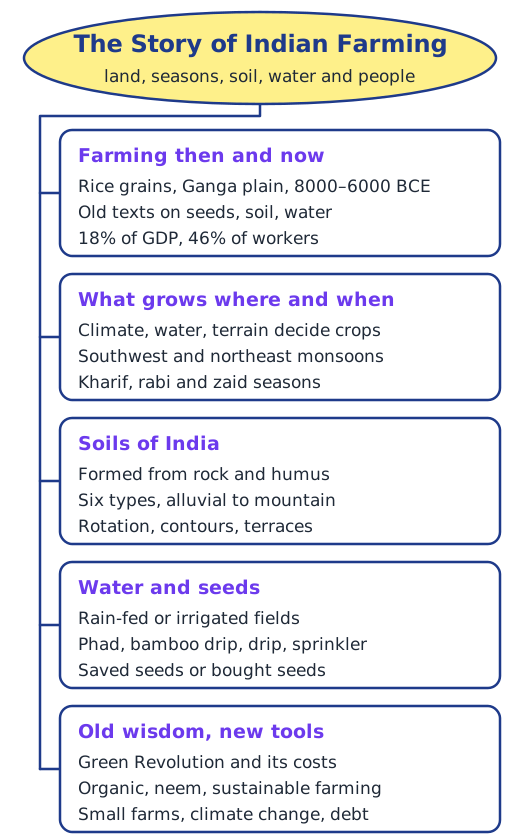
The Story of Indian Farming shows how farming in India depends on climate, soil and water, and how it has grown over thousands of years. Crops follow three seasons, kharif, rabi and zaid, set by the monsoons. India has six major soils, from fertile alluvial soil to thin mountain soil. Farmers use rain or irrigation, traditional wisdom and modern tools. The Green Revolution raised harvests but hurt soil and water, so the goal now is sustainable farming.
What is this chapter about?
The Story of Indian Farming asks three big questions: what makes Indian farming special, how farming, climate, soil and water are linked, and how old and new ways of farming can work together. It begins with farming in India’s distant past, then looks at seasons and crops, soils, water and seeds, the move from traditional methods to the Green Revolution and back towards sustainable farming, and the problems farmers face today.
India’s agricultural landscape
Agriculture means preparing the soil, growing crops and rearing animals, and it often includes growing trees and fruit too. The government also counts allied activities such as fisheries, beekeeping (apiculture), rearing silkworms for silk and growing fibre crops like cotton and hemp.
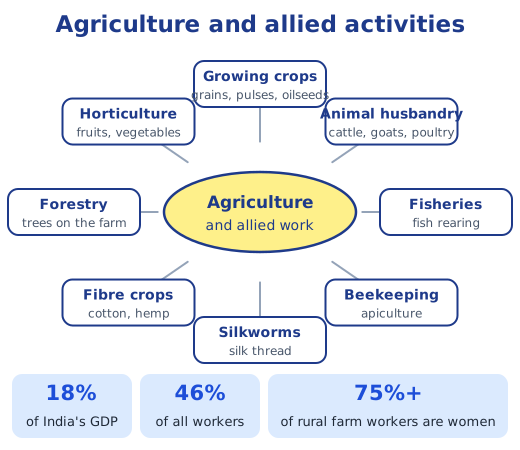
These activities produce a little over 18% of India’s GDP and give work to about 46% of its working people (2022-23). In rural areas, more than 75% of the people working in agriculture are women (2025), and they do most of the work, from sowing to harvesting and threshing. India’s farms range from the wheat fields of Punjab and the saffron fields of Kashmir to the tea gardens of the Northeast and the Nilgiris and the paddy fields of Kerala.
Echoes from the past
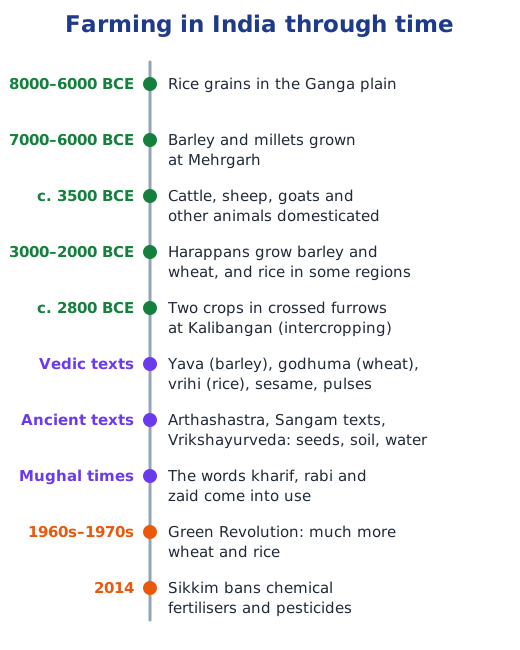
Farming in India is very old. Rice grains found in the Ganga plain date back to the 7th or 8th millennium BCE, though regular rice farming may have taken a few thousand years more. At Mehrgarh, barley and millets were grown in the 7th millennium BCE. The Harappans grew barley and wheat as main crops, along with rice in some regions, millets and vegetables. Furrows at Kalibangan in Rajasthan show intercropping, two crops in one field, around 2800 BCE, a practice still seen there in the 1960s.
Over time farmers added oilseeds such as sesame and mustard, pulses such as green gram and black gram, fibre crops such as cotton and jute, and fruits such as mango, jackfruit and black plum. Cattle, sheep, goats and other animals were domesticated from about 3500 BCE. The Vedas mention barley (yava), wheat (godhuma) and rice (vrihi), and texts such as Kautilya’s Arthashastra, Sangam literature, the Amarakosha, Varahamihira’s Brihatsamhita and Surapala’s Vrikshayurveda give advice on seeds, soils, planting, watering and grafting.
What grows where and when
India has seven climate types, from alpine in the Himalayas to arid in the Thar Desert, and is divided into 15 agroclimatic zones that help plan what, when and how to grow. The southwest monsoon brings rain from June to September and is vital for kharif crops in northern and central India. The northeast monsoon brings rain to the east and south from October to December. The Malabar and Coromandel coasts get rain from both.
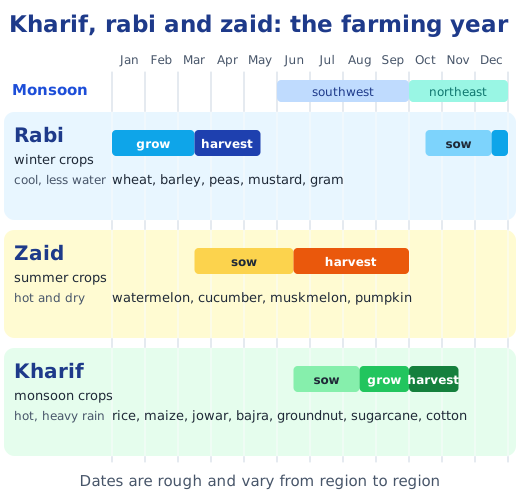
Indian farming follows three seasons: kharif (monsoon crops such as rice, maize, jowar, bajra, groundnut, sugarcane and cotton), rabi (winter crops such as wheat, barley, peas, mustard and gram) and zaid (summer crops such as watermelon, cucumber, muskmelon and pumpkin). The names are Arabic and have been used since Mughal times. Each season brings risks: kharif crops suffer if the monsoon is late, and too much rain can destroy them. More in what grows where and when.
Soil, the foundation of cultivation
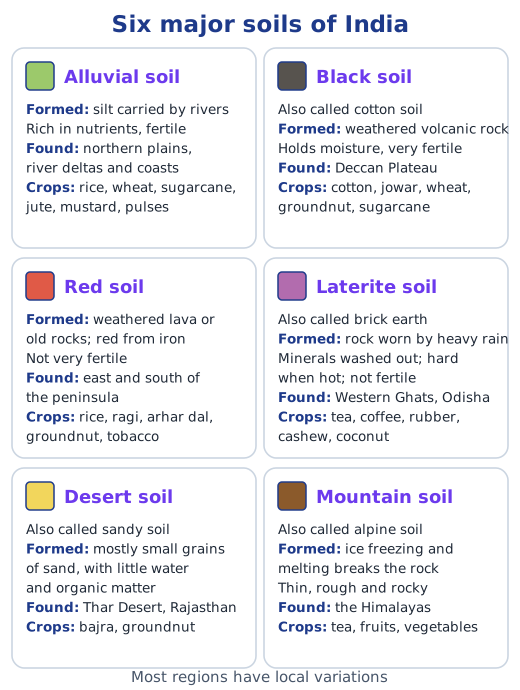
Soil is the thin top layer of the Earth’s crust that supports plants. It forms over a century to many thousands of years as rocks break down and plant and animal matter decays into humus. India has six major soils: alluvial, black, red, laterite, desert and mountain soil, and each suits different crops. Black soil, for example, holds moisture and suits cotton. Farmers protect soil with crop rotation, multiple cropping, contour ploughing, terracing, mulching and manure. Read soils of India.
Water and seeds
Some farms are rain-fed and depend only on rain; others are irrigated. India has used water structures since the Indus civilisation, with local names such as kund, ahar, khadin, eri and kolam. Traditional systems include phad canals in Maharashtra, bamboo drip irrigation in the Northeast and farm ponds; Kallanai, built across the Kaveri about 1,800 years ago, still diverts water. Modern drip and sprinkler irrigation save water, which matters because groundwater is falling in many places.
Seeds have long been saved in families and shared in communities. Ancient Indian farmers invented a seed drill that prepared the soil, planted the seed and closed the furrow in one go. Today many farmers buy high-yielding seeds from companies, but seeds from such plants are often not good for the next season, which makes farmers depend on the companies.
Traditional wisdom and modern innovations
Traditional farming treats the soil and its tiny living things, together with the plants, as one system, and uses methods such as terrace farming, kulagar home gardens in the Konkan, and gokrishi, in which cows give manure and bullocks plough. The Green Revolution of the 1960s and 1970s brought high-yielding seeds, more irrigation, chemical fertilisers and pesticides, and machines, and India came to grow enough food for itself.
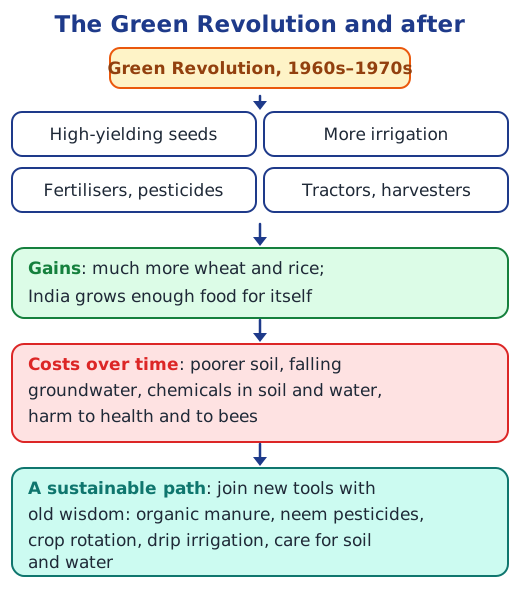
Over the years its costs have shown: poorer soil, falling groundwater, chemicals in soil and water, and harm to the health of people and animals. Sustainable farming now joins modern tools with traditional wisdom: organic manure, neem-based pesticides and seed coatings such as beejamrit. Sikkim became the world’s first fully organic state after banning chemical fertilisers and pesticides in 2014. See traditional and modern farming.
The role of the government
Governments help farmers with seeds, fertilisers, weather forecasts, research and training, and cheaper electricity for irrigation. Crop insurance, such as the Pradhan Mantri Fasal Bima Yojana, covers losses, and the government buys important crops so that farmers get fair prices. Cold storages and digital information about markets help farmers sell at better prices.
Challenges
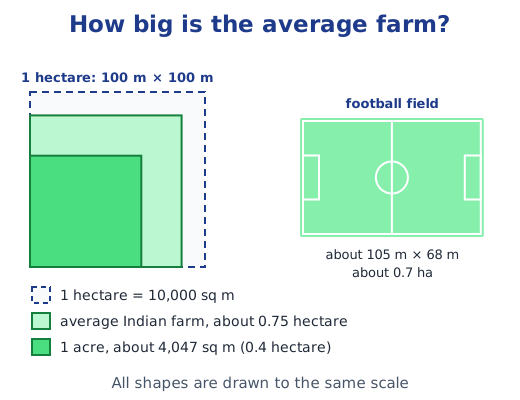
Land is divided among family members over generations, so the average landholding is only about three-fourths of a hectare, about the size of a football field. Small farms earn little, and most machines are made for bigger farms. Climate change brings untimely rain, droughts and floods. The Ganga basin, which feeds more than 500 million people, is under stress from melting glaciers, water taken for irrigation, groundwater pumping and dams. Many farmers fall into debt, and by some estimates about 2,300 farmers leave farming every day. Answers to all the questions are in the NCERT solutions for Part 2 Chapter 1.
Key terms
| Term | Meaning |
|---|---|
| Agriculture | Preparing the soil, growing plants and rearing animals; in a wide sense it also covers forestry and horticulture. The word comes from Latin agri (field) and culture (to cultivate). |
| Allied activities | Work linked to farming, such as rearing livestock, fisheries, beekeeping (apiculture), rearing silkworms and growing fibre crops. |
| Intercropping | Growing two or more different crops in the same field at the same time, as at Kalibangan around 2800 BCE. |
| Agroclimatic zone | A region grouped by its climate, soil, terrain and plants. India has 15, such as the Western Dry Region. |
| Kharif crops | Monsoon crops, sown with the southwest monsoon rains, such as rice, maize, jowar, bajra, groundnut and cotton. |
| Rabi crops | Winter crops that need cool weather and less water, such as wheat, barley, peas, mustard and gram. |
| Zaid crops | Summer crops grown in the short season between rabi and kharif, such as watermelon, cucumber, muskmelon and pumpkin. |
| Humus | The dark organic matter in soil, formed when plant and animal matter decays. It is rich in nutrients and holds moisture. |
| Crop rotation | Growing different crops in the same field in different seasons, so the soil does not keep losing the same nutrients. |
| Contour ploughing | Ploughing along the natural curves of a slope, so rainwater does not wash the soil downhill. |
| Rain-fed agriculture | Farming that depends only on rainfall, with no other supply of water to the fields. |
| Irrigated agriculture | Farming in which water is brought to the crops by people, through canals, wells, ponds, pipes, drips or sprinklers. |
| Green Revolution | The big rise in wheat and rice harvests in the 1960s and 1970s that came from high-yielding seeds, more irrigation, chemicals and machines. |
| Sustainable agriculture | Farming that keeps soil, water and living things healthy for the future, often by joining modern tools with traditional practices. |
| Landholding | The area of land a person owns. In India the average is about three-fourths of a hectare. |
Topics in this chapter
Practice
-
Which of these is a rabi crop?
Show answer
Answer: (b) Wheat Wheat grows in the cool winter season. Rice and cotton are kharif crops, and watermelon is a zaid crop.
-
Kharif crops are sown with the arrival of the:
Show answer
Answer: (b) southwest monsoon
-
Which soil is also called cotton soil?
Show answer
Answer: (b) Black soil Black soil holds a lot of moisture and is very fertile, which suits cotton.
-
Contour ploughing means ploughing:
Show answer
Answer: (b) along the curves of a slope
-
Which of these was not a part of the Green Revolution?
Show answer
Answer: (c) Neem-based pesticides Neem-based pesticides are a natural choice that sustainable farming uses instead of chemical pesticides.
-
The average landholding of a farmer in India is about:
Show answer
Answer: (a) 0.75 hectare
Questions students ask
What are the main topics of Class 7 SST Part 2 Chapter 1?
India’s agricultural landscape; the history of farming in India; climate, seasons and crops (kharif, rabi and zaid); the soils of India; rain-fed and irrigated farming; seeds; traditional and modern practices, including the Green Revolution and sustainable farming; the role of the government; and the challenges farmers face.
Is The Story of Indian Farming in the new NCERT book?
Yes. It is Chapter 1 of Exploring Society: India and Beyond, Grade 7 Part 2, the Class 7 Social Science book used in the 2026-27 session. It belongs to the theme India and the World: Land and the People.
What are kharif, rabi and zaid crops?
Kharif crops, such as rice and cotton, are sown with the monsoon rains. Rabi crops, such as wheat and mustard, grow in the cool winter. Zaid crops, such as watermelon and cucumber, grow in the short summer season between the two. The names have been used since Mughal times.
Stuck on a question?
Take a photo and Lagnever AI explains it step by step. Try it for 7 days for ₹2.
Get it on Google Play Open in browser
For parents: after the trial, the plan renews monthly by UPI or card autopay. You can cancel anytime in the app.