
Soils of India
Answer in short
Soil is the thin top layer of the Earth’s crust that supports plants. It forms slowly from broken rock and humus. India has six major soils: alluvial, black, red, laterite, desert and mountain. Each suits different crops, such as cotton on black soil. Farmers keep soil healthy with crop rotation, contour ploughing, terracing and manure.
Stuck on a question? Take a photo and Lagnever AI explains it step by step. Try it for 7 days for ₹2. Get it on Google Play
What soil is
Soil is the thin top layer of the Earth’s crust in which plants grow. It gives crops nutrients, water and a firm place for their roots, which makes it a farmer’s most important resource. Healthy soil is full of life: bacteria, fungi, earthworms and insects break down dead matter and keep the soil fertile. Soil also holds minerals, organic matter, water and air.
How soil forms
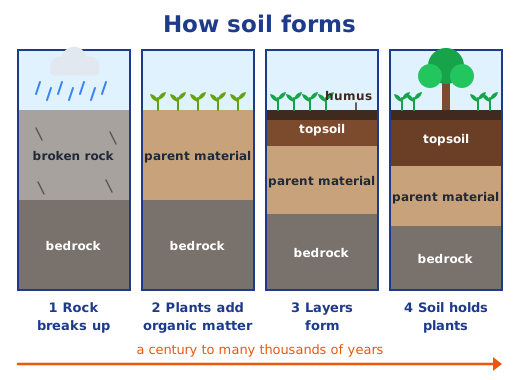
Soil forms as rocks break down and plants and animals decay. Rain, heat and cold crack the bedrock (the original rock), a process called weathering. Small plants grow in the cracks and their remains add organic matter, which helps break the rock further into parent material. Slowly layers form, with a dark topsoil that holds humus, decayed plant and animal matter that is rich in nutrients and holds moisture. The whole process takes from about a century to many thousands of years, which is why soil lost to erosion is so hard to replace.
Six major soils of India
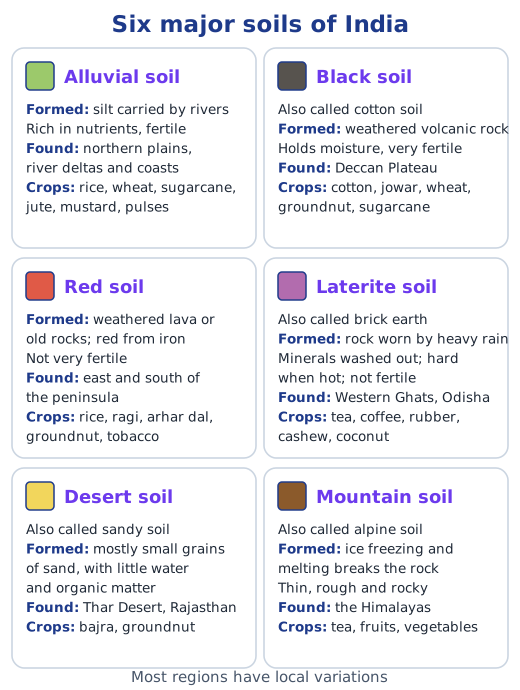
| Soil | Main features |
|---|---|
| Alluvial | silt, sand and mud brought by rivers from mountains and plateaus; rich in nutrients; northern plains and coasts |
| Black (cotton soil) | from weathered volcanic rock; holds a lot of moisture; very fertile; Deccan Plateau |
| Red | from weathered lava or old rocks; red because of iron; not very fertile |
| Laterite (brick earth) | rock weathered by heavy rain washes most minerals away; hard in hot weather; not fertile |
| Desert (sandy) | mostly small grains of sand, with a little water, air and organic matter |
| Mountain (alpine) | rock broken by freezing and melting ice; thin, rough and rocky |
Soils also tell stories about a place: the history of its rocks, its rivers and how people have used the land.
Soils and crops
Crops depend on soil as well as climate. Alluvial plains grow rice, wheat, maize, barley, chana, mustard, sugarcane and jute. Black soil grows cotton, jowar, wheat, urad, sunflower, linseed and sugarcane. Red soil grows rice, ragi, arhar, groundnut and tobacco. Laterite areas grow tea, coffee, rubber, coconut, areca nut, cashew and tapioca. Desert soil grows bajra and groundnut, and mountain soils grow tea, fruits and vegetables. Some crops can be grown on soils that do not suit them well, but only with careful irrigation.
Looking after the soil
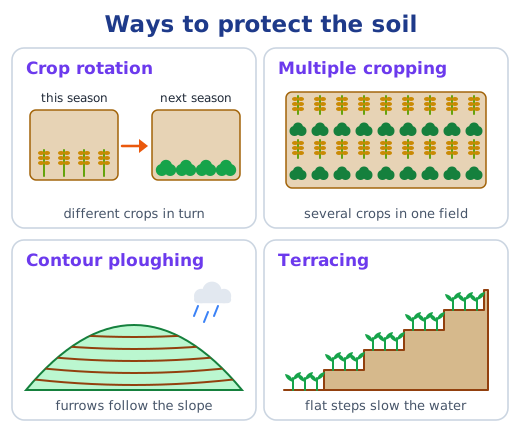
Farmers protect soil, which is called soil conservation. Traditional methods include crop rotation (different crops in different seasons, so the soil does not keep losing the same nutrients), multiple cropping (several crops in one field, which lowers the risk from pests and gives harvests at different times), contour ploughing (furrows along the curves of a slope) and organic manure such as cow dung. Panchagavya, a fermented mix of five cow products, has been found to work as a biofertiliser. Today, terraces on hills, planting trees, mulching, ploughing crop leftovers back into the soil and careful use of fertilisers also keep soil healthy. Bananas planted on the bunds of rice fields break the wind, hold the soil and give farmers another crop.
Why it matters
Healthy soil means good harvests year after year, and damaged soil can take centuries to rebuild. See which crops grow in which season in what grows where and when, and how farming methods have changed in traditional and modern farming. Answers to the textbook questions are in the NCERT solutions for Part 2 Chapter 1; see all of Part 2 Chapter 1 notes.
Practice
-
Which soil is made of silt brought by rivers?
Show answer
Answer: (b) Alluvial soil
-
Why is red soil red?
Show answer
Answer: (b) It contains iron that reacts with air and water
-
Thin, rough and rocky soil formed by freezing and melting ice is:
Show answer
Answer: (b) mountain (alpine) soil
-
What is humus, and why is it useful?
Show answer
Answer: Humus is the dark organic matter in soil, formed when plant and animal matter decays. It is rich in nutrients and holds moisture, so it helps plants grow.
-
How does contour ploughing protect the soil?
Show answer
Answer: Ploughing along the curves of a slope makes furrows across the slope. They hold back rainwater, so it cannot rush downhill and wash the soil away.
Questions students ask
How many types of soil are there in India?
The chapter groups India’s soils into six major types: alluvial, black, red, laterite, desert (sandy) and mountain (alpine) soil. Most regions also have local variations. Long ago, the Amarakosha described twelve types of farmland based on fertility.
Which soil is known as the soil for cotton?
Black soil, also called cotton soil. It forms from volcanic rocks, holds a lot of moisture and is very fertile, and it covers much of the Deccan Plateau.
How is soil formed?
Rain, heat and cold break bedrock into pieces. Small plants and decaying matter help break it down further and add humus. Over a century to many thousands of years, layers form: topsoil with humus, parent material and bedrock.
Stuck on a question?
Take a photo and Lagnever AI explains it step by step. Try it for 7 days for ₹2.
Get it on Google Play Open in browser
For parents: after the trial, the plan renews monthly by UPI or card autopay. You can cancel anytime in the app.