
What grows where and when?
Answer in short
What grows in a place depends on its climate, soil, water and terrain. India has seven climate types and 15 agroclimatic zones. Kharif crops such as rice and cotton are sown with the southwest monsoon; rabi crops such as wheat and mustard grow in the cool winter; zaid crops such as watermelon grow in the short summer season.
Stuck on a question? Take a photo and Lagnever AI explains it step by step. Try it for 7 days for ₹2. Get it on Google Play
Why crops differ from place to place
Make a list of what you eat in a day and you will find grains, pulses, oils, vegetables and fruits. Some grow near your home and some come from far away. A crop grows well only where it gets the right climate (heat, sunshine and rain), soil, water and terrain. Back in the 7th century, the Chinese pilgrim Xuanzang noticed that India’s produce changes from place to place because its climate and soils change.
Seven climates of India
| Climate | Where it is found |
|---|---|
| Alpine | the Himalayas |
| Temperate | the lower Himalayas |
| Subtropical | the northern plains |
| Arid | the Thar Desert |
| Tropical wet | the western coastal strip |
| Semi-arid | the central Deccan Plateau |
| Tropical | eastern India and the southern peninsula |
Each of these areas gets a different amount of sunshine and rain, has different temperatures through the year, and feels the monsoons differently.
Agroclimatic zones
To plan farming better, India is divided into 15 agroclimatic zones. Each zone groups together places with similar climate, soil, terrain and natural plants. Examples are the Upper Gangetic Plain Region, the Southern Plateau and Hills Region and the Western Dry Region. The zones help the government and other agencies decide what to grow, when to grow it and how.
The two monsoons
The monsoon brings the rain that many crops need. The southwest monsoon brings rain from June to September and is vital for kharif crops in northern and central India. The northeast monsoon blows from October to December and brings rain to the east and south. The Malabar coast (Kerala) and the Coromandel coast (Tamil Nadu) get rain from both. Between the two monsoons, farmers in the south can still grow crops, while in the north this is a dry season, when farmers depend on groundwater, rivers, canals, ponds and moisture held in the soil. Tamil Nadu, West Bengal and Andhra Pradesh grow rice through the year, thanks to monsoon rain and irrigation.
Kharif, rabi and zaid
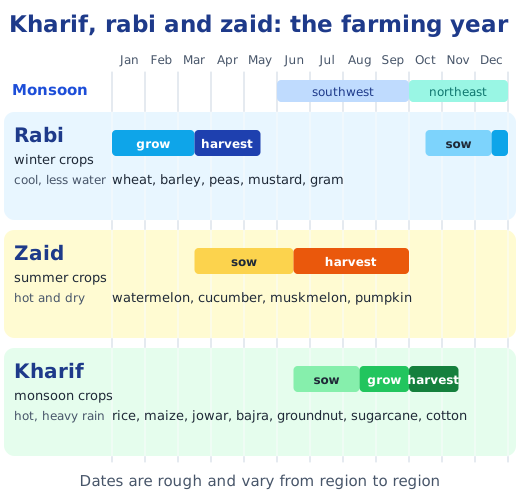
| Season | When and which crops (most of India) |
|---|---|
| Kharif (monsoon) | sown with the monsoon from about June, harvested about October to November: rice, maize, jowar, bajra, groundnut, sugarcane, cotton |
| Rabi (winter) | sown about October to December, harvested about March to May: wheat, barley, peas, mustard, gram |
| Zaid (summer) | grown in the short hot season between rabi and kharif: watermelon, cucumber, muskmelon, pumpkin |
Farmers have followed this rhythm for centuries, so something is being sown or harvested in almost every month, which keeps food coming through the year. The words kharif, rabi and zaid are Arabic and have been used since Mughal times. Earlier, the three kinds of crops were called kedara (wet crops), haimana (winter crops) and graishmika (summer crops).
Each season has its risks. Kharif crops depend on the monsoon arriving on time, and very heavy rain can destroy them, which brings hardship to farming families.
An old rule about rain
The Arthashastra describes a good rainy season as one in which about a third of the year’s rain falls at the start and the end of the season and about two-thirds in the middle months. This suits the crop cycle: a little rain to plough and sow, the most rain while the crop grows fastest, and some at the end to finish the crop and leave the soil moist for the next sowing.
Why it matters
Knowing what grows where and when explains why your food comes from many places, why a weak monsoon makes some foods costly, and why farmers plan their year around the rains. Next, read about the soils of India and traditional and modern farming. Answers to the textbook questions are in the NCERT solutions for Part 2 Chapter 1; see all of Part 2 Chapter 1 notes.
Practice
-
Which of these is a zaid crop?
Show answer
Answer: (c) Muskmelon
-
The southwest monsoon brings rain from:
Show answer
Answer: (b) June to September
-
How many agroclimatic zones is India divided into?
Show answer
Answer: (c) 15
-
Why can Tamil Nadu grow rice through the year?
Show answer
Answer: It gets rain from both the southwest and the northeast monsoons, and it also has irrigation, so water is available for rice in more than one season.
-
Name two kharif crops and two rabi crops, and say how their seasons differ.
Show answer
Answer: Kharif: rice and cotton, sown with the monsoon rains in the hot, wet months. Rabi: wheat and gram, sown after the monsoon and grown in the cool winter with less water.
Questions students ask
What is the difference between kharif and rabi crops?
Kharif crops are sown with the start of the southwest monsoon and need heat and plenty of water; they are harvested around October and November. Rabi crops are sown around October to December, grow in the cool winter with less water, and are harvested around March to May.
What are zaid crops?
Crops grown in the short summer season between the rabi harvest and the kharif sowing, such as watermelon, cucumber, muskmelon and pumpkin.
What is an agroclimatic zone?
A region grouped by its climate, soil, terrain and natural plants. India has 15, such as the Upper Gangetic Plain Region and the Western Dry Region. They help the government plan what, when and how to grow.
Stuck on a question?
Take a photo and Lagnever AI explains it step by step. Try it for 7 days for ₹2.
Get it on Google Play Open in browser
For parents: after the trial, the plan renews monthly by UPI or card autopay. You can cancel anytime in the app.