
Types and distribution of natural resources
Answer in short
A natural resource is something from Nature that people can reach, can afford to take out and are allowed by their culture to use. Resources can be grouped by use, for life, materials or energy, or as renewable and non-renewable. They are spread unevenly, which shapes where people settle, what they trade and even why they fight.
Stuck on a question? Take a photo and Lagnever AI explains it step by step. Try it for 7 days for ₹2. Get it on Google Play
When does something from Nature become a resource?
Look around you: your desk, your clothes, the water bottle, even a plastic shirt button. Trace each one back far enough and you reach Nature. One meaning of Nature is everything around us, living and non-living, that people did not make. A tree in a forest exists whether or not we use it. When we cut it and turn its wood into a table, we start to see it as a resource.
The Earth holds many such gifts, some of which took millions of years to form. A few are easy to spot, like water, air and soil. Others are less obvious, like metal ores, coal, petroleum, gems and timber.
But not everything in Nature is a resource straight away. Three conditions must hold:
- Technologically accessible: we must have the tools to reach it. Oil lying far beneath the ocean floor may be beyond our reach today.
- Economically feasible: taking it out must not cost more than it is worth.
- Culturally acceptable: people’s beliefs must allow its use. In many places, trees in sacred groves are never cut.
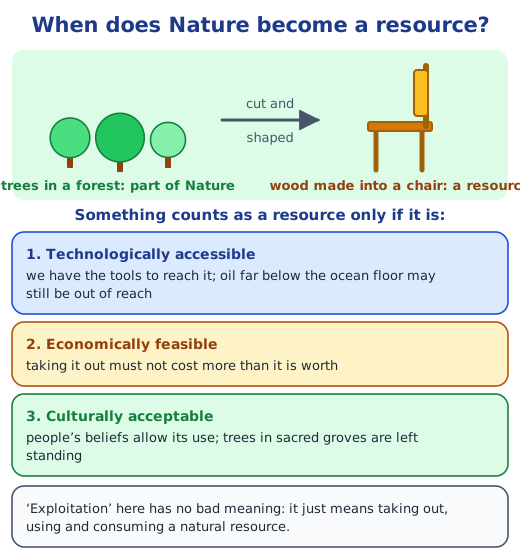
The chapter also uses the word ‘exploitation’ in a neutral way: here it simply means taking out, using and consuming a natural resource.
How do we group resources by use?
In Science you sort things into groups such as living and non-living, so that one word is enough to talk about a whole set. We can sort natural resources the same way. One way is by what we use them for:
- Essential for life: air for our lungs, water to drink, and the soil, plants and animals that feed us. We cannot make any of them ourselves.
- For materials: people shape Nature’s gifts into useful or beautiful things. One piece of wood can become a chair or a carved statuette. India’s varied geography gives us wood, marble, coal, gold and much more.
- For energy: electricity for buildings, fuel for transport and power for factories come from coal, water, petroleum, natural gas, sunlight and wind.
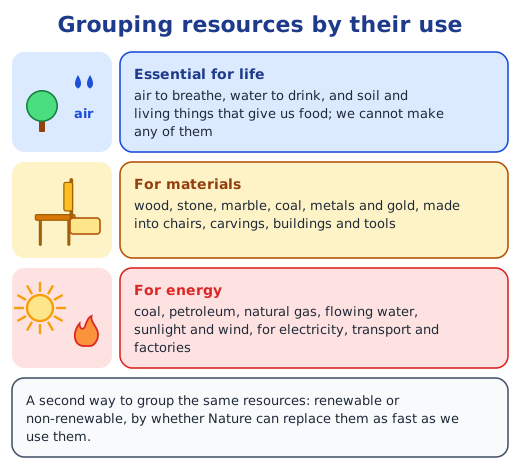
A second way is to ask whether Nature can renew a resource. Sunlight, wind, flowing water and forests are renewable; coal, petroleum and metals such as iron, copper and gold are non-renewable, because they formed over very long periods. This grouping is explained in renewable and non-renewable resources.
Where are resources found?
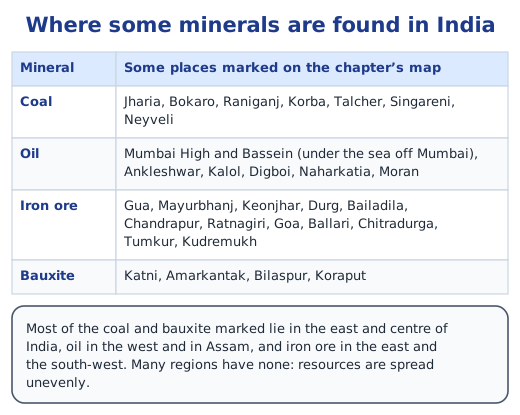
Resources are not spread evenly over the Earth, or even within one country. The chapter’s map of India shows this clearly. Coal is marked at places such as Jharia, Bokaro, Raniganj, Korba, Talcher, Singareni and Neyveli. Oil comes from Mumbai High and Bassein under the sea off Mumbai, from Ankleshwar and Kalol, and from Digboi and its neighbours in Assam. Iron ore stretches from Gua and Keonjhar to Ballari and Kudremukh, and bauxite is found at Katni, Amarkantak, Bilaspur and Koraput. Large parts of the country have none of these four.
How does this uneven spread shape our lives?
Where resources lie decides a great deal: where people settle, what goods are traded, how countries treat each other, and sometimes who goes to war. Control of resources has caused many wars, in the past and today.
Industries set up near resources create jobs for people nearby. New towns spring up around them, other businesses follow, and modern facilities improve life. But there are costs too, now and later. Around the world, communities in places rich in resources have been moved out of their homes to make way for mines and factories, and sometimes their sacred places are threatened, which leads to conflict.
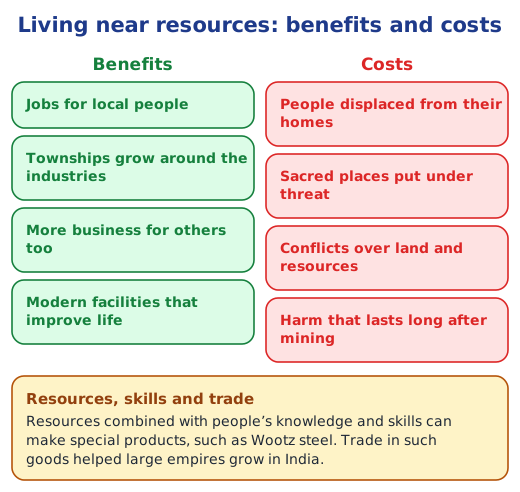
Trade within India and with other countries also depends on where resources are found. Joined with human knowledge and skill, they can become something special, such as Wootz steel, and trade of this kind helped large empires grow in India.
Rivers do not stop at borders
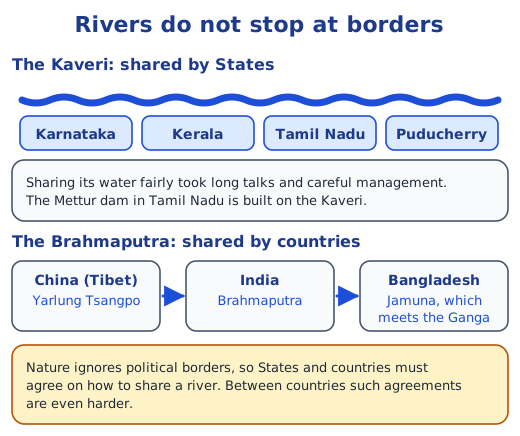
Nature does not follow political boundaries, so sharing a resource can cause tension between States and between countries. The water of the Kaveri is shared by Karnataka, Tamil Nadu, Kerala and Puducherry, and keeping that sharing fair and peaceful took long negotiations and careful management. The Brahmaputra begins in Tibet in China as the Yarlung Tsangpo, flows through India and enters Bangladesh as the Jamuna. Agreements between countries are even harder to reach.
Does having plenty make a country rich?
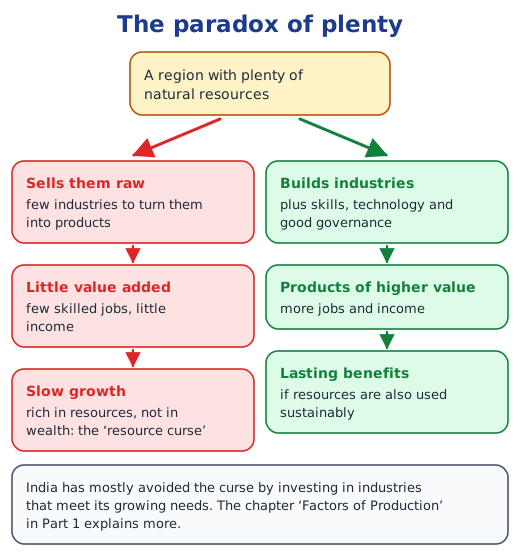
Not always. Some regions with plenty of resources grow slowly. Economists call this the paradox of plenty or the resource curse. Often such places cannot build the industries that turn raw resources into products of higher value. India has mostly avoided the curse by investing in those industries to meet its own growing needs. In the end, knowledge, good governance and careful planning decide whether resources bring lasting benefits or only a brief windfall.
Read on: using resources wisely, renewable and non-renewable resources, the chapter notes and the NCERT solutions.
Practice
-
Trees in a sacred grove are not cut. Which condition for a resource is missing?
Show answer
Answer: (c) culturally acceptable
-
Marble and gold are mainly resources for:
Show answer
Answer: (b) materials
-
Which river is shared by Karnataka, Tamil Nadu, Kerala and Puducherry?
Show answer
Answer: (b) Kaveri
-
Name two places on the chapter’s map where coal is found and two where oil is found.
Show answer
Answer: Coal: any two of Jharia, Bokaro, Raniganj, Korba, Talcher, Singareni and Neyveli. Oil: any two of Mumbai High, Bassein, Ankleshwar, Kalol, Digboi, Naharkatia and Moran.
-
Give one benefit and one cost of setting up industries near natural resources.
Show answer
Answer: Benefit: jobs for local people, and townships with better facilities. Cost: people may be moved out of their homes, or their sacred places may be threatened.
Questions students ask
What are natural resources?
They are things found in Nature that people find useful, such as air, water, soil, timber, coal, petroleum and metal ores. Something becomes a resource when we can reach it, can afford to take it out, and our culture accepts its use.
What are the types of natural resources?
By use, there are resources essential for life, resources for materials and resources for energy. By whether Nature can renew them, there are renewable resources, such as sunlight, wind and forests, and non-renewable ones, such as coal, petroleum and metals.
Why does the uneven distribution of resources matter?
Because people and industries settle near resources, countries trade for what they lack, and quarrels arise over who controls them. Many wars have been fought to control natural resources, and rivers that cross borders must be shared by agreement.
What is the paradox of plenty?
It is when a region rich in natural resources still grows slowly, often because it sells them raw instead of building industries that turn them into products of higher value. It is also called the resource curse. India has mostly avoided it.
Stuck on a question?
Take a photo and Lagnever AI explains it step by step. Try it for 7 days for ₹2.
Get it on Google Play Open in browser
For parents: after the trial, the plan renews monthly by UPI or card autopay. You can cancel anytime in the app.