
Renewable and non-renewable resources
Answer in short
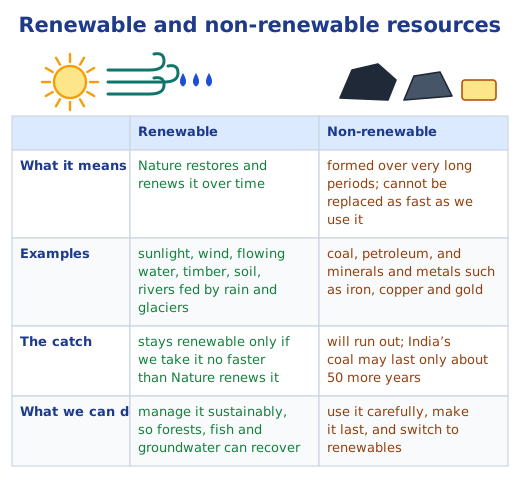
Renewable resources, such as sunlight, wind, flowing water, forests and soil, are restored by Nature over time, but only if we use them no faster than they renew. Non-renewable resources, such as coal, petroleum, iron, copper and gold, formed over very long periods and cannot be replaced as fast as we use them, so they must be used carefully.
Stuck on a question? Take a photo and Lagnever AI explains it step by step. Try it for 7 days for ₹2. Get it on Google Play
How does Nature renew itself?
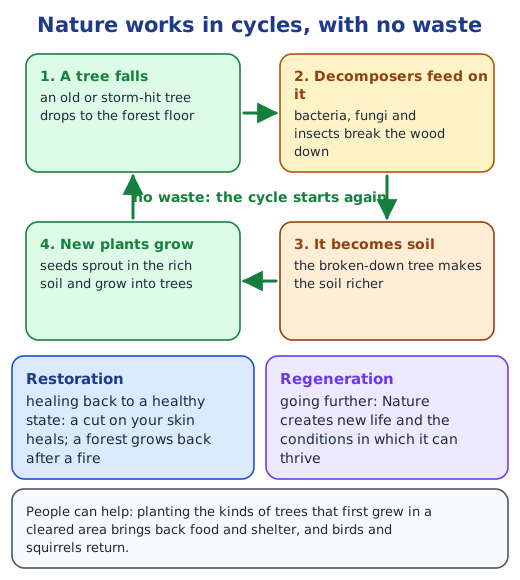
Nature is good at repairing itself. Restoration means bringing something damaged back to a healthy state: a cut on your skin heals, and a forest grows back after a wildfire. Regeneration goes a step further: it is Nature’s power to bring forth new life and the conditions in which life can thrive.
People can help. Where forests were cleared for housing, planting the kinds of trees that first grew there brings the ecosystem back: they feed and shelter birds, squirrels and other animals, and life returns.
Nature also works in cycles in which nothing is wasted. When a tree falls in a forest, bacteria, fungi and insects feed on it and break it down. The wood turns into soil and makes it richer. Seeds sprout in that soil and grow into new trees, which one day fall too, and the cycle begins again. You can read about these decomposers in food chains and decomposers in Class 8 Science.
What are renewable resources?
Resources that share this power to restore and regenerate are renewable. Most of India gets plenty of sunshine. Left to itself, Nature keeps refilling rivers with rain and glacier melt, lets forests grow back, and slowly rebuilds the soil. So solar energy, wind energy, the energy of flowing water and timber from forests are all renewable, as long as we manage them sustainably. Many Indian traditions treat these gifts with gratitude, for example by offering water to Sūrya, the sun, as arghyam.
When can a renewable resource run out?
There is one condition: we must leave Nature’s rhythm of healing and renewal undisturbed. Think of a tank that Nature keeps refilling. If we draw no more than flows in, the level holds; if we draw more, it falls until the tank is empty.
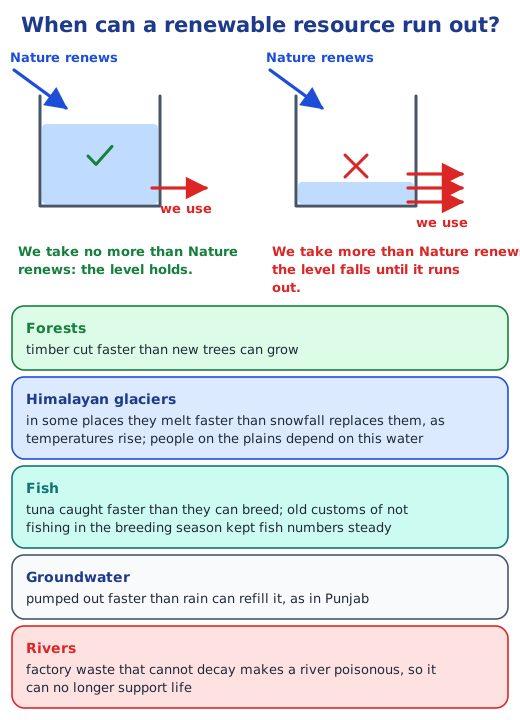
- Forests: if trees are cut faster than new ones grow, the forest is used up.
- Glaciers: factors such as industry run on fossil fuels and the clearing of forests have raised temperatures, so in some places Himalayan glaciers melt faster than snowfall replaces them. People on the plains depend on this ‘water tower’ for water.
- Fish: communities once avoided fishing in the breeding season, so fish numbers stayed steady. Commercial fishing led to overfishing. Tuna, which keep the ocean in balance by eating smaller fish and shrimps, declined so fast that countries agreed to limit their catch, yet they are still declining.
- Rivers: factories often release waste into rivers. Waste that cannot decay breaks Nature’s cycle, and the river can become poisonous and unable to support life.
What do ecosystems do for us?
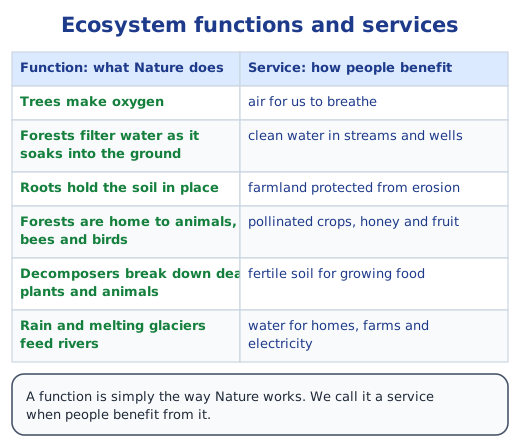
Nature has its own ways of working, called ecosystem functions: trees make oxygen, a forest filters water, holds the soil and gives animals a home. When these natural processes benefit people, we call them ecosystem services: clean water, farmland protected from erosion and crops pollinated by the insects and birds the forest shelters.
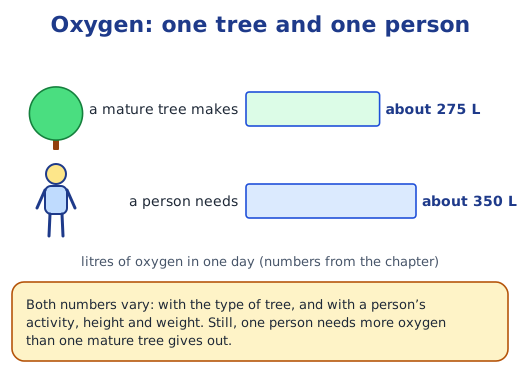
One number shows how much we depend on trees. A mature tree gives out about 275 litres of oxygen a day, varying a little with the kind of tree. A person needs about 350 litres a day, depending on activity, height and weight.
What are non-renewable resources?
Non-renewable resources formed over very long periods and cannot be replenished as fast as we use them. Coal and petroleum (the fossil fuels) are examples, and so are metals such as iron, copper and gold. India has large coal reserves and mines coal to meet its growing need for energy, but these reserves may last only about another 50 years, while the demand for electricity keeps rising with a growing population and fast development. Until cleaner options are widely available, we must use the coal we have with care.
How can we switch to renewables?
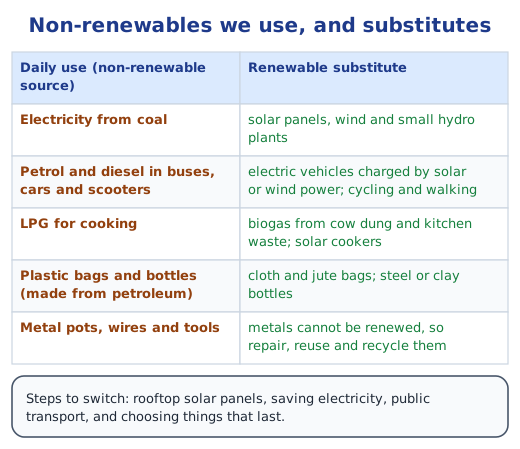
Look at the non-renewable resources you use every day, directly or indirectly: electricity from coal, petrol and diesel in buses and scooters, LPG for cooking, and plastic made from petroleum. Many have renewable substitutes, such as solar and wind power, electric vehicles, biogas and cloth bags.
Read on: types and distribution of natural resources, using resources wisely, the chapter notes and the NCERT solutions.
Practice
-
Which of these is a renewable resource?
Show answer
Answer: (c) wind
-
Bacteria, fungi and insects breaking down a fallen tree into soil is an example of:
Show answer
Answer: (a) Nature’s cycle with no waste
-
About how much oxygen does a mature tree produce in a day?
Show answer
Answer: (b) 275 litres
-
Why are some Himalayan glaciers a worry for people living on the plains?
Show answer
Answer: Rising temperatures make some glaciers melt faster than snowfall can replace them. The rivers of the plains depend on this ‘water tower’, so people there may face water shortages.
-
Give two renewable substitutes for things we now get from non-renewable resources.
Show answer
Answer: Any two: electricity from solar panels or wind instead of coal; electric vehicles, cycling or walking instead of petrol and diesel; cloth or jute bags instead of plastic made from petroleum; biogas instead of LPG.
Questions students ask
What are renewable resources?
They are resources that Nature restores over time, such as sunlight, wind, flowing water, timber from forests and soil. They stay renewable only as long as we manage them sustainably and do not disturb Nature’s rhythm of restoration and regeneration.
What are non-renewable resources? Give examples.
They are resources that formed over very long periods and cannot be replaced at the rate we use them. Coal and petroleum, which are fossil fuels, are examples, and so are metals such as iron, copper and gold.
Can a renewable resource become non-renewable?
Yes, in practice. If we cut trees faster than a forest grows, catch fish faster than they breed or pump groundwater faster than rain refills it, the resource runs out, and pollution or rising temperatures can break Nature’s cycle too.
What are ecosystem services?
They are the benefits people get from the way Nature works. A forest filters water, holds the soil and shelters animals: these are ecosystem functions. The clean water to drink, fields safe from erosion and crops pollinated by insects are ecosystem services.
Stuck on a question?
Take a photo and Lagnever AI explains it step by step. Try it for 7 days for ₹2.
Get it on Google Play Open in browser
For parents: after the trial, the plan renews monthly by UPI or card autopay. You can cancel anytime in the app.