
NCERT Solutions Class 8 Social Science Chapter 2: Reshaping India’s Political Map
Answers to the Big Questions, every Let’s Explore and Think About It box, the Don’t Miss Out box on Gurudwara Sis Ganj Sahib, and all seven Questions and activities in Chapter 2, Reshaping India’s Political Map, of Exploring Society: India and Beyond, Grade 8 Part 1. Page numbers follow the book (pages 21–60). Short notes: Chapter 2 notes.
The Big Questions (page 21)
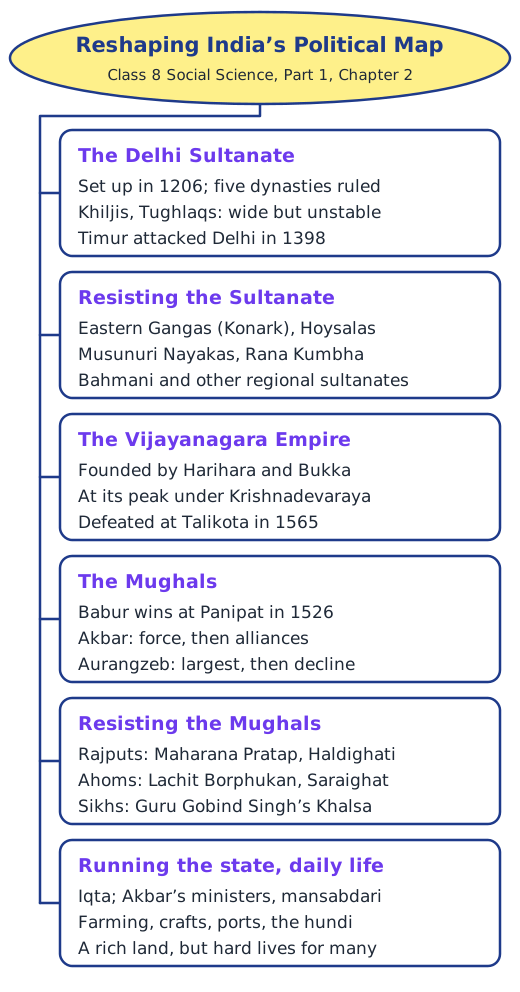
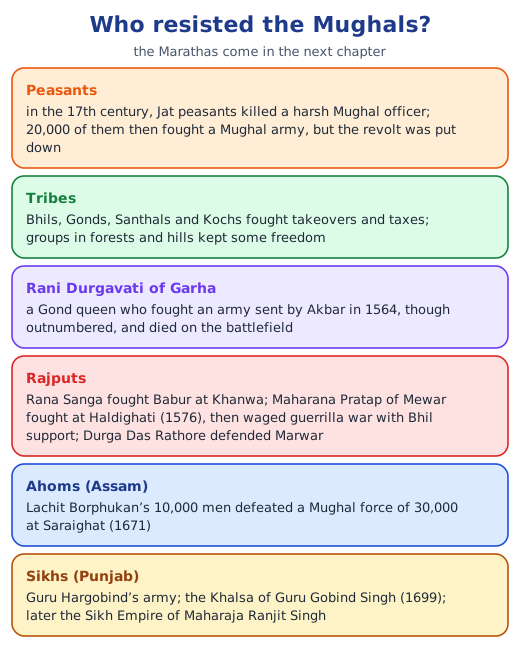
1. How did invasions and new dynasties redraw India’s borders? The Delhi Sultanate, set up in 1206 after Prithviraj Chauhan’s defeat, spread across the north and, under Muhammad bin Tughlaq, briefly over most of the Subcontinent. It then shrank, as Timur’s attack and regional revolts left the Lodis only part of the north. New powers rose: the Bahmani Sultanate and later the five Deccan Sultanates, and Vijayanagara in the south. After 1526 the Mughals built an empire that reached its largest size under Aurangzeb, while the Rajputs, Ahoms and Sikhs held their own regions, and the Mughal empire later declined.
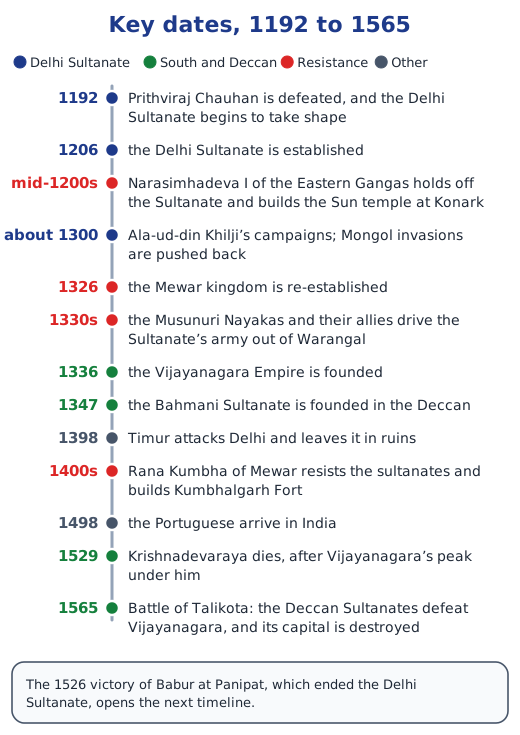
2. How did society respond to invasions, and how did the economy adapt to unstable times? Society resisted: kingdoms fought back, chieftains formed alliances like the Musunuri Nayakas’, Rajputs and Ahoms used guerrilla warfare, and peasants and tribes rebelled. People rebuilt towns and temples and kept their traditions alive. The economy adapted too: farming, crafts and trade went on through changes of ruler, merchants used hundis so they did not have to carry cash past plunderers, trader communities such as the Marwaris worked across many kingdoms, and temples gave credit and built tanks and rest houses.
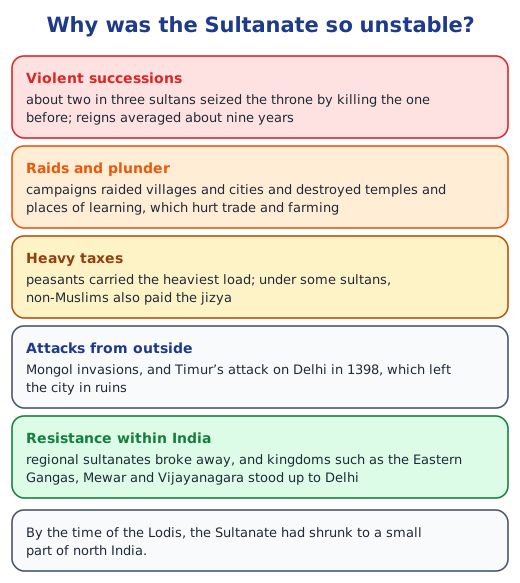
3. How did this period affect people’s lives? Many suffered: cities were sacked, people were killed or enslaved, temples and places of learning were destroyed, and some rulers persecuted people for their faith or taxed them through the jizya. Peasants paid a fifth of their crop or more, famines struck, and by the late 1600s many had lost their land. Yet there were roads, canals, new cities and a rich trade, and art, music and architecture flourished. Most of the time, people of different faiths lived side by side and depended on each other.
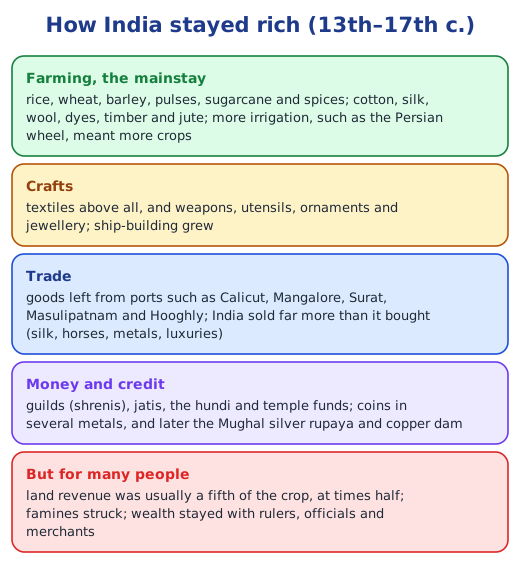
Let’s Explore, Think About It and Don’t Miss Out (pages 26–52)
Why ‘the second Alexander’? (page 26). Alexander of Macedon was remembered as a great world conqueror (Extra: he reached north-western India in the 4th century BCE). By putting the Persian title ‘Sikander Sani’ on his coins, Ala-ud-din Khilji wanted everyone who handled them to see him as a conqueror of the same rank. His wide campaigns and his victories over the Mongols gave him reason to boast.
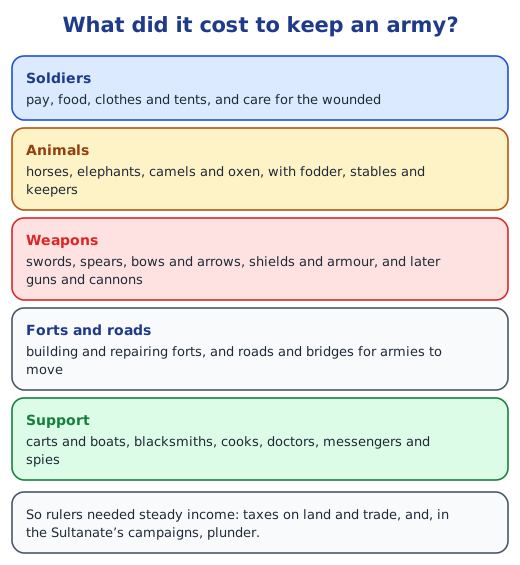
What does it cost to keep an army? (page 26). Pay, food, clothes and tents for the soldiers; horses, elephants, camels and oxen with fodder, stables and keepers; swords, spears, bows, shields and armour, and later guns and cannons; forts, and roads and bridges for armies to move along; and carts, boats, blacksmiths, cooks, messengers and spies. Rulers met these costs through taxes on land and trade and, in many Sultanate campaigns, through plunder.
Why say ‘image’ and not ‘idol’ or ‘icon’? (page 28). In Judaism, Christianity and Islam, ‘idol’ and ‘icon’ are words of disapproval, because their orthodox schools condemn worship of such objects. Indian texts use respectful words such as mūrti, vigraha, pratimā and rūpa, and in English ‘image’ is the neutral word. Using it describes the sacred statue without passing judgement.
Was it easy to unite 75 chieftains? (page 29). No. In those days messages travelled by horse or on foot, so meetings took weeks. Each chief was proud of his own land and may have had old quarrels with his neighbours. They had to trust each other, agree on who would lead, and share any land or wealth won, all while fearing Delhi’s revenge. That the Musunuri Nayakas managed it shows strong leadership and how much they all feared the common enemy.
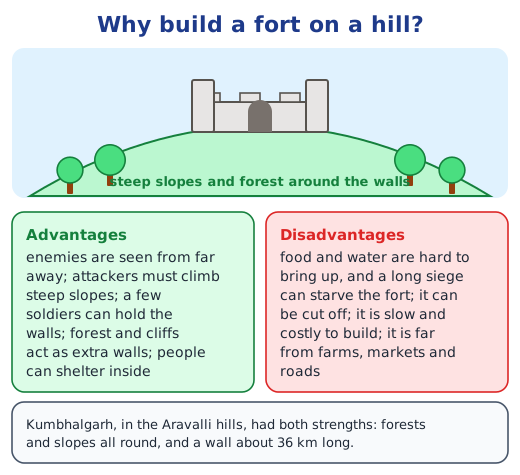
Why build forts on hills? (page 31). Advantages: enemies could be seen from far off; attackers had to climb steep slopes; a few soldiers could hold the walls; forests and cliffs acted as extra walls; and people could shelter inside. Disadvantages: food and water were hard to bring up, so a long siege could starve the fort; it could be cut off; it was slow and costly to build; and it was far from farms, markets and trade routes.
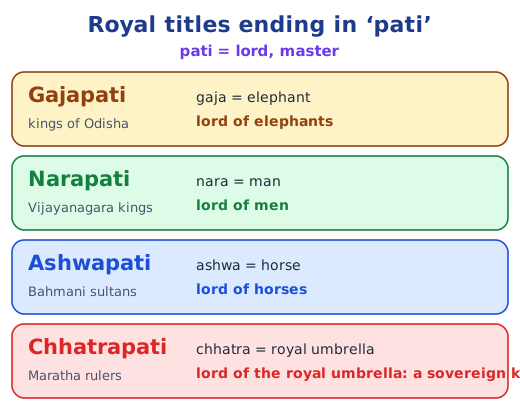
What do Gajapati, Narapati, Ashwapati and Chhatrapati mean? (page 32). Pati means lord. Gaja is elephant, so Gajapati is lord of elephants; nara is man, so Narapati is lord of men; ashwa is horse, so Ashwapati is lord of horses; and chhatra is the royal umbrella, a sign of kingship, so Chhatrapati is lord of the royal umbrella, that is, a sovereign king. The titles show what each power took pride in.
The Vitthala temple panel, Fig. 2.14 (page 35). Rows of carvings show elephants; camels with riders; horsemen with raised swords; hunters with bows and arrows chasing deer, with dogs; soldiers with shields and spears marching in a line; and people dancing or playing music. They tell us that the kingdom had a large army with cavalry and elephants, that horses were prized (the king bought them from Portuguese traders), that camels carried goods and people, that hunting was a popular sport, and that processions and festivals were part of life.
What strikes you in Babur’s view of India? (page 37). He missed Central Asia and found India short of charms, yet he admired its gold and silver, the pleasant air of the rainy season and its countless skilled workers. It is striking that a man who could note birds and fruit trees so carefully was also a ruthless conqueror, and that it was India’s wealth, not its beauty, that made him stay.
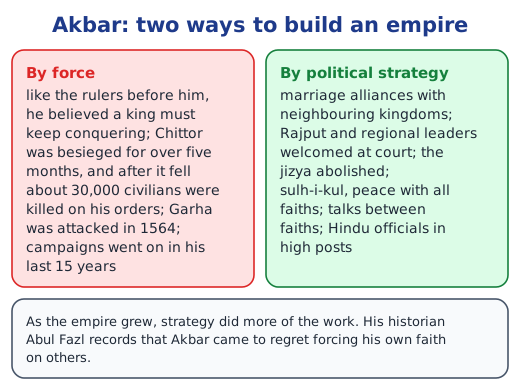
Why did Akbar use new strategies? (page 40). His empire was large and full of different peoples, and most of his subjects were not Muslims, so force alone could not hold it. Rebellions were costly, while Rajput allies brought soldiers and loyalty, and fair treatment won the support of his subjects. A peaceful empire also yielded more taxes and trade. His own curiosity about other faiths and ideas played a part, and short, violent reigns before him showed how fragile rule by force could be.
Figs. 2.3, 2.12 and 2.16 compared (page 41). In Fig. 2.3, the Tughlaqs (1335) cover most of the Subcontinent from Peshawar to Madurai, but the Lodis (1479) hold only a band in the north around Delhi, Gwalior and Jaunpur; the Eastern Gangas hold the east and the Hoysalas the south. In Fig. 2.12, the Deccan is split between the Bahmani Sultanate in the north and Vijayanagara in the south, which grows under Krishnadevaraya, with the Gajapatis along the east coast. In Fig. 2.16, the Mughals under Akbar rule the north and centre, Aurangzeb pushes deep into the south, and later regional powers appear: the Rajputs, the Ahoms in the north-east and the Sikhs in the north-west. The ‘reshaping’ is this constant growing, shrinking and splitting of kingdoms.
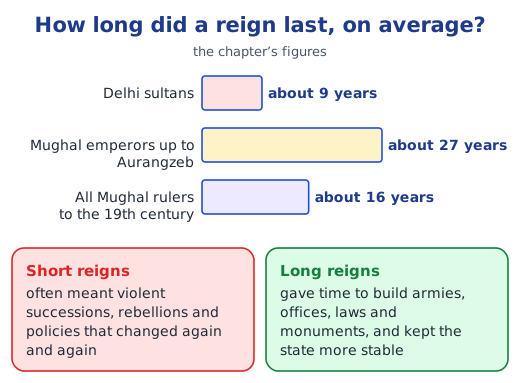
What do the average reigns tell us? (page 43). Mughal emperors up to Aurangzeb ruled for about 27 years on average, three times as long as the sultans’ nine. Longer reigns gave time to build armies, offices and monuments, and made the state more stable, though Mughal successions were still bloody. The average for all Mughal rulers falls to 16 years because, after Aurangzeb, rulers changed often as the empire weakened.
Aurangzeb’s last letters (page 45). In his last letters, Aurangzeb wrote that he had come into the world alone and was leaving alone, that he did not know what he had achieved, that he had not done well for the country and its people, and that he felt helpless. They show a lonely old man full of doubt and regret, who saw at the end that power and conquest had not brought what he hoped. A sample feeling: it is sad, and it reminds us that a ruler is judged by the good he does for people, not by the land he conquers.
The darker deeds of the past (page 45). The chapter’s point is that we must know the facts, remember and respect the victims, and learn how such cruelty became possible, so that it is not repeated. But these were people of the past: no one living today is responsible for them, and no community today should be blamed.
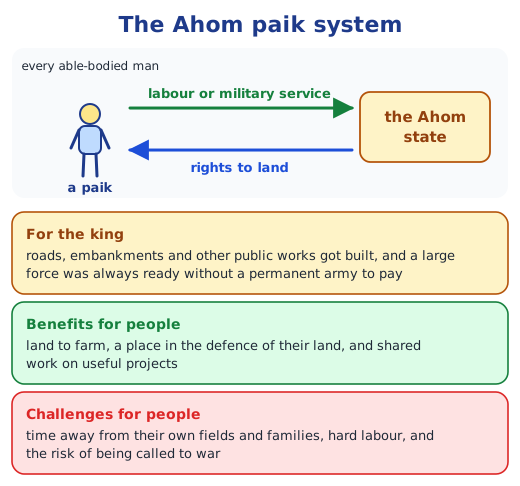
The paik system in daily life (page 48). Every able-bodied man served the state for a time, as a labourer or a soldier, and in return held rights to land. Benefits: families had land to farm, everyone shared in defending the land, and roads, embankments and other works got built. Challenges: men spent time away from their own fields and families, the work could be hard, and they could be called to war. For the king, it meant public works and a large force ready at any time, without the cost of a permanent army, and it tied the economy and the army together.
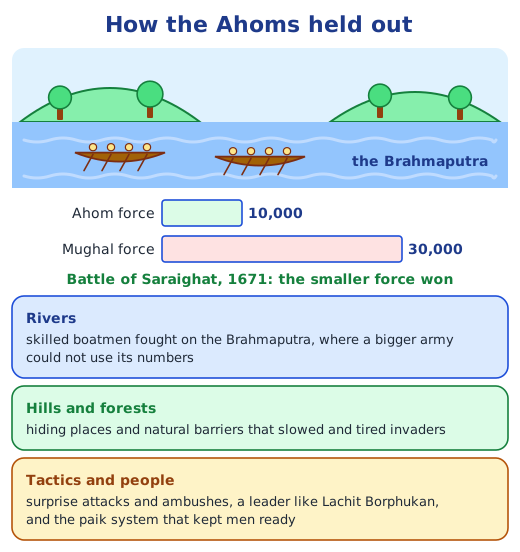
How did the Ahoms use their geography? (page 49). They knew the land far better than the invaders. On the Brahmaputra, skilled boatmen fought where the Mughals could not use their bigger numbers, as at Saraighat. Dense forests and hills gave them hiding places for surprise attacks and ambushes, and slowed and tired the enemy. The Mughal general Ram Singh himself praised the Ahom soldiers as skilled at rowing, archery, digging trenches and using guns.
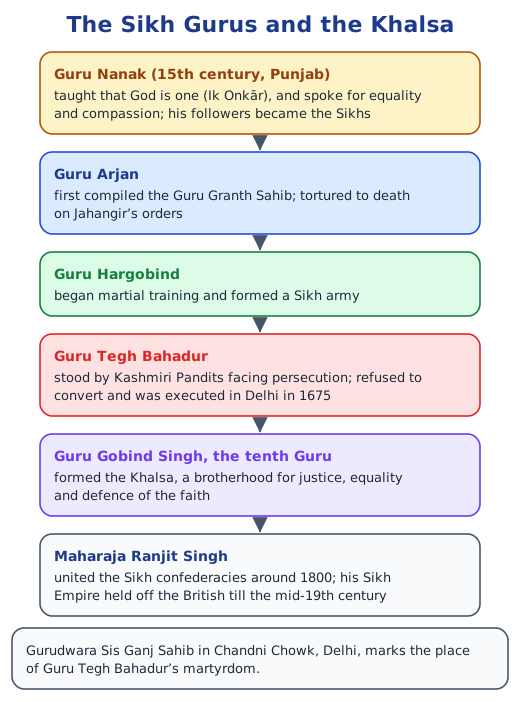
What does Gurudwara Sis Ganj Sahib mark? (page 51). It stands in Chandni Chowk, Delhi, at the place where the ninth Sikh Guru, Guru Tegh Bahadur, was beheaded on Aurangzeb’s orders in 1675. The chapter notes that the Sikh Regiment has saluted it at the Republic Day parade every year since 1979. It is a symbol of faith and sacrifice.
Guru Tegh Bahadur, and the values of the Sikh Gurus (page 52). He believed that every person has the right to follow their own faith, and he had promised to stand by the Kashmiri Pandits. Giving in would have betrayed them and his principles, while his sacrifice would show others that forced conversion could be resisted, and it inspired the Sikhs, including his son, Guru Gobind Singh. The Gurus and the Khalsa stood for one God for all, equality, compassion, truthful living, humility, self-control, seva and justice, and courage in defending the weak. Today these values matter in protecting the freedom of faith, in treating everyone as equal whatever their caste, gender or religion, and in serving people in need.
Questions and activities (page 59)
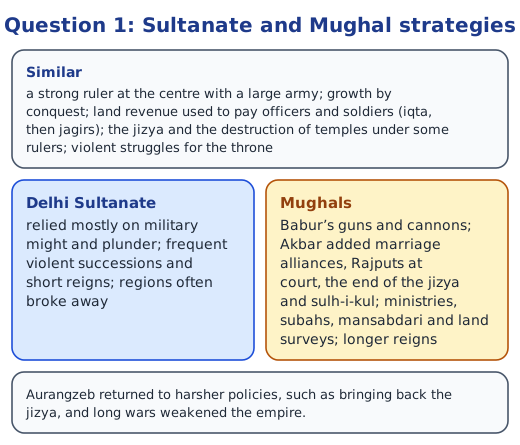
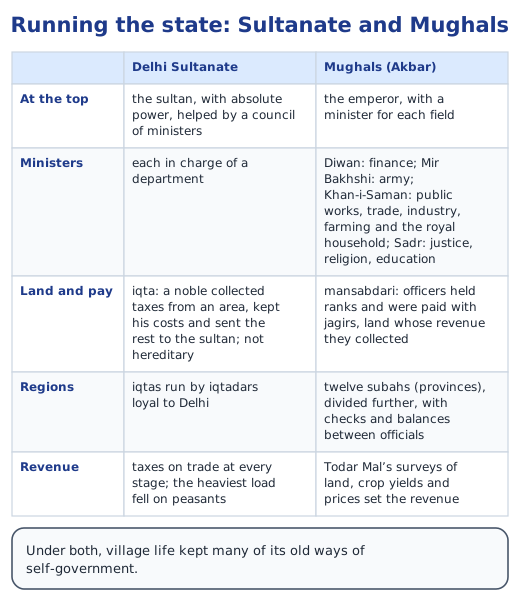
Q1. “Compare the political strategies of the Delhi Sultanate and the Mughals. What similarities and differences existed between them?” Similarities: both had a powerful ruler at the centre with a large army, and both grew by conquest. Both paid officers with land revenue: the iqta under the sultans, jagirs under the Mughals. Both saw violent struggles for the throne, and some rulers of both imposed the jizya and destroyed temples. Differences: the sultans relied mostly on military might and plunder, their reigns were short, and regions often broke away. The Mughals brought guns and cannons to Indian battlefields, and Akbar added political strategies: marriage alliances, Rajput leaders at court, Hindu officials, the end of the jizya and sulh-i-kul. He also built a more organised government, with ministers, twelve subahs, the mansabdari system and Todar Mal’s land surveys, and Mughal reigns were longer. Aurangzeb, however, returned to harsher religious policies and long wars, which weakened the empire.
Q2. “Why did kingdoms like the Vijayanagara Empire and the Ahom Kingdom manage to resist conquest for a longer time compared to others? What geographical, military, and social factors contributed to their success?” Vijayanagara: geographically, it lay far from Delhi in the south, and its rocky capital stood by the Tungabhadra river (Extra). Militarily, it kept a large army, bought fine horses from the Portuguese and fought its neighbours for two centuries. Socially and economically, it had able rulers such as Krishnadevaraya, wealth from trade and temples, and a culture that its people were proud of. It fell only when the Deccan Sultanates united against it in 1565. Ahoms: geographically, they had the Brahmaputra, dense forests and hills, which made large invasions hard. Militarily, they used river boats, guerrilla tactics and able commanders such as Lachit Borphukan, who won at Saraighat against three times as many soldiers. Socially, the paik system meant that every able-bodied man could be called to serve, and the Ahoms won local support by adopting local culture, promoting farming and welcoming many faiths. So they kept their independence.
Q3. “Imagine you are a scholar in the court of Akbar or Krishnadevaraya. Write a letter to a friend describing the politics, trade, culture, and society you are witnessing.” A sample letter from Fatehpur Sikri:
Dear Friend, greetings from the emperor’s new city. Politics: the empire keeps growing, but the emperor now wins as many friends as battles. Rajput kings sit in his court, Hindu officials hold high posts, and the jizya has been abolished. Ministers handle finance, the army, public works and justice, and Todar Mal’s officers are measuring every field to fix the revenue. Trade: caravans bring goods to the markets, ships leave Surat with cotton cloth and spices, and silver rupayas change hands. Culture: in the house of translation, scholars are turning the Mahābhārata into Persian, and painters are filling a Persian Rāmāyaṇa with miniatures; scholars of many faiths, even Jesuit priests, debate before the emperor. Society: the nobles live in great luxury, but the peasants who feed us pay a large share of their crop, and a poor harvest hits them hard. Your friend, the scholar.
Q4. “How come Akbar, a ruthless conqueror in his young days, grew tolerant and benevolent after some years? What could have led to such a change?” Several things may have led to it. (1) Experience: the long siege of Chittor and fierce Rajput resistance showed how costly force was, while alliances brought loyal generals and soldiers. (2) The size of the empire: most of his subjects were not Muslims, and a vast, varied empire could be held only with their support. (3) Curiosity: although he could not read, he loved ideas, invited scholars of many faiths and had great Sanskrit works translated, which widened his outlook. (4) Conscience: Abul Fazl records Akbar saying that as his knowledge grew he felt ashamed of forcing his faith on others, since a faith accepted under force does not last. The change was real but partial: he kept fighting wars in his last 15 years, and non-Muslims remained a minority among his high officials.
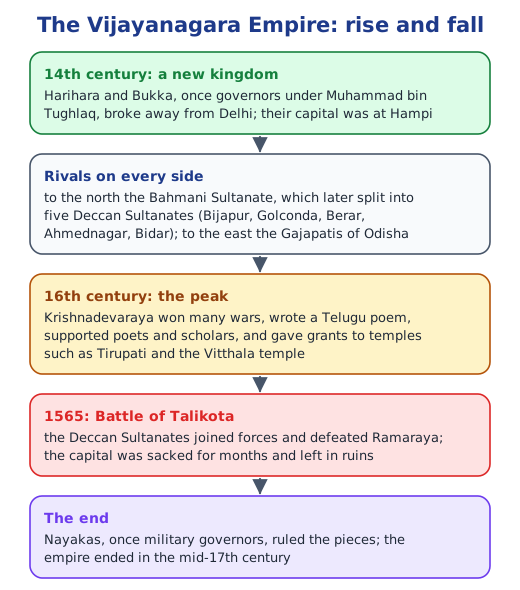
Q5. “What might have happened if the Vijayanagara Empire had won the Battle of Talikota? Imagine and describe how it could have changed the political and cultural history of south India.” A possible picture. Politics: Vijayanagara would have stayed the strongest power in the south, and the Deccan Sultanates, having lost, might have weakened or split further. Instead of breaking into Nayaka states, the empire could have stayed united, and it might later have stood in the way of the Mughals’ push into the Deccan. Culture: Hampi would not have been destroyed, so its temples, palaces and markets would have kept growing. Royal support for Telugu, Kannada and Sanskrit poetry, for music and for temple building would have continued, and trade with the Portuguese and others would have gone on through its ports. Of course, this is only imagination; history might still have taken other turns.
Q6. “Many values promoted by early Sikhism, including equality, seva, and justice, remain relevant today. Select one of these values and discuss how it remains relevant in contemporary society.” Seva, selfless service. Today, seva can be seen when volunteers cook and serve meals to everyone who comes, at no charge, in community kitchens, such as the langar of gurudwaras, where everyone sits together whatever their religion or caste (Extra). People also serve by helping after floods and earthquakes, donating blood, teaching poor children, caring for the sick and elderly, and cleaning public places. Seva reduces hunger and loneliness, builds trust between communities and reminds us that every person is equal. Students can practise it at home and in school: helping a classmate, sharing books and joining cleanliness drives.
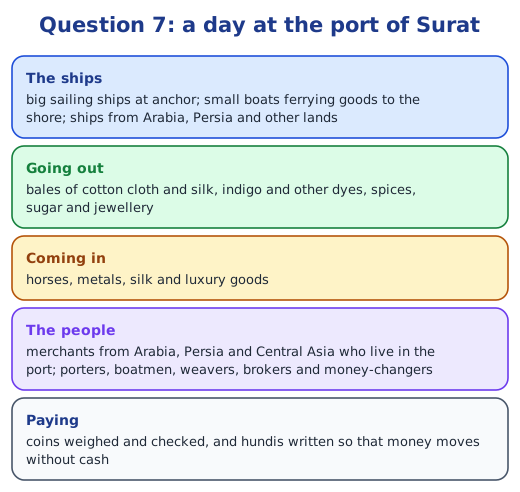
Q7. “Imagine you are a trader in a port city (Surat, Calicut or Hooghly). Describe the scenes you see as regards goods, people you trade with, movement of ships, etc.” A sample from Surat. At dawn the harbour is crowded with tall sailing ships, while small boats ferry goods between them and the shore. Porters carry bales of cotton cloth and silk, sacks of spices and sugar, and jars of indigo and other dyes to the ships, because Indian goods are in demand everywhere. Coming in are horses, metals, silk and luxury goods. I trade with merchants from Arabia, Persia and Central Asia, some of whom have settled here, and with weavers, brokers and money-changers from our own land. Coins are weighed and checked, and I send money to my partner inland with a hundi instead of cash. By evening, ships leave on the tide for distant ports.
Practice
-
The capital of the Vijayanagara Empire was at:
Show answer
Answer: (a) Hampi
-
Which Portuguese visitor compared the Vijayanagara capital to Rome?
Show answer
Answer: (a) Domingo Paes
-
Which Ahom capital did Mughal forces capture for a short time?
Show answer
Answer: (a) Garhgaon
-
What title did Aurangzeb take, and what does it mean?
Show answer
Answer: ‘Alamgir’, which means conqueror of the world. He took it when he crowned himself emperor in 1658.
-
Name Akbar’s four main ministers and their work.
Show answer
Answer: The Diwan (finance), the Mir Bakhshi (the army), the Khan-i-Saman (public works, trade, industry, farming and the royal household) and the Sadr (justice, religion and education).
Stuck on a question?
Take a photo and Lagnever AI explains it step by step. Try it for 7 days for ₹2.
Get it on Google Play Open in browser
For parents: after the trial, the plan renews monthly by UPI or card autopay. You can cancel anytime in the app.