
Class 8 Social Science Chapter 2: Reshaping India’s Political Map Notes
This chapter in five lines
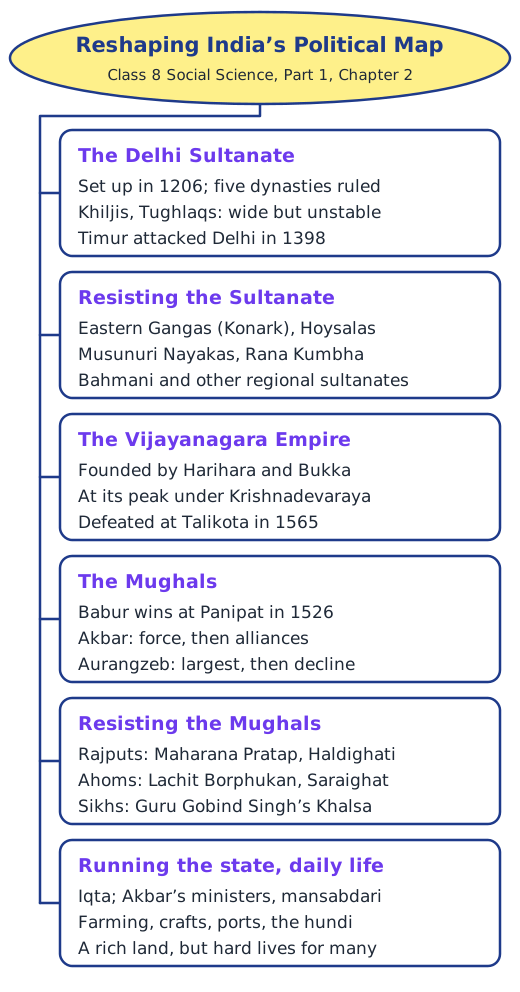
Reshaping India’s Political Map covers the 13th to 17th centuries. The Delhi Sultanate, set up in 1206, grew through war and then shrank as kingdoms such as Vijayanagara rose against it. From 1526 the Mughals built a vast empire, resisted by Rajputs, Ahoms, Sikhs and others. India stayed rich through farming and trade, but life was often hard for ordinary people.
What is this chapter about?
This chapter opens Theme B of Part 1, Tapestry of the Past, and covers roughly the 13th to the 17th centuries. Its Big Questions ask how invasions and new dynasties redrew India’s borders, how society and the economy coped in unsettled times, and what all this meant for ordinary people. Historians often call this period the later part of the ‘medieval’ age, but the word was first used for Europe, so the book uses it simply for India’s 11th to 17th centuries.
From the early 11th century, armies crossed the Hindu Kush into India far more often than before. Many invaders were Turkic or Afghan, from Central Asia. The chapter says they came for India’s wealth and for land, and often also to spread their own version of their religion, by force if needed. Names written in Persian have several English spellings, so you will see Khilji or Khalji, and Tughlaq or Tughluq. The book suggests reading this chapter together with Cultural Currents: 13th to 17th Centuries in Part 2, which tells the cultural story of the same centuries.
How did the Delhi Sultanate rise and fall?
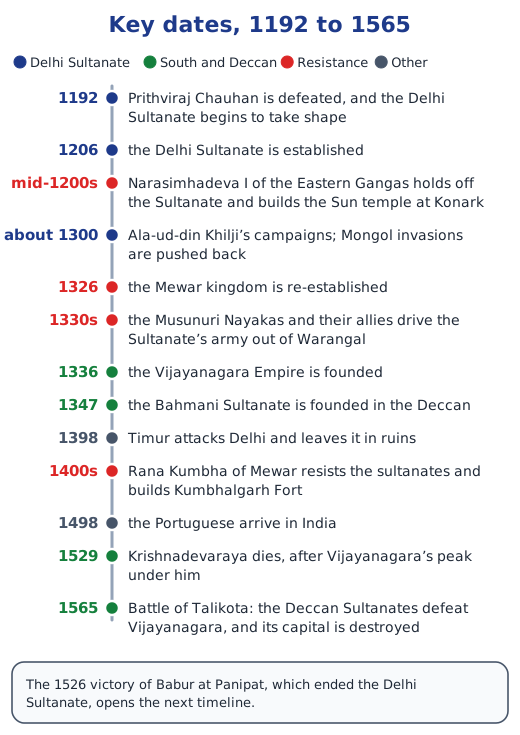
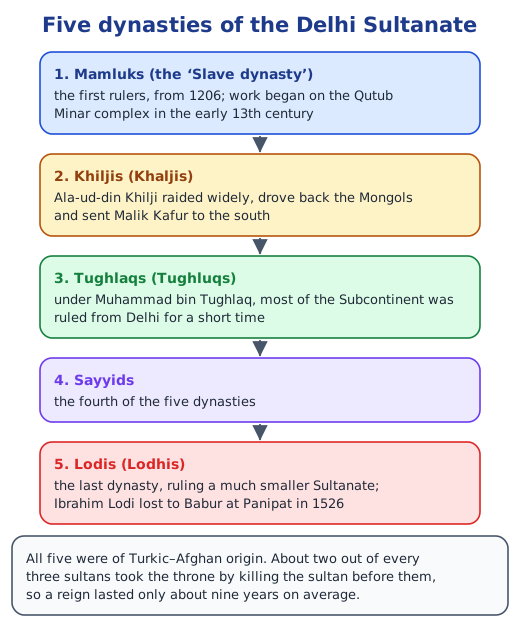
The Delhi Sultanate took shape after Prithviraj Chauhan, who ruled parts of north-western India, was defeated in 1192, and it was established in 1206. Five dynasties of Turkic–Afghan origin ruled it one after another: the Mamluks, the Khiljis, the Tughlaqs, the Sayyids and the Lodis. Delhi became far more important in the politics of the north.
The Sultanate was unstable. About two out of three sultans took power by killing the sultan before them, so a reign lasted only about nine years on average. Military campaigns raided villages and cities and destroyed temples and places of learning. Around 1300, Ala-ud-din Khilji plundered many cities of the north and centre, but he also drove back Mongol invasions; his general Malik Kafur pushed south. Later, Muhammad bin Tughlaq ruled most of the Subcontinent for a short time, but his plans to shift the capital to Daulatabad and to use copper tokens as money went badly wrong. Some sultans imposed the jizya, a tax on non-Muslims. In 1398 Timur, a Turkic–Mongol conqueror, attacked Delhi and left it in ruins. The Lodis became the last dynasty, ruling a much smaller Sultanate. Read the Delhi Sultanate.
Who resisted the Delhi Sultanate?
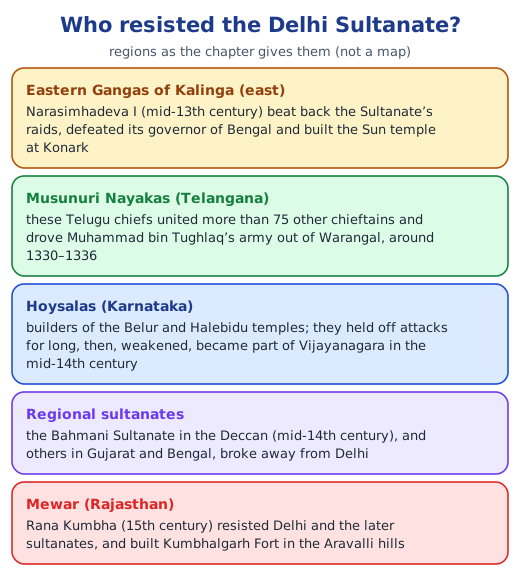
Many did. In the east, the Eastern Ganga king Narasimhadeva I beat back the Sultanate’s raids in the mid-13th century and built the Sun temple at Konark. In Telangana, the Musunuri Nayakas brought together more than 75 chieftains and drove Muhammad bin Tughlaq’s army out of Warangal. In the south, the Hoysalas, builders of the temples at Belur and Halebidu, held out for a long time. The Bahmani Sultanate and other regional sultanates broke away, and in Rajasthan, Rana Kumbha of Mewar held his ground and built Kumbhalgarh Fort.
How did the Vijayanagara Empire rise and fall?
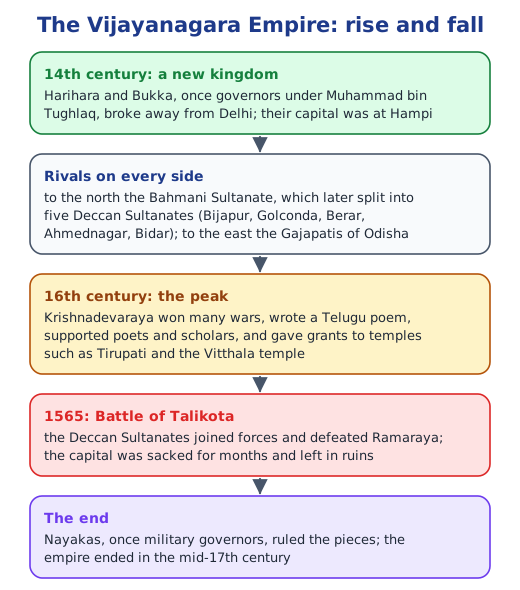
Two brothers, Harihara and Bukka, who had served as governors under Muhammad bin Tughlaq, broke away from Delhi in the 14th century and founded a kingdom that grew into the Vijayanagara Empire, with its capital at Hampi. Its rivals were the Bahmani Sultanate to the north, which later split into five Deccan Sultanates, and the Gajapati kings of Odisha to the east. The empire reached its peak in the 16th century under Krishnadevaraya, a great patron of poets who wrote a Telugu poem himself. Foreign visitors, such as the Portuguese Domingo Paes, described a huge and prosperous capital. In 1565 the Deccan Sultanates united and defeated Vijayanagara at the Battle of Talikota. The capital was looted for months and left in ruins, and the empire broke into smaller parts.
How did the Mughals build their empire?
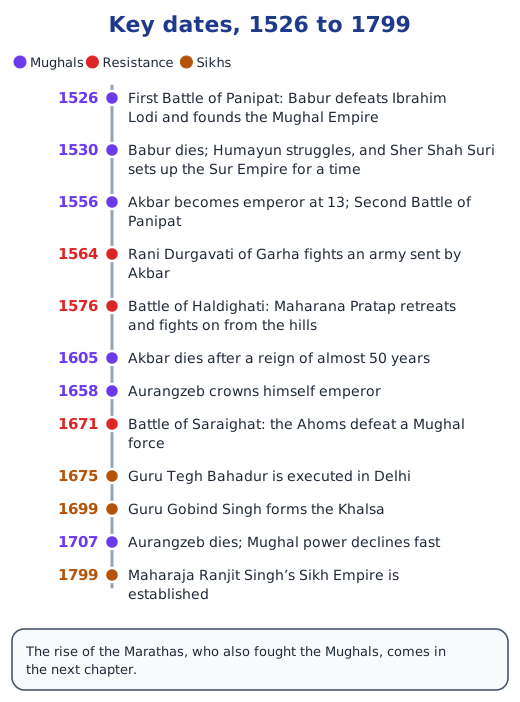
In 1526 Babur, a Turkic–Mongol ruler descended from Timur, beat Ibrahim Lodi at Panipat with the help of guns and cannons. This ended the Delhi Sultanate and began the Mughal Empire. His son Humayun lost much of the north to Sher Shah Suri and later won it back. Akbar, emperor at 13, at first conquered by force: at Chittor, the chapter says, he ordered the killing of about 30,000 civilians. Later he relied more on alliances, welcomed Rajput leaders to his court, abolished the jizya and promoted sulh-i-kul, peace with all faiths. Under Jahangir and Shah Jahan, builder of the Taj Mahal, art and architecture flourished.
Aurangzeb seized the throne after defeating his brothers and imprisoning his father, and ruled for almost 49 years. The empire reached its largest size, but 25 years of war in the Deccan drained the treasury. He brought back the jizya, and in 1669 ordered temples and schools of non-Muslims to be destroyed. After his death in 1707, Mughal power declined quickly. Read the Mughals and resistance to them.
Who resisted the Mughals?
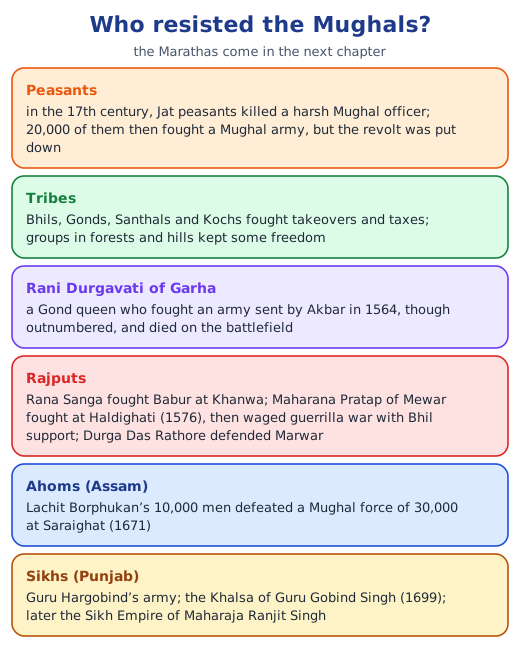
Peasants such as the Jats rose against harsh officials, and tribes such as the Bhils, Gonds, Santhals and Kochs fought to keep their land; those in forests and hills kept some freedom. Rani Durgavati of the Gond kingdom of Garha fought an army sent by Akbar in 1564. Among the Rajputs, Maharana Pratap of Mewar fought at Haldighati in 1576 and then carried on a guerrilla war from the Aravalli hills, with the Bhils at his side. The Ahoms of Assam, led by Lachit Borphukan, defeated a much larger Mughal force at Saraighat in 1671. The Sikh Gurus faced persecution: Guru Tegh Bahadur was executed in Delhi in 1675, and his son Guru Gobind Singh formed the Khalsa. Later, Maharaja Ranjit Singh built a strong Sikh Empire.
How were the Sultanate and the Mughal Empire run?
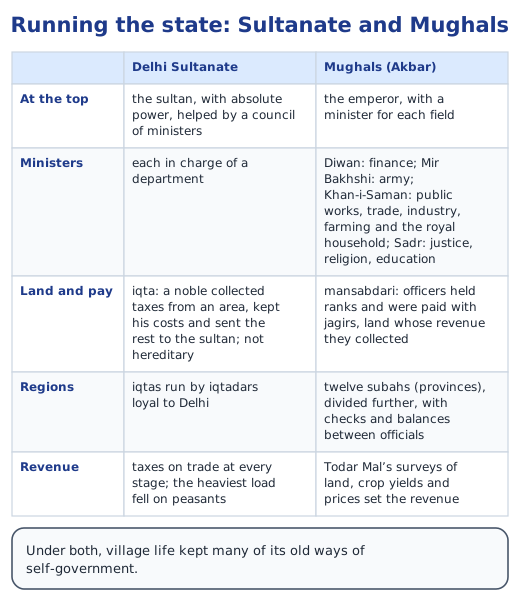
The sultan held absolute power, helped by a council of ministers. Under the iqta system, nobles collected taxes from an area to pay for the army and sent the rest to Delhi. Akbar reorganised the Mughal state: ministers for finance, the army, public works and justice; twelve provinces called subahs; and the mansabdari system, in which officers held ranks, kept troops and animals for the state and were paid with land called jagirs. His finance minister Todar Mal surveyed the land and crops to fix the revenue. Read administration and people’s lives.
How did people live?
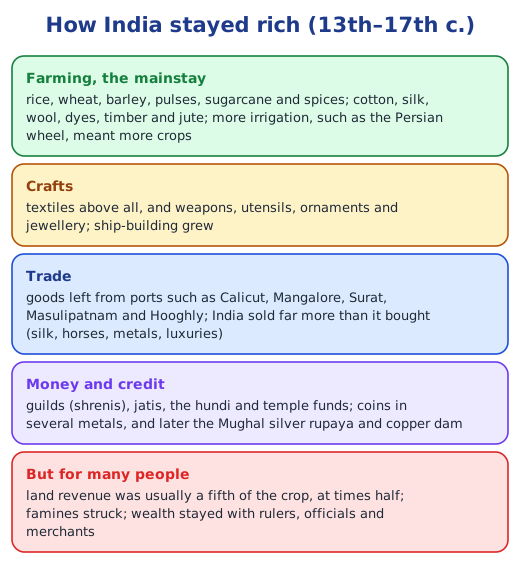
Farming was the backbone of the economy, and rulers usually took a fifth of the harvest as revenue, some sultans as much as half. Craftspeople made fine textiles and much else, and goods left through ports such as Calicut, Surat and Hooghly; India sold far more than it bought. Merchants used the hundi to move money safely, and temples were centres of trade and credit as well as worship. India stayed one of the richest regions of the world, but its wealth stayed with rulers, officials and merchants, famines struck, and many peasants lost their land in the late 1600s. Even so, people of different faiths mostly lived side by side and depended on each other.
Before we move on
In these centuries invaders came, old dynasties fell, and new kingdoms and empires rose and fell, and many people suffered persecution for their faith. Yet society rebuilt again and again, kept its traditions and created new forms of art, music and architecture. The chapter asks us to face the darker parts of this history calmly: the victims deserve remembrance, but no one living today is to blame for what was done centuries ago. Answers to every question are in the NCERT solutions for Chapter 2.
Key terms
| Term | Meaning |
|---|---|
| Medieval period | A term first used for Europe’s history; in this book it simply means India’s 11th to 17th centuries. |
| Sultanate | A land ruled by a sultan, a title taken by some Muslim rulers. |
| Turkic | To do with the peoples, languages and cultures of a huge region stretching from Central Asia to Turkey and Siberia. |
| Iconoclasm | Destroying religious images because they are thought to be idolatrous. |
| Jizya | A tax some rulers charged non-Muslim subjects; Akbar abolished it and Aurangzeb brought it back. |
| Iqta | In the Delhi Sultanate, an area whose taxes a noble (iqtadar) collected, sending the rest to the sultan after his costs; it was not hereditary. |
| Mansabdari | Akbar’s system of ranks (mansabs): each officer kept a set number of soldiers and animals for the state. |
| Jagir | Land whose revenue was given to a mansabdar as pay, so mansabdars were also called jagirdars. |
| Subah | A province of the Mughal Empire; Akbar divided his empire into twelve. |
| Sulh-i-kul | ‘Peace with all’: Akbar’s policy of tolerating all faiths. |
| Jauhar | The choice of some Rajput women to die in fire rather than be captured by an invading army; it was seen at the time as a last act of resistance. |
| Guerrilla warfare | Fighting in small groups that know the land well, with surprise attacks and ambushes on a bigger army. |
| Paik system | The Ahom system in which every able-bodied man served the state with labour or as a soldier, in return for rights to land. |
| Khalsa | The brotherhood formed by Guru Gobind Singh, committed to justice, equality and the defence of the faith. |
| Hundi | A written order to pay a person, which let merchants move money across borders without carrying cash. |
Topics in this chapter
Practice
-
Which battle in 1526 led to the founding of the Mughal Empire?
Show answer
Answer: (b) First Battle of Panipat
-
Which sultan moved his capital from Delhi to Daulatabad?
Show answer
Answer: (b) Muhammad bin Tughlaq
-
Who led the Ahom army at the Battle of Saraighat?
Show answer
Answer: (b) Lachit Borphukan
-
In which year was Vijayanagara defeated at Talikota?
Show answer
Answer: (c) 1565
-
Akbar’s system of ranks for officers was called the:
Show answer
Answer: (c) mansabdari system
-
Who formed the Khalsa?
Show answer
Answer: (d) Guru Gobind Singh
Questions students ask
What are the main topics of Class 8 Social Science Chapter 2?
The rise and fall of the Delhi Sultanate and the kingdoms that resisted it; the Vijayanagara Empire; the Mughal emperors from Babur to Aurangzeb; resistance by peasants, tribes, Rajputs, Ahoms and Sikhs; how the Sultanate and the Mughals ran their states; and how people lived and traded.
Is Reshaping India’s Political Map in the new NCERT Class 8 book?
Yes. It is Chapter 2 of Exploring Society: India and Beyond, Grade 8 Part 1 (Reprint 2026-27), on pages 21 to 60, and the first chapter of the theme Tapestry of the Past. The book suggests reading it together with Cultural Currents: 13th to 17th Centuries in Part 2.
Why is the chapter called ‘reshaping’ India’s political map?
Because borders kept changing. The Tughlaqs ruled most of the Subcontinent for a short time, the Lodis held only part of the north, the Deccan split between Vijayanagara and the sultanates, the Mughals reached their largest size under Aurangzeb, and regional powers such as the Rajputs, Ahoms and Sikhs held their own.
How does the chapter ask us to read the cruel parts of this history?
It describes wars, massacres and the destruction of temples, and asks us to study them calmly and with sensitivity. The victims deserve to be remembered, but people living today bear no responsibility for what rulers did hundreds of years ago.
Stuck on a question?
Take a photo and Lagnever AI explains it step by step. Try it for 7 days for ₹2.
Get it on Google Play Open in browser
For parents: after the trial, the plan renews monthly by UPI or card autopay. You can cancel anytime in the app.