
The Mughals and the resistance to them
Answer in short
The Mughal Empire began in 1526, when Babur won the First Battle of Panipat against Ibrahim Lodi. Akbar expanded it by war and then by alliances, and under Aurangzeb it reached its largest size. Many resisted Mughal rule: peasants, tribes, Rani Durgavati, Rajputs such as Maharana Pratap, the Ahoms under Lachit Borphukan, and the Sikhs.
Stuck on a question? Take a photo and Lagnever AI explains it step by step. Try it for 7 days for ₹2. Get it on Google Play
How did the Mughal Empire begin?
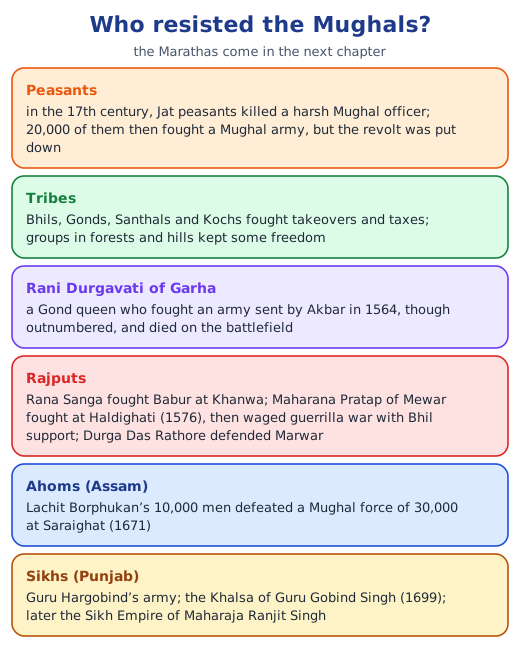
Babur, a Turkic–Mongol ruler descended from Timur, had been driven out of Samarkand, in today’s Uzbekistan. He turned to India and in 1526 defeated Ibrahim Lodi at Panipat, a battle later called the First Battle of Panipat. Gunpowder, field cannons and matchlock guns, then new to warfare in India, helped him win. This ended the Delhi Sultanate and began the Mughal Empire. Babur’s memoir, the Baburnama, shows a curious man who loved birds, fruit trees, buildings and poetry; the chapter adds that he was also a ruthless conqueror who massacred the people of cities he took. He stayed on, the chapter suggests, largely because of India’s wealth.
After Babur died in 1530, his son Humayun lost much of the north to the Afghan leader Sher Shah Suri, who set up the Sur Empire and brought in lasting reforms, but Humayun later won the land back. Himu (Hemu), a commander and chief minister under one of the last Sur rulers, captured Delhi for a short time and ruled as Hemchandra Vikramaditya. At the Second Battle of Panipat in 1556 he was wounded and captured, and Akbar had him put to death.
How did Akbar build his empire?
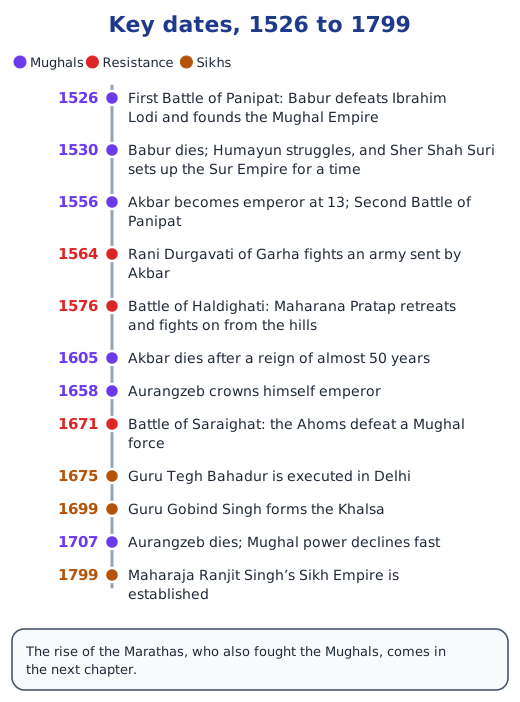
Akbar became emperor at 13. In his early conquests he was harsh. He besieged the fort of Chittor for over five months; the Rajput defenders died fighting, hundreds of women chose jauhar, and the chapter says he ordered the killing of about 30,000 civilians. As the empire grew, he turned more to strategy: marriage alliances with neighbouring kingdoms, Rajput and regional leaders at his court, Hindu officials in high posts, the end of the jizya, and sulh-i-kul, peace with all faiths. His historian Abul Fazl records that Akbar came to regret forcing his faith on others. Though he could not read, Akbar loved ideas: at Fatehpur Sikri he had the Mahābhārata, Rāmāyaṇa, Bhagavad Gītā and Pañchatantra translated into Persian. He ruled from 1556 to 1605.
What happened after Akbar?
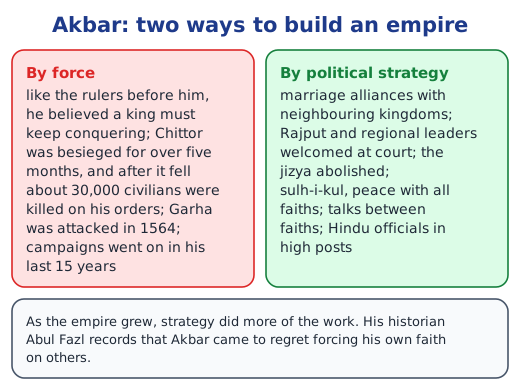
His son Jahangir loved art and tried to expand into the Deccan, and Shah Jahan built the Taj Mahal at Agra. Mughal times saw great buildings such as Humayun’s tomb and the Red Forts of Delhi and Agra, and fine calligraphy, music and miniature painting. When Shah Jahan fell ill in 1657, his son Aurangzeb defeated and executed his elder brother Dara Shikoh, removed his two other brothers and imprisoned his father in the Agra Fort. Crowned in 1658, he ruled for almost 49 years.
Under Aurangzeb the empire was at its largest, but he spent his last 25 years at war in the Deccan, which drained the treasury. A strict Sunni Muslim, he banned music and dance at court, brought back the jizya and a tax on Hindu pilgrims, and in 1669 ordered temples and schools of non-Muslims to be pulled down; temples at Banaras, Mathura and Somnath were among those destroyed. He also persecuted Sufis and Zoroastrians. Some scholars stress his political aims and point to grants and promises of protection he gave some temples; the chapter holds that his own orders show a religious motive too. After he died in 1707, Mughal power declined quickly.
Who resisted the Mughals?
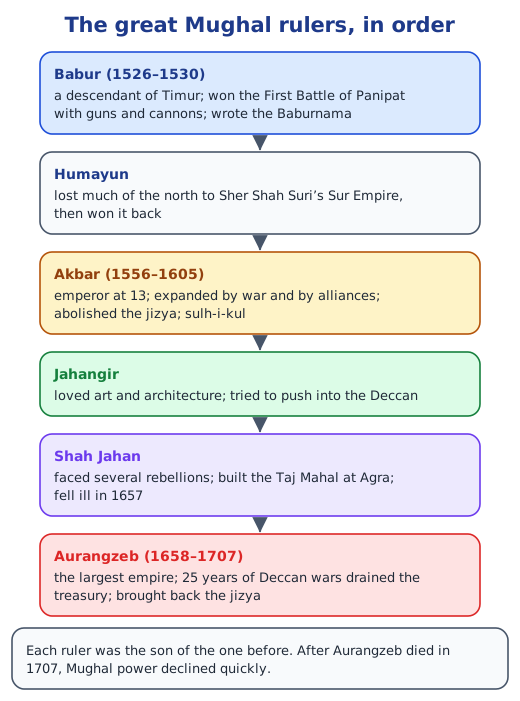
In the 17th century, Jat peasants rose against a cruel Mughal officer, but their revolt was crushed. Tribes such as the Bhils, Gonds, Santhals and Kochs fought takeovers and taxes. Rani Durgavati, a Gond queen of Garha, fought an army sent by Akbar in 1564 and died on the battlefield.
Among the Rajputs, Rana Sanga united several clans but lost to Babur at Khanwa. Maharana Pratap of Mewar fought the Mughals at Haldighati in 1576 and then waged guerrilla war from the Aravalli hills, helped by Bhil archers. Under Aurangzeb, Durga Das Rathore of Marwar fought to keep Jodhpur independent, so Mughal power stayed limited in Rajasthan.
The Ahoms, who moved into the Brahmaputra valley from what is now Myanmar in the 13th century, used rivers, hills and forests to drive the Mughals back. At Saraighat in 1671, Lachit Borphukan’s 10,000 men defeated a Mughal force of 30,000.
The Sikhs, followers of Guru Nanak, faced persecution: Guru Arjan was tortured to death on Jahangir’s orders, and Guru Hargobind formed a Sikh army. In 1675 Guru Tegh Bahadur refused to convert and was executed in Delhi, and his son Guru Gobind Singh formed the Khalsa. Around 1800, Maharaja Ranjit Singh united the Sikhs in a strong empire.
How should we read this history?
The chapter does not hide cruel deeds, but it asks us to study them calmly. The victims deserve respect and remembrance, but no one alive today is responsible for what rulers did centuries ago.
Read on: the Delhi Sultanate, administration and people’s lives, the chapter notes and the NCERT solutions.
Practice
-
Whom did Babur defeat at the First Battle of Panipat in 1526?
Show answer
Answer: (b) Ibrahim Lodi
-
Akbar’s policy of ‘peace with all’ faiths is called:
Show answer
Answer: (b) sulh-i-kul
-
In the Battle of Saraighat (1671), the Ahoms fought the Mughals on the:
Show answer
Answer: (c) Brahmaputra
-
Why is Maharana Pratap remembered?
Show answer
Answer: He refused to accept Mughal rule. After the Battle of Haldighati in 1576 he escaped and fought on for years from the Aravalli hills, with Bhil archers at his side.
-
Name two policies of Aurangzeb that differed from Akbar’s.
Show answer
Answer: He brought back the jizya and the pilgrimage tax on Hindus, which Akbar had abolished, and he banned music and dance at his court.
Questions students ask
Who founded the Mughal Empire?
Babur, a Turkic–Mongol ruler descended from Timur. After losing Samarkand, he turned to India and defeated Ibrahim Lodi at the First Battle of Panipat in 1526, using guns and cannons. This ended the Delhi Sultanate.
How did Akbar expand his empire?
At first mainly by war, as at Chittor and Garha. As the empire grew, he used marriage alliances, welcomed Rajput and regional leaders to his court, abolished the jizya, promoted peace among all faiths and gave Hindu officials high posts.
Who resisted the Mughals?
Peasants such as the Jats; tribes such as the Bhils, Gonds, Santhals and Kochs; Rani Durgavati of Garha; Rajputs such as Rana Sanga, Maharana Pratap and Durga Das Rathore; the Ahoms; and the Sikhs. The Marathas come in the next chapter.
Why did the Mughal Empire decline after Aurangzeb?
Aurangzeb spent his last 25 years fighting in the Deccan. These wars emptied the treasury and strained the administration, and many groups were in revolt. After his death in 1707, Mughal power declined quickly.
Stuck on a question?
Take a photo and Lagnever AI explains it step by step. Try it for 7 days for ₹2.
Get it on Google Play Open in browser
For parents: after the trial, the plan renews monthly by UPI or card autopay. You can cancel anytime in the app.