
Administration and people’s lives under the sultans and the Mughals
Answer in short
The sultan held absolute power, helped by ministers, and nobles collected taxes through iqtas. Akbar set up ministers for finance, the army, public works and justice, twelve provinces and the mansabdari system. Farming, crafts and trade kept India among the richest regions, but heavy taxes, wars and famines often made life hard for ordinary people.
Stuck on a question? Take a photo and Lagnever AI explains it step by step. Try it for 7 days for ₹2. Get it on Google Play
How was the Delhi Sultanate run?
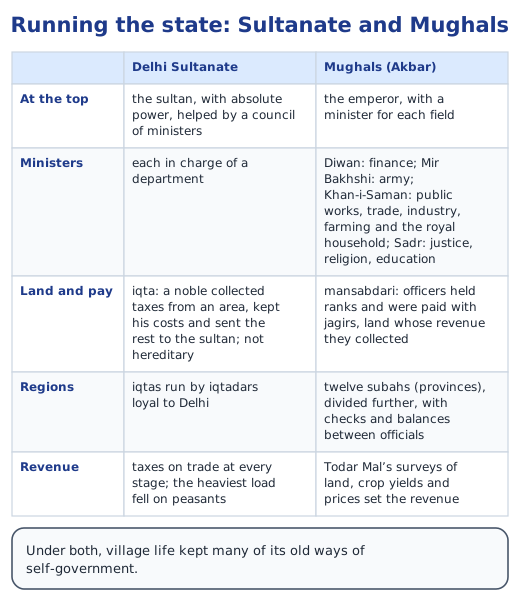
The sultan was the head of both the state and the army, and his authority was absolute. Chronicles of the time list his duties: defending the lands of Islam from attack, collecting taxes and fees, and keeping in personal touch with the people and their condition. A council of ministers, each heading a department, helped him.
A key tool was the iqta system. The sultan handed out areas called iqtas to nobles, the iqtadars. Each collected the taxes of his area, kept enough for his costs, above all for soldiers, and was meant to send the rest to the sultan’s treasury. Since these posts were not hereditary, the iqtadars stayed dependent on, and loyal to, Delhi. Trade was taxed at every stage, but the heaviest burden fell on peasants, and some writers of the time describe great cruelty in collecting land revenue.
How did Akbar organise the Mughal state?
Akbar wanted firmer control and better working, so he reorganised the government. Four ministers shared the work:
- the Diwan: finance;
- the Mir Bakhshi: the army;
- the Khan-i-Saman: public works, trade, industry and farming, and the royal household;
- the Sadr: justice, religion and education.
The empire was split into twelve provinces, or subahs, each with such ministers, and these were divided further. Officials checked one another. In villages, the old ways of self-government carried on much as before.
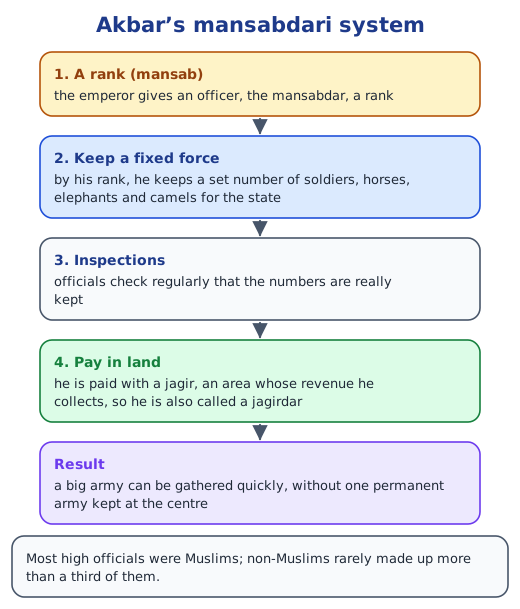
Akbar also set up the mansabdari system. Abul Fazl’s Ain-i-Akbari describes it. Each officer, a mansabdar, held a rank (mansab) and had to keep a fixed number of soldiers, horses, elephants and camels for the state, and inspectors checked this. So the emperor could raise a big army quickly without keeping one huge permanent army. Mansabdars were usually paid with jagirs, land whose revenue they collected, so they were also called jagirdars. Even under the tolerant Akbar, non-Muslims rarely filled more than a third of the high posts, and Muslims of foreign origin were often preferred to Indian Muslims. His finance minister Todar Mal surveyed the land of the whole empire and studied crop yields and prices to fix the revenue for each crop.
How did people earn a living?
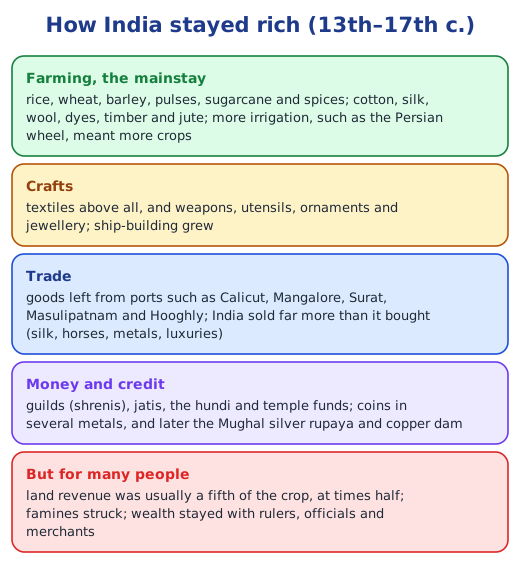
Farming was the backbone. Rulers usually took a fifth of the produce as land revenue, and some sultans took as much as half. More irrigation, such as wells worked by the Persian wheel, let farmers grow rice, wheat, barley, pulses, sugarcane and spices, and also cotton, silk, wool, dyes, timber and jute. Harvests varied, and in severe famines relief depended on how caring a ruler was.
Craftspeople wove textiles and made weapons, utensils and jewellery, and ship-building grew. Goods were shipped from ports such as Calicut, Mangalore, Surat, Masulipatnam and Hooghly. India sold far more than it bought; it imported silk, horses, metals and luxuries, and merchants from Arabia, Persia and Central Asia settled in its ports. Guilds (śhreṇis), jātis and systems of credit kept business going. Roads, bridges, canals and new cities were built under the sultans, and more under the Mughals, who used a silver rupaya and a copper dam.
How did merchants move money safely?
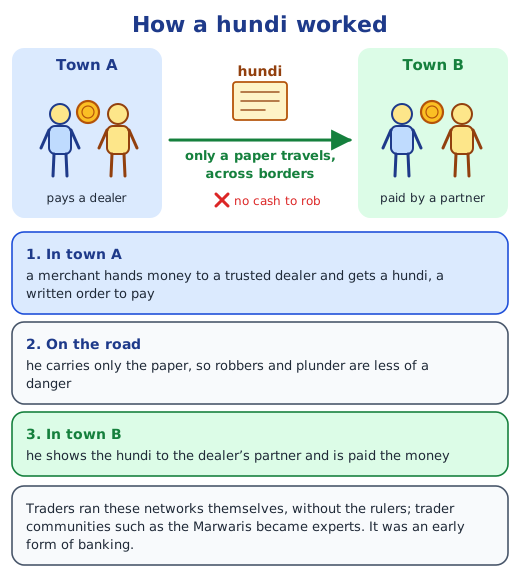
They used the hundi, a written order to pay money to a person. A merchant could pay a trusted dealer in one town and collect the money from a partner in another, carrying only the paper, even across borders. Traders such as the Marwaris ran these networks themselves, without the rulers. It was an early form of banking.
Many temples were economic centres too. Rulers gave them land and wealth (dāna), and temple managers used it to build tanks, irrigation works and rest houses for pilgrims, gave merchants credit and helped pay for trade, even overseas.
Was life good for ordinary people?
Not always. By the late 1600s, peasants kept only a small share of their crop after taxes and payments to middlemen, and many lost their land and became bonded labourers. Craftspeople and labourers also struggled, wealth stayed with rulers, courtiers, officials and merchants, and wars drove people from their homes. There were clashes over sacred places destroyed with rulers’ approval, but mostly people of different faiths lived peacefully side by side and depended on each other for their living.
Read on: the Delhi Sultanate, the Mughals and resistance to them, the chapter notes and the NCERT solutions.
Practice
-
Under Akbar, the minister in charge of military matters was the:
Show answer
Answer: (b) Mir Bakhshi
-
Land given to a mansabdar as pay was called a:
Show answer
Answer: (b) jagir
-
Who carried out land and crop surveys to set the revenue under Akbar?
Show answer
Answer: (b) Todar Mal
-
How did the hundi make trade safer?
Show answer
Answer: It was a written order to pay money, so a merchant could travel with a piece of paper instead of cash, which robbers and plunderers could not easily take.
-
Give two reasons why life was hard for many peasants in this period.
Show answer
Answer: Any two: land revenue took a fifth of the crop or more; officials and middlemen took further shares; famines struck; wars displaced people; and by the late 1600s many lost their land and became bonded labourers.
Questions students ask
What was the iqta system?
In the Delhi Sultanate, the sultan assigned areas called iqtas to nobles, the iqtadars. They collected taxes there, used part to meet their costs, mainly the army, and sent the rest to the sultan. The posts were not hereditary, which kept the iqtadars loyal to Delhi.
What was the mansabdari system?
It was Akbar’s system of ranks. Each officer, a mansabdar, held a rank and had to keep a set number of soldiers, horses, elephants and camels for the state. Mansabdars were usually paid with land revenue (jagirs), so they were also called jagirdars.
How was the Mughal Empire divided?
Akbar divided it into twelve provinces called subahs, each with its own ministers, and these were divided further. Officials checked each other’s work, and in villages the old ways of self-government carried on.
What was the economy like in the 13th to 17th centuries?
It rested on farming, with crafts such as textiles and a large trade through ports like Surat, Calicut and Hooghly. India sold far more than it bought and stayed one of the richest regions, but famines, heavy taxes and war made life hard for many.
Stuck on a question?
Take a photo and Lagnever AI explains it step by step. Try it for 7 days for ₹2.
Get it on Google Play Open in browser
For parents: after the trial, the plan renews monthly by UPI or card autopay. You can cancel anytime in the app.