
The Delhi Sultanate and the kingdoms that resisted it
Answer in short
The Delhi Sultanate took shape after Prithviraj Chauhan’s defeat in 1192 and was established in 1206. Five dynasties of Turkic–Afghan origin ruled it, from the Mamluks to the Lodis. It grew through war but was often unstable, and kingdoms such as the Eastern Gangas, the Hoysalas, Mewar and Vijayanagara resisted it.
Stuck on a question? Take a photo and Lagnever AI explains it step by step. Try it for 7 days for ₹2. Get it on Google Play
How did the Delhi Sultanate begin?
In 1192 Prithviraj Chauhan, who ruled parts of north-western India, was defeated, and in 1206 the Delhi Sultanate was established. A sultanate is a land under a sultan, a title used by some Muslim rulers. Delhi now became the centre of power in the north. In the early 13th century, work began on a mosque in what is now the Qutub Minar complex; an inscription there says it used material from 27 Hindu and Jain temples that had been destroyed.
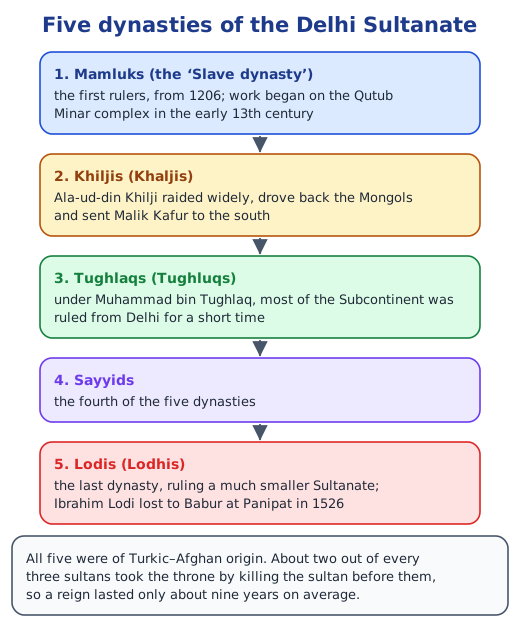
Five dynasties of Turkic–Afghan origin ruled the Sultanate in turn.
What did Ala-ud-din Khilji and Muhammad bin Tughlaq do?
Around 1300, Ala-ud-din Khilji led campaigns across north and central India and plundered many cities. He also drove back several Mongol invasions; the Mongol Empire then covered most of Asia. On his coins he called himself the ‘second Alexander’. His general Malik Kafur, once a slave, marched south, conquered kingdoms on the way and attacked temple towns such as Srirangam, Madurai and Chidambaram. The wealth taken paid for the Sultanate’s huge army.
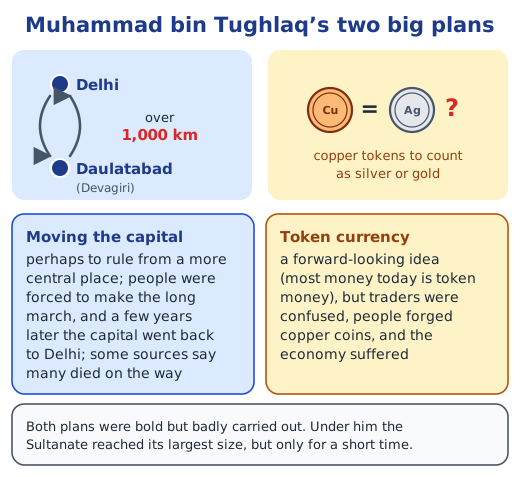
A few decades later, Muhammad bin Tughlaq expanded the Sultanate until most of the Subcontinent was under one ruler, for the first time since the Mauryas, though only briefly. His plans were bold but badly carried out. He shifted the capital south to Daulatabad (known then as Devagiri), perhaps to rule from a more central place, and forced people to travel more than 1,000 km; a few years later he moved it back. He also declared cheap copper coins to be worth silver or gold. Most money today works this way, but then it confused traders, led to forged coins and weakened the economy.
Why was the Sultanate so unstable?
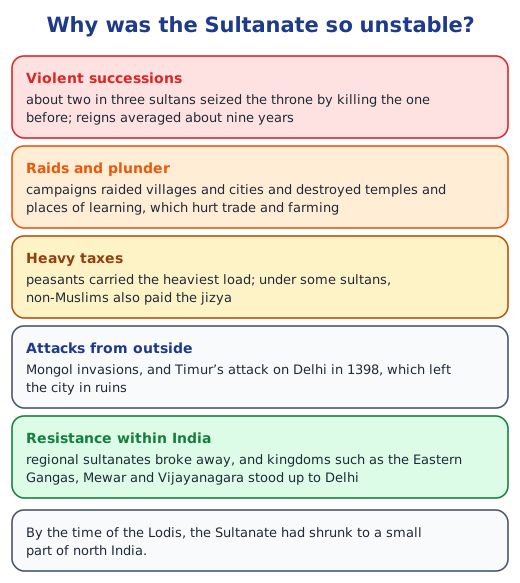
Changes of ruler were often violent: about two out of every three sultans took the throne by killing the one before, so a reign lasted only about nine years on average. The sultans and their court lived in luxury, paid for by plunder, by taxes on ordinary people and conquered lands, and by the trade in enslaved people. Plunder in turn disrupted trade and farming. Sacred images in Buddhist, Jain and Hindu temples were attacked, for loot and out of iconoclasm, the belief that such images should be destroyed. Some sultans imposed the jizya, a tax on non-Muslims; the chapter explains that in practice it could be a heavy and humiliating burden that pushed people to convert.
At the end of the 14th century, in 1398, Timur, a Turkic–Mongol conqueror from Central Asia, attacked Delhi. Huge numbers of people were killed or enslaved, and he left the city in ruins. By the time the Lodis, the last dynasty, came to power, the Sultanate had shrunk to a small part of the north.
Who resisted the Delhi Sultanate?
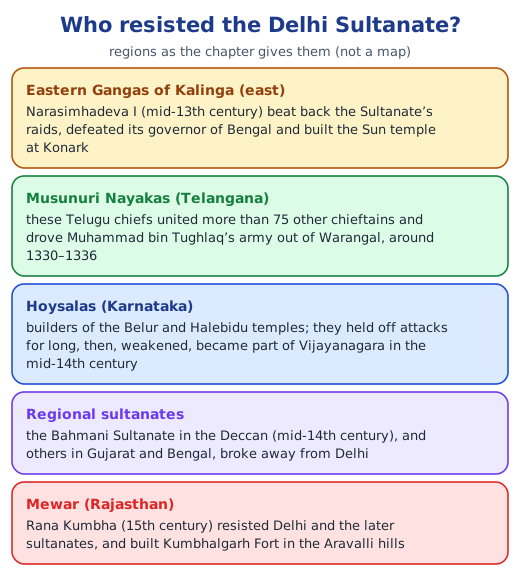
The Eastern Gangas of Kalinga, covering today’s Odisha with parts of Andhra Pradesh and Bengal, were never conquered. Their king Narasimhadeva I beat back the Sultanate’s raids in the mid-13th century and built the Sun temple at Konark, partly to mark his victories. Around 1330–1336, the Musunuri Nayakas, Telugu chiefs, united more than 75 other chieftains and drove Muhammad bin Tughlaq’s army out of Warangal. The Hoysalas of present-day Karnataka, famous for the temples of Belur and Halebidu, held off several attacks; weakened, they became part of Vijayanagara in the mid-14th century. Regional sultanates, such as the Bahmani Sultanate in the Deccan and others in Gujarat and Bengal, broke away from Delhi. In the 15th century, Rana Kumbha of Mewar resisted Delhi and these later sultanates, and built the mighty Kumbhalgarh Fort in the Aravalli hills.
How did the Vijayanagara Empire rise and fall?
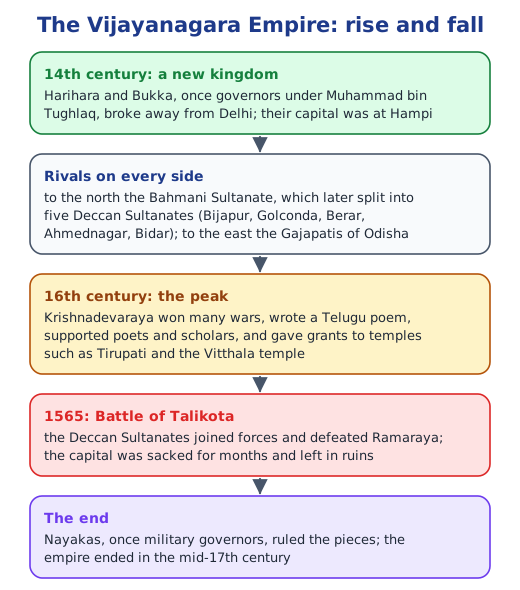
In the 14th century, the brothers Harihara and Bukka, once governors under Muhammad bin Tughlaq, rejected Delhi’s rule. A popular story says their guru Vidyaranya told them to build their capital at Hampi, where they had seen a hare turn and chase a pack of hounds. Their kingdom grew into the Vijayanagara Empire. It fought the Bahmani Sultanate, which later split into five Deccan Sultanates, and the Gajapati kings of Odisha.
Under Krishnadevaraya, in the 16th century, the empire was at its height. He supported poets in Sanskrit, Telugu and Kannada, wrote a Telugu poem on the poet-saint Āṇḍāl, and gave grants to temples such as Tirupati and the Vitthala temple. Portuguese traders, who sold him horses, were welcomed. He died in 1529. In 1565 the Deccan Sultanates joined forces and defeated the Vijayanagara army at the Battle of Talikota; the capital was sacked for months and left in ruins.
Read on: the Mughals and resistance to them, administration and people’s lives, the chapter notes and the NCERT solutions.
Practice
-
Which was the last dynasty of the Delhi Sultanate?
Show answer
Answer: (d) Lodis
-
The Sun temple at Konark was built by:
Show answer
Answer: (b) Narasimhadeva I
-
The Vijayanagara Empire was founded by:
Show answer
Answer: (a) Harihara and Bukka
-
Why did Muhammad bin Tughlaq’s token currency fail?
Show answer
Answer: Copper coins were declared to be worth as much as silver or gold, but traders were confused and people began forging copper coins, so trade suffered and the economy declined.
-
Name two kingdoms that resisted the Delhi Sultanate and say how.
Show answer
Answer: Any two: the Eastern Gangas, whose king Narasimhadeva I beat back raids; the Musunuri Nayakas, who drove the Sultanate’s army out of Warangal; the Hoysalas, who held off attacks; Mewar, where Rana Kumbha held his ground.
Questions students ask
What was the Delhi Sultanate?
It was the state ruled by sultans from Delhi, from 1206 until Babur defeated Ibrahim Lodi in 1526. A sultanate is a land ruled by a sultan, a title some Muslim rulers took. Five dynasties of Turkic–Afghan origin ruled it in turn.
What are the five dynasties of the Delhi Sultanate?
First the Mamluks, known as the ‘Slave dynasty’, then the Khiljis (Khaljis), Tughlaqs and Sayyids, and last of all the Lodis.
Why was the Delhi Sultanate unstable?
Successions were often violent, so reigns were short; campaigns of plunder hurt farming and trade; peasants were heavily taxed; the Mongols and later Timur attacked; and regional kingdoms and sultanates kept resisting or breaking away.
Who founded the Vijayanagara Empire?
The brothers Harihara and Bukka, in the 14th century. They had served as governors under Muhammad bin Tughlaq before breaking away from Delhi, and built their capital at Hampi, in present-day Karnataka.
Stuck on a question?
Take a photo and Lagnever AI explains it step by step. Try it for 7 days for ₹2.
Get it on Google Play Open in browser
For parents: after the trial, the plan renews monthly by UPI or card autopay. You can cancel anytime in the app.