
Class 8 Social Science Part 2 Chapter 8: Cultural Currents: 13th to 17th Centuries Notes
This chapter in five lines
Cultural Currents shows how Indian culture stayed alive and grew richer from the 13th to the 17th centuries, despite invasions and unstable politics. Bhakti and Sufi saints spread devotion through song; music, painting, gardens and buildings mixed old and new styles; learning, science and regional languages kept growing; and food, clothes and words blended Indian and Persian ways.
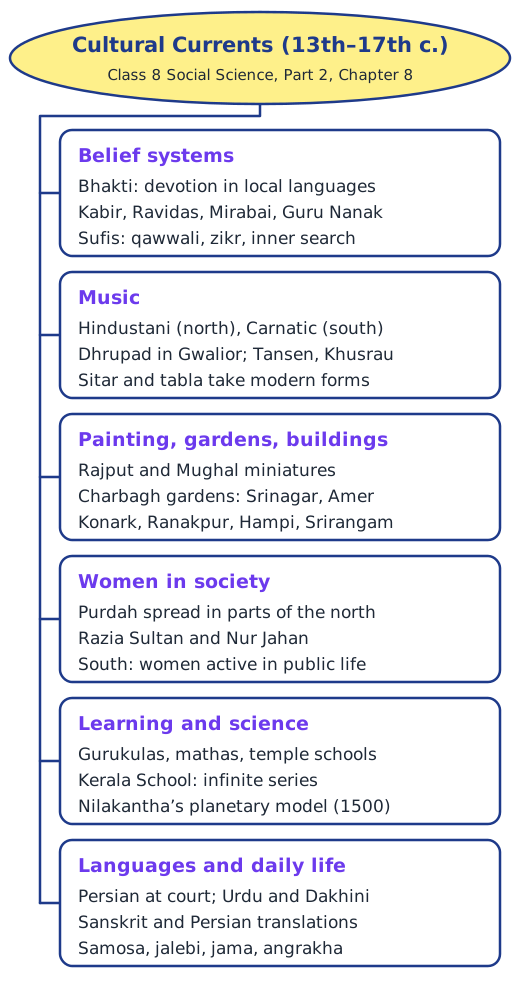
What is this chapter about?
The chapter opens with a thought from Mahatma Gandhi: he wants the cultures of every land to blow freely through his house, but he will not let any of them sweep him off his feet. Its Big Questions ask how Indian culture lasted and grew richer between the 13th and 17th centuries despite invasions and unsettled politics, what the main cultural trends were, and how they met and mixed. The chapter belongs to the theme Our Cultural Heritage and Knowledge Traditions; the book places it at the end of Part 2 and says it is meant to move to the Part 1 book in future.
Culture is the shared way of life of a group, handed down the generations: its values, customs and traditions, and its art, music, literature, philosophy and science. Many old civilisations, such as Egypt, Mesopotamia, Greece and Rome, faded or were destroyed, but India’s culture is still alive. Over the centuries, merchants, scholars, envoys and refugees came from lands such as Greece, Persia, and Central and East Asia, like the Greek scholar Megasthenes in the 4th century BCE, and they brought their own food, dress, languages and beliefs. From the early 13th century, rulers with new political ideas, styles of art and building, and religious beliefs governed large parts of India.
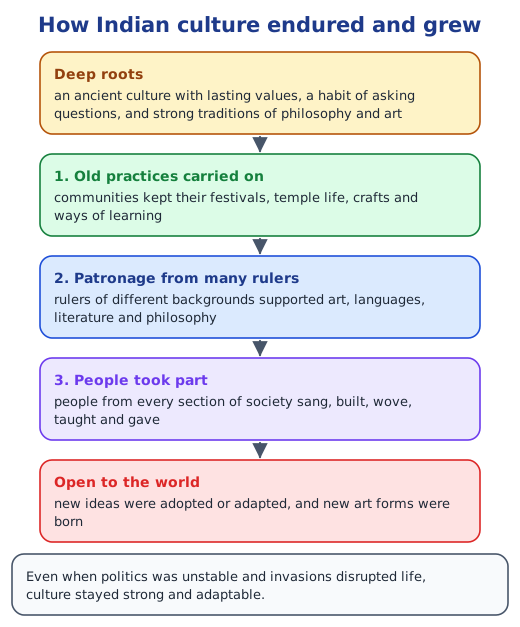
How did Indian culture endure?
The chapter finds three patterns running through these turbulent centuries. Traditional practices carried on in communities; rulers of many backgrounds supported art, languages, literature and philosophy; and people from every section of society took part. Indian culture also adopted or adapted ideas from outside. Where Muslim rulers were patrons, Persian and Arabic influences entered local culture and often produced new art forms.
What happened to belief systems?
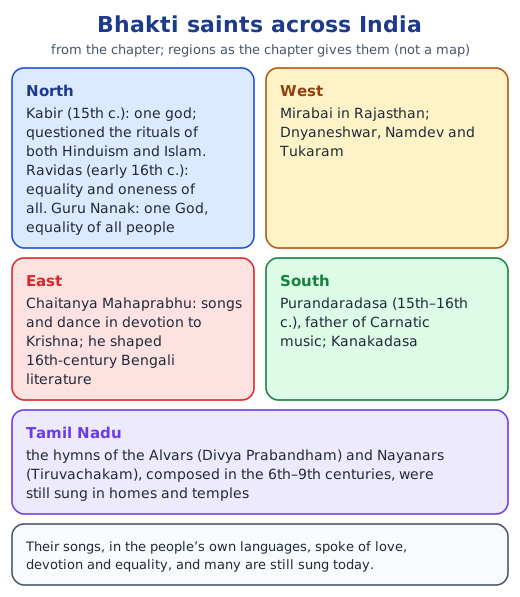
The faith of many invaders, Islam, with one god and one prophet, was very different from India’s religions, with their many schools of thought and no one sacred book. Some invaders looted and destroyed ancient temples and sacred sites. Yet the faiths native to India survived, and Islam is also practised in India today along with other religions. The bhakti tradition, the path of devotion to god that needs no rituals or priests, grew popular again. Saints such as Kabir, Ravidas, Guru Nanak, Mirabai, Chaitanya Mahaprabhu, Tukaram and Purandaradasa sang of love, equality and one god in the people’s own languages. Sufis, who follow a devotional path within Islam, sang qawwalis, and the two traditions often overlapped. Read bhakti and belief systems.
How did music and painting change?
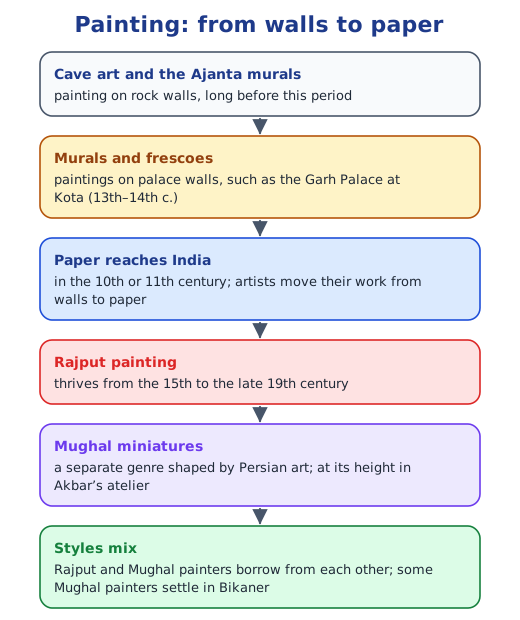
Indian classical music developed along two related lines: the Hindustani stream of the north and the Carnatic stream of the south. In Gwalior, Raja Mansingh Tomar raised the ancient dhrupad style to new heights in the late 15th century, and the singer Tansen later joined Akbar’s court as one of its nine ratnas. The Sufi poet Amir Khusrau is credited with developing the qawwali, while Carnatic music, which Purandaradasa did much to shape, grew largely untouched by Persian and Arabic influence. The modern sitar and tabla also took shape. In painting, artists moved from walls to paper once paper arrived in India, around the 10th or 11th century. Rajput painting, with Hindu themes, and Mughal miniatures, with court scenes and portraits, borrowed from each other. Read art, literature and science.
Gardens and buildings
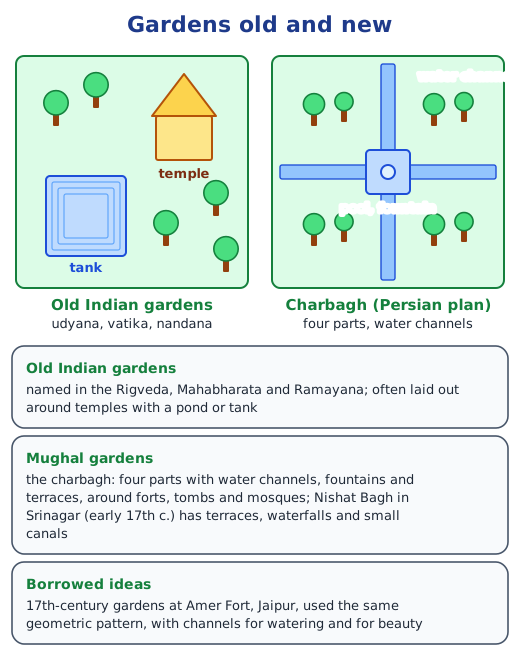
Gardens called udyana, vatika and nandana are named in the Rigveda and the epics, often laid out around temples with a pond or tank. The Mughals brought the Persian charbagh, a garden in four parts divided by water channels, with fountains and terraces, as at Nishat Bagh in Srinagar; 17th-century gardens at Amer Fort borrowed its geometric plan. Temple building went on too: the Surya Mandir at Konark with its carved stone wheels (13th century), the Jain temple at Ranakpur (15th century) and the temples of Hampi under Krishnadevaraya. The Sri Ranganathaswamy temple at Srirangam, damaged in the early 14th century, was rebuilt within that century. There is more in A Journey Through Indian Architecture.
How did women’s lives differ across regions?
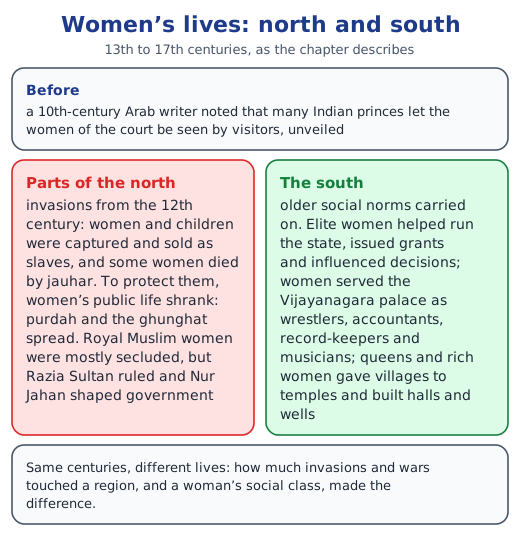
A 10th-century Arab writer noticed that many Indian princes let the women of their court be seen without a veil. Invasions from the 12th century changed this in parts of the north: women and children were captured and sold as slaves, and to protect women, their public life shrank and purdah and the ghunghat spread. Even so, Razia Sultan ruled the Delhi Sultanate in the 13th century, and Nur Jahan took an active part in Mughal government in the 17th. In the south, older norms carried on: elite women took part in administration, gave grants and endowed temples, and women worked in the Vijayanagara palace as accountants, record-keepers, wrestlers and musicians. Read women, education and daily life.
How did learning continue?
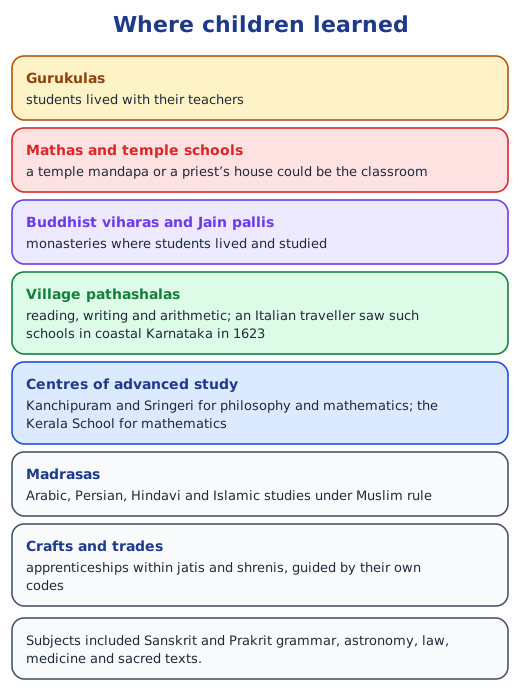
Students learned in gurukulas, mathas, temple schools, Buddhist viharas and Jain pallis, and villages had pathashalas. Kanchipuram and Sringeri were centres of philosophy and mathematics, and madrasas taught Arabic, Persian, Hindavi and Islamic studies. Craft skills passed down through jatis and shrenis by apprenticeship. The destruction of the great universities of Nalanda and Vikramashila in the late 12th century was a huge loss, but these smaller, spread-out systems survived. Weavers show how skills travelled: Gujarati weavers moved to Banaras with Akbar’s encouragement, and Mughal zari and brocade became part of the Banarasi sari.
Languages, literature and science
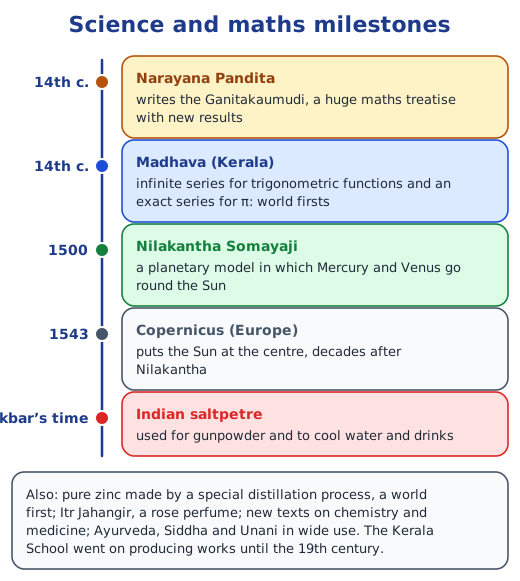
Literature flourished in Bengali, Hindavi, Kannada, Marathi, Odia, Sanskrit, Tamil, Telugu and other languages. Persian became the language of the Mughal court, and texts moved both ways: Bhaskaracharya’s Lilavati and 52 Upanishads were translated into Persian, and the Mahabharata into Persian and Bengali. Urdu grew in the Ganga-Yamuna plains from Hindavi with Arabic and Persian words. In science, Narayana Pandita wrote the Ganitakaumudi in the 14th century, Madhava of Kerala found infinite series for trigonometric functions and π, and in 1500 Nilakantha Somayaji described Mercury and Venus going round the Sun, decades before Copernicus. Pure zinc was made by a new distillation process, saltpetre cooled water in Akbar’s time, and Ayurveda, Siddha and Unani were widely practised.
Food and clothes
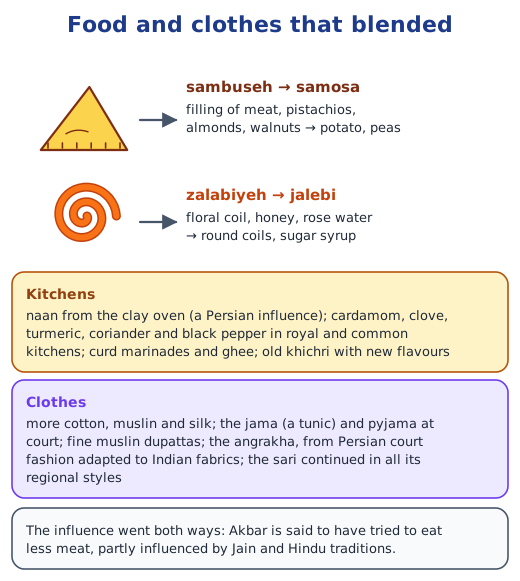
Cuisines influenced each other. Spices such as cardamom, clove and black pepper spread from royal kitchens to ordinary homes, naan from the clay oven reflects Persian influence, and the Persian sambuseh and zalabiyeh became the Indian samosa and jalebi. At court, people wore the jama and pyjama, and the angrakha grew out of Persian court fashion, while the sari continued in its many regional styles.
Before we move on
Across these centuries, Indian culture kept its roots while taking in new ideas. Bhakti and Sufi saints brought people together through song; music, painting, gardens and buildings blended styles; destroyed temples were rebuilt; learning survived the loss of great universities; and mathematics made some world firsts. Answers to every question are in the NCERT solutions for Part 2 Chapter 8.
Key terms
| Term | Meaning |
|---|---|
| Culture | The shared way of life of a group, handed down the generations: its values, customs, art, music, literature, philosophy and science. |
| Bhakti marga | The path of devotion: one of several paths to moksha, open to all, which needs no rituals or priests. |
| Moksha | Realising the Truth, or being released from the endless cycle of birth and death. |
| Sufism | A path within Islam centred on devotion and an inner, personal search for god. |
| Qawwali | A Sufi devotional song that blends Indian, Persian and Arabic styles of singing. |
| Zikr | Remembering god by repeating divine names, aloud or silently. |
| Dhrupad | A very old style of Indian classical singing (dhruva, fixed; pada, verse), raised to new heights in Gwalior in the late 15th century. |
| Pattachitra | A painting on cloth (patta, cloth; chitra, picture) that travelling bards used to tell stories from the epics and Puranas. |
| Miniature painting | A small, finely detailed painting on paper, often in a book; the Rajput and Mughal styles flourished in this period. |
| Charbagh | A Persian garden plan of four parts divided by water channels, used in Mughal gardens. |
| Purdah | A Persian word for curtain or veil; the custom of keeping women veiled or out of public view. |
| Hindavi | An early form of Hindi-Urdu with the grammar and words of Indian languages, along with some Persian and Arabic words. |
| Brocade | A heavy, rich cloth with a raised woven design, often using gold or silver thread. |
| Geographical Indication (GI) tag | A label that lets only products from a certain area use a name, such as Banarasi saris. |
| Purvamaryade | A Kannada word for following earlier established practices of dharma and social norms, which guided Vijayanagara’s rulers. |
Topics in this chapter
Practice
-
Which saint, thought to have been raised by a weaver couple, sang of one god?
Show answer
Answer: (b) Kabir
-
Who is called the father of Carnatic music?
Show answer
Answer: (c) Purandaradasa
-
A charbagh garden is divided into:
Show answer
Answer: (c) four parts
-
Who was the first and only woman ruler of the Delhi Sultanate?
Show answer
Answer: (b) Razia Sultan
-
Which language grew from Hindavi with Arabic and Persian words?
Show answer
Answer: (a) Urdu
-
Nilakantha Somayaji worked out his planetary model in about:
Show answer
Answer: (b) 1500
Questions students ask
What are the main topics of Class 8 Social Science Part 2 Chapter 8?
How Indian culture endured from the 13th to the 17th centuries: the bhakti and Sufi traditions; music, painting, gardens and buildings; the changing lives of women; schools and crafts; literature, translations and the growth of Urdu; science and mathematics; and the blending of food and clothing.
Is Cultural Currents in the new NCERT Class 8 Social Science book?
Yes. It is Chapter 8 of Exploring Society: India and Beyond, Grade 8 Part 2, on pages 215 to 249, in the theme Our Cultural Heritage and Knowledge Traditions. The book’s note to students says it sits at the end of Part 2 but is meant to move to the Part 1 book in future.
Why is science part of a chapter on culture?
Because asking questions, experimenting and learning have long been part of Indian culture. The chapter shows that mathematics, astronomy, chemistry and medicine kept advancing in this period, often with support from regional courts and temple institutions.
What does the title Cultural Currents mean?
Like currents in a river, many cultural streams flowed, met and mixed in these centuries. Old Indian traditions carried on, while Persian and Arabic influences arrived, blended in and helped create new art forms.
Stuck on a question?
Take a photo and Lagnever AI explains it step by step. Try it for 7 days for ₹2.
Get it on Google Play Open in browser
For parents: after the trial, the plan renews monthly by UPI or card autopay. You can cancel anytime in the app.