
What were the bhakti and Sufi traditions?
Answer in short
Between the 13th and 17th centuries, bhakti, the path of devotion that needs no rituals or priests, became popular again. Saints such as Kabir, Ravidas, Guru Nanak, Mirabai and Chaitanya sang of one god and equality in local languages. Sufism, a devotional path within Islam, also used music, and the two traditions often met and overlapped.
Stuck on a question? Take a photo and Lagnever AI explains it step by step. Try it for 7 days for ₹2. Get it on Google Play
Why were belief systems tested in this period?
From the 13th century, rulers whose faith was very different from the local religions controlled large parts of India. Islam teaches belief in one god and one prophet, while India’s religions had many schools of thought and no one sacred book. Some invaders looted and destroyed ancient temples and sacred sites. For a time it may have seemed that the local faiths would be crushed, as had happened elsewhere in the world. Instead, the faiths native to India survived, and Islam too is practised in India today, side by side with other religions. How did so many different groups learn to live together? A large part of the answer lies in devotion, song and the people themselves.
What is the bhakti marga?
Long before these invasions, stories from the Puranas and the two epics lived on in poems and plays, puppet shows, paintings, dance and sculpture, and in people’s temple visits and festivals. Bhakti marga, the path of devotion, was accepted as one of several paths to moksha, which means realising the Truth, or being released from the endless cycle of birth and death. It needed no rituals and no priests. The tradition had taken shape by the 6th century, as you saw with the Tamil Alvars and Nayanars in Grade 7. In these troubled centuries it became popular again: people turned to it for inner strength, and saints composed verses in local languages about love, compassion and equality.
Who were the bhakti saints?
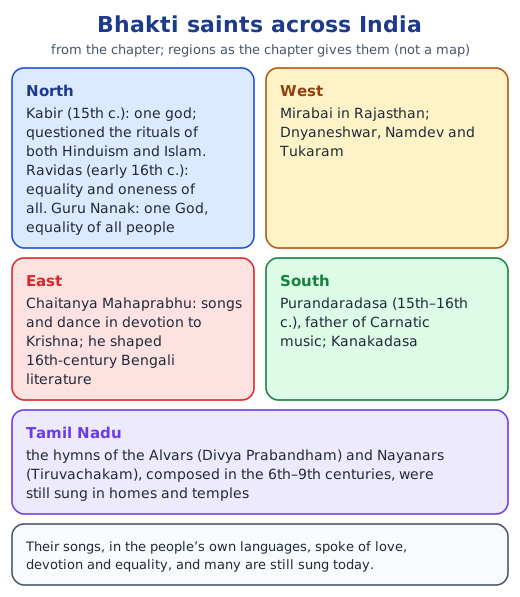
In north India, Kabir lived in the 15th century in what is now Uttar Pradesh; he is thought to have been raised by weavers. He sang of one god and criticised the rituals of both Hinduism and Islam, and his verses became very popular. Ravidas, born in the early 16th century into a family of leather-workers, wrote poems about equality and the oneness of all, challenging the rigid walls around varna and jati. Guru Nanak travelled widely, teaching that there is one God and that all people are equal; his teachings, with hymns by several Hindu saints, are kept in the Guru Granth Sahib, the holy book of the Sikhs.
Others carried the same tradition across India. In the west there were Tukaram, Dnyaneshwar and Namdev, and Mirabai in Rajasthan; in the east, Chaitanya Mahaprabhu; and in the south, Purandaradasa and Kanakadasa. Purandaradasa, called the father of Carnatic music, is said to have given up a diamond business to become a devotee of Krishna, and he later joined the court of Krishnadevaraya.
What did Kabir mean by wheat and flour?
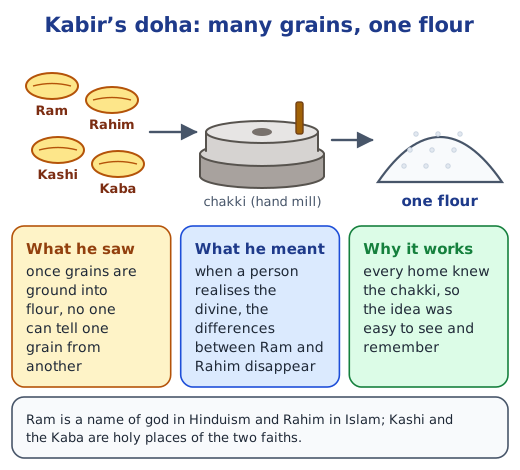
In one doha, Kabir notices that once grains of wheat are ground, the flour shows no trace of separate grains. In the same way, he says, when a person realises the divine, the difference between Ram and Rahim, names of god in Hinduism and Islam, melts away. Then he can sit down peacefully to eat. By using the chakki, something every family knew, he made a deep idea easy to see.
Why did music and dance matter?
Bhakti was sung, not just read. People of every section of society gathered to sing bhajans with musical instruments and dancing. Some bhajans stressed that god is one, an idea discussed in the Upanishads and close to the Islamic idea of one god; others simply drew people together. Some paintings of the saints were made almost two centuries after they lived, which shows how long their influence lasted, and their bhajans are still sung today.
What is Sufism?
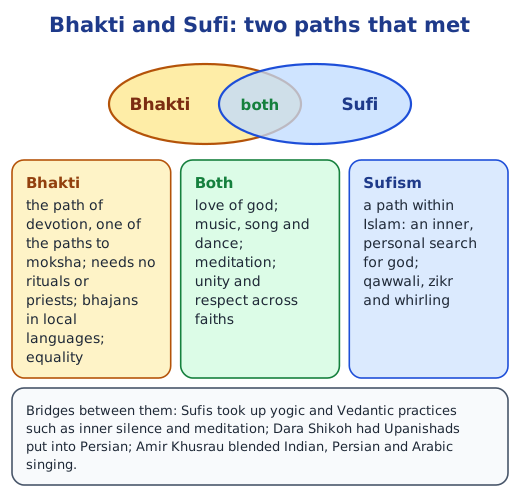
Sufism is a path within Islam centred on devotion and a personal, inner search for god. Sufi saints such as Khwaja Moinuddin Chishti and Nizamuddin Auliya saw music as a way to come closer to god. They sang qawwalis, devotional songs that mixed local classical music with their own styles and spoke of love, faith and unity. Sufis also practised zikr, remembering god by repeating divine names aloud or silently, and in some Sufi orders whirling is a form of meditation that takes great practice. They took up yogic and Vedantic practices too, such as inner silence, giving up worldly desires, and meditation.
How did bhakti and Sufi ideas meet?
The two traditions often overlapped, and poets mixed ideas from different faiths, filling Indian literature with songs of unity and devotion. In the 17th century, Dara Shikoh, Aurangzeb’s elder brother, saw Vedanta and Sufism as two roads to the same truth, and had some Upanishads translated into Persian. A painting in the chapter even shows Guru Gobind Singh greeting a Sufi saint.
How did the Tamil hymns live on?
In Tamil Nadu, the Divya Prabandham of the Alvars, in praise of Vishnu, and the Tiruvachakam of the Nayanars, in praise of Shiva, composed between the 6th and 9th centuries, were still recited in homes and temples. Through long periods of political turmoil, such traditions stayed alive while making room for new ideas. Royal support helped, but it was ordinary people who kept them thriving.
Read on: art, literature and science, women, education and daily life, the chapter notes and the NCERT solutions.
Practice
-
Ravidas was born into a family of:
Show answer
Answer: (b) leather-workers
-
The Guru Granth Sahib preserves the teachings of Guru Nanak along with:
Show answer
Answer: (a) the hymns of several Hindu saints
-
Zikr means:
Show answer
Answer: (b) remembering god by repeating divine names
-
Why did bhakti songs reach so many people?
Show answer
Answer: They were in local languages, set to music and dance, and open to everyone without rituals or priests, so people of every section of society could join in.
-
Name two Sufi saints from the chapter.
Show answer
Answer: Khwaja Moinuddin Chishti and Nizamuddin Auliya, who both saw music as a way to come closer to god.
Questions students ask
What is the bhakti movement in Class 8?
In this chapter, bhakti is the path of devotion to god, one of several paths to moksha, which needs no rituals or priests. From the 13th to the 17th centuries, saints across India spread it through songs in local languages about love, equality and one god.
What was Kabir’s main message?
Kabir taught that there is one god and criticised the rituals of both Hinduism and Islam. In one doha he says that, just as ground grains become one flour, the difference between Ram and Rahim disappears once a person realises the divine.
What is the difference between bhakti and Sufism?
Bhakti grew within Indian traditions as a path to moksha, while Sufism is a devotional path within Islam. Both stressed love of god, music and unity, so they often overlapped and influenced each other.
Who was Dara Shikoh?
Aurangzeb’s elder brother, a 17th-century scholar who supported harmony between Hindus and Muslims. The chapter credits him with translating 52 Upanishads into Persian, helped by scholars in Varanasi. Aurangzeb later captured him, accused him of heresy and had him executed.
Stuck on a question?
Take a photo and Lagnever AI explains it step by step. Try it for 7 days for ₹2.
Get it on Google Play Open in browser
For parents: after the trial, the plan renews monthly by UPI or card autopay. You can cancel anytime in the app.