
How did art, literature and science grow from the 13th to 17th centuries?
Answer in short
Between the 13th and 17th centuries, Hindustani and Carnatic music grew as two streams, and Rajput and Mughal painters learned from each other. Mughal charbagh gardens and grand temples were built. Regional languages flourished, Urdu took shape, and texts were translated between Sanskrit and Persian, while Kerala mathematicians discovered infinite series.
Stuck on a question? Take a photo and Lagnever AI explains it step by step. Try it for 7 days for ₹2. Get it on Google Play
How did Indian music change?
Music and dance-drama were part of Indian life from ancient times, with many local forms. The Natyashastra brought dance, drama, music, mathematics and aesthetics together, yet left room for regional streams. Stories were told with song and dance: with puppets in Rajasthan, and with pattachitra, painted cloth showing scenes from the Ramayana, Mahabharata and Puranas, in Odisha, West Bengal and Andhra Pradesh.
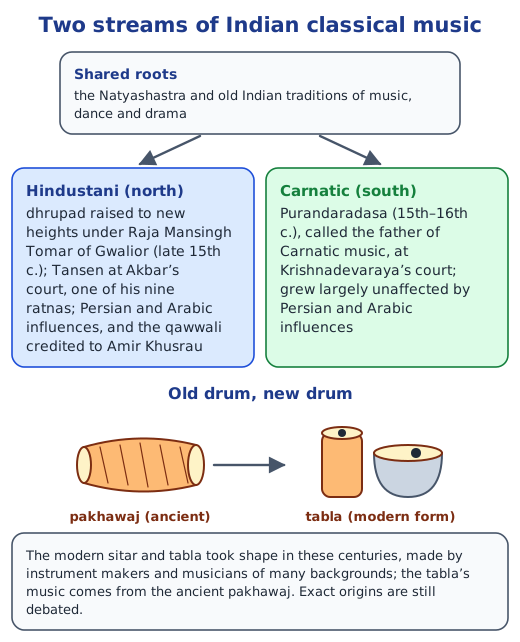
Classical music grew in two related streams. In the Hindustani stream of the north, Raja Mansingh Tomar of Gwalior, himself a composer, raised the ancient dhrupad style to new heights in the late 15th century. Tansen (Ramtanu Pandey) joined Akbar’s court and became one of its nine ratnas; he is said to have been influenced by a Sufi saint, yet he kept composing in praise of Krishna and Shiva. The Sufi poet-singer Amir Khusrau is credited with developing the qawwali. The Carnatic stream of the south, shaped by Purandaradasa, grew largely untouched by Persian and Arabic influences. The modern sitar and tabla took shape too, though their exact origins are debated; the tabla’s music comes from the ancient pakhawaj.
How did painting move from walls to paper?
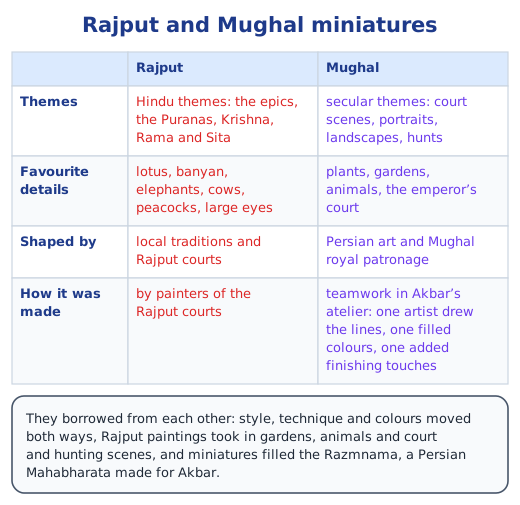
Painting in India runs from cave art and the Ajanta murals to palace frescoes. Once paper arrived in India, around the 10th or 11th century, artists began to paint on it. Rajput painting, which thrived from the 15th to the late 19th century, showed Hindu themes and loved lotuses, banyan trees, elephants, cows and peacocks; Abul Fazl, writing in the Ain-i-Akbari, praised Hindu painters very highly. Mughal miniatures, shaped by Persian art, showed court scenes, portraits and landscapes. In Akbar’s atelier (studio), painters worked as a team: one drew the outlines, one coloured and one finished. The two styles borrowed from each other, and some Mughal painters settled in Bikaner.
What is a charbagh garden?
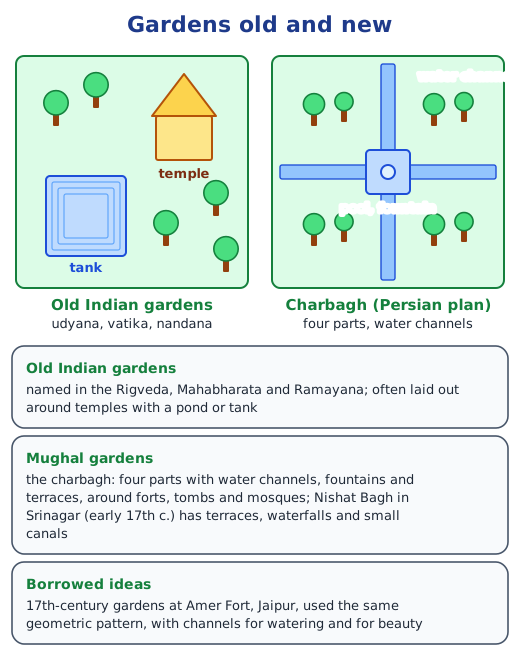
Old texts such as the Rigveda, Mahabharata and Ramayana mention gardens called udyana, vatika and nandana, often around temples with a pond or tank. The Mughals brought the Persian charbagh: a garden in four parts, with water channels standing for the rivers of Paradise in the Quran, plus fountains and terraces. Nishat Bagh in Srinagar, from the early 17th century, has terraces, waterfalls and small canals, and gardens at Amer Fort borrowed the same geometry. The book also names the Mughal Gardens at Rashtrapati Bhavan (Extra: renamed Amrit Udyan in 2023).
Which buildings stand out?
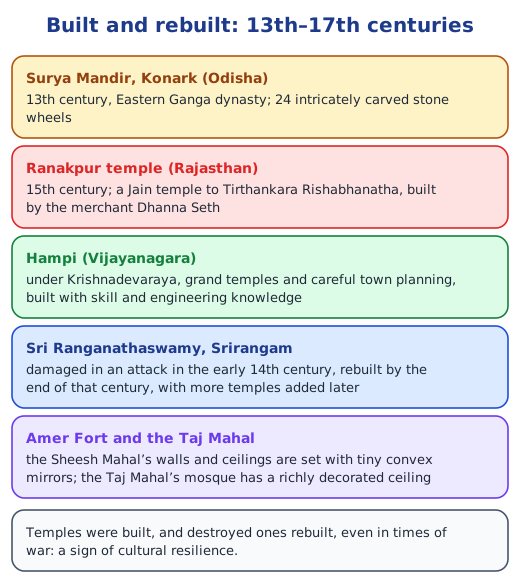
Kings, queens and nobles paid for grand buildings. The 13th-century Surya Mandir at Konark has 24 carved stone wheels; the 15th-century Jain temple at Ranakpur was built by a merchant, Dhanna Seth; and Hampi under Krishnadevaraya was a centre of town planning and temple building. The Sri Ranganathaswamy temple at Srirangam, damaged in the early 14th century, was rebuilt by the end of that century.
How did languages and literature grow?
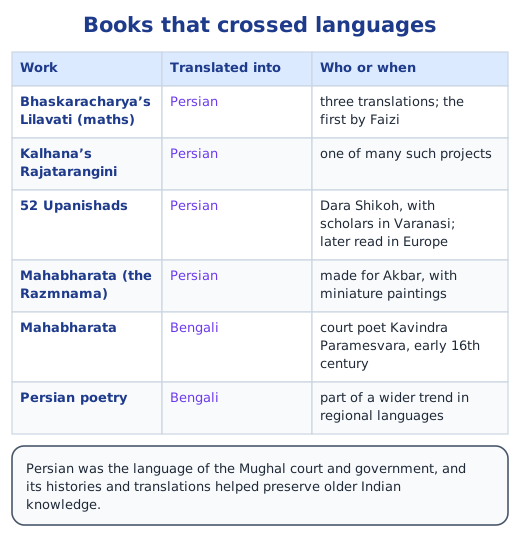
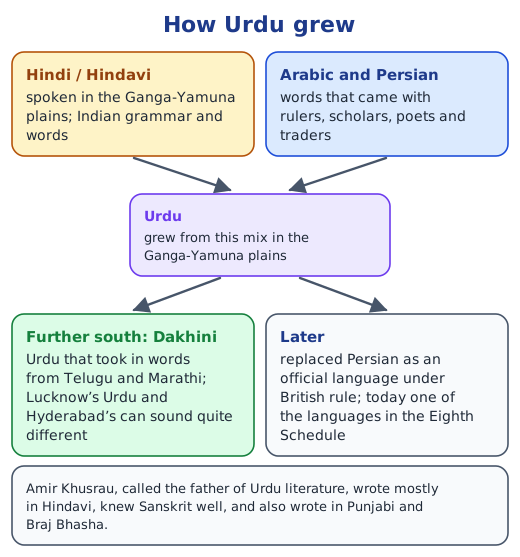
Bengali, Hindavi, Kannada, Marathi, Odia, Sanskrit, Tamil and Telugu all thrived, in daily speech and in poetry. Chaitanya Mahaprabhu inspired Bengali biographies and Dhamali, a new style of folk song about Krishna, and Kavindra Paramesvara translated the Mahabharata into Bengali. Krishnadevaraya and the Gajapati kings of Odisha supported poets, and Tirumalamba, at the court of Achyutadevaraya, wrote a Sanskrit kavya. Persian, the Mughal court language, lent many words to regional languages, and books crossed languages: Bhaskaracharya’s Lilavati was put into Persian three times, the first by Faizi. Urdu grew in the Ganga-Yamuna plains from Hindavi with Arabic and Persian words, and further south it became Dakhini. Amir Khusrau is called the father of Urdu literature.
What did scientists and mathematicians achieve?
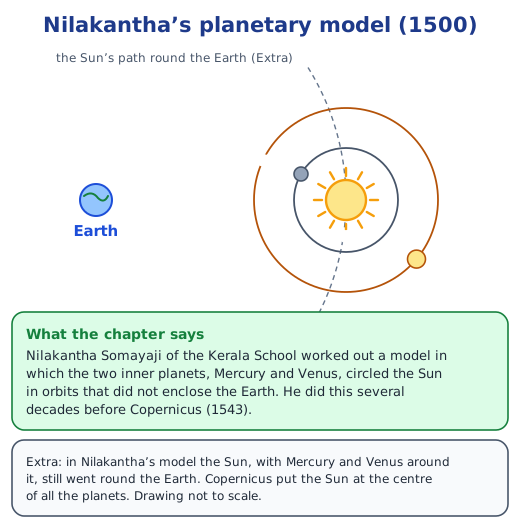
Asking questions and experimenting were long part of Indian culture. In the 14th century, Narayana Pandita wrote the Ganitakaumudi, a huge maths treatise, and Madhava in the south found infinite series for trigonometric functions and π, both world firsts. In 1500, Nilakantha Somayaji of the Kerala School described Mercury and Venus going round the Sun, decades before Copernicus (1543). Pure zinc was made by a special distillation process for the first time in the world, saltpetre cooled drinks in Akbar’s time, and Ayurveda, Siddha and Unani were widely practised.
Read on: bhakti and belief systems, women, education and daily life, the chapter notes and the NCERT solutions.
Practice
-
Who raised dhrupad to new heights in the late 15th century?
Show answer
Answer: (b) Raja Mansingh Tomar of Gwalior
-
The Razmnama is a Persian translation of:
Show answer
Answer: (b) the Mahabharata
-
Dakhini is a form of Urdu that took in words from:
Show answer
Answer: (a) Telugu and Marathi
-
How did artists in Akbar’s atelier share the work on one painting?
Show answer
Answer: One artist drew the outlines, another filled in the colours, and a third added the finishing touches.
-
Give two uses of Indian saltpetre in Akbar’s time.
Show answer
Answer: It was used to make gunpowder, and to cool water and other drinks.
Questions students ask
What are the two streams of Indian classical music?
Hindustani music, which grew in the north, and Carnatic music, which grew in the south. Hindustani music took in Persian and Arabic influences, while Carnatic music grew largely untouched by them.
What is a charbagh garden?
A Persian garden plan in four parts, divided by water channels that stand for the rivers of Paradise in the Quran, with fountains and terraces. The Mughals built such gardens around forts, tombs and mosques, such as Nishat Bagh in Srinagar.
Who is called the father of Urdu literature?
Amir Khusrau, a Sufi poet and singer of the 13th and 14th centuries. He wrote mostly in Hindavi, knew Sanskrit well, and also wrote in Punjabi and Braj Bhasha.
What did the Kerala School of mathematics discover?
Madhava, in the 14th century, found infinite series for trigonometric functions and a series giving the exact value of π, both world firsts. The school went on producing important works until the 19th century.
Stuck on a question?
Take a photo and Lagnever AI explains it step by step. Try it for 7 days for ₹2.
Get it on Google Play Open in browser
For parents: after the trial, the plan renews monthly by UPI or card autopay. You can cancel anytime in the app.