
NCERT Solutions Class 8 Social Science Part 2 Chapter 8: Cultural Currents: 13th to 17th Centuries
Answers to the Big Questions, every Let’s Explore, Think About It and Let’s Remember box, and all nine Questions and activities in Chapter 8, Cultural Currents: 13th to 17th Centuries, of Exploring Society: India and Beyond, Grade 8 Part 2. Page numbers follow the book (pages 215–249). Short notes: Part 2 Chapter 8 notes.
The Big Questions (page 215)
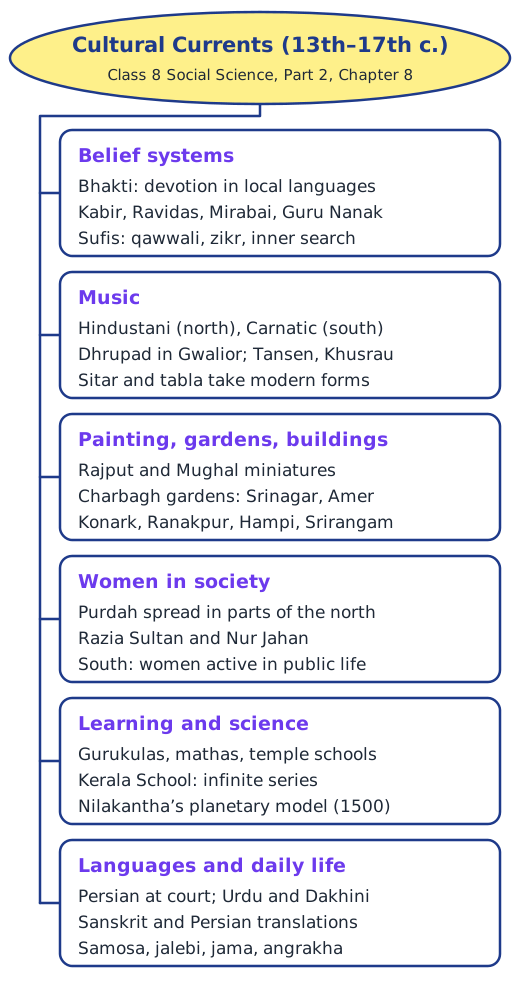
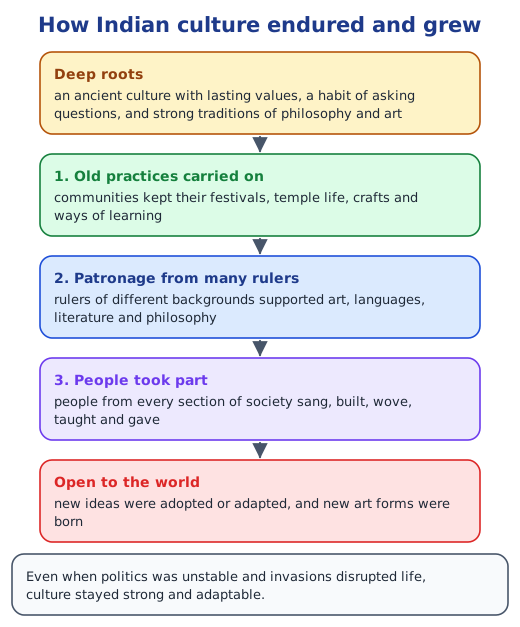
1. How did Indian culture last, and keep growing richer, despite invasions and unstable politics? Its roots were deep: lasting values, a habit of enquiry and strong traditions of philosophy and art. Three patterns helped: communities carried on their traditional practices; rulers of many backgrounds, Hindu and Muslim, supported art, languages, literature and philosophy; and people from every section of society took part, singing bhajans, building and rebuilding temples, weaving, teaching and giving. Learning was spread across many small places, so it survived the loss of great universities. Indian culture also adopted or adapted new ideas instead of being swept away by them.
2. What were the main cultural trends and movements of the time? The bhakti tradition grew popular again and Sufism spread; classical music grew in Hindustani and Carnatic streams; miniature painting flourished in Rajput and Mughal styles; Mughal charbagh gardens and grand temples were built; regional literature flourished, Persian became the court language and Urdu took shape; Kerala mathematicians made world firsts; and food and clothing blended Indian and Persian ways.
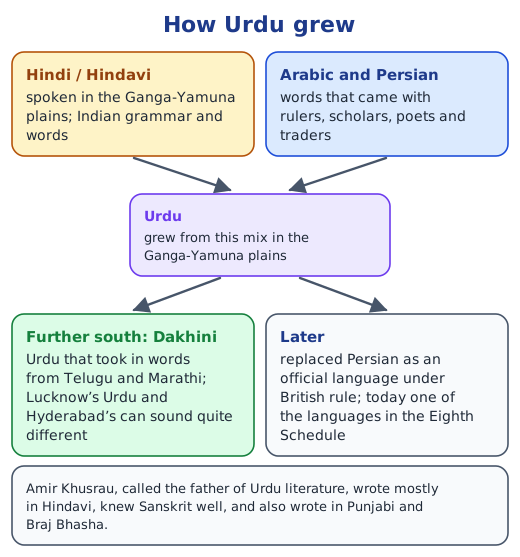
3. How did the different cultural currents meet and mix? Bhakti and Sufi saints shared music and the message of unity, and Dara Shikoh had Upanishads translated into Persian. Indian, Persian and Arabic singing gave the qawwali; Rajput and Mughal painters borrowed from each other; Persian garden plans were used at Amer; Hindavi took in Persian and Arabic words and became Urdu; books moved between Sanskrit and Persian; and dishes and dress, such as the samosa, jalebi and angrakha, were adapted to Indian tastes.
Let’s Explore, Think About It and Let’s Remember (pages 220–247)
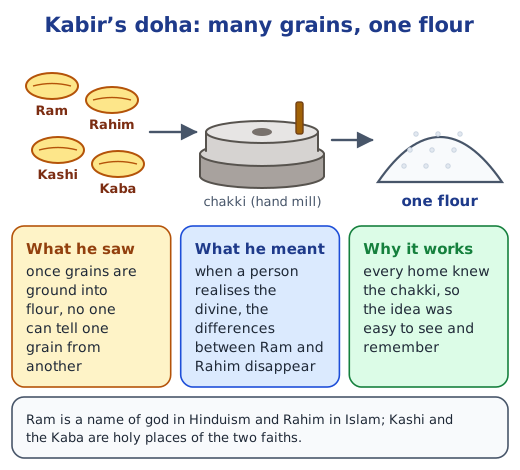
Kabir’s doha (page 220). The message is that god is one, whatever name people use. Once wheat is ground, the flour shows no sign of separate grains; in the same way, a person who truly realises the divine no longer sees Ram and Rahim, or Kashi and the Kaba, as separate. At peace, such a person can sit down and eat. Kabir asks Hindus and Muslims to look past outward differences and rituals to the one truth they share.
Music and dance in bhakti (page 221). Songs are easy to remember and pass on, even for people who could not read. Bhajans were in local languages and set to simple tunes, so everyone could join in. Singing and dancing together made people feel equal and united, whatever their jati or wealth, and music can express love and longing for god better than a lecture can. No priest or ritual was needed: anyone could sing, anywhere.
Storytelling in your region (page 224). A sample answer: the chapter names puppet shows in Rajasthan and pattachitra scrolls in Odisha, West Bengal and Andhra Pradesh. Other examples (Extra) are Harikatha, in which a storyteller mixes speech and song, in Karnataka and Andhra Pradesh, and Pandavani, sung stories from the Mahabharata, in Chhattisgarh. To invite a practitioner: ask your teacher to contact a local cultural centre or a performer’s family, fix a date, prepare questions (How did you learn? Who taught you? Do young people still learn it?), and thank them afterwards with a short note from the class.
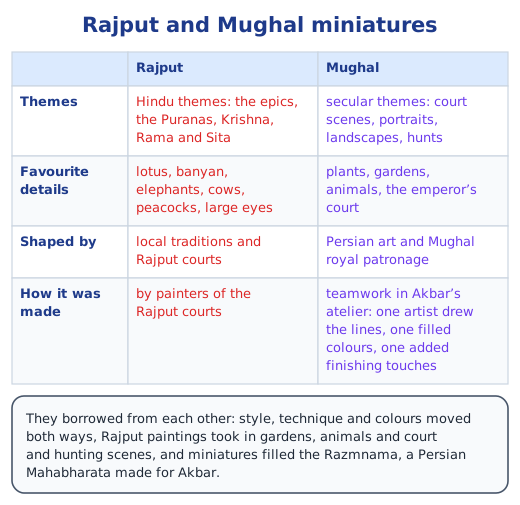
Comparing the miniatures (page 228). Similarities: all are small and finely detailed, painted on paper in strong colours, often with borders or text, and they tell a story. Differences: the Rajput paintings of Krishna and of Rama and Lakshmana use flat, bright backgrounds, stylised trees and figures shown side-on with large eyes; the Mughal paintings of Jahangir’s court and of the Razmnama show crowds of individual faces, horses and landscapes with more depth and natural detail. Changed: later works add portraits, court and hunting scenes, gardens and a sense of depth. Retained: Hindu themes, festivals such as Holi in the Bikaner painting, bright colours and fine brushwork.
Local art and craft (page 230). A sample plan for a group: list the crafts around you, such as pottery, weaving, embroidery, wood carving, metalwork or wall painting; visit one artisan; ask whether the craft is still practised, who buys the work, and how it is taught. Typical findings: many crafts continue, but some are fading because machine-made goods are cheaper. Skills pass from parent to child or from a master to an apprentice, by watching and practising; today some artisans also teach in workshops, through training schemes or with online videos.
Women who went against the grain (page 232). Women met in earlier chapters include Prabhavati Gupta, who ruled the Vakataka kingdom as regent for her young sons; Andal and Karaikal Ammaiyar, Tamil poet-saints of the bhakti tradition; Savitribai Phule, who opened schools for girls; and Kanaklata Barua, who was shot leading a procession in the Quit India movement. In this chapter, Razia Sultan ruled and Nur Jahan shaped government. Their motivations included devotion to god, duty to family and kingdom, the belief that girls deserve education, and love of their country’s freedom.
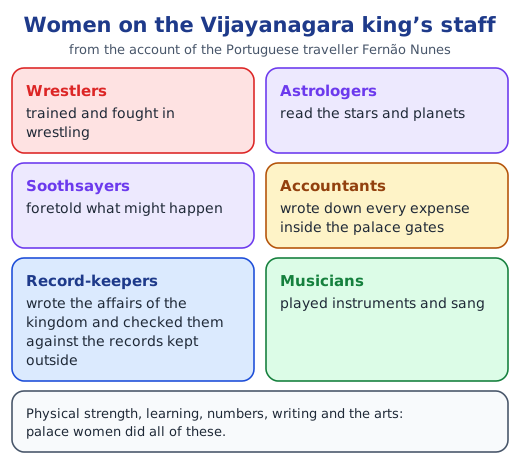
Women on the Vijayanagara king’s staff (page 232). Fernão Nunes describes women who were wrestlers; astrologers and soothsayers; accountants who wrote down every expense inside the palace gates; record-keepers who wrote the affairs of the kingdom and checked their books against those of the writers outside; and musicians who played instruments and sang.
Gifts by women (page 233). These women owned or controlled wealth, such as land, whole villages and money, and could decide how to use it, so they had economic independence. Their gifts were recorded in inscriptions, which shows they were respected and had a voice in public life. Building halls and wells for everyone shows they cared about the welfare of the community.
A historian of the 22nd century (page 233). Aspects to write about: girls’ schooling and higher education; women in every kind of work, from science and sport to the armed forces and business; women as leaders in panchayats, Parliament and companies; laws for equal rights and safety; health; how housework and childcare are shared; and the problems still left, such as safety and unequal pay. Classmates may stress different things, which shows that history depends on what the historian chooses to look at.
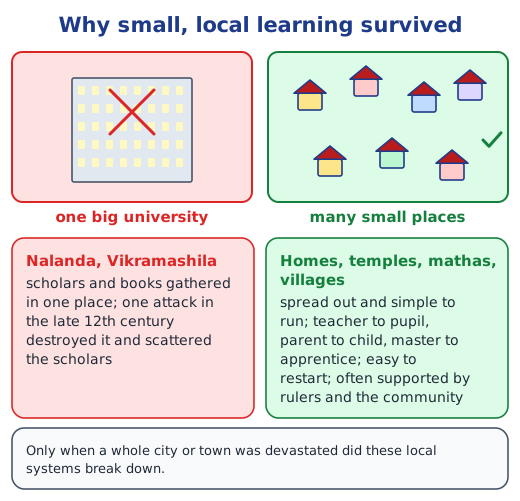
The loss of Nalanda and Vikramashila (page 235). Huge libraries of manuscripts were destroyed, and some knowledge may have been lost for ever. Scholars were killed or scattered, so advanced teaching and research stopped there. Students from other parts of Asia (Extra) could no longer come to study, so India’s exchange of ideas with the world shrank. Learning in India moved to smaller, local places such as temple schools, mathas and gurukulas, which kept it alive but on a smaller scale.
Persian loan words (page 238). A sample list from Hindi (Extra; check each in a dictionary): bazaar (market), darwaza (door), dost (friend), zameen (land), aasmaan (sky), sabzi (vegetables), shahar (city), kaarigar (craftsperson), kaagaz (paper) and roz (every day). Many of these are also used, with small changes, in languages such as Bengali, Marathi, Punjabi and Urdu.
Popular dishes in your region (page 246). A sample from north India: samosa (from the Persian sambuseh), jalebi (from zalabiyeh), naan from the clay oven, and khichri, an old Indian dish that took on new flavours. Extra, beyond this period: potatoes, tomatoes and chillies, now in almost every Indian kitchen, came from the Americas through European traders such as the Portuguese. Ask older family members and local cooks where each dish came from and how it has changed.
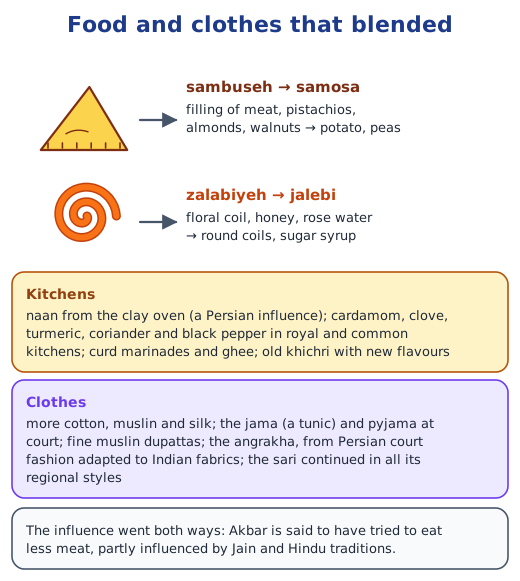
Clothing then and now (page 247). Continuity: the sari, dhoti, kurta and pyjama, the dupatta, and angrakha-style kurtas at weddings and festivals. Change: jeans, T-shirts, school uniforms, sports shoes and ready-made clothes for daily wear. Reasons: comfort and ease of movement, cost, factory-made clothes, the needs of work and travel, films and the internet, contact with other countries, and the climate. Traditional dress is often kept for special occasions.
Questions and activities (pages 248–249)
Q1. “What is the path to mokṣha that became popular in the period from the 13th to 17th centuries?” The bhakti marga, the path of devotion. It is one of several paths to moksha and needs no rituals or priests: a person reaches god through love and devotion. It had taken shape by the 6th century and became popular again in this period, spread by saints through songs in local languages.
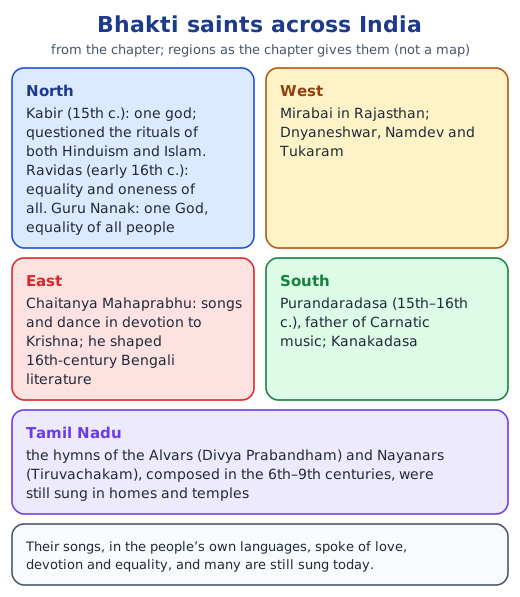
Q2. “Name three bhakti saints from different regions of India and identify the key messages they promoted.” Kabir (north, 15th century): there is one god, and the rituals of both Hinduism and Islam are not needed to reach god; Ram and Rahim are one. Chaitanya Mahaprabhu (east): loving devotion to Krishna, expressed through song and dance in which everyone could join. Purandaradasa (south, 15th–16th centuries): devotion to Krishna through music; he is said to have given up a diamond business, and his songs helped shape Carnatic music. Other answers can include Guru Nanak (there is one God, and all people are equal), Ravidas (equality and the oneness of all) or Mirabai in Rajasthan.
Q3. “Kabir’s doha compares wheat being ground into flour with the unity of Ram and Rahim. Why do you think he used this everyday example?” Grinding grain was something almost every household did, so everyone, rich or poor, Hindu or Muslim, educated or not, could picture it at once. A familiar image makes a deep idea, the oneness of god, easy to understand and remember. It also suggests that unity is natural: just as no one argues over which grain a pinch of flour came from, people should not quarrel over the names they give to god. And a short doha with a homely picture was easy to sing and pass on.
Q4. “The chapter mentions that while major universities like Nalanda were destroyed, education continued through decentralised systems like gurukulas, temple schools, and apprenticeships. What advantages might these smaller, local systems have had in surviving political turmoil?” There was no single target: learning was spread over many homes, temples, mathas and villages, so one attack could not end it. They needed little money or buildings, so they were simple to keep going or restart. Knowledge lived in people and passed from teacher to pupil, parent to child and master to apprentice, so it moved wherever people moved. Local communities and rulers who followed established practice, such as Vijayanagara’s purvamaryade, kept supporting them. They also taught useful skills for daily life and work, so families had good reason to keep them alive.
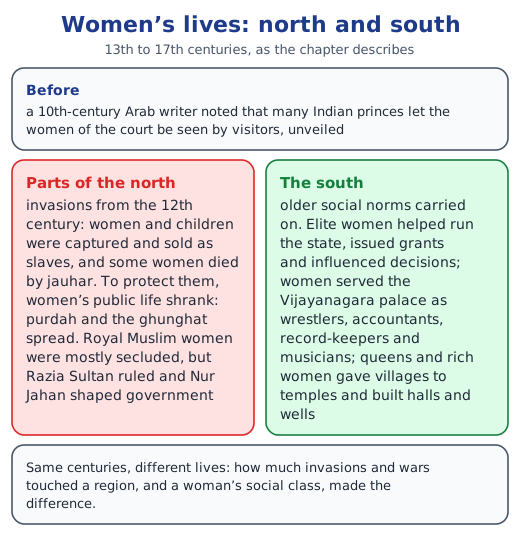
Q5. “Women’s roles changed differently across regions during this period. What factors mentioned in the chapter might explain why the same historical events affected women differently in different regions?” How directly a region faced invasions and military campaigns: in parts of the north, the danger of capture and slavery led families to keep women out of public view. The customs of the ruling class: the Muslim nobility in the north practised purdah, and veiling spread partly as a mark of high status. The strength of older social norms: in the south, rulers followed earlier practices and women’s public roles carried on. Social class: elite women could own wealth, give grants and influence decisions, while women in royal Muslim households were mostly secluded. Personal ability and position also mattered, as Razia Sultan and Nur Jahan show.
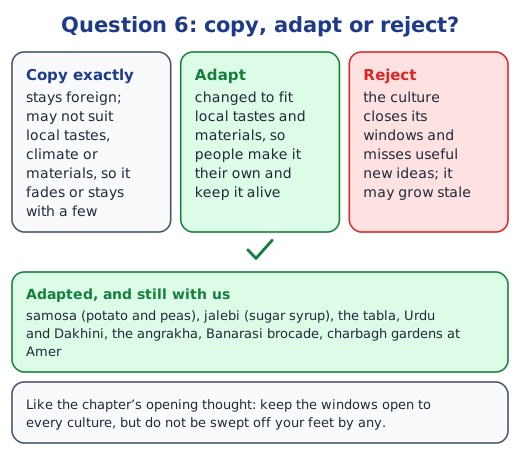
Q6. “The chapter describes how Indian culture sometimes “adopted or adapted” external influences. Why do you think adaptation (changing something to fit local tastes) might be more successful for cultural survival than simply copying or completely rejecting new ideas?” A copied idea stays foreign: it may not suit local tastes, climate, materials or beliefs, so it fades or remains with a few people. Rejecting every new idea closes a culture off, so it misses useful knowledge and may grow stale. Adapting keeps the local core while adding something new, so people feel the result is their own and keep it alive. The samosa, filled with potatoes and peas instead of meat and nuts, the tabla, Urdu and the angrakha all show this. It matches the thought that opens the chapter: keep the windows open, but stay on your own feet.
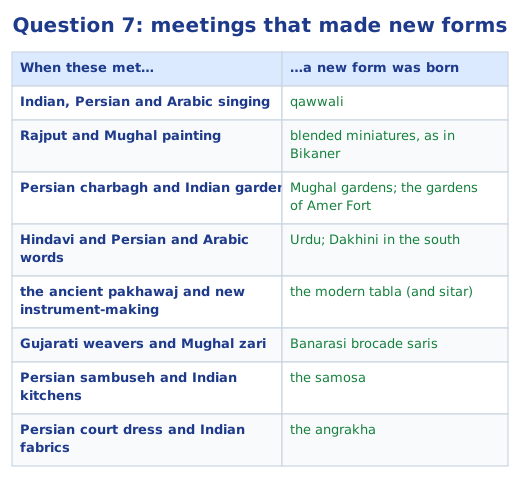
Q7. “What are some examples of cultural interactions that led to the creation of new art forms?” Indian, Persian and Arabic singing traditions met in the qawwali, which Amir Khusrau is credited with developing. Rajput and Mughal painting borrowed style, technique and colours from each other, and Mughal painters who moved to Bikaner blended the two. The Persian charbagh shaped Mughal gardens and later the gardens of Amer Fort. Hindavi took in Persian and Arabic words and became Urdu, and Dakhini in the south. Gujarati weavers and Mughal zari created the Banarasi brocade sari. Persian court dress and Indian fabrics gave the angrakha.
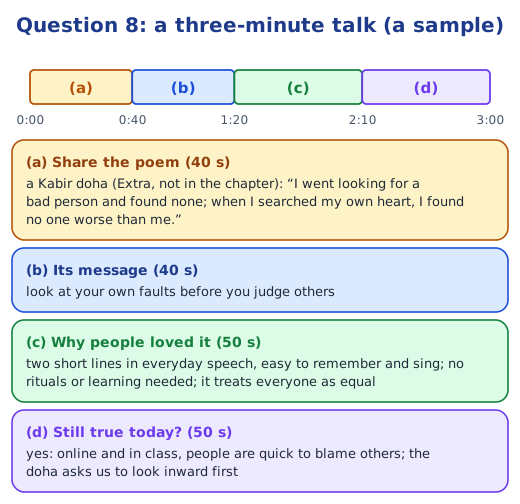
Q8. “Research one bhakti or Sufi saint mentioned in the chapter (Kabir, Mirabai, Ravidas, Tukaram, Chishti or others). Find one of their poems or bhajans in translation, and prepare a three-minute presentation where you: (a) Share the poem/song, (b) Explain its main message, (c) Describe why it might have appealed to common people during that time, and (d) Discuss whether its message is still relevant today.” A sample on Kabir. (a) The doha (Extra, not in the chapter), in our own translation: “I went looking for a bad person and found none; when I searched my own heart, I found no one worse than me.” (b) Message: look at your own faults before judging others. (c) Appeal: two short lines in everyday speech, easy to remember and sing; no learning, money or ritual needed; it treats everyone as equal, whatever their jati or faith. (d) Still relevant: people today are quick to blame others, at home, in class and online; the doha asks us to look inward first. Keep each part to under a minute and practise with a timer.
Q9. “Choose one aspect of culture from the chapter (architecture, clothing, food, music, education, or gardens) and create a group project to study how it appears in your region. Try to enquire into: What has changed and what has remained the same over time? What are your thoughts on why certain elements continued while others changed? You can present your report in any form — as an illustrated report, or digital presentation, or in any other creative way.” A sample project on food. Steps: split the group into roles (interviewer, photographer, writer, artist); interview grandparents, a local cook and a sweet-seller; visit a market; collect old and new recipes. What has stayed the same: everyday dal, rice and roti, khichri when someone is unwell, and festival sweets. What has changed: new fillings and snacks, ready-made spice mixes, packaged food, gas stoves instead of clay chulhas, and dishes from other states and countries. Why: dishes tied to local crops, climate, festivals and religious customs continue; changes come with trade, travel, migration, cost, convenience and television. Present it as an illustrated recipe book with a “then and now” page for each dish.
Practice
-
Which of these is NOT one of the chapter’s three common patterns of the period?
Show answer
Answer: (d) all culture came from a single court
-
Tirumalamba wrote a Sanskrit kavya at the court of:
Show answer
Answer: (b) Achyutadevaraya
-
The buta (paisley) motif on pashmina shawls looks like:
Show answer
Answer: (b) a teardrop with a curved end
-
What is a whirling dervish?
Show answer
Answer: A member of a Sufi order for whom whirling is a form of meditation that needs a great deal of practice.
-
Why might Urdu spoken in Hyderabad sound unfamiliar to a traveller from Lucknow?
Show answer
Answer: Because in the south Urdu became Dakhini, taking in words from local languages such as Telugu and Marathi.
Stuck on a question?
Take a photo and Lagnever AI explains it step by step. Try it for 7 days for ₹2.
Get it on Google Play Open in browser
For parents: after the trial, the plan renews monthly by UPI or card autopay. You can cancel anytime in the app.