
How did women’s lives, learning and daily life change from the 13th to 17th centuries?
Answer in short
Women’s lives differed by region. In parts of the north, invasions led to purdah and less public life, though Razia Sultan and Nur Jahan held power; in the south, elite women stayed active in public life. Learning continued in gurukulas, mathas, temple schools and madrasas, and food, clothes and crafts blended Indian and Persian styles.
Stuck on a question? Take a photo and Lagnever AI explains it step by step. Try it for 7 days for ₹2. Get it on Google Play
How did invasions change women’s lives in the north?
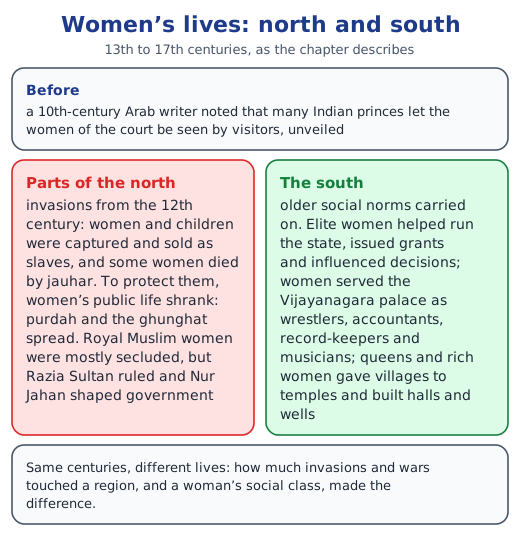
In the 10th century, an Arab writer, Abu Zaidu-l Hasan, noticed that many Indian princes allowed visitors to see the women of their court, with no veil. From the 12th century, invasions and wars changed this in parts of north India. Women and children were taken prisoner and sold as slaves in West and Central Asia, and some women died by jauhar rather than be captured. Families tried to protect women by keeping them out of sight, so women appeared less in public. The purdah (a Persian word meaning curtain or veil) spread in some regions, and in parts of the north the ghunghat, often draped over the head rather than covering the whole face, became part of women’s dress. Some scholars think veiling was also a mark of high status, because the ruling Muslim nobility practised it. Veiling stayed largely a north Indian custom.
Who were Razia Sultan and Nur Jahan?
Women in royal Muslim households mostly lived in seclusion, but a few took part in politics, education and public life. Razia Sultan became the first and only woman to rule the Delhi Sultanate, during the first half of the 13th century. Nobles opposed a woman on the throne, but she led military campaigns herself, dealt cleverly with plotters, set up places of learning across Delhi and chose officials on merit. She appeared at court unveiled and spoke directly to the people; these bold steps helped her enemies plot against her, and her reign was short. In the early 17th century, Nur Jahan, the wife of Emperor Jahangir, issued royal orders, attended court meetings and had coins minted in her name. She also supported art, architecture and trade.
What about women in the south?
In most of south India, women’s lives did not change much in these centuries. Elite women held power, gave grants and influenced political decisions, and carvings on the walls at Hampi show women active in public life. The Portuguese traveller Fernão Nunes found women in the Vijayanagara palace working as wrestlers, astrologers, accountants, record-keepers and musicians. Queens and wealthy women gave whole villages to temples and paid for community halls and wells for public use. The chapter concludes that the prosperity of this period depended on women’s active part.
Where did children learn?
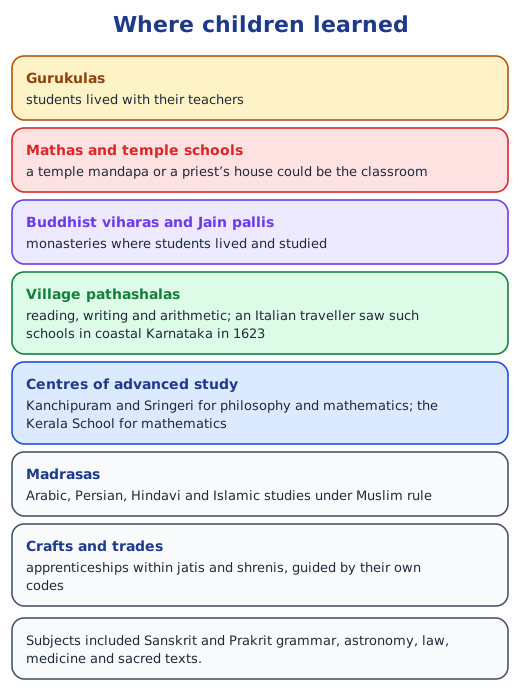
Invasions disrupted education, but learning went on from villages to temples. Students lived with teachers in gurukulas, mathas, temple schools, Buddhist viharas and Jain pallis, studying subjects such as grammar in Sanskrit and Prakrit, astronomy, medicine, law and sacred texts. Villages had pathashalas; in 1623 the Italian traveller Pietro Della Valle described children in coastal Karnataka learning to read, write and do arithmetic, probably in a priest’s house or a temple mandapa. Kanchipuram and Sringeri were known for philosophy and mathematics, and madrasas taught Arabic, Persian, Hindavi and Islamic studies. Vijayanagara’s kings followed purvamaryade, carrying on established practices, so they kept supporting temples and mathas.
What did the loss of Nalanda mean?
The great universities of Nalanda and Vikramashila, destroyed in invasions near the end of the 12th century, as you read in Grade 7, were a huge loss to the world. Scholars scattered and a whole community of learning broke up. Yet the jati and shreni systems that trained craftspeople and traders, with their own rules and apprenticeships, carried on, except where whole cities were destroyed.
How were crafts like weaving passed on?
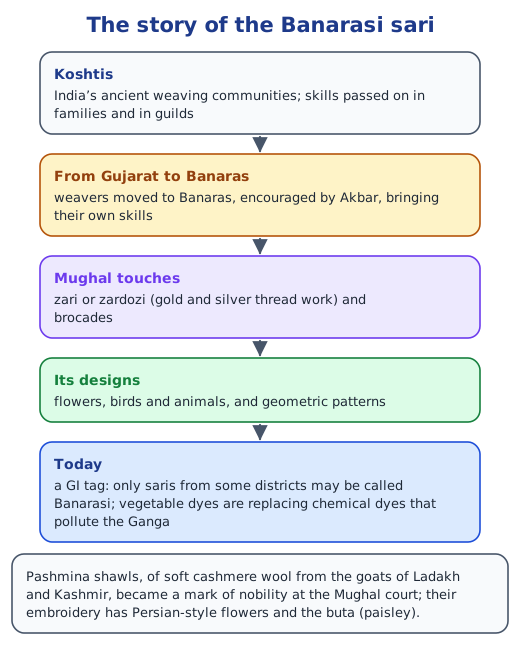
Skilled work was learned by hand from a young age. India’s ancient weaving communities, known together as the Koshtis, passed on their skills within families or from a master in a guild. With Akbar’s encouragement, weavers from Gujarat moved to Banaras, and the Mughals brought zari (zardozi) and brocade, which became part of the Banarasi sari’s style, along with designs of flowers, animals and geometric patterns. Today Banarasi saris have a GI tag. Soft pashmina shawls, of cashmere, the soft wool of goats from Ladakh and Kashmir, were prized by the Mughal emperors and sold across Asia and to Europe.
How did food and clothing mix?
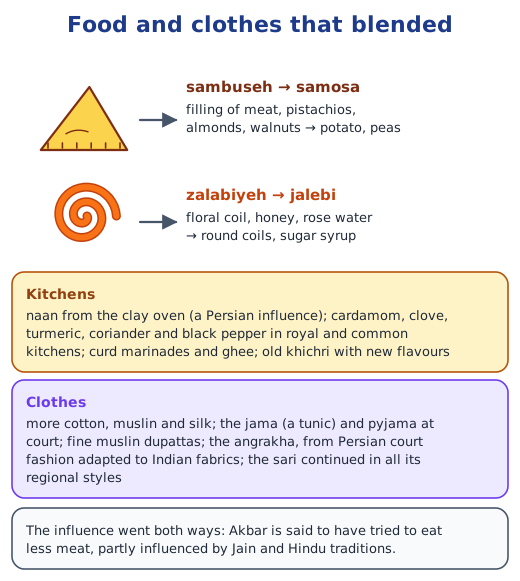
Kitchens influenced each other, especially among the rich. Cardamom, clove, turmeric, coriander and black pepper spread from royal kitchens to ordinary homes; curd marinades and ghee became popular; and khichri, made for over a thousand years, got new flavours. Akbar is said to have tried to cut down meat at court, partly under Jain and Hindu influence. Naan baked in a clay oven reflects Persian influence, and the samosa and jalebi grew from Persian dishes. More cotton, muslin and silk were made; the jama and pyjama were adopted at court, and the angrakha grew out of Persian court dress, while the sari continued.
Read on: bhakti and belief systems, art, literature and science, the chapter notes and the NCERT solutions.
Practice
-
Which woman of the Mughal Empire had coins minted in her name?
Show answer
Answer: (b) Nur Jahan
-
Which Italian traveller wrote in 1623 about village schools in coastal Karnataka?
Show answer
Answer: (b) Pietro Della Valle
-
Pashmina shawls are woven from the wool of goats from:
Show answer
Answer: (b) Ladakh and Kashmir
-
Why may only some saris be called Banarasi?
Show answer
Answer: Banarasi saris carry a GI (Geographical Indication) tag, so only brocades from certain districts may use the name, which protects the weavers’ knowledge.
-
How did the samosa change after it reached India?
Show answer
Answer: Its Persian filling of meat, pistachios, almonds and walnuts was replaced with potatoes and peas.
Questions students ask
Why did purdah spread in north India?
Invasions and wars from the 12th century put women at risk of capture, so families tried to protect them by keeping them out of public view. Some scholars also think veiling became a mark of high rank because the ruling nobility practised it.
Who was Razia Sultan?
The first and only woman to rule the Delhi Sultanate, for a short time in the 13th century. She led armies herself, set up places of learning in Delhi, chose officials on merit and appeared at court unveiled, but nobles who opposed a woman ruler plotted against her and her reign was short.
Where did children study between the 13th and 17th centuries?
In gurukulas, mathas, temple schools, Buddhist viharas, Jain pallis and village pathashalas; at centres such as Kanchipuram and Sringeri; and in madrasas teaching Arabic, Persian, Hindavi and Islamic studies. Crafts were learned by apprenticeship.
Which foods show Persian influence?
The chapter names naan baked in a clay oven, and the samosa and jalebi, which grew from the Persian sambuseh and zalabiyeh and were changed to suit Indian tastes.
Stuck on a question?
Take a photo and Lagnever AI explains it step by step. Try it for 7 days for ₹2.
Get it on Google Play Open in browser
For parents: after the trial, the plan renews monthly by UPI or card autopay. You can cancel anytime in the app.