
Ghaznavid and Ghurid invasions
Answer in short
In the 11th century Mahmud of Ghazni defeated the Hindu Shahis and led 17 raids into north India, plundering cities and temples such as Mathura and Somnath, but he did not stay. In the 12th century Muhammad Ghuri won the Second Battle of Tarain in 1192, took Delhi and left generals in charge, starting foreign rule in the north.
Stuck on a question? Take a photo and Lagnever AI explains it step by step. Try it for 7 days for ₹2. Get it on Google Play
Guarding the Khyber Pass
In the 9th and 10th centuries the Hindu Shahis ruled from present-day Afghanistan and northern Pakistan up to Punjab. They held the Khyber Pass, one of the main routes through the Hindu Kush, used for some 2,500 years by traders and Buddhist monks, and by many invaders. With help from other Indian kings, the Shahis turned back several attacks. Then the Turkic Ghaznavids of Ghazni broke through: early in the 11th century, their ruler Mahmud defeated King Jayapala and, in 1008, after a long battle in northern Punjab, his son Anandapala. The way to the Indus plains lay open.
Mahmud’s campaigns
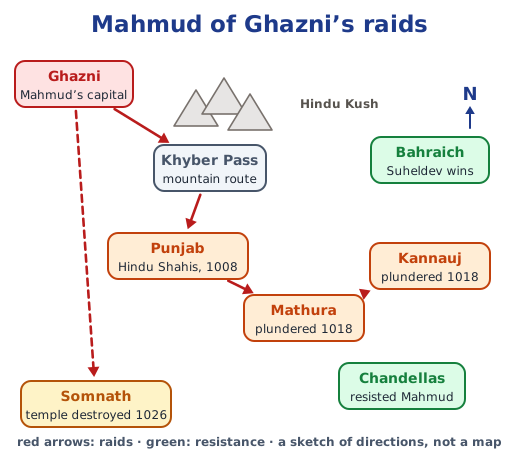
Mahmud, who took the title sultan, led 17 campaigns into India, each time going home with vast booty. His fast-moving army, with mounted archers, was hard to stop, though rulers such as the Chandellas resisted strongly. In 1018 he reached Mathura, a rich city whose great temple his own court historian, al-Utbi, could not praise enough; he destroyed and looted it, then sacked Kannauj. A later campaign reached the busy port of Somnath in Gujarat, where, after days of fierce local resistance, he destroyed the Somanatha temple and seized its treasure in 1026. His raids also killed tens of thousands of civilians, and many people, children among them, were carried off to be sold as slaves. Mahmud died in 1030. Around then his nephew Salar Masud attacked the Gangetic region but was defeated and killed at Bahraich by the local ruler Suheldev.
Why did Mahmud raid?
Since Mahmud never tried to rule beyond Punjab, historians have long argued about his motives. Many stress plunder: big temples held wealth gathered from centuries of offerings. Yet writers of his own time, such as al-Utbi, also show him keen to spread his version of Islam, and he attacked rival Muslim sects too. Curiously, a coin he issued from Lahore carries Sanskrit on one side and calls him nripati, king. The book asks us to face such dark periods honestly, to understand them, while remembering that nobody living today is responsible for them.
The Persian scholar al-Biruni, who travelled with Mahmud, admired the defeated Hindu Shahis as noble rulers and wrote that the raids drove Indian sciences away to places such as Kashmir and Varanasi.
Muhammad Ghuri
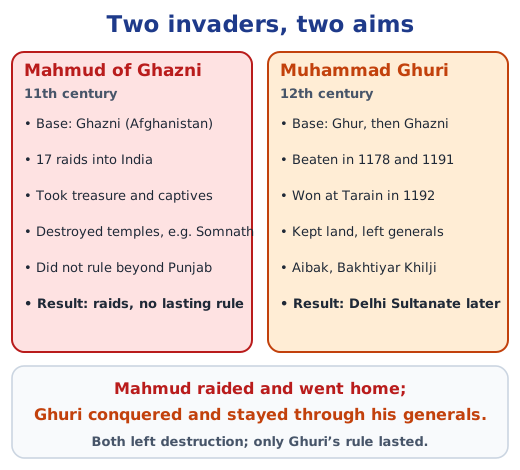
After Mahmud, the Ghaznavid empire broke up. The chiefs of Ghur, once its vassals, seized Ghazni, and their leader Muhammad Ghuri took parts of Punjab and Sindh. India resisted hard: in 1178 the Chaulukya king Mularaja II, or by another account his mother, Queen Naikidevi, defeated him near Mount Abu, and in 1191 Prithviraja III of the Chahamanas beat him at Tarain. A year later Ghuri returned with a bigger army, won the Second Battle of Tarain and had Prithviraja executed. He then took Delhi. Unlike Mahmud, he wanted lasting control, so he left generals behind, among them Qutb-ud-din Aibak, the future founder of the Delhi Sultanate.
Nalanda and the east
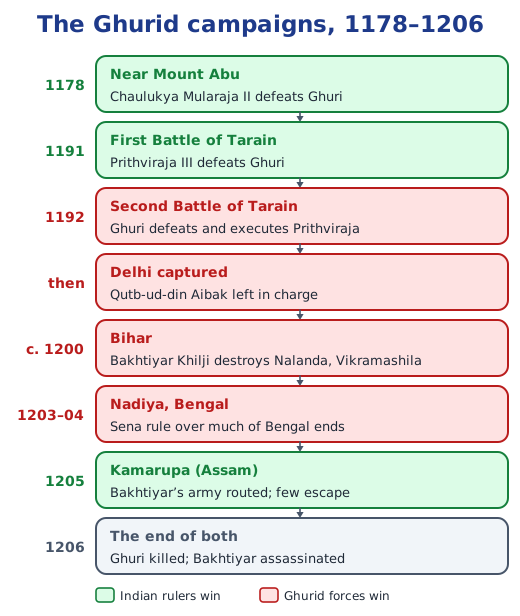
Aibak’s commander Bakhtiyar Khilji marched into Bihar and Bengal near the end of the 12th century. He destroyed the great monasteries and universities of Nalanda and Vikramashila, killing many monks; Nalanda’s vast library reportedly kept burning for months. In 1203–04 he surprised the Sena king at Nadiya, ending Sena rule over much of Bengal. But on his way towards Tibet in 1205, the forces of Kamarupa routed his army, and he escaped with only a few men. Both Ghuri and Bakhtiyar died in 1206.
Why it matters
These invasions changed the balance of power in north India and led to the Delhi Sultanate, yet large parts of India stayed with Indian kingdoms. Compare them with the Chola Empire and the regional kingdoms of the 11th and 12th centuries. Answers to the textbook questions are in the NCERT solutions for Part 2 Chapter 4; see all of Part 2 Chapter 4 notes.
Practice
-
The capital of the Ghaznavids was:
Show answer
Answer: (b) Ghazni
-
Who defeated Muhammad Ghuri near Mount Abu in 1178?
Show answer
Answer: (c) Mularaja II of the Chaulukyas
-
In which year was the Second Battle of Tarain fought?
Show answer
Answer: (c) 1192
-
Why was the Khyber Pass important?
Show answer
Answer: It was one of the main passes through the Hindu Kush, linking the Indus plains with Central Asia. For about 2,500 years traders and Buddhist monks travelled through it, and many invaders came the same way, so whoever held it guarded the north-west.
-
How did Muhammad Ghuri’s aims differ from Mahmud’s?
Show answer
Answer: Mahmud raided, took plunder and went back to Ghazni without ruling beyond Punjab. Muhammad Ghuri wanted land and lasting control: after taking Delhi he left generals such as Qutb-ud-din Aibak to hold and extend his conquests.
Questions students ask
Who was Mahmud of Ghazni?
Mahmud was the Turkic ruler of Ghazni, in present-day Afghanistan, in the early 11th century. He took the title sultan, defeated the Hindu Shahis and led 17 campaigns into India, plundering cities and temples such as Mathura, Kannauj and Somnath, but he did not set up rule beyond Punjab.
What happened at the battles of Tarain?
At Tarain, in present-day Haryana, Prithviraja III of the Chahamanas defeated Muhammad Ghuri in 1191. Ghuri returned the next year with a larger army and won the Second Battle of Tarain in 1192; Prithviraja was executed, and Ghuri went on to take Delhi.
How was Nalanda destroyed?
Around the end of the 12th century, Bakhtiyar Khilji, an army commander under Ghuri’s general Aibak, attacked Bihar. He destroyed the great monasteries and universities of Nalanda and Vikramashila, killed many monks and took huge booty. Historians of Buddhism agree that this hastened the decline of Buddhism in India.
Stuck on a question?
Take a photo and Lagnever AI explains it step by step. Try it for 7 days for ₹2.
Get it on Google Play Open in browser
For parents: after the trial, the plan renews monthly by UPI or card autopay. You can cancel anytime in the app.