
NCERT Solutions Class 7 Social Science Part 2 Chapter 4: Turning Tides, 11th and 12th Centuries
Answers to every question in Part 2 Chapter 4, Turning Tides: 11th and 12th Centuries, of Exploring Society: India and Beyond Grade 7 (2026-27): the Big Questions, every Let’s Explore and Think About It box, the Lilavati riddle and all 8 questions and activities. Page numbers follow the book (pages 97–124). Short notes: Part 2 Chapter 4 notes.
The Big Questions (page 97)
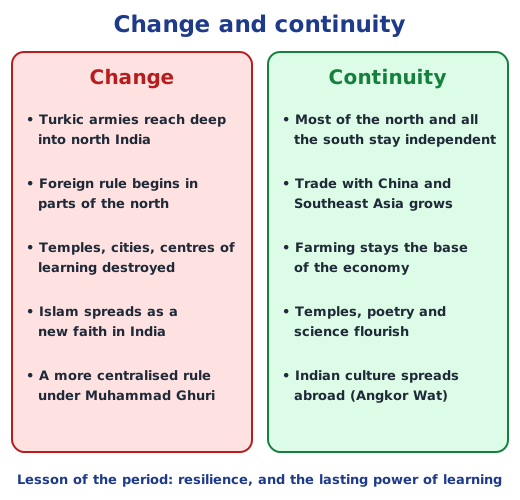
1. Why are the 11th and 12th centuries seen as a period of transition? Turkic invaders reached much deeper into north India than any earlier invaders. Mahmud of Ghazni raided and plundered, and Muhammad Ghuri and his generals began foreign rule in parts of the north, which grew into the Delhi Sultanate. Temples, cities and centres of learning such as Nalanda were destroyed, and Islam spread as a new faith. Yet much carried on: most of the north and all of the south stayed under Indian kingdoms, and trade, farming, art and learning continued. A period with such change alongside continuity is a transition.
2. Which new powers emerged, and what were their economic, military and administrative features? From the north-west came the Turkic Ghaznavids and Ghurids, with fast cavalry and mounted archers. Within India, the Senas, Eastern Gangas, Kakatiyas, Hoysalas, Paramaras, Chandellas, Chaulukyas and Chahamanas rose, and the Cholas reached their peak. Constant war meant large armies of soldiers, horses, elephants and camels, paid for by an efficient administration that collected tribute from vassals and taxes from traders. Muhammad Ghuri’s system was more centralised, giving officers temporary land assignments in return for collecting revenue and military service. The Kakatiyas built village self-government, a good revenue system and irrigation; the Cholas had a strong navy and public works. Farming was the base of the economy, with a growing trade with China and Southeast Asia run by merchant guilds.
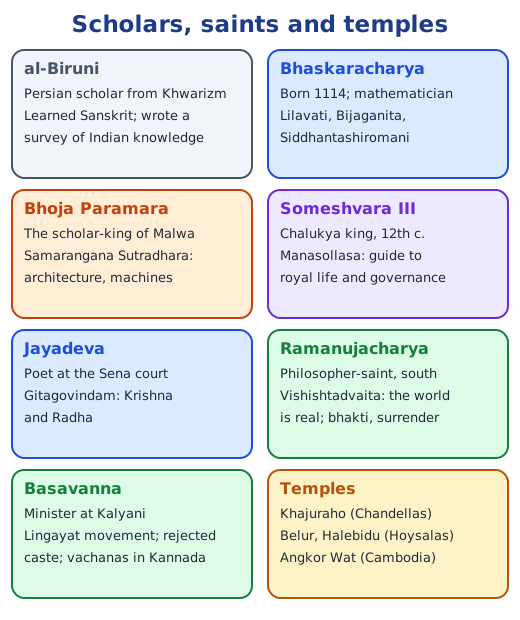
3. What high accomplishments do we find in this period? In architecture: the Brihadishvara temple at Thanjavur and the temple at Gangaikondacholapuram, the Hoysala temples of Belur and Halebidu, the Kakatiya gateways of Warangal and the Thousand Pillar temple, the Khajuraho temples, the Jagannatha temple at Puri, and Bhoja’s lake and Bhojeshwar temple. In literature: Jayadeva’s Gitagovindam, Basavanna’s Kannada vachanas, Telugu works, and Bhoja’s and Someshvara III’s treatises. In science: Bhaskaracharya’s Lilavati, Bijaganita and Siddhantashiromani, and al-Biruni’s survey of Indian knowledge. In thought: Ramanujacharya’s vishishtadvaita and Basavanna’s Lingayat movement. Indian culture also inspired Angkor Wat in Cambodia.
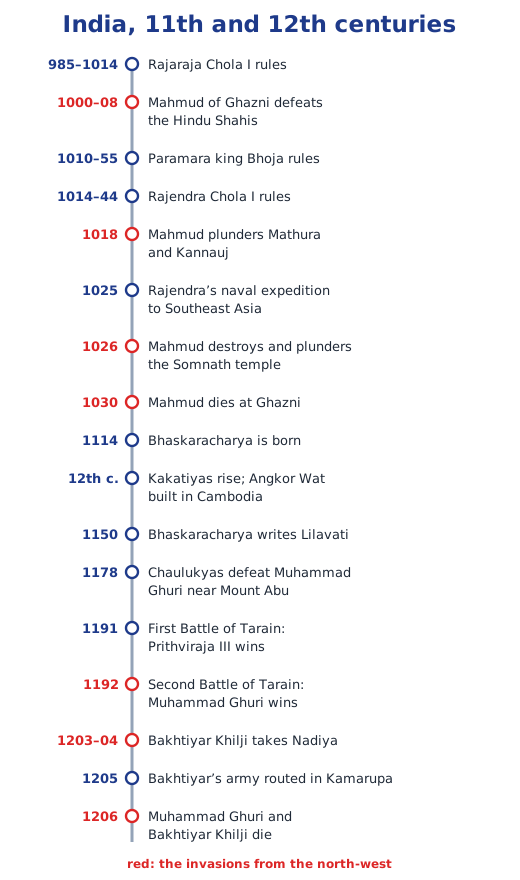
The Ghaznavid invasions (pages 99–107)
Let’s Explore (page 100): what kind of terrain does the sketch of the Khyber Pass show? Rugged, rocky mountains with steep slopes, and a narrow, winding valley running between them, watched over by a fort on a height.
What advantages would it offer an army trying to reach the Indus plains? What dangers? Advantages: it was the most direct route through the Hindu Kush, a known path along a valley, leading straight down to the rich plains. Dangers: the pass is narrow, so a small force on the heights could ambush or block a large army; moving supplies, horses and baggage was slow and hard; weather and rock falls were risks; and retreat through it was difficult.
The same questions for traders’ caravans. Advantages: for centuries it was the main trade route linking India with Central Asia and beyond, shorter than going round the mountains, with forts and stops along the way. Dangers: robbers and raiders, tolls, ambush in the narrow sections, harsh weather and a tiring climb for people and pack animals.
Think About It (page 101): what can we conclude from al-Biruni’s remark that the Hindu Shahis were noble and always wished to do good? Even a scholar who travelled with Mahmud, the Shahis’ conqueror, admired them, so they must have been respected and honourable rulers. It also shows al-Biruni trying to be fair to the defeated, which makes him a valuable source. And it confirms that the dynasty had been wiped out by his time.
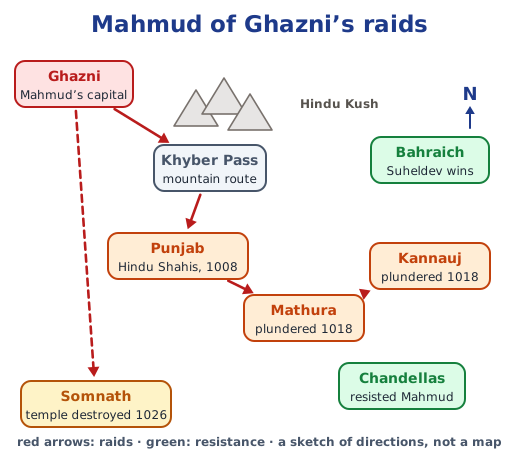
Let’s Explore (page 103): why was the new Somanatha temple (built in 1950, opened in 1951) paid for entirely by public donations? So that the people themselves would rebuild it, as a symbol of their faith, pride and resilience after it had been destroyed many times; and because in a secular democracy the government does not use public money to build places of worship for any one religion. (Extra) Mahatma Gandhi is reported to have advised that the money should come from the public rather than the government.
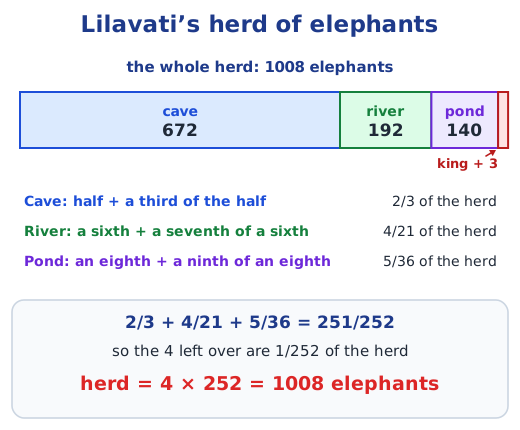
Lilavati (page 105): how many elephants were in the herd? Call the herd N. Half and a third of the half is N/2 + N/6 = 2N/3 (cave). A sixth and a seventh of a sixth is N/6 + N/42 = 4N/21 (river). An eighth and a ninth of an eighth is N/8 + N/72 = 5N/36 (pond). The king and three females make 4. Since 2/3 + 4/21 + 5/36 = 251/252, the 4 elephants are 1/252 of the herd, so N = 4 × 252 = 1008: 672 in the cave, 192 at the river, 140 in the pond and 4 with the king.
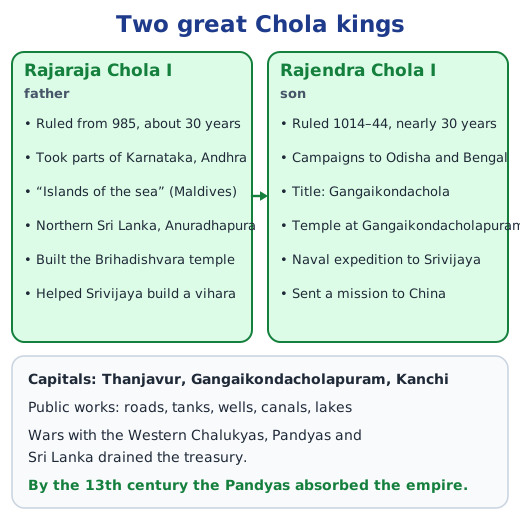
The Cholas (pages 110–113)
Let’s Explore (page 112): in Fig. 4.14, who is the king and who is the guru? What does the king’s posture express? The guru is the older, bearded figure with tall, piled-up hair. The king is the younger, beardless figure with a crown and jewellery, standing close beside and slightly behind him. His calm face and quiet stance express respect, humility and devotion towards his teacher: even a great emperor honours his guru.
The Ghurids in India (pages 114–118)
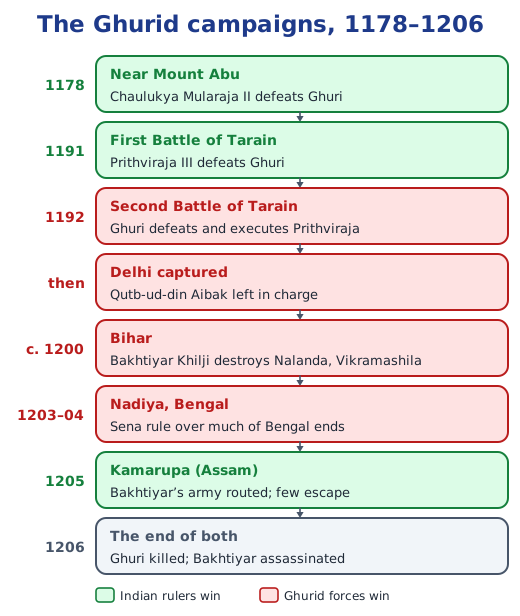
Let’s Explore (page 117): find two more clues that the ‘fortress’ in Juzjani’s account was a Buddhist monastery near Nalanda. (1) The people there had shaven heads: they were not Brahmans but Buddhist monks, who shave their heads. (2) There were a great number of books, a library, like Nalanda’s famous library. Together with the place being a college called ‘bihar’, from vihara, these clues show it was a Buddhist mahavihara, a monastery-university. (Extra) Many historians think it was the Odantapuri monastery at today’s Bihar Sharif, near Nalanda; the name of the state of Bihar also comes from vihara.
Governance, trade and cultural life (pages 118–121)
Let’s Explore (page 121): why did Basava want people from all backgrounds to come together in the Anubhava Mandapa? He believed every person has the same spiritual worth, whatever their caste, gender, wealth or language. Bringing everyone together let people learn from one another, broke down social barriers and helped build a fairer, more united society through open discussion.
If an Anubhava Mandapa existed today, what should people discuss? Possible topics: ending discrimination of every kind; education for all; fair work and wages; protecting water, forests and the climate; kindness and mental health; using technology wisely; and how each of us can serve the community.
What lessons can we draw from its spirit for a just and civil society today? Respect every person equally; listen to views different from our own; settle disagreements by calm dialogue; include women and people of all backgrounds in decisions; and judge people by their character and work, not by birth or rank.
Questions and activities (pages 123–124)
1. Why is this period a major transition? Two examples each of change and continuity. It is a transition because the old pattern of Indian kingdoms fighting one another was joined by deep Turkic invasions, which began foreign rule in parts of the north, while much of Indian life went on. Change: (a) Turkic invasions brought plunder and destroyed temples, cities and places of learning such as Nalanda; (b) foreign rule began in parts of north India, later the Delhi Sultanate, and Islam spread as a new faith. Continuity: (a) large parts of the north and all of the south stayed under Indian kingdoms such as the Cholas, Kakatiyas and Hoysalas, which went on fighting and allying with one another; (b) trade with China and Southeast Asia, run by merchant guilds, kept growing, and temples, literature and science continued to flourish.
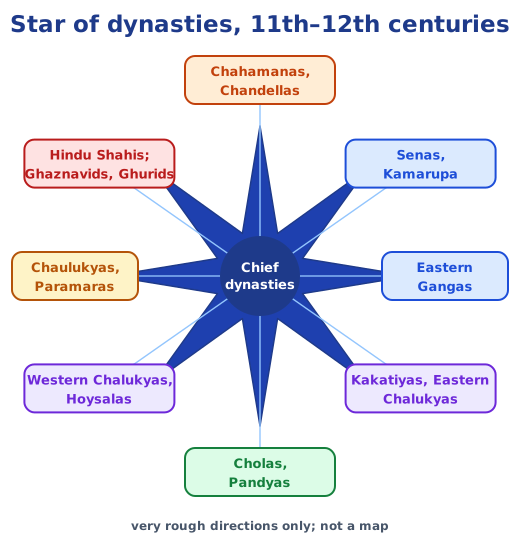
2. A ‘star of dynasties’ for this chapter. Place each dynasty in its rough direction around the centre. North: Chahamanas and Chandellas. North-west: the Hindu Shahis, and the invading Ghaznavids and Ghurids. North-east: Senas and Kamarupa. West: Chaulukyas and Paramaras. East: Eastern Gangas. South-west: Western Chalukyas and Hoysalas. South-east: Kakatiyas and Eastern Chalukyas. South: Cholas and Pandyas.
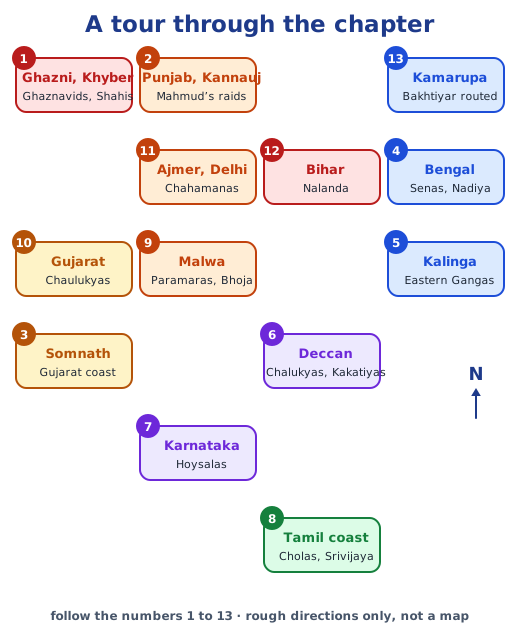
3. A geographical tour of the chapter’s dynasties. Follow the chapter’s own order on a map of the Subcontinent: (1) the north-west, Ghazni and the Khyber Pass (Ghaznavids, Hindu Shahis); (2) Punjab, Mathura and Kannauj; (3) Somnath on the Gujarat coast; (4) Bengal (Senas at Nadiya); (5) Kalinga (Eastern Gangas); (6) the Deccan (Western Chalukyas at Kalyani, Eastern Chalukyas at Vengi, Kakatiyas at Warangal); (7) Karnataka (Hoysalas at Belur and Halebidu); (8) the Tamil coast (Cholas at Thanjavur, Gangaikondacholapuram and Kanchi, and by sea to Srivijaya); (9) Malwa (Paramaras at Dhara); (10) Gujarat (Chaulukyas at Patan, Mount Abu); (11) Ajmer, Delhi and Tarain (Chahamanas); (12) Bihar (Nalanda, Vikramashila); (13) Kamarupa. Mark each capital on the map and join them with arrows in this order.
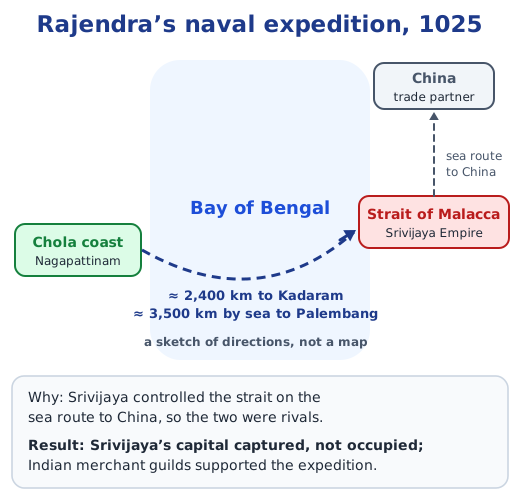
4. Approximately how far did Rajendra I’s fleet sail? Measure on a map, using its scale, from the Chola coast (for example Nagapattinam) to the Strait of Malacca. Straight across the Bay of Bengal to Kadaram (Kedah) on the Malay Peninsula is about 2,300–2,400 km; going on through the strait to Palembang in Sumatra makes about 3,500 km by sea. (Extra) Chola inscriptions name Kadaram among the places attacked, and many historians place the Srivijaya capital at Palembang.
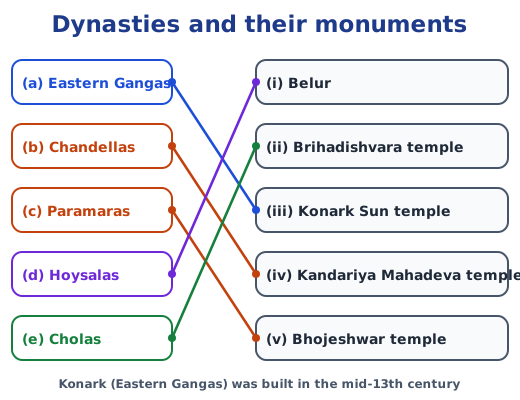
5. Match the pairs. (a) Eastern Gangas – (iii) Konark Sun temple; (b) Chandellas – (iv) Kandariya Mahadeva temple; (c) Paramaras – (v) Bhojeshwar temple; (d) Hoysalas – (i) Belur; (e) Cholas – (ii) Brihadishvara temple.
6. Compare the dynasties of this chapter and the previous one.
| Group | Dynasties |
|---|---|
| In both chapters | Chalukyas (the Western Chalukyas of Kalyani and the Eastern Chalukyas of Vengi), Cholas, Pandyas, Palas (now in decline), Gurjara-Pratiharas (their last kings, at Kannauj) and the kingdom of Kamarupa |
| Disappear after the previous chapter | Pushyabhutis (Harsha), Karkotas of Kashmir, Pallavas, Cheras, Rashtrakutas (named now only as former overlords of the Paramaras) and the Varmans of Kamarupa |
| Appear in this chapter | Hindu Shahis, Ghaznavids, Ghurids, Senas, Eastern Gangas, Kakatiyas, Hoysalas, Paramaras, Chandellas, Chaulukyas (Solankis) and Chahamanas (Chauhans) |
(The previous chapter only names the Paramaras, Chahamanas and Gangas in a list, and the Kakatiyas once in passing.)
7. A short note on centres of learning like Nalanda. (1) Why they mattered: Nalanda, a great Buddhist mahavihara, drew teachers and students from across India and from abroad, such as the Chinese pilgrims Xuanzang and Yijing and scholars from Tibet. Its library, in three multi-storey buildings, held lakhs of manuscripts, and kings in India and even in Srivijaya supported it. Such centres preserved and spread knowledge across Asia. (2) Effects of their destruction: when Bakhtiyar Khilji attacked, monks were killed and the library reportedly kept burning for months, so countless manuscripts and much knowledge were lost. Teachers and students were scattered, and Tibetan scholars fled home with what books they could carry. Historians agree that this hastened the decline of Buddhism in India, and learning in the region suffered for a long time. Yet the old teacher Rahula Shribhadra, still teaching about 70 students in the ruins decades later, shows how hard learning is to kill.
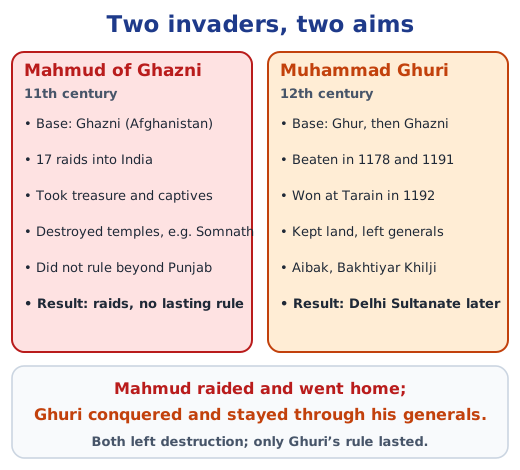
8. Why did Mahmud keep raiding while Muhammad Ghuri sought lasting control? How did their motives shape the outcomes? Mahmud’s power lay in Ghazni, and he came to India mainly for its wealth, the treasure stored in its temples and cities, and, as writers of his own time say, also to spread his version of Islam. So he raided, destroyed and returned home, and after his death the north Indian kingdoms carried on. Muhammad Ghuri, who took over a collapsing Ghaznavid empire, wanted land, revenue and lasting rule. He kept what he conquered, ran a centralised system with officers paid by temporary land assignments, and left trusted generals such as Qutb-ud-din Aibak behind. His aims led to the Delhi Sultanate and changed the politics of north India for centuries.
Practice
-
Which dynasty did Mahmud of Ghazni defeat to gain access to the Indus plains?
Show answer
Answer: (b) Hindu Shahis
-
The Thousand Pillar temple at Hanamkonda was built under the:
Show answer
Answer: (b) Kakatiyas
-
Who wrote the Gitagovindam?
Show answer
Answer: (a) Jayadeva
-
Why did the Cholas and the Srivijaya Empire become rivals?
Show answer
Answer: The Cholas traded busily with China, and one sea route to China passed through the Strait of Malacca, which the Srivijaya king controlled. Competition over this route led Rajendra I to send a punitive naval expedition.
-
Name two Indian rulers who defeated Muhammad Ghuri.
Show answer
Answer: The Chaulukya king Mularaja II (or his mother, Queen Naikidevi) defeated him near Mount Abu in 1178, and Prithviraja III of the Chahamanas defeated him at Tarain in 1191.
Stuck on a question?
Take a photo and Lagnever AI explains it step by step. Try it for 7 days for ₹2.
Get it on Google Play Open in browser
For parents: after the trial, the plan renews monthly by UPI or card autopay. You can cancel anytime in the app.