
Class 7 Social Science Part 2 Chapter 4: Turning Tides, 11th and 12th Centuries Notes
This chapter in five lines
Turning Tides covers India in the 11th and 12th centuries, a time of transition. Mahmud of Ghazni raided north India again and again, and later Muhammad Ghuri conquered Delhi and much of the Gangetic plains, causing great destruction, including at Nalanda. Yet most of India stayed under Indian kingdoms: the Cholas ruled the seas, regional kingdoms flourished, and trade, temples, science and Bhakti thought continued.
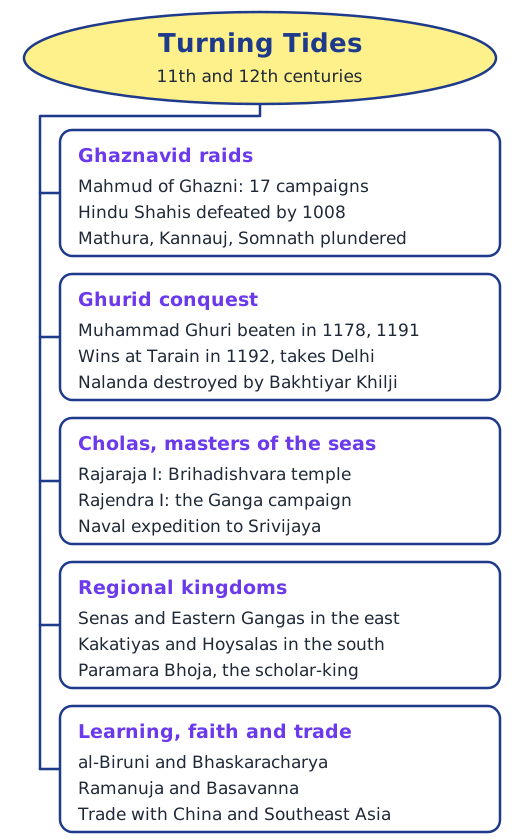
What is this chapter about?
The previous chapter ended with the Arabs, whose raids had little lasting effect on India. The 11th and 12th centuries were different. Turkic powers from the north-west pushed much deeper into north India, though they met stubborn resistance. The chapter opens with one invasion and closes with another, but between them many Indian kingdoms flourished: they fought the invaders (and one another), sent navies overseas, raised great temples and supported poets, saints and scientists. The book also adds a word of caution: history records wars more than peace, and it is better to study dark periods honestly, but no one living today can be held responsible for them.
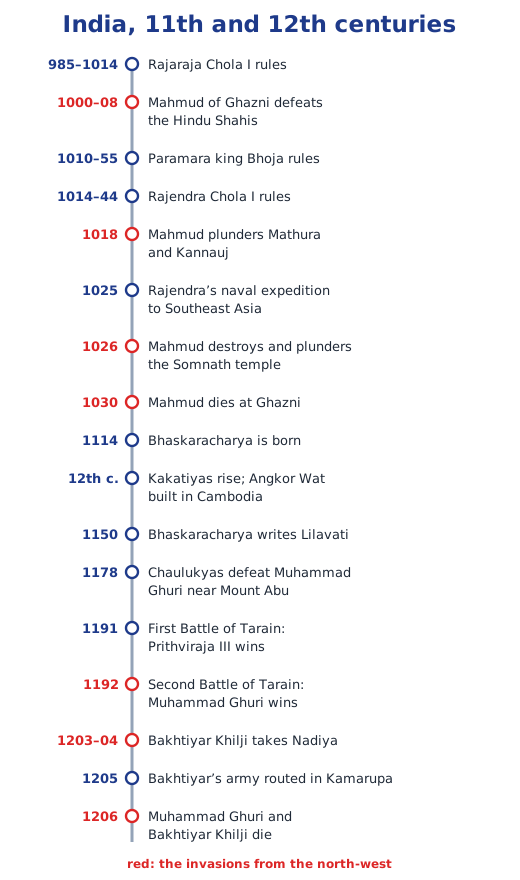
Mahmud of Ghazni
The Hindu Shahis ruled from present-day Afghanistan to Punjab and held the Khyber Pass, the main route through the Hindu Kush into the Indus plains. The Turkic Ghaznavids of Ghazni overran them: their ruler Mahmud defeated Jayapala and then, in 1008, his son Anandapala, even though other north Indian rulers had sent help. In all, Mahmud led 17 campaigns into India. He plundered Mathura and Kannauj in 1018 and destroyed the Somnath temple in 1026, carrying off huge treasure, and his armies killed and enslaved many civilians. He met strong resistance, from the Chandellas among others, yet he never tried to rule beyond Punjab. Read more in Ghaznavid and Ghurid invasions.
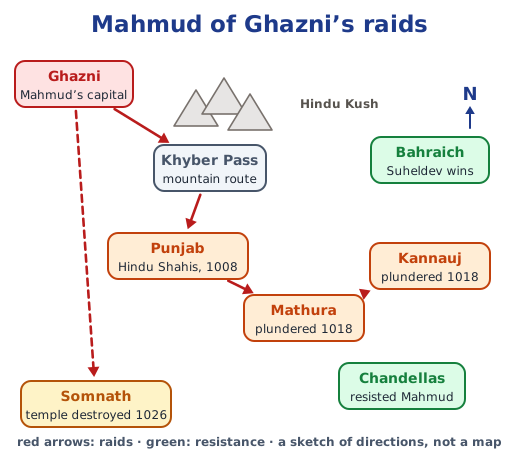
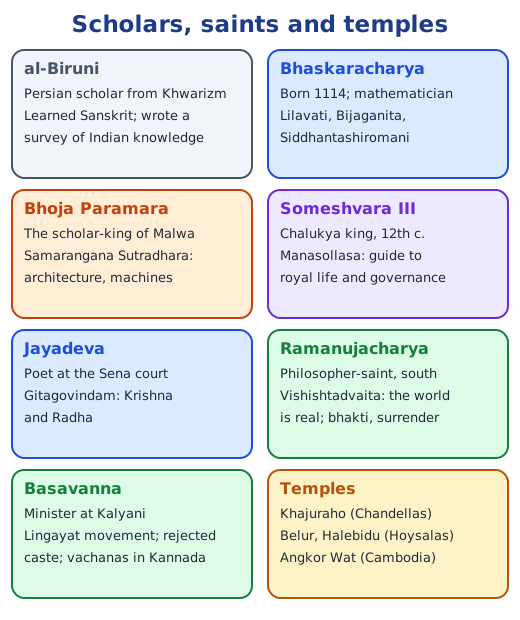
Mahmud brought with him the Persian scholar al-Biruni, who learned Sanskrit, talked with Indian scholars and wrote a detailed survey of Indian religion, philosophy and science. He also noted that Mahmud’s raids drove learning away to places such as Kashmir and Varanasi. Learning still thrived elsewhere: Bhaskaracharya, born in 1114, wrote Lilavati, a mathematics book full of lively riddles, along with Bijaganita and Siddhantashiromani.
The east and the south
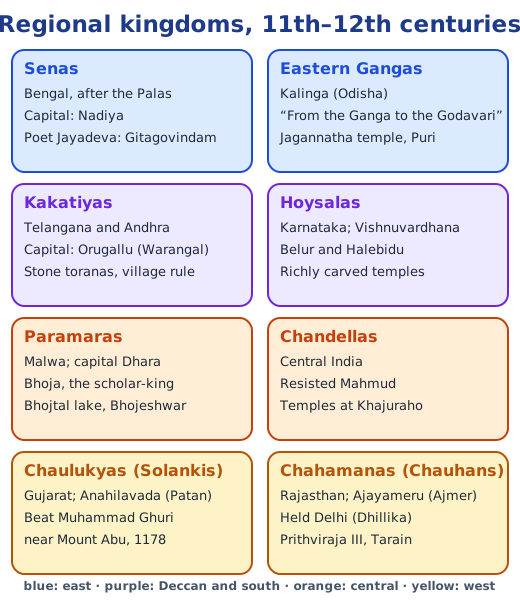
After the Palas, the Senas ruled much of Bengal from Nadiya and hosted the poet Jayadeva, author of the Gitagovindam. In Kalinga, the Eastern Gangas began the Jagannatha temple at Puri. In the Deccan, the Kakatiyas ruled from Orugallu (Warangal), with its stone gateways, and the Hoysalas of Karnataka built the richly carved temples of Belur and Halebidu. See regional kingdoms of the 11th and 12th centuries.
Further south, the Cholas became masters of the seas. Rajaraja I conquered northern Sri Lanka and built the Brihadishvara temple at Thanjavur. His son Rajendra I campaigned as far as Bengal, took the title Gangaikondachola and, in 1025, sent a navy against the Srivijaya Empire, which controlled a sea route to China. Read the Chola Empire.
The Ghurids: a turning point
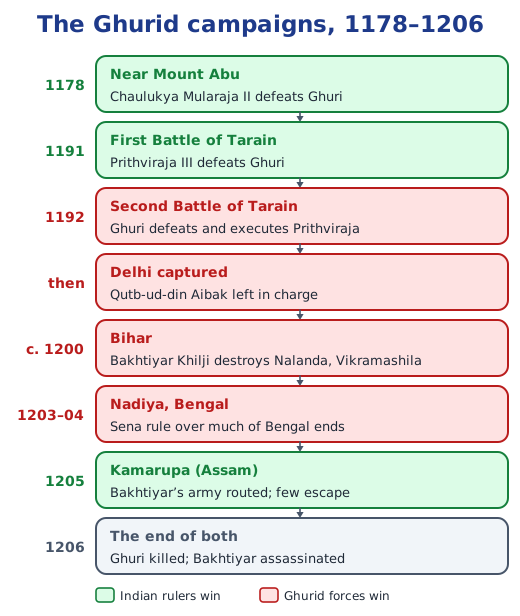
Back in the north, Bhoja Paramara of Malwa was a scholar-king. Meanwhile Muhammad Ghuri of Ghur took Ghazni and moved into India. He was defeated near Mount Abu in 1178 by the Chaulukyas of Gujarat and at Tarain in 1191 by Prithviraja III, but he won the Second Battle of Tarain in 1192 and took Delhi. Unlike Mahmud, he left generals behind to hold the land; one of them, Qutb-ud-din Aibak, later founded the Delhi Sultanate. Another, Bakhtiyar Khilji, destroyed the great monasteries and universities of Nalanda and Vikramashila, ended Sena rule over Bengal, and then lost most of his army in Kamarupa in 1205.
Governance, trade and culture
Constant war meant large armies, so kingdoms needed strong administration to collect tribute and taxes; Muhammad Ghuri’s system was more centralised, with temporary land grants to officers. Trade with China and Southeast Asia grew steadily, though farming remained the base of the economy. Kings and scholars wrote widely, from Someshvara III’s Manasollasa to Bhoja’s treatises, and the Chandellas built the temples of Khajuraho. Ramanujacharya taught vishishtadvaita, and Basavanna founded the Lingayat movement against caste distinctions.
Taking stock
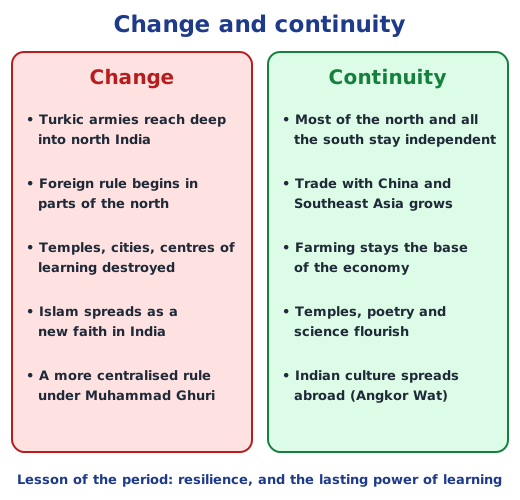
The period brought real change: plunder, the destruction of temples and centres of learning, foreign rule beginning in parts of the north, and Islam spreading as a new faith. But much continued: large parts of the north and all of the south stayed independent, trade and guilds carried on, and Indian culture travelled to Southeast Asia, where Angkor Wat was built. Compare with Part 2 Chapter 3 on the kingdoms of the Deccan and the south, and find every answer in the NCERT solutions for Part 2 Chapter 4.
Key terms
| Term | Meaning |
|---|---|
| Turkic | Belonging to the peoples, languages and cultures of a huge region stretching from Central Asia to Turkey and Siberia. The Ghaznavids and Ghurids were Turkic powers. |
| Sultan | An Arabic word for authority or power, later used in Muslim lands for a sovereign ruler. Mahmud of Ghazni took this title. |
| Khyber Pass | A main route through the Hindu Kush mountains between present-day Afghanistan and the Indus plains, used for centuries by traders, Buddhist monks and invaders. |
| Hindu Shahis | A dynasty that ruled from present-day Afghanistan to Punjab and held the Khyber Pass until Mahmud of Ghazni overran them in the early 11th century. |
| Punitive expedition | A campaign meant to punish a rival rather than to occupy its land, like Rajendra Chola’s naval raid on the Srivijaya Empire. |
| Merchant guild | An association of traders. Indian guilds backed the Chola navy and kept trade going through the wars of this period. |
| Vishishtadvaita | Ramanujacharya’s school of Vedanta, which holds that the world and individual souls are real and teaches bhakti and surrender to the divine. |
| Lingayat movement | The movement founded by Basavanna, which rejected caste and ritual and taught personal devotion and dedicated work. |
| Anubhava Mandapa | ‘Pavilion of experience’: the hall Basavanna set up at Kalyani where men and women of every background met to discuss life, values and religion. |
| Transition | A period when one state of affairs gives way to another. Historians study both what changed and what continued. |
Topics in this chapter
Practice
-
Which mountain pass did many invaders use to enter the Subcontinent from the north-west?
Show answer
Answer: (a) Khyber Pass
-
Who built the Brihadishvara temple at Thanjavur?
Show answer
Answer: (b) Rajaraja Chola I
-
Who won the Second Battle of Tarain in 1192?
Show answer
Answer: (b) Muhammad Ghuri
-
The Hoysala temples at Belur and Halebidu are in present-day:
Show answer
Answer: (c) Karnataka
-
Which scholar-king of Malwa wrote Samarangana Sutradhara?
Show answer
Answer: (a) Bhoja
-
Who destroyed the universities of Nalanda and Vikramashila?
Show answer
Answer: (c) Bakhtiyar Khilji
Questions students ask
What are the main topics of Class 7 SST Part 2 Chapter 4?
The raids of Mahmud of Ghazni and the end of the Hindu Shahis; the scholars al-Biruni and Bhaskaracharya; the Senas, Eastern Gangas, Kakatiyas, Hoysalas and Paramaras; the Chola Empire and its navy; the Ghurid conquest of north India and the destruction of Nalanda; and governance, trade and cultural life, including Ramanuja and Basavanna.
Why are the 11th and 12th centuries called a turning point?
Turkic invaders reached deep into north India. Mahmud of Ghazni raided and plundered, and Muhammad Ghuri and his generals began foreign rule in parts of the north, which later grew into the Delhi Sultanate. Yet large parts of the north and all of the south stayed with Indian kingdoms, and trade, art and learning continued.
Is Turning Tides in the new Class 7 SST Part 2 book?
Yes. It is Chapter 4 of Exploring Society: India and Beyond, Grade 7 Part 2 (2026-27), on pages 97 to 124, in the history theme Tapestry of the Past.
Stuck on a question?
Take a photo and Lagnever AI explains it step by step. Try it for 7 days for ₹2.
Get it on Google Play Open in browser
For parents: after the trial, the plan renews monthly by UPI or card autopay. You can cancel anytime in the app.