
Regional kingdoms of the 11th and 12th centuries
Answer in short
Besides the Cholas, many regional kingdoms flourished in the 11th and 12th centuries. The Senas ruled Bengal, the Eastern Gangas Kalinga, the Kakatiyas Telangana and Andhra, and the Hoysalas Karnataka. Bhoja Paramara of Malwa was a famed scholar-king, while the Chaulukyas of Gujarat and the Chahamanas of Rajasthan fought Muhammad Ghuri.
Stuck on a question? Take a photo and Lagnever AI explains it step by step. Try it for 7 days for ₹2. Get it on Google Play
The east: Senas and Eastern Gangas
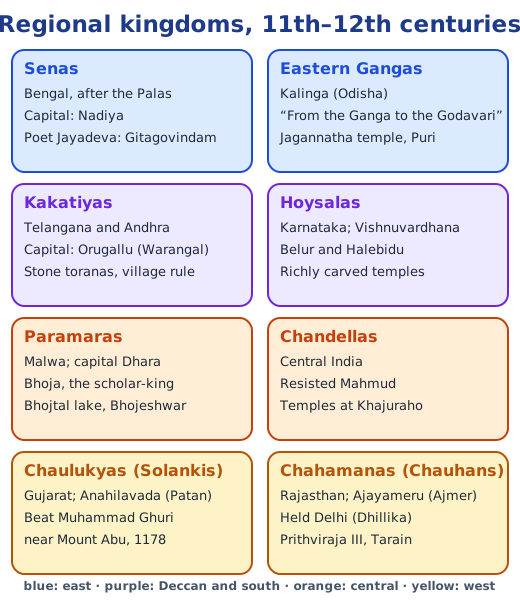
While the north faced the Ghaznavid raids, eastern India saw a different scene. After the Palas declined, the Senas became the leading power in Bengal, ruling from Nadiya (today’s Nadia district). Their ties with neighbouring Kamarupa (Assam) and Kalinga swung between friendship and war. Unlike the Palas, who backed Buddhist monasteries, the Senas encouraged Hindu learning and literature and hosted poets such as Jayadeva, whose Gitagovindam tells the story of Krishna and Radha.
Down the coast in Kalinga, roughly present-day Odisha, ruled the Eastern Gangas. They married into the Chola family yet sometimes fought the Cholas. By the end of the 12th century they were among the steadiest powers of the east, with a kingdom stretching “from the Ganga to the Godavari”, as their inscriptions claim. They began the Jagannatha temple at Puri and later, in the mid-13th century, the great Sun temple at Konark.
The Deccan: Kakatiyas and Hoysalas
The Western Chalukyas of Kalyani fought the Cholas for years over Vengi, the fertile land of the Eastern Chalukyas. They faded, and two new powers grew in their place. In the 12th century the Kakatiyas took firm control of most of today’s Telangana and Andhra Pradesh. Their capital, Orugallu (Warangal), had a fort with impressive stone gateways, or toranas, and they built the Thousand Pillar temple at Hanamkonda. They supported Telugu literature, strong village self-government, an efficient revenue system and irrigation.
The Hoysalas came from southern Karnataka. A legend, told in inscriptions and temple carvings, explains their name: when a tiger appeared at a Jain temple, the ascetic there cried “Poy, Sala!” (“strike, Sala!”), and their founder Sala obeyed and saved his life. From Velapura (Belur) and Dvarasamudra (Halebidu), King Vishnuvardhana broke away from the Chalukyas and took most of Karnataka. Their temples, with carved pillars, sculptures and panels, are famous; three are UNESCO World Heritage monuments.
Central India: Bhoja Paramara and the Chandellas
The Paramaras, once vassals of the Pratiharas and Rashtrakutas, ruled Malwa from Dhara (Dhar). Their greatest king, Bhoja, ruled from 1010 for almost fifty years, from the Konkan coast to parts of Rajasthan, and sent troops to help the Hindu Shahis against Mahmud. A scholar-king, he wrote Samarangana Sutradhara on architecture, town planning and machines, along with works on governance, poetry and medicine. He made a vast lake near Bhopal, a name said to come from ‘Bhojpal’, and began the never-finished Bhojeshwar temple. The Chandellas of central India resisted Mahmud and built dozens of temples at Khajuraho, such as the Kandariya Mahadeva temple.
The west: Chaulukyas and Chahamanas
The Chaulukyas, or Solankis, ruled Gujarat and parts of Rajasthan from Anahilavada (Patan). In 1178 their king Mularaja II, or by another account his mother, Queen Naikidevi, defeated Muhammad Ghuri near Mount Abu. The Chahamanas, or Chauhans, ruled most of Rajasthan from Ajayameru (Ajmer) and also held Delhi, then called Dhillika. Their king Prithviraja III defeated Ghuri at Tarain in 1191 but lost to him there in 1192.
Why it matters
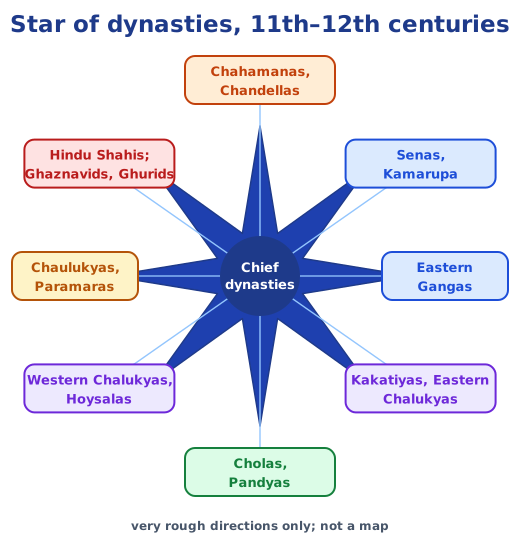
These kingdoms show that, even in an age of invasions, much of India was ruled by its own dynasties, which built temples, lakes and forts and supported literature. Read about the Chola Empire and the Ghaznavid and Ghurid invasions. Answers to the textbook questions are in the NCERT solutions for Part 2 Chapter 4; see all of Part 2 Chapter 4 notes.
Practice
-
The Kakatiya capital Orugallu is today’s:
Show answer
Answer: (b) Warangal
-
Which dynasty began building the Jagannatha temple at Puri?
Show answer
Answer: (b) Eastern Gangas
-
The poet Jayadeva, author of the Gitagovindam, was supported by the:
Show answer
Answer: (a) Senas
-
How did the Hoysalas get their name, according to legend?
Show answer
Answer: When their founder Sala was worshipping at a Jain temple, a tiger appeared, and the ascetic meditating there cried “Poy, Sala”, which means “strike, Sala” in old Kannada. Sala killed the tiger and saved the ascetic, who blessed him with kingship, and ‘Poy Sala’ became ‘Hoysala’.
-
Why is Bhoja Paramara called a scholar-king?
Show answer
Answer: Bhoja wrote on many subjects himself: Samarangana Sutradhara on architecture, town planning and machines, works on governance, poetry and medicine, and a commentary on the Yogasutras. He also drew scholars, poets and artists from across India to his capital, Dhara.
Questions students ask
Which regional kingdoms rose in the 11th and 12th centuries?
In the east, the Senas of Bengal and the Eastern Gangas of Kalinga; in the Deccan, the Kakatiyas and Hoysalas, who replaced the Western Chalukyas; in central India, the Paramaras of Malwa and the Chandellas; and in the west, the Chaulukyas of Gujarat and the Chahamanas of Rajasthan.
What are the Hoysalas known for?
The Hoysalas ruled most of present-day Karnataka from Belur and Halebidu. Under King Vishnuvardhana they broke away from the Chalukyas. They encouraged Kannada literature and built temples with finely carved pillars, sculptures and panels; three of their temples are UNESCO World Heritage monuments.
What did the Kakatiyas build?
The Kakatiyas built a fort at their capital Orugallu (Warangal) with impressive stone gateways called toranas, and the Thousand Pillar temple at Hanamkonda. They also built irrigation works and an efficient revenue system that made farming prosperous.
Stuck on a question?
Take a photo and Lagnever AI explains it step by step. Try it for 7 days for ₹2.
Get it on Google Play Open in browser
For parents: after the trial, the plan renews monthly by UPI or card autopay. You can cancel anytime in the app.