
The Chola Empire
Answer in short
The Cholas of present-day Tamil Nadu became masters of the seas in the 11th century. Rajaraja I conquered northern Sri Lanka and built the Brihadishvara temple at Thanjavur. His son Rajendra I campaigned up to the Ganga and, in 1025, sent a navy against the Srivijaya Empire. Long wars later weakened them, and the Pandyas absorbed them.
Stuck on a question? Take a photo and Lagnever AI explains it step by step. Try it for 7 days for ₹2. Get it on Google Play
Who were the Cholas?
The Cholas rose in present-day Tamil Nadu; in the previous chapter we saw them reborn under Vijayalaya in the 9th century (see kingdoms of the Deccan and the south). In the 11th century they became one of the most powerful dynasties of Asia, with Thanjavur, Gangaikondacholapuram and Kanchi (Kanchipuram) as their capitals. Most Chola kings were Shaivites, devotees of Shiva, but they supported other traditions too.
Rajaraja Chola I
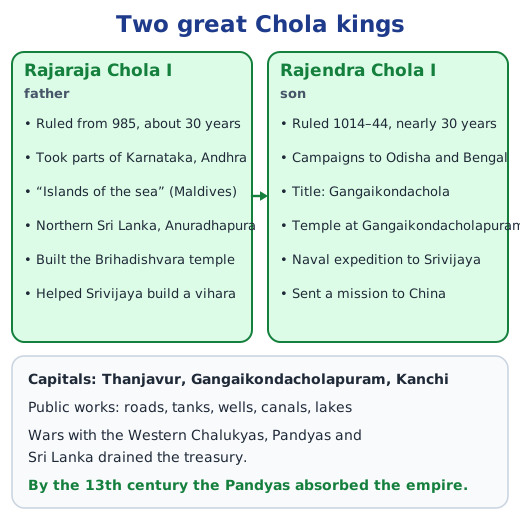
From 985, Rajaraja I ruled for about thirty years. He won territory in what is now Karnataka and Andhra Pradesh, and his inscriptions boast of taking the ‘islands of the sea’, which most historians take to be the Maldives. He also conquered northern Sri Lanka, including the kingdom of Anuradhapura. At Thanjavur he raised the Brihadishvara temple, also called Rajarajeshvaram after him, a masterpiece of architecture and engineering. Though a Shaivite, he helped the ruler of the Srivijaya Empire build a Buddhist vihara, or monastery, at Nagapattinam, then a major Chola port.
Rajendra Chola I
His son Rajendra I, who also ruled for nearly thirty years, pushed the empire further north, taking territory in today’s Odisha and Bengal. To celebrate, he took the title Gangaikondachola, “the Chola who seized (or brought) the Ganga”, a nod both to his northern campaigns and to the sacred river. His temple at Gangaikondacholapuram, one of the Chola capitals, celebrates his victory over the rulers of the north. He also tightened Chola rule over northern Sri Lanka, first won by his father; it stayed part of the Chola Empire for about half a century, until King Vijayabahu I drove the Cholas out after several battles.
The naval expedition to Srivijaya
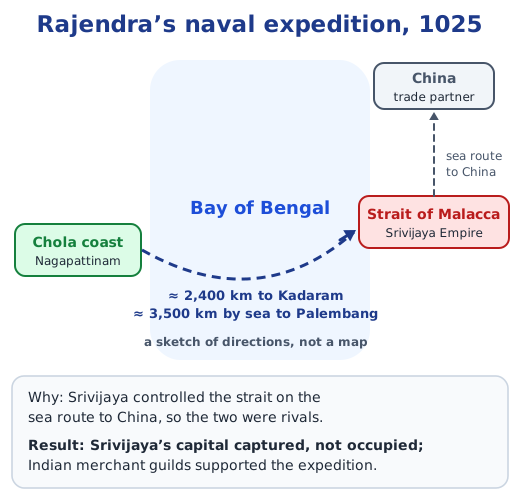
Under the Cholas, trade with China flourished, as finds and inscriptions show, and Rajendra even sent a diplomatic mission there. But one sea route to China ran through the Strait of Malacca, the narrow waters between the Malay Peninsula and Sumatra, and the Srivijaya king controlled it. In 1025 Rajendra’s navy crossed the Bay of Bengal, defeated the Srivijaya forces and captured their capital. He did not try to occupy the empire: it was a punitive expedition, backed by many Indian merchant guilds, and it appears to have served its purpose. Relations were not only hostile, though. A Srivijaya ruler gave gifts to Nalanda and, with the Pala king’s permission, built another monastery there.
Life at home and decline
At home the Cholas built roads, tanks, wells, irrigation canals and artificial lakes. A painting at the Brihadishvara temple shows the king standing respectfully beside his guru. But their constant wars, especially with the Western Chalukyas, the Pandyas and the rulers of Sri Lanka, drained the treasury. By the 13th century the empire had shrunk a great deal, and the Pandyas finally absorbed it.
Why it matters
The Cholas show India’s power at sea and how trade and culture linked India with Southeast Asia and China. Read about the other kingdoms of this period in regional kingdoms of the 11th and 12th centuries and about the north in Ghaznavid and Ghurid invasions. Answers to the textbook questions are in the NCERT solutions for Part 2 Chapter 4; see all of Part 2 Chapter 4 notes.
Practice
-
Which Chola king built the Brihadishvara temple?
Show answer
Answer: (b) Rajaraja I
-
The title Gangaikondachola means:
Show answer
Answer: (a) the Chola who seized (or brought) the Ganga
-
The Srivijaya Empire controlled the:
Show answer
Answer: (b) Strait of Malacca
-
Why did Rajendra send his navy against Srivijaya?
Show answer
Answer: Chola trade with China was booming, but one sea route to China passed through the Strait of Malacca, which the Srivijaya king controlled. This made them rivals, so Rajendra sent a punitive expedition, backed by Indian merchant guilds, which defeated Srivijaya and captured its capital.
-
What led to the decline of the Cholas?
Show answer
Answer: Frequent, long wars with neighbours, especially the Western Chalukyas, the Pandyas and the rulers of Sri Lanka, drained the treasury. By the 13th century the empire had shrunk a great deal and was finally absorbed by the Pandyas.
Questions students ask
Who was Rajaraja Chola I?
Rajaraja I ruled the Chola kingdom for about three decades from 985. He won territory in what is now Karnataka and Andhra Pradesh, the ‘islands of the sea’ (most likely the Maldives) and northern Sri Lanka, and built the Brihadishvara temple at Thanjavur.
What did Rajendra Chola I achieve?
Rajendra I, Rajaraja’s son, ruled for nearly 30 years. He conquered parts of Odisha and Bengal, took the title Gangaikondachola, extended Chola rule in northern Sri Lanka, sent a mission to China and led a successful naval expedition against the Srivijaya Empire in Southeast Asia.
Why are the Cholas called masters of the seas?
Their navy carried Chola power across the water: Rajaraja took the Maldives and northern Sri Lanka, and Rajendra’s fleet crossed the Bay of Bengal to defeat Srivijaya. Chola ports also carried a busy trade with China and Southeast Asia.
Stuck on a question?
Take a photo and Lagnever AI explains it step by step. Try it for 7 days for ₹2.
Get it on Google Play Open in browser
For parents: after the trial, the plan renews monthly by UPI or card autopay. You can cancel anytime in the app.