
Kingdoms of the Deccan and the south
Answer in short
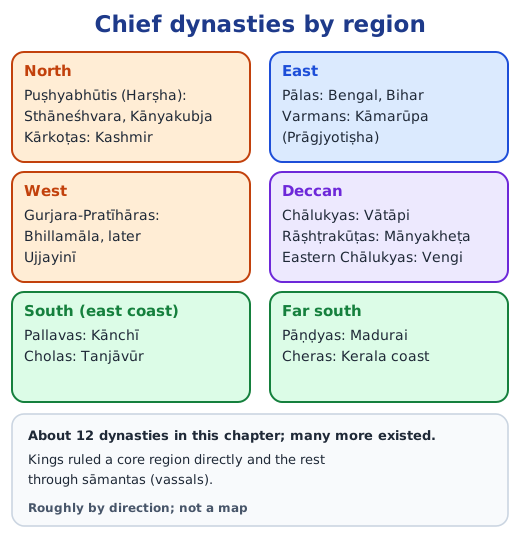
From the 6th to the 10th centuries, powerful kingdoms ruled the Deccan and the south. The Chalukyas of Vatapi were replaced by the Rashtrakutas of Manyakheta, while the Eastern Chalukyas ruled from Vengi. In the south, the Pallavas of Kanchi, the Pandyas of Madurai and the Cheras of Kerala were followed by the rising Cholas of Thanjavur.
Stuck on a question? Take a photo and Lagnever AI explains it step by step. Try it for 7 days for ₹2. Get it on Google Play
A crowded Deccan and south
After the Vakataka dynasty ended, several strong kingdoms competed for the Deccan Plateau and the far south. They often fought, sometimes allied, and almost all of them built temples, supported learning and traded overseas.
The Chalukyas
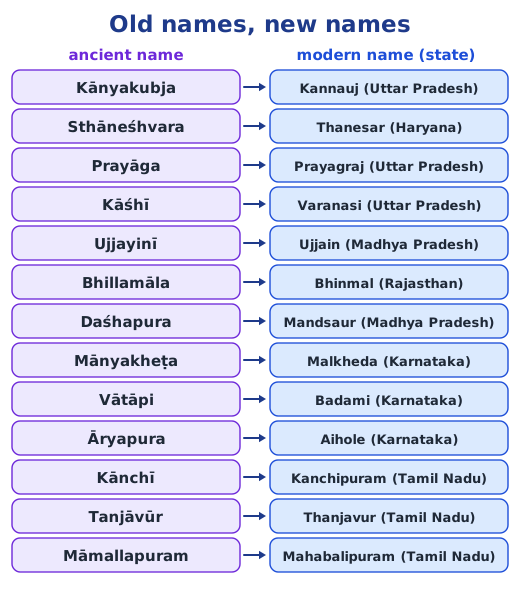
Pulakeshin I founded the Chalukya dynasty in the mid-6th century. His grandson Pulakeshin II stopped Harsha’s march south and widened the kingdom. The capital, Vatapi (Badami), has fine Hindu and Jain cave temples, and the older capital, Aryapura (Aihole), has more than 100 temples of the Hindu, Buddhist and Jain faiths. At Aihole, the court poet Ravikirti praised Pulakeshin II in a long inscription on the Meguti Jain temple, though some of its claims are exaggerated. Xuanzang wrote that the king’s good deeds were felt far and wide. In the early 7th century, Harsha held the land north of the Vindhyas, and Pulakeshin II the land to their south.
Pulakeshin II was later defeated by the Pallavas, and in the mid-8th century the Rashtrakutas took over the Deccan. A branch, the Eastern Chalukyas, ruled from Vengi in Andhra Pradesh, where Telugu and Kannada literature grew; another revived the dynasty at Kalyani from the 10th century.
The Rashtrakutas
From Manyakheta (Malkheda in Karnataka) the Rashtrakutas were one of the strongest powers for nearly two centuries. Krishna I had the Kailasha temple at Ellora carved out of a hillside: it is not built but sculpted, the largest rock-cut temple in India. Amoghavarsha I, called Nripatunga, ‘peak of kings’, ruled for 64 years, was drawn to Jainism while supporting Hindu temples, and wrote in Sanskrit and Kannada; Nrupatunga Road in Bengaluru is named after him. The Arab traveller Al-Masudi praised a Rashtrakuta king for his army and for protecting Muslims in his kingdom.
The Pallavas
From Kanchi (Kanchipuram), the Pallavas peaked in the 7th century under Mahendravarman I, a poet who wrote a satirical play, and his son Narasimhavarman I, called Mamalla, who defeated Pulakeshin II and captured Badami before returning, with the Tungabhadra as an unofficial border. He also sent a fleet to Sri Lanka to help a prince regain his throne. Kanchi traded in spices, silk and ivory, and the port of Mamallapuram has yielded Chinese, Persian and Roman coins. There the Pallavas carved caves and monolithic temples, including a lively relief of Durga fighting the buffalo demon. They supported Jain, Vaishnava and Shaiva traditions and Sanskrit and Tamil poets. The Chola king Aditya I overthrew them in the late 9th century.
Pandyas, Cheras and Cholas
These three kingdoms, named in Ashoka’s edicts and Sangam poetry long before, rose again. The Pandyas, from Madurai, ruled southern Tamil Nadu by the 6th century, traded with Southeast Asia through ports such as Korkai, and had the Mahabharata translated into Tamil. The Cheras, or Chera Perumals, kept their independence on the Kerala coast. The Cholas returned under Vijayalaya in the 9th century with their capital at Thanjavur, and his son Aditya I defeated the Pallavas. The Cholas went on to build one of the largest empires of south India, with an efficient government, a strong navy, grand temples, bronzes such as the Nataraja, and rich farms in the Kaveri delta.
Why it matters
These kingdoms gave India some of its greatest monuments, from Ellora to Mamallapuram, and kept the south linked by sea to the wider world. Compare the north in Harsha and the struggle for Kannauj and read about daily life in society and culture, 6th to 10th centuries. Answers to the textbook questions are in the NCERT solutions for Part 2 Chapter 3; see all of Part 2 Chapter 3 notes.
Practice
-
The capital of the Chalukyas of Pulakeshin II was:
Show answer
Answer: (b) Vatapi
-
Which Pallava king defeated Pulakeshin II and captured Badami?
Show answer
Answer: (b) Narasimhavarman I
-
Which Rashtrakuta king ruled for 64 years?
Show answer
Answer: (c) Amoghavarsha I
-
What do the coins found at Mamallapuram tell us?
Show answer
Answer: Ancient Chinese, Persian and Roman coins found there show that the Pallava port traded with distant lands across the seas.
-
Why should the Aihole inscription of Ravikirti be read with care?
Show answer
Answer: It praises Pulakeshin II in a very poetic style, and some of its ‘facts’ are contradicted by other inscriptions, so it contains exaggerations and must be checked against other sources.
Questions students ask
Which kingdoms ruled south India from the 6th to 10th centuries?
The Pallavas of Kanchi, the Pandyas of Madurai, the Cheras on the Kerala coast and, from the 9th century, the Cholas of Thanjavur. In the Deccan, the Chalukyas, the Rashtrakutas and the Eastern Chalukyas ruled.
Who built the Kailasha temple at Ellora?
The Rashtrakuta king Krishna I had it carved out of a hillside at Ellora. It is the largest rock-cut temple in India.
Why are the Pallavas remembered?
For their capital Kanchi, a centre of culture and trade; for the rock-cut and monolithic temples of Mamallapuram; for their sea trade with Sri Lanka and Southeast Asia; and for supporting Sanskrit and Tamil literature.
Stuck on a question?
Take a photo and Lagnever AI explains it step by step. Try it for 7 days for ₹2.
Get it on Google Play Open in browser
For parents: after the trial, the plan renews monthly by UPI or card autopay. You can cancel anytime in the app.