
Harsha and the struggle for Kannauj
Answer in short
Harshavardhana ruled north India from Kannauj from 606 CE. A poet and patron of scholars such as Bana, he respected all faiths, and the pilgrim Xuanzang praised him. After he died in 647, the Palas of the east, the Gurjara-Pratiharas of the west and the Rashtrakutas of the Deccan fought over Kannauj for two centuries, with no lasting winner.
Stuck on a question? Take a photo and Lagnever AI explains it step by step. Try it for 7 days for ₹2. Get it on Google Play
The ‘great king of kings’
In 606 CE Harshavardhana came to the throne. His family, the Pushyabhuti (or Vardhana) dynasty, earlier ruled from Sthaneshvara, today’s Thanesar in Haryana, but Harsha ruled from Kannauj (Kanyakubja) on the Ganga in present-day Uttar Pradesh. A copper plate found at Banskhera carries his signature, calling him the great king of kings. His empire spread over much of northern and eastern India, though its exact extent is not known.
Harsha was a fine poet and is thought to have written three Sanskrit plays. He supported the writer Bana, whose Kadambari is one of the world’s first novels and whose Harshacharita is a biography of the king. Inscriptions call Harsha a devotee of Shiva, while other sources show his attachment to Buddhism and respect for all schools of thought.
Xuanzang’s visit
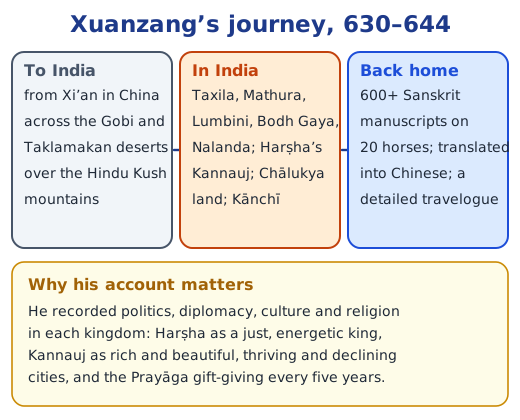
The Chinese pilgrim Xuanzang travelled around India from 630 to 644 to visit Buddhist sites and study with Indian teachers. He carried home more than 600 Sanskrit manuscripts on 20 horses and translated them into Chinese. Harsha welcomed him and held a great assembly at Kannauj in his honour. Xuanzang described Kannauj as beautiful and prosperous and Harsha as just and energetic, with a vast army. Every five years, at Prayaga, where the Ganga and Yamuna meet, Harsha performed sacred rites and gave away wealth to Buddhists, Brahmins and the poor.
Harsha could not unite all of north India. He made an ally of the Varman dynasty of Kamarupa in Assam, but when he tried to move south of the Narmada, Pulakeshin II of the Chalukyas stopped him.
The Tripartite Struggle
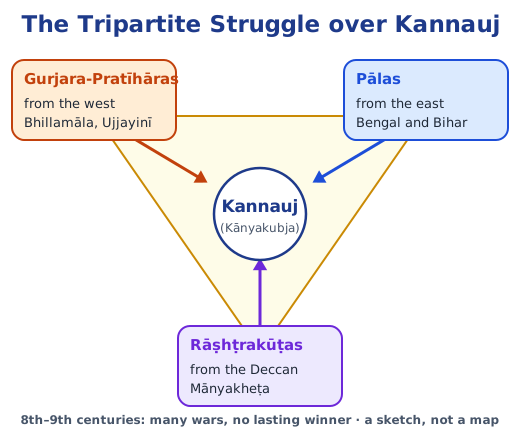
Harsha died in 647, and north India fell into turmoil. Kannauj, rich, central and famous, became the prize in a long Tripartite Struggle in the 8th and 9th centuries between three powers. Their wars went back and forth, and none won for good.
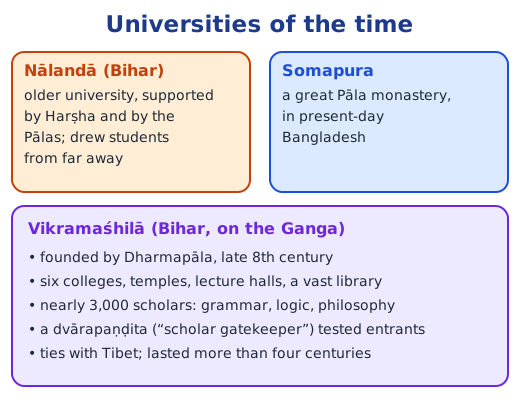
The Palas. An inscription says that in 750 the people of Bengal, then in disorder, picked Gopala to bring back order. His successor Dharmapala spread Pala rule across much of the east and north, supported Mahayana Buddhism and founded the great monasteries of Vikramashila in Bihar and Somapura in present-day Bangladesh, while also supporting Nalanda. Sea trade from east-coast ports linked the Palas with Southeast Asia.
The Gurjara-Pratiharas. Founded in the mid-8th century by Nagabhata I, probably in western India, they first ruled from Bhillamala (Bhinmal) and later from Ujjayini. They became famous for pushing back Arab invasions. In the 9th century King Bhoja, also called Mihira and Adi Varaha, ruled from Punjab and Kathiawar to Kannauj.
The Rashtrakutas. Dantidurga overthrew the Chalukyas in the mid-8th century, and the Rashtrakutas ruled from Manyakheta in Karnataka for nearly two centuries. Their armies reached Kannauj, and they later destroyed it, which weakened the Pratiharas.
Why it matters
The story of Kannauj shows how one rich city could draw kings into centuries of war, and yet the same rulers built universities and supported learning. Continue with kingdoms of the Deccan and the south and society and culture, 6th to 10th centuries. Answers to the textbook questions are in the NCERT solutions for Part 2 Chapter 3; see all of Part 2 Chapter 3 notes.
Practice
-
Harsha belonged to which dynasty?
Show answer
Answer: (b) Pushyabhuti
-
Which Pala king founded Vikramashila?
Show answer
Answer: (b) Dharmapala
-
The Chinese pilgrim who visited Harsha’s court was:
Show answer
Answer: (b) Xuanzang
-
Why was Kannauj so prized?
Show answer
Answer: It lay on the Ganga in the fertile plains at the heart of north India, on major river and trade routes, and as Harsha’s capital it carried great prestige. Whoever held it could claim to lead north India.
-
How did the Pala dynasty begin?
Show answer
Answer: After Harsha’s death, Bengal fell into disorder. According to an inscription, the people chose Gopala in 750 CE to restore stability, and he became the first Pala king.
Questions students ask
Who was Harshavardhana?
Harshavardhana, or Harsha, was a king of the Pushyabhuti dynasty who ruled from Kannauj from 606 CE over much of northern and eastern India. He was a poet and playwright, a patron of scholars and of Nalanda, and respected all schools of thought.
What was the Tripartite Struggle?
It was the long contest for Kannauj in the 8th and 9th centuries between three powers: the Palas of the east, the Gurjara-Pratiharas of the west and the Rashtrakutas of the Deccan. None of them won lastingly.
Why is Xuanzang important for historians?
The Chinese pilgrim travelled in India from 630 to 644 and kept a careful record of the politics, culture and religion of the kingdoms he crossed, so his travelogue is a major source for this period.
Stuck on a question?
Take a photo and Lagnever AI explains it step by step. Try it for 7 days for ₹2.
Get it on Google Play Open in browser
For parents: after the trial, the plan renews monthly by UPI or card autopay. You can cancel anytime in the app.