
Class 7 Social Science Part 2 Chapter 3: Empires and Kingdoms, 6th to 10th Centuries Notes
This chapter in five lines
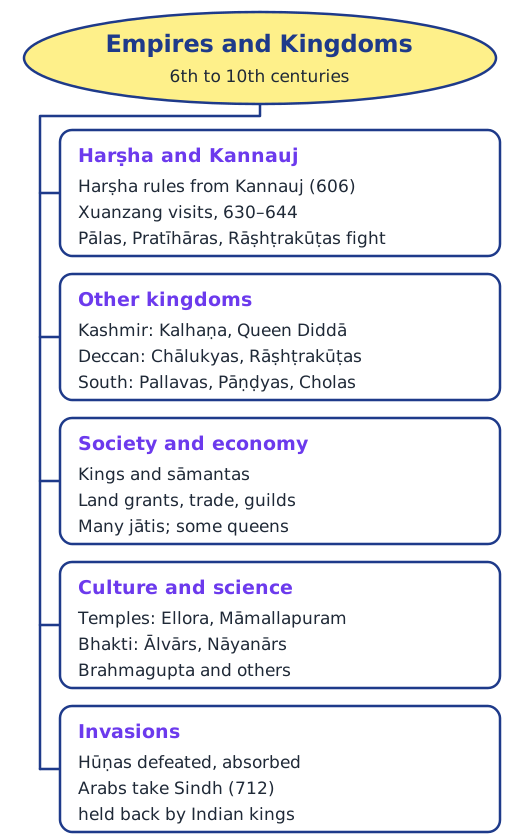
Empires and Kingdoms covers India from about 600 to 1000 CE, after the Gupta Empire. Harsha ruled north India from Kannauj, and after him three powers fought over that city: the Palas, the Rashtrakutas and the Gurjara-Pratiharas. In the Deccan and the south, the Chalukyas, Pallavas, Pandyas, Cheras and Cholas rose. Many regional kingdoms meant rivalry, but also temples, universities, Bhakti poetry, new mathematics and wide trade. The Hunas were absorbed, and the Arabs conquered only Sindh.
What is this chapter about?
By about 600 CE the Gupta Empire had lost its hold. For the next centuries no single empire ruled most of India; instead, strong regional kingdoms rose, fought and allied with one another. The chapter asks whether this was an age of disorder or the dawn of something new, and shows a land full of new ideas, art and learning, different in each region yet part of one India.
Harsha and Xuanzang
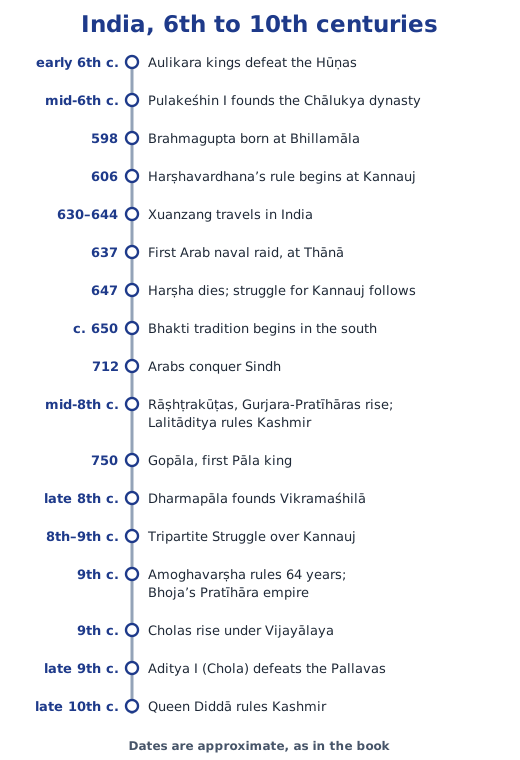
Harshavardhana of the Pushyabhuti dynasty, earlier based at Thanesar, began ruling from Kannauj on the Ganga in 606. He was a poet and playwright, supported the writer Bana, author of the novel Kadambari and of Harsha’s biography, and patronised Nalanda. Inscriptions call him a devotee of Shiva, and he also cared deeply for Buddhism. The Chinese pilgrim Xuanzang, who travelled in India from 630 to 644, describes Harsha as just and energetic and Kannauj as rich; every five years Harsha gave away his wealth at Prayaga. His push south was stopped at the Narmada by Pulakeshin II of the Chalukyas. Read more in Harsha and the struggle for Kannauj.
The struggle for Kannauj
After Harsha died in 647, three powers fought over Kannauj, the prize of north India, during the 8th and 9th centuries: the Palas of the east, the Gurjara-Pratiharas of the west and the Rashtrakutas of the Deccan. No one won for good.
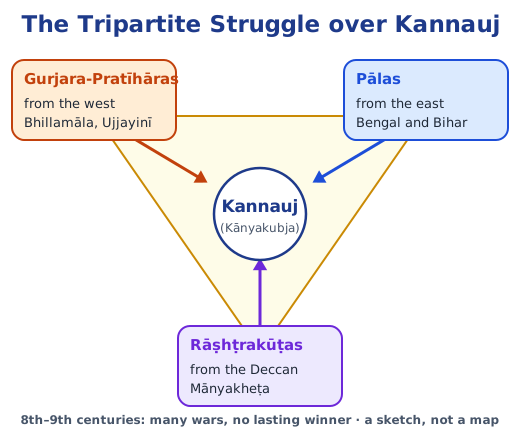
The Pala king Dharmapala founded the university of Vikramashila; the Gurjara-Pratihara kings Nagabhata I and Bhoja held back Arab armies and ruled much of the north; and the Rashtrakutas, with their capital at Manyakheta, carved the Kailasha temple at Ellora. Far north, Kalhana’s Rajatarangini records Kashmir’s rulers, such as Lalitaditya and Queen Didda, and Kashmir shone with Sanskrit learning.
The Deccan and the south
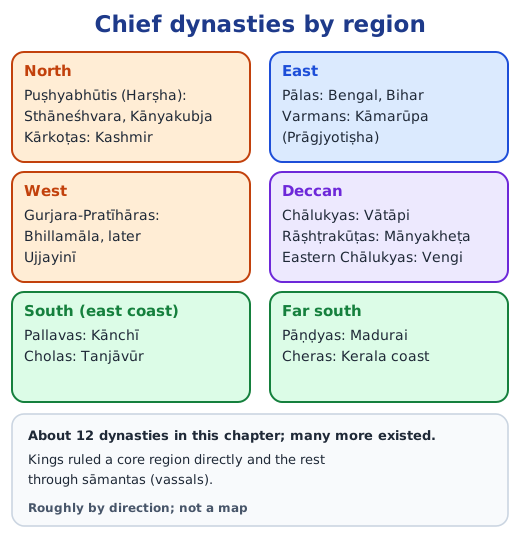
The Chalukyas of Vatapi (Badami) built cave temples at Badami and over a hundred temples at Aihole; the Rashtrakutas replaced them in the mid-8th century, while the Eastern Chalukyas ruled from Vengi. The Pallavas of Kanchi carved rock temples at Mamallapuram and traded with Southeast Asia. Further south, the Pandyas ruled from Madurai, the Cheras held the Kerala coast, and the Cholas rose in the 9th century at Thanjavur. See kingdoms of the Deccan and the south.
Society, economy and culture
Kings ruled their core regions directly and the rest through samantas (vassals). Land grants, irrigation tanks and trade by land and sea grew, and merchant guilds were strong. New jatis formed, and some women became queens. Rulers supported Hindu, Buddhist and Jain institutions, and the Bhakti tradition spread from the Tamil Alvars and Nayanars across India. Brahmagupta and other mathematicians made lasting advances. Read society and culture, 6th to 10th centuries.
Foreign invasions
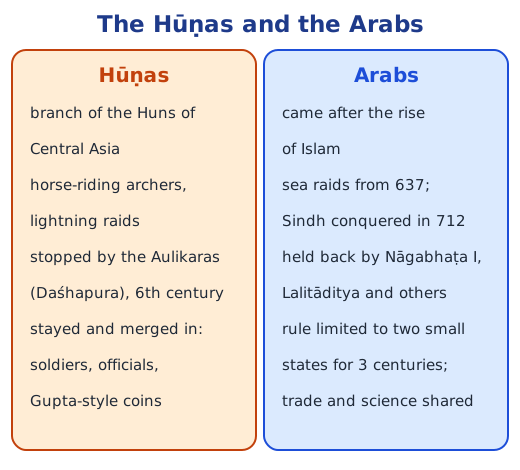
The Hunas pushed into the Ganga plains in the early 6th century but were defeated by the Aulikara kings of Dashapura (Mandsaur) and soon merged into Indian society. The Arabs raided the west coast from 637 and conquered Sindh in 712 under Muhammad bin Qasim, but Indian kings such as Nagabhata I and Lalitaditya held them back; for three centuries their rule stayed limited to two small states. Meanwhile trade, ideas and the Indian numerals crossed the Arabian Sea. Answers to every question are in the NCERT solutions for Part 2 Chapter 3.
Key terms
| Term | Meaning |
|---|---|
| Tripartite Struggle | The long fight over Kannauj in the 8th and 9th centuries between three powers: the Palas, the Rashtrakutas and the Gurjara-Pratiharas. |
| Samanta | A subordinate ruler, or vassal, who governed a region for a king, paid tribute and led armies. |
| Land grant | A gift of land by a king, chief or official to a person, community or religious body; it created a new class of landholders. |
| Guild | An association of traders, artisans or moneylenders that organised trade and supported religious and charitable work. |
| Jati | A community, often based on occupation or region, whose members mostly married within the group. Many new jatis formed in this period. |
| Bhakti | Personal devotion to a deity, open to everyone. It spread from the south from about the 6th century through Tamil poet-saints. |
| Alvars and Nayanars | Tamil poet-saints: the 12 Alvars were devotees of Vishnu, and the 63 Nayanars devotees of Shiva. |
| Monolithic | Made from a single stone or rock, like the temples of Mamallapuram and the Kailasha temple at Ellora. |
| Rajatarangini | The ‘River of Kings’, a Sanskrit history of Kashmir written in the 12th century by Kalhana. |
| Mlechchha | A term that first meant people who did not speak clearly or follow Vedic culture, and later came to mean foreigners. |
| Hunas | A branch of the Huns of Central Asia who invaded India in the 5th and 6th centuries and later merged into Indian society. |
Topics in this chapter
Practice
-
Harsha ruled from which city?
Show answer
Answer: (b) Kannauj
-
Which three powers fought the Tripartite Struggle?
Show answer
Answer: (b) Palas, Rashtrakutas and Gurjara-Pratiharas
-
The Kailasha temple at Ellora was carved under the:
Show answer
Answer: (b) Rashtrakutas
-
Who wrote the Rajatarangini?
Show answer
Answer: (b) Kalhana
-
The Arabs conquered Sindh in:
Show answer
Answer: (c) 712
-
The 12 Alvars were devotees of:
Show answer
Answer: (b) Vishnu
Questions students ask
What are the main topics of Class 7 SST Part 2 Chapter 3?
Harsha and Xuanzang; the Tripartite Struggle for Kannauj between the Palas, Gurjara-Pratiharas and Rashtrakutas; Kashmir; the Chalukyas, Pallavas, Pandyas, Cheras and Cholas; government, trade, society and culture, including Bhakti and mathematics; and the Huna and Arab invasions.
Is Empires and Kingdoms in the new NCERT book?
Yes. It is Chapter 3 of Exploring Society: India and Beyond, the Class 7 Social Science textbook Part 2 (2026-27), on pages 61 to 96.
Why is this period not just a time of disorder?
Though many kingdoms fought one another, the period also saw great temples such as Ellora and Mamallapuram, universities such as Vikramashila, literature in Sanskrit and regional languages, the Bhakti tradition, new mathematics and busy trade. India also resisted foreign invasions and renewed itself.
Stuck on a question?
Take a photo and Lagnever AI explains it step by step. Try it for 7 days for ₹2.
Get it on Google Play Open in browser
For parents: after the trial, the plan renews monthly by UPI or card autopay. You can cancel anytime in the app.