
NCERT Solutions Class 7 Social Science Part 2 Chapter 3: Empires and Kingdoms, 6th to 10th Centuries
Answers to every question in Part 2 Chapter 3, Empires and Kingdoms: 6th to 10th Centuries, of Exploring Society: India and Beyond (2026-27): the Big Questions, every Let’s Explore and Think About It, and all 7 questions and activities. The page numbers match the book (pages 61–96). Short notes: Part 2 Chapter 3 notes.
The Big Questions (page 61)
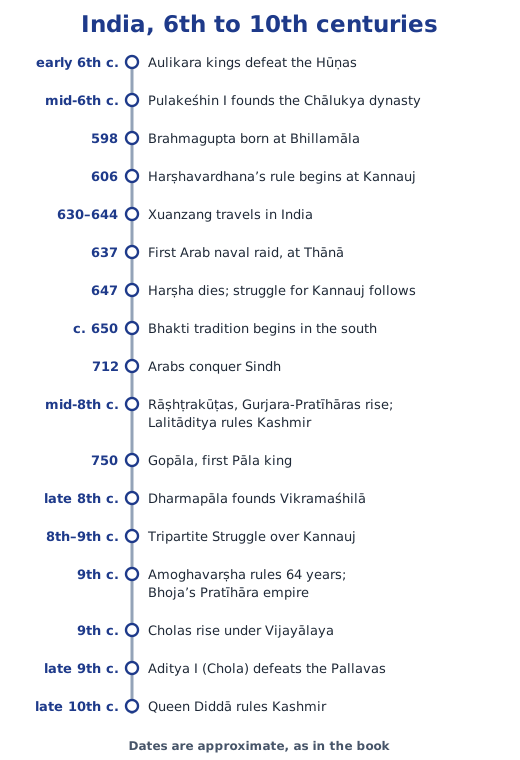
1. What major changes marked this period? The Gupta Empire faded, and instead of one large empire many strong regional kingdoms rose and competed, such as the Palas, Gurjara-Pratiharas, Rashtrakutas, Chalukyas, Pallavas and Cholas. Kings ruled through samantas, land grants spread, new jatis formed, regional languages grew alongside Sanskrit, temple-building and the Bhakti tradition spread, and the Arabs arrived in Sindh.
2. How did political, cultural and religious developments shape India? Rival kingdoms each built temples and supported learning, so art and literature flourished in many regions at once, from Ellora and Mamallapuram to Vikramashila. Rulers supported Hindu, Buddhist and Jain traditions, and Bhakti carried devotion to all sections of society. The result was a varied but connected culture across India.
3. What was the impact of foreign invasions and contacts? The Hunas weakened the Guptas but were defeated and absorbed into Indian society. The Arabs took Sindh but were held back by Indian kings for three centuries. Trade with Arabia carried words, goods and ideas both ways, and Indian mathematics, with its numerals and zero, reached the Arab world and Europe.
Let’s Explore: capitals (page 64)
Where was the capital of the Maurya and Gupta empires? At Pataliputra, present-day Patna in Bihar.
How might the shift to Kannauj have shaped politics? Power moved west along the Ganga plains to Kannauj, which became the new symbol of rule over the north. Owning Kannauj meant prestige, so later dynasties from the east, west and Deccan fought over it for two centuries, the Tripartite Struggle.
Let’s Explore: Harsha’s signature (page 64)
Can you find some Devanagari letters in Harsha’s signature? Yes, with a teacher’s help. The Nagari script is an older form of Devanagari, so letters such as ‘ma’, ‘ha’, ‘ra’ and ‘sha’, in the line where Harsha signs with his own hand as the great king of kings, look close to their modern forms, though they lack the continuous top line and some strokes are shaped differently.
Let’s Explore: Xuanzang’s route (page 66)
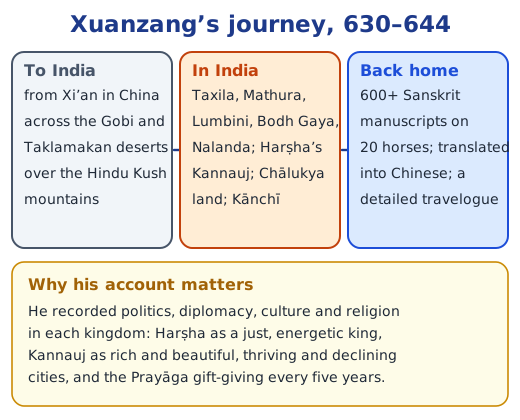
Which mountain passes or deserts did Xuanzang cross? The Gobi and Taklamakan deserts, and the passes of the Hindu Kush mountains on the way into India; he also skirted the high Plateau of Tibet and the Himalayas.
Which Buddhist centres of learning did he visit? Nalanda, the great monastic university in Bihar; Taxila, an ancient centre of learning; Bodh Gaya, where the Buddha attained enlightenment; Lumbini, his birthplace; and places such as Mathura, Ajanta, Amaravati and Kanchipuram.
Think About It: the Prayaga ceremony (page 67)
Does Harsha’s ceremony at Prayaga remind you of an event in Part 1? Yes, the Kumbh Mela at Prayagraj, described in the chapter ‘How the Land Becomes Sacred’: a vast gathering at the same confluence of rivers for sacred bathing, rites and charity.
Let’s Explore: why Kannauj? (page 68)
Why was Kannauj so attractive to powerful dynasties? It stood on the Ganga in the fertile plains at the centre of north India, so it was rich in farming and trade and well connected by river and road. As Harsha’s famous capital it also carried prestige: holding it was a claim to lead north India.
Think About It: Al-Masudi on the Rashtrakutas (page 72)
What does his praise tell us about the Rashtrakutas? They were powerful, with large armies and many elephants, and they were tolerant: Muslims, mostly traders, lived safely in their kingdom and could build and use mosques. It also shows their close trading ties with the Arab world.
Let’s Explore: Kalhana the historian (page 74)
What qualities should a historian have, according to Kalhana? Care, patience and fairness: he joined broken accounts into a connected story, studied eleven earlier works and checked inscriptions and records to correct errors.
What does this say about his method, and how does it compare with history today? He collected many sources and cross-checked written works against inscriptions and grants, as historians still do. But he wrote in verse and aimed to teach moral lessons, while today historians try to explain rather than judge, and also use archaeology, scientific dating and many more kinds of evidence.
What does Kalhana mean when he says the past should be told without love or hatred? Being impartial: not favouring a ruler one admires or attacking one one dislikes. A historian who reports facts without such bias is more reliable, because readers can trust that the facts have not been twisted.
Let’s Explore: Shankaracharya’s four mathas (pages 74–75)
Locate the four mathas. Why four corners of India? Badrinath is in the north (Uttarakhand), Puri in the east (Odisha), Dwarka in the west (Gujarat) and Sringeri in the south (Karnataka). Placing centres of learning at the four ends of the land spread his teaching to every region and joined the whole of India in one network of learning and pilgrimage, rather than serving only one central area.
Let’s Explore: the Durga panel (page 79)
Durga’s weapons and vahana: in her many arms she holds weapons such as a bow with an arrow drawn back and a sword, and she rides a lion, her vahana.
Her attendants and the demon’s: her small attendants rush forward eagerly, some flying, one holding a parasol over her; the demon’s attendants are falling back or lying defeated.
The demon’s slanted posture: Mahishasura, with a buffalo head and a heavy club, leans backwards and turns away. Though he is large, he is retreating, showing that he is losing courage before Durga’s attack.
Don’t Miss Out: inscriptions in two languages (page 81)
Why were land grants written in two languages? The praise of the king and his family was in Sanskrit, the respected language read by elites across India, which raised the king’s prestige. The working details of the grant, such as the land, its boundaries and who received it, were in the local language, so that villagers and local officials could understand and follow them.
Let’s Explore: the coins of Toramana and Skandagupta (page 90)
What details do you see, and why are they so alike? Both are small silver coins with the king’s head in profile on one side, and Indian symbols with Brahmi letters on the other; Toramana’s shows a wheel and his name ‘Tora’, and Skandagupta’s a peacock with spread tail. The Huna ruler copied the design of Gupta coins.
What can we conclude? The Hunas adopted Gupta-style coins, titles, scripts and symbols to appear as rightful rulers to their Indian subjects and traders. It is a sign of how quickly they merged into Indian society.
Let’s Explore: resistance in Sindh (page 91)
What does the queens’ resistance suggest about how people responded to invasion? The people of Sindh resisted fiercely and refused to give in even when the situation was hopeless.
Why did a queen give away her treasure? To reward and encourage the soldiers so that they would keep fighting, and so that the treasure would help the defence rather than fall to the invaders.
What does it reveal about women’s role in war? Royal women were not mere bystanders: they led resistance, raised morale and took hard decisions in times of war.
Think About It: Sulaiman on a Pratihara king (page 92)
Why does Sulaiman call the king a ‘foe’ of the Muslim faith? Because this Gurjara-Pratihara king was the strongest barrier to Arab expansion in India: his large army and fine cavalry kept the Arabs out. From the Arab writer’s point of view, the king who blocked their advance was an enemy. Yet the same account praises his wealth and the safety of his kingdom.
Think About It: words in three languages (page 93)
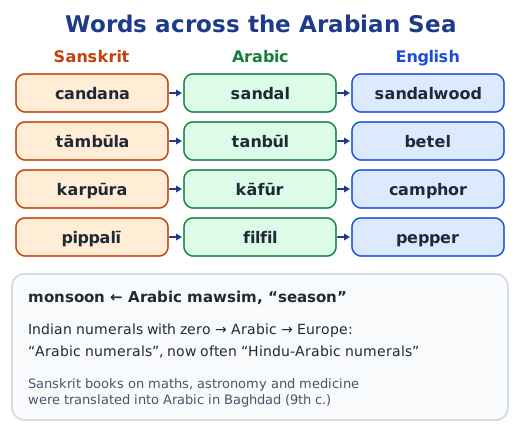
| Sanskrit word | Arabic → English |
|---|---|
| candana | sandal → sandalwood |
| tambula | tanbul → betel |
| karpura | kafur → camphor |
| pippali | filfil → pepper |
Questions and activities (page 96)
1. A letter from Kannauj to a friend in Kanchipuram during the Tripartite Struggle. A sample:
Dear Kavya, Greetings from Kannauj. Life here is never calm. This year the Pala army camped outside the walls; last year it was the Pratiharas, and people say the Rashtrakutas are marching north again. Each time the gates close, prices in the market rise, boats on the Ganga stop, and new officials demand taxes in a new king’s name. Our teachers still hold classes and the temple bells still ring, but fields near the river are trampled. I have begun to think these kings fight more for the glory of owning Kannauj than for the good of its people. Your letters about Kanchi’s silk markets and the new temples at Mamallapuram make me envious. Write soon. Your friend, Arun.
2. Advantages and challenges of ruling through vassals. Advantages: a king could control large and distant areas without officials everywhere; samantas knew local people and conditions, paid tribute and supplied troops; and local government kept running. Challenges: loyalty was fragile, especially when the centre weakened; powerful samantas could rebel or become independent, as the Rashtrakutas did against the Chalukyas; they could fight one another or burden peasants; and the king had less direct control.
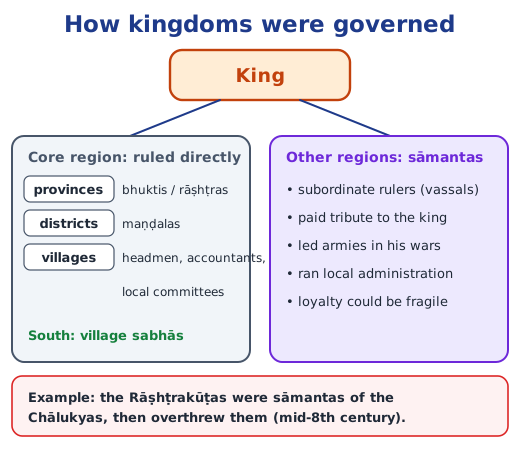
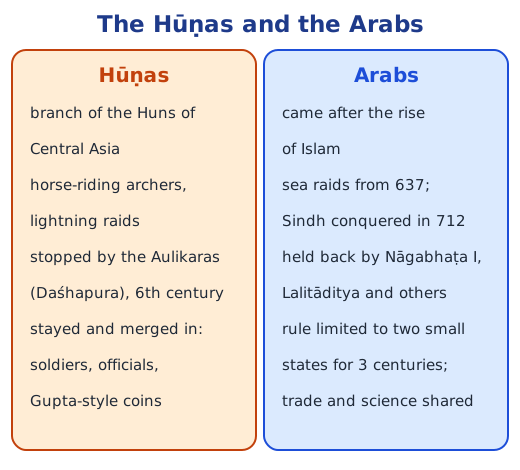
3. How were the Huna and Arab invasions different?
- Aims: the Hunas, a branch of the nomadic Huns, sought conquest and plunder. The Arab armies came after the rise of Islam to extend their empire and their faith, as their own accounts say, and to control trade routes and ports.
- Methods: the Hunas were horse-riding archers making lightning raids into the Ganga plains. The Arabs first raided by sea (637) and later sent a large land army that conquered Sindh in 712.
- How they were stopped: the Aulikara kings of Dashapura defeated the Hunas in the 6th century. Indian kings such as Nagabhata I and Lalitaditya held back the Arabs, whose rule stayed limited to two small states in Sindh and Punjab for three centuries.
- Impact: the Hunas weakened the Guptas, then merged into Indian society as soldiers and officials, using Sanskrit, Prakrit and Gupta-style coins. The Arab conquest had limited political and religious impact; in Sindh they later let Hindus and Buddhists rebuild temples. Trade and learning were shared: Indian mathematics and numerals passed to the Arabs and on to Europe.
4. As a citizen at the Prayaga assembly, how would you react to Harsha giving away his wealth? Many would feel amazed and grateful: the gifts helped Buddhists, Brahmins and the poor, and showed a king following dharma and sharing his fortune. A thoughtful citizen might also wonder where the wealth came from, mostly taxes, and whether steady help such as wells, roads and fair taxes would do more good than a gift once every five years. Such ceremonies also built the king’s fame and loyalty.
5. A poster on one Alvar and one Nayanar. Choose, for example, Andal (Alvar) and Karaikal Ammaiyar (Nayanar). (Extra) Andal, from Srivilliputhur in Tamil Nadu, is the only woman among the 12 Alvars; her Tiruppavai, 30 verses sung in the month of Margazhi, invites friends to wake at dawn and worship Krishna together. Karaikal Ammaiyar, who probably lived in the 6th century, is one of the earliest Tamil Shaiva poets and one of the three women Nayanars; her hymns describe Shiva’s dance. For each saint include the place and time, the god they worshipped, the main events of their life, one or two short poems from a published translation, and why people still sing them.
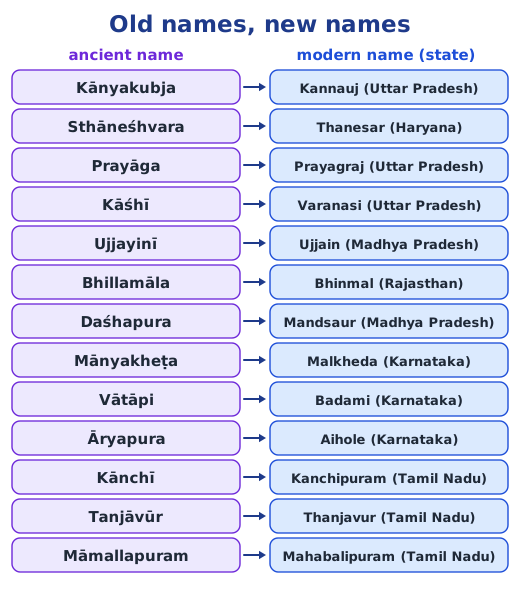
6. Modern names of the cities on the maps. Use pencil on the book’s maps:
| Ancient name | Modern name |
|---|---|
| Kanyakubja | Kannauj (Uttar Pradesh) |
| Sthaneshvara | Thanesar (Haryana) |
| Prayaga | Prayagraj (Uttar Pradesh) |
| Ujjayini | Ujjain (Madhya Pradesh) |
| Kashi | Varanasi (Uttar Pradesh) |
| Manyakheta | Malkheda (Karnataka) |
| Vatapi | Badami (Karnataka) |
| Aryapura | Aihole (Karnataka) |
| Kanchi | Kanchipuram (Tamil Nadu) |
| Tanjavur | Thanjavur (Tamil Nadu) |
| Mamallapuram | Mahabalipuram (Tamil Nadu) |
Madurai keeps its name, and Vengi lies in present-day Andhra Pradesh.
7. Match the ruler or dynasty with the city. (a) Rashtrakutas → (iii) Manyakheta. (b) Gurjara-Pratiharas → (iv) Ujjayini. (c) Cholas → (ii) Tanjavur. (d) Harshavardhana → (v) Kanyakubja. (e) Pallavas → (i) Kanchi.
Practice
-
Which dynasty had its capital at Manyakheta?
Show answer
Answer: (b) Rashtrakutas
-
Kanchi was the capital of the:
Show answer
Answer: (a) Pallavas
-
Who stopped Harsha at the Narmada?
Show answer
Answer: (b) Pulakeshin II
-
The English word ‘monsoon’ comes from an Arabic word meaning:
Show answer
Answer: (c) season
-
Give one advantage and one challenge of ruling through samantas.
Show answer
Answer: Advantage: a king could control distant regions through local rulers who knew the area, paid tribute and raised troops. Challenge: their loyalty was fragile, and a strong samanta could rebel when the centre was weak, as the Rashtrakutas did against the Chalukyas.
Stuck on a question?
Take a photo and Lagnever AI explains it step by step. Try it for 7 days for ₹2.
Get it on Google Play Open in browser
For parents: after the trial, the plan renews monthly by UPI or card autopay. You can cancel anytime in the app.