
Society and culture, 6th to 10th centuries
Answer in short
From the 6th to the 10th centuries, kings ruled through officials and samantas, land grants and irrigation spread farming, and trade linked India with West Asia, Africa and China. Jatis multiplied, and some women ruled as queens. Rulers supported Hindu, Buddhist and Jain traditions, Bhakti spread from the Tamil Alvars and Nayanars, and Brahmagupta advanced mathematics.
Stuck on a question? Take a photo and Lagnever AI explains it step by step. Try it for 7 days for ₹2. Get it on Google Play
Government
With large empires gone, kingdoms were smaller and more spread out in power. Kings such as the Chalukyas and Rashtrakutas governed their home or core regions directly, splitting them into provinces (bhuktis or rashtras), then districts (mandalas), then villages, each with its officials. Villages were largely self-governed by headmen, accountants and local committees, and by the 9th century the south had assemblies at several levels; Chola inscriptions at Uttaramerur describe how members of a village sabha were chosen.
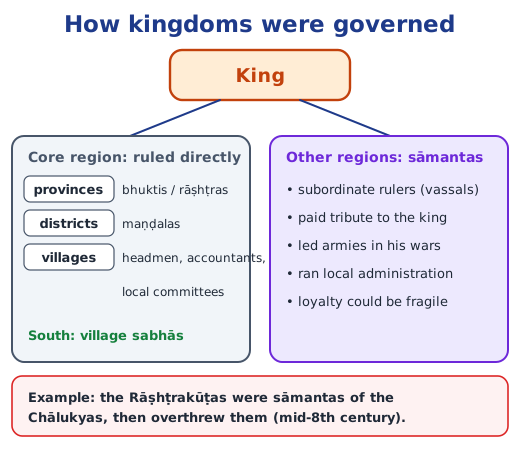
Other regions were governed through samantas, subordinate rulers who paid tribute, led armies and ran local affairs. They were essential, but their loyalty could break when the centre grew weak: the Rashtrakutas, once samantas of the Chalukyas, overthrew them.
Farming, trade and towns
The land grants begun under the Guptas grew greatly. Kings, chiefs and officials gave land to individuals, communities and religious bodies, creating new landholders; many did not farm themselves, and peasants were often exploited. Grants also brought new land under cultivation. Irrigation spread: the Pallavas built many tanks in Tamil Nadu that still work, and donors proudly recorded gifts of wells, ponds and tanks. Cash crops supported crafts.
Small traders ran local markets, while ship-owning merchants traded with ports in Iran, Iraq and East Africa from the west coast, and with Sri Lanka, Southeast Asia and China from the east. Chera copper plates mention traders from West Asia who were Christian, Jewish and Muslim. Merchant guilds of traders, artisans and moneylenders were powerful. Society stayed mostly rural, but many cities thrived, and in the south temples were also centres of trade.
People and society
Society grew more complex. The jatis multiplied, many based on occupation or region, and most people married within their group. Some groups, such as tribes and migrants, were absorbed into the varna-jati system, which was flexible: the Palas, for example, are said to have risen from Shudra origins to be seen as Kshatriyas. The Kayasthas, once scribes from different varnas, became a jati by the 10th century. At the same time, some texts speak of communities treated as ‘untouchable’, and Xuanzang saw certain workers made to live outside the city.
Women’s lives varied by region and class. Bana describes women in farming, crafts and royal courts, and inscriptions record women donating to temples and building water works. Some queens ruled, such as Queen Didda of Kashmir and Tribhuvana Mahadevi I of the Bhauma-Karas in Odisha.
Faith and Bhakti
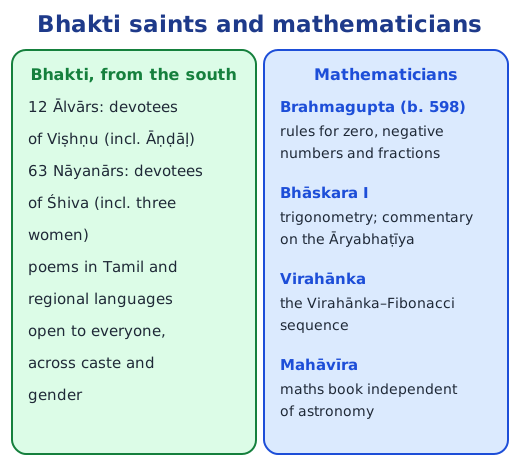
Rulers supported Hindu, Buddhist and Jain traditions whatever their own beliefs, and the traditions shared ideas such as dharma and karma. Buddhism flourished in the east under the Palas but declined elsewhere; Jainism stayed strong in western India and Karnataka, where the great Bahubali statue at Shravanabelagola dates from the 10th century. The Puranas linked local gods to Shiva, Vishnu, Krishna and the goddesses. Bhakti, loving devotion open to all, spread from the south: the 12 Alvars, including Andal, sang of Vishnu, and the 63 Nayanars, including three women, of Shiva, in Tamil. Later saints across India wrote in regional languages.
Mathematics and astronomy
Brahmagupta, born in 598 at Bhillamala, gave rules for calculating with zero, negative numbers and fractions in his Brahmasphutasiddhanta. Bhaskara I worked on trigonometry, Virahanka described the sequence now called Virahanka–Fibonacci, and Mahavira, at the Rashtrakuta court, wrote the first mathematics book separate from astronomy. Translated into Arabic, Indian mathematics carried the numerals with zero to Europe.
Why it matters
The ideas, temples, poems and numbers of these centuries still shape Indian life today. Compare the rulers in Harsha and the struggle for Kannauj and kingdoms of the Deccan and the south. Answers to the textbook questions are in the NCERT solutions for Part 2 Chapter 3; see all of Part 2 Chapter 3 notes.
Practice
-
A samanta was a:
Show answer
Answer: (b) subordinate ruler
-
The 63 Nayanars were devotees of:
Show answer
Answer: (b) Shiva
-
Brahmagupta was born at:
Show answer
Answer: (b) Bhillamala
-
Why were land grants important in this period?
Show answer
Answer: Kings and others gave land to people, communities and religious bodies. This created a new class of landholders and brought more land under the plough, though powerful middlemen often exploited the peasants.
-
Why were many inscriptions written in two languages?
Show answer
Answer: The praise of the king and his family was written in Sanskrit, the prestigious language understood across India, while the practical details of a land grant were written in the local language so that local people and officials could understand them.
Questions students ask
How were kingdoms governed in the 6th to 10th centuries?
Kings ruled a core region directly through provinces, districts and villages, and governed other regions through samantas, subordinate rulers who paid tribute and led armies. Villages were largely self-governed, and in the south village assemblies chose their members.
Who were the Alvars and the Nayanars?
They were Tamil poet-saints who spread Bhakti, personal devotion open to all. The 12 Alvars, including Andal, were devotees of Vishnu, and the 63 Nayanars, including three women such as Karaikal Ammaiyar, were devotees of Shiva.
What did Brahmagupta contribute?
Born in 598 at Bhillamala, Brahmagupta wrote the Brahmasphutasiddhanta, giving rules for working with zero, negative numbers and fractions, and new ways of solving equations. His work later reached the Arab world and Europe.
Stuck on a question?
Take a photo and Lagnever AI explains it step by step. Try it for 7 days for ₹2.
Get it on Google Play Open in browser
For parents: after the trial, the plan renews monthly by UPI or card autopay. You can cancel anytime in the app.