
NCERT Solutions Class 8 Social Science Chapter 3: The Rise of the Marathas
Answers to the Big Questions, every Let’s Explore and Think About It box, and all eight Questions and activities in Chapter 3, The Rise of the Marathas, of Exploring Society: India and Beyond, Grade 8 Part 1. Page numbers follow the book (pages 61–82). Short notes: Chapter 3 notes.
The Big Questions (page 61)
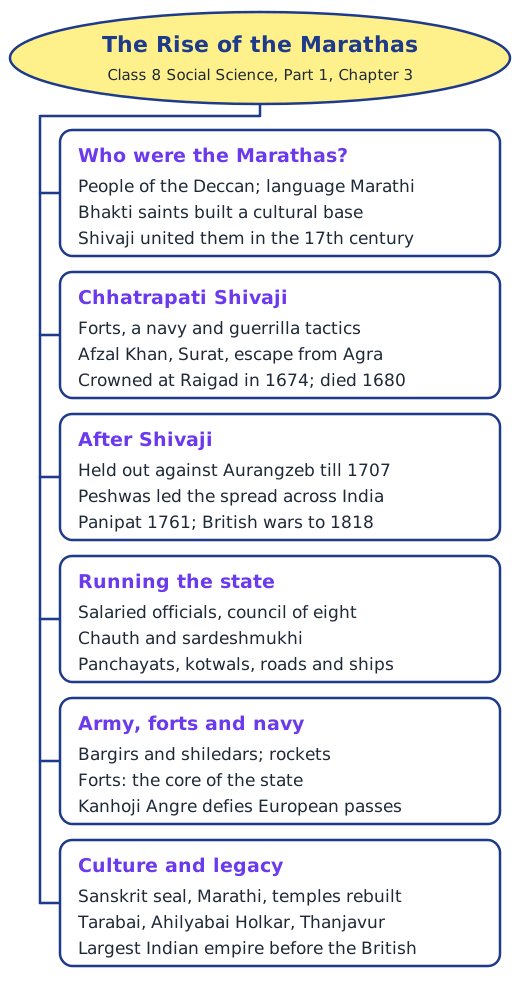
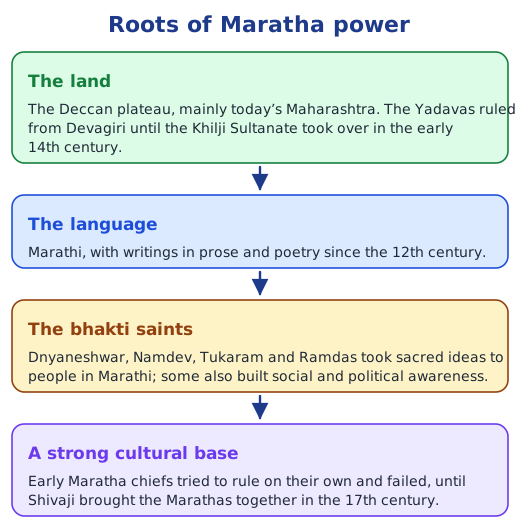
1. Who were the Marathas, and how did they become the largest power across India before the British? The Marathas are a people of the Deccan plateau, mainly today’s Maharashtra, who speak Marathi. Bhakti saints such as Dnyaneshwar, Namdev, Tukaram and Ramdas gave them a shared culture. In the 17th century Chhatrapati Shivaji brought them together: he took and built forts, founded a navy, used guerrilla warfare against Bijapur and the Mughals, was crowned in 1674 and conquered lands in the South. After him, the Marathas resisted Aurangzeb for decades from their forts and from Gingee, and that long struggle, the chapter says, gave them the experience to expand. Led first by Tarabai and then by the Peshwas, above all Bajirao I and Nanasaheb Peshwa, they pushed into the weakened Mughal lands, took chauth and sardeshmukhi from many provinces, and by 1771 held Delhi.
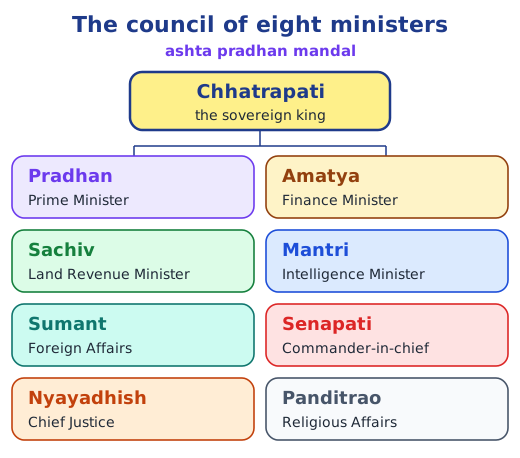
2. What were the main features of Maratha government? Under Shivaji the state was fairly centralised: no hereditary posts, salaries for officials from the treasury, regular transfers, pensions for soldiers’ widows, and coins in his own name. A council of eight ministers, the ashta pradhan mandal, helped him. The Marathas took chauth and sardeshmukhi from provinces outside their direct rule in return for protection. The army had infantry, cavalry (bargirs and shiledars) and a navy, and forts were the core of the state. Panchayats gave justice, with appeals to a Maratha chief and kotwals in big towns, and the death penalty was used sparingly. Roads, bridges, ferries and sea trade were encouraged. In the 18th century the state became more decentralised, with the Peshwa and the chiefs holding real power.
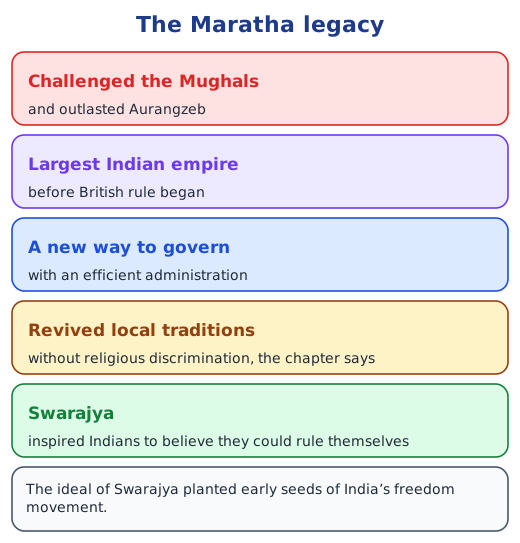
3. What mark did the Maratha Empire leave on Indian history? It challenged and outlasted Mughal power and became the largest Indian empire before the British, so that, as the chapter puts it, India passed to the British more from the Marathas than from anyone else. Its navy held off European sea power for a long time. It brought a cultural revival: Sanskrit and Marathi were promoted, temples were rebuilt across India by rulers such as Ahilyabai Holkar, and Thanjavur saw music, dance, medicine and printing flourish. Above all, the ideal of Swarajya showed Indians that they could govern themselves, which later inspired the freedom movement.
Let’s Explore and Think About It (pages 63–79)
Choose a bhakti saint (page 63). Bhakti means loving devotion to the divine or to a chosen deity; bhakti saints taught that a sincere heart matters more than outward ritual, and they sang in the people’s own languages. A sample choice is Sant Tukaram, one of the saints the chapter names. Extra: he lived in the 17th century at Dehu, near Pune, and composed devotional songs in Marathi called abhangas, addressed to Vitthal of Pandharpur; he taught that honest living and a pure heart please God, and that all people are equal before God. Varkari pilgrims still sing his abhangas as they walk to Pandharpur each year. For the class, pick one abhanga, read or sing it with its meaning, and explain its message in your own words.
Three questions for Shivaji (page 65). (1) “How did you keep calm and plan your escape while under house arrest at Agra?” I would ask this to learn how to think clearly in danger. (2) “Why did you build a navy when most rulers of your time ignored the sea?” Because it shows rare foresight, and I want to know what he saw coming. (3) “What did Swarajya mean to you, and how did you choose officials you could trust?” Because his idea of self-rule inspired India for centuries, and no kingdom works without honest people.
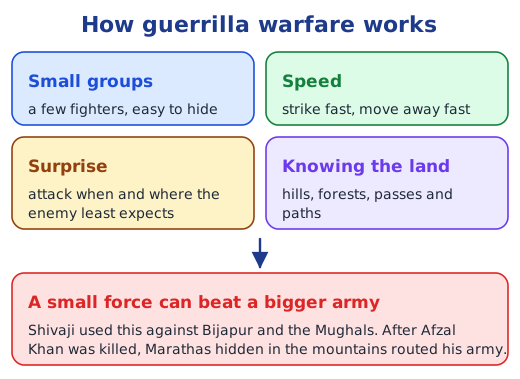
Guerrilla warfare around the world (page 66). Guerrilla warfare means small groups using speed, surprise and knowledge of the land against a bigger army. Extra: the word ‘guerrilla’ is Spanish for ‘little war’; it spread when Spanish fighters used their mountains to resist Napoleon’s French armies in the early 1800s. In the 20th century, fighters in Vietnam used thick jungles and tunnels against much stronger armies. In India, Maharana Pratap fought this way from the Aravalli hills, and the Ahoms used the Brahmaputra and its forests (Chapter 2). The geographical advantages are the same everywhere: mountains, forests, rivers and marshes where small groups can hide, strike and vanish, while big armies with heavy equipment move slowly.
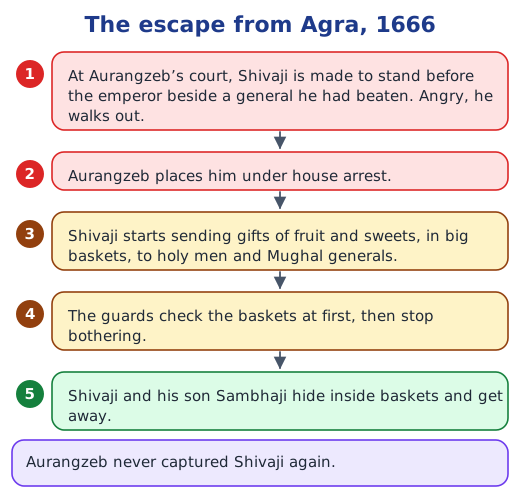
Stage an event as a play (page 69). A sample plan: The escape from Agra. Scene 1, the court: Shivaji is made to stand beside a general he once defeated, and walks out in protest. Scene 2, house arrest: Shivaji and Sambhaji plan, and baskets of fruit and sweets go out to holy men and generals while guards check them. Scene 3: the bored guards stop checking, and father and son slip away hidden in baskets. A narrator ends: Aurangzeb never caught him again. Roles: Shivaji, Sambhaji, Aurangzeb, courtiers, guards and a narrator; props: baskets, a throne and paper turbans. The play shows patience and clever planning, with no fighting on stage.
Shivaji’s letter and his values as a ruler (page 72). In the letter, Shivaji allows teak to be cut for the navy only after permission is taken, and forbids his officials to touch the mango and jackfruit trees that families have cared for over many years, because anything won through oppression does not last. It shows these values: care for his subjects and their property; justice and the rule of law (ask first, never use force); sympathy for people’s feelings; foresight, since such trees take years to grow; respect for nature; and the belief that a ruler serves the people instead of grabbing from them.
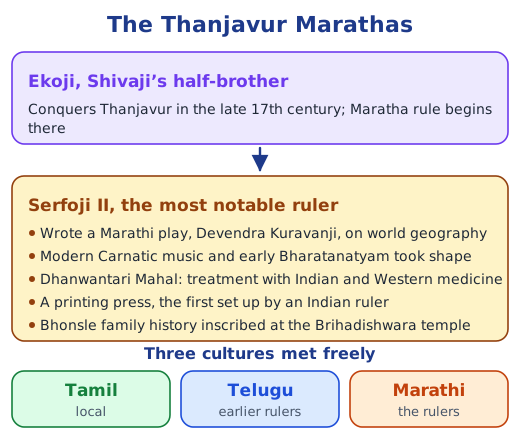
Bharatanatyam and the Marathas (page 79). The chapter says the early form of Bharatanatyam took shape at the Thanjavur court of the Maratha ruler Serfoji II, who supported many talented musicians, and that modern Carnatic music took shape there too. Extra: four brothers known as the Thanjavur (Tanjore) Quartet worked at his court; they set the order of items in a Bharatanatyam performance, which dancers still largely follow, and composed music for it. So Maratha patronage helped give this classical dance its shape.
Questions and activities (page 81)
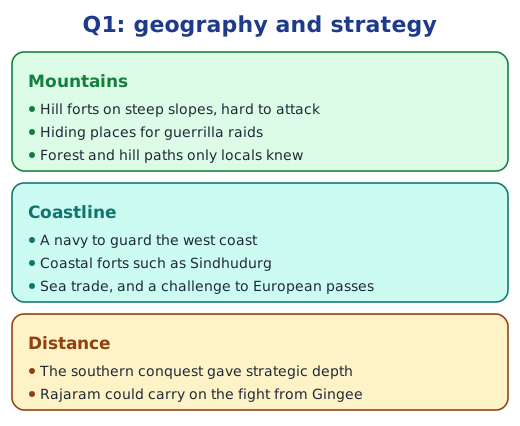
Q1. “Analyse how geography (particularly mountains and coastlines) guided Maratha military strategy and state formation.” Mountains: Shivaji began by taking neglected hill forts around Pune and strengthening them, and his kingdom was built fort by fort; Ramachandrapant Amatya even wrote that the kingdom was created from forts. Steep hills made the forts hard to attack and gave the army shelter. Hills and forests also suited guerrilla warfare: after Afzal Khan’s death, Marathas hidden in the mountains routed his army, and Shivaji’s men knew paths the enemy did not. Coastlines: when the kingdom reached the west coast, Shivaji founded a navy to protect its resources, backed by sea forts such as Sindhudurg. The coast opened sea trade to Mocha, Muscat and Malacca, and in the 18th century Kanhoji Angre used the coast and clever tactics to beat better-armed European ships. Distance: the conquest of the South gave the Marathas room to fall back, so Rajaram could carry on the war from Gingee. Geography thus shaped both how the Marathas fought and how their state grew.
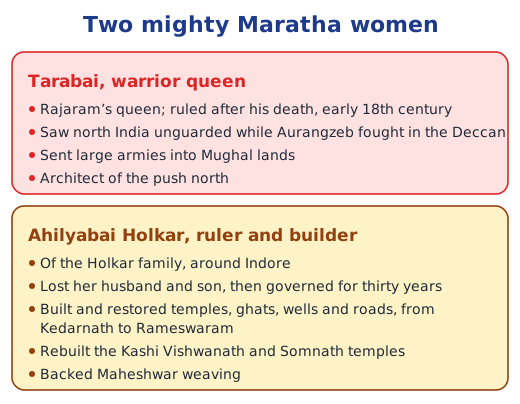
Q2. “Imagine you are creating a short biography of a Maratha leader for younger students. Choose one personality (Kanhoji Angre, Bajirao I, Mahadji Shinde, Ahilyabai Holkar or Tarabai) and write 3–4 paragraphs highlighting what makes them inspirational. Include at least one challenge they overcame.” A sample biography of Ahilyabai Holkar:
Ahilyabai Holkar belonged to the Holkar family, one of the great Maratha families that spread Maratha power in north India. In the 18th century the Holkars ruled a large kingdom in central India, around today’s Indore.
Her life had great sorrow. She lost her husband and then her son. Many people might have given up, but Ahilyabai took charge and ran the state for thirty years. She ruled wisely and looked after the common people.
She was also a great builder. She built or repaired hundreds of temples, wells, ghats and roads all over India, all the way from Kedarnath to Rameswaram. In Varanasi she rebuilt the Kashi Vishwanath temple, and in Gujarat the Somnath temple. She also helped the weavers of Maheshwar, and their handloom craft still thrives today.
Why is she inspiring? She turned grief into service. She showed that a woman could rule well in her time, and that a ruler’s work is to care for people and build for the future. India has honoured her with a postage stamp.
Q3. “If you could visit one Maratha fort today (such as Raigad, Sindhudurg, Gingee, or Pratapgad), which would you choose and why? Research its history, architecture, and strategic importance. Present your findings as a digital presentation or a poster in class.” A sample choice: Raigad. Why: it is where Shivaji was crowned Chhatrapati in 1674, with full Vedic rites, marking the formal start of the Maratha Empire, and it was the Maratha capital. History: the chapter calls it a strong mountain fortress; after Sambhaji’s death, Aurangzeb’s forces captured it. Architecture (Extra): it stands on a flat hilltop in the Sahyadri hills, in today’s Raigad district of Maharashtra, with steep cliffs on most sides; inside are gates, walls, the remains of the palace, water tanks and a market street, and visitors reach it by a long stone path or a ropeway. Strategic importance: cliffs made it very hard to attack, a few gates could be easily guarded, and water stored on top helped it hold out in a siege. For the poster: a title, a simple sketch of the hill and the fort, a timeline (1674 coronation; later captured by the Mughals) and three boxes for history, architecture and strategy.
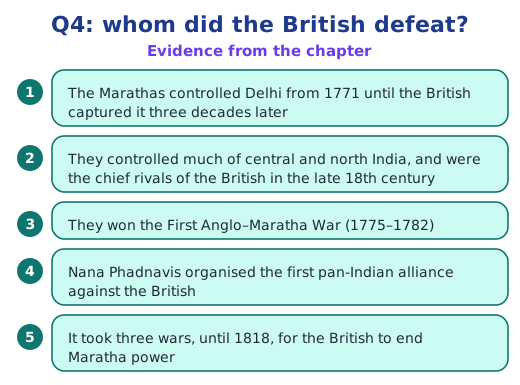
Q4. “The chapter states, ‘The British took India from the Marathas more than from the Mughals or any other power.’ What do you think this means? What evidence from the chapter supports this idea?” It means that by the time the British were expanding, the Mughal Empire was already weak, and the Marathas were the strongest power ruling much of India. So the British won India mainly by defeating the Marathas, not the Mughals. Evidence: (1) the Marathas controlled large parts of central and north India and held Delhi from 1771 until the British captured it three decades later; (2) the chapter says they were the chief rivals of the British in the second half of the 18th century; (3) they won the First Anglo–Maratha War (1775–1782); (4) Nana Phadnavis organised the first alliance across India against the British; (5) it took three wars, until 1818, for the British to end Maratha power. The chapter also says no Indian empire before British rule was larger than the Maratha Empire.
Q5. “Compare how Chhatrapati Shivaji and later Marathas treated religious places and people of different faiths. What evidence from the chapter shows their approach to religious diversity?” Shivaji: the chapter describes him as a devout Hindu who also respected other faiths. When he sacked Surat he did not attack religious places, he rebuilt damaged temples, and he supported religious institutions. Later Marathas: they carried this forward. The Bhonsles of Nagpur helped revive the worship of Lord Jagannath at Puri, and Ahilyabai Holkar built and restored temples across India, including Kashi Vishwanath and Somnath. A Maratha rupee carried both Devanagari and Persian writing, and in Thanjavur, Tamil, Telugu and Marathi cultures mixed freely. Comparison: both protected and revived their own traditions while respecting others; the chapter sums up that they revived local Hindu traditions without religious discrimination. The chapter also notes that, as chiefs grew more powerful in the 18th century, there was sometimes indiscipline and abuse, unlike Shivaji’s values.
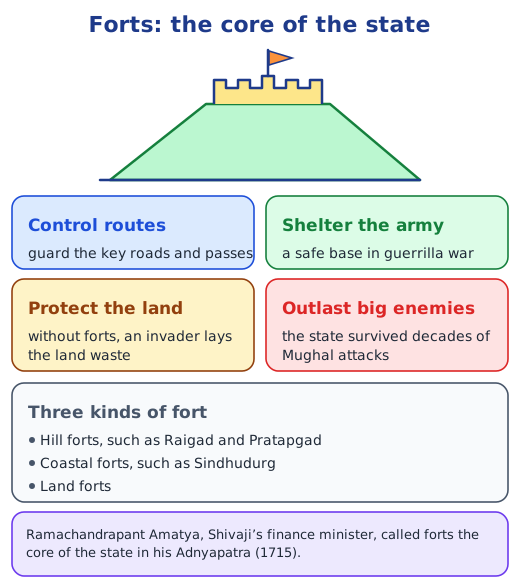
Q6. “The chapter describes how forts were ‘the core of the state’ for Marathas. Why were they so important? How did they help the Marathas survive against larger enemies?” Why important: forts controlled important routes, protected the land from invaders, and gave the army a safe base during guerrilla war. Shivaji’s kingdom was built by taking and strengthening forts, and the Marathas controlled hundreds of them. How they helped: a few defenders on a hill or sea fort could hold off a much bigger army, so the enemy had to besiege fort after fort, which cost time and money. When Aurangzeb captured Raigad, the Marathas fought on from other forts and from Gingee, and they staunchly defended their fortresses. As Ramachandrapant Amatya wrote, the state survived decades of attacks because of its forts, even after great kingdoms like Bijapur fell.
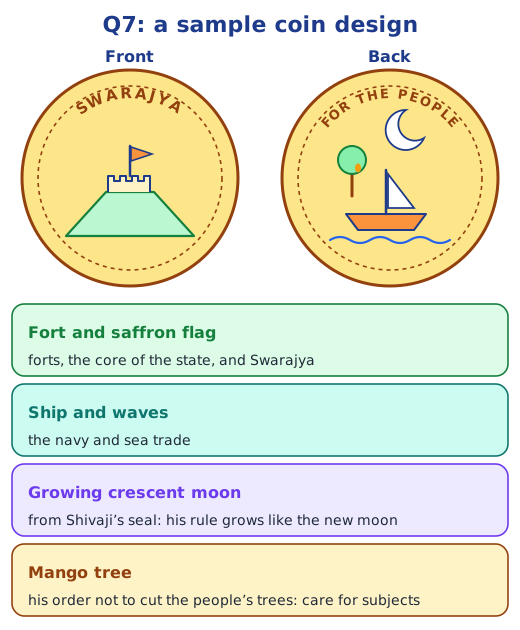
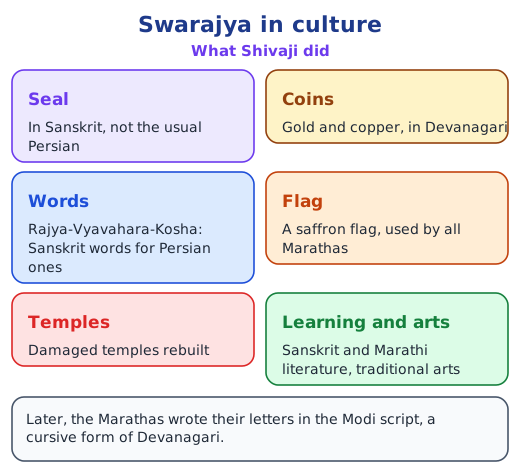
Q7. “You have been appointed as the chief designer for Maratha coins. Design a coin that represents Maratha achievements and values. Explain the symbols you chose.” A sample design. Front: a hill fort with a saffron flag on top, and the word SWARAJYA around the edge. The fort stands for forts as the core of the state, the flag for the Maratha flag and self-rule. Back: a ship on the waves under a growing crescent moon, with a mango tree beside it and the words FOR THE PEOPLE around the edge. The ship stands for the navy and sea trade; the growing moon comes from Shivaji’s seal, which compares his rule to the new moon and dedicates it to the people’s welfare; the mango tree recalls his order not to harm people’s trees, that is, his care for his subjects. Like real Maratha coins, the writing would be in Devanagari.
Q8. “After this introduction to the Maratha period, what do you think was their most important contribution to Indian history? Write a paragraph supporting your opinion with examples from the chapter. Then share and discuss your ideas with classmates.” A sample paragraph: In my opinion, the Marathas’ most important contribution was the ideal of Swarajya, self-rule. Shivaji began with a few neglected forts near Pune and showed that even mighty empires such as Bijapur and the Mughals could be resisted. He built a state that paid its officials, cared for soldiers’ families and protected people’s trees, and he used Sanskrit, Marathi and Devanagari instead of Persian. After him the Marathas outlasted Aurangzeb and built the largest Indian empire before the British. The chapter says this confidence later helped Indians believe in self-government, sowing early seeds of the freedom movement. Classmates may choose other answers, such as the navy that challenged European sea power or the cultural revival led by Ahilyabai Holkar and Serfoji II, and comparing reasons is the point of the discussion.
Practice
-
Whom did Shivaji stop from trading in slaves while he was in the South?
Show answer
Answer: (b) The Dutch
-
Which poet came to Maharashtra to meet Shivaji and wrote poems in his praise?
Show answer
Answer: (a) Bhushan
-
According to the chapter, in which year did four of Shivaji’s ships reach Muscat?
Show answer
Answer: (b) 1665
-
Who was Nana Phadnavis?
Show answer
Answer: An influential official serving the Peshwas. He is credited with the first alliance against the British across India, which brought in even old rivals such as Mysore’s Hyder Ali and the Nizam of Hyderabad.
-
Name the three parts of the Maratha armed forces.
Show answer
Answer: Infantry, cavalry and navy.
Stuck on a question?
Take a photo and Lagnever AI explains it step by step. Try it for 7 days for ₹2.
Get it on Google Play Open in browser
For parents: after the trial, the plan renews monthly by UPI or card autopay. You can cancel anytime in the app.