
Class 8 Social Science Chapter 3: The Rise of the Marathas Notes
This chapter in five lines
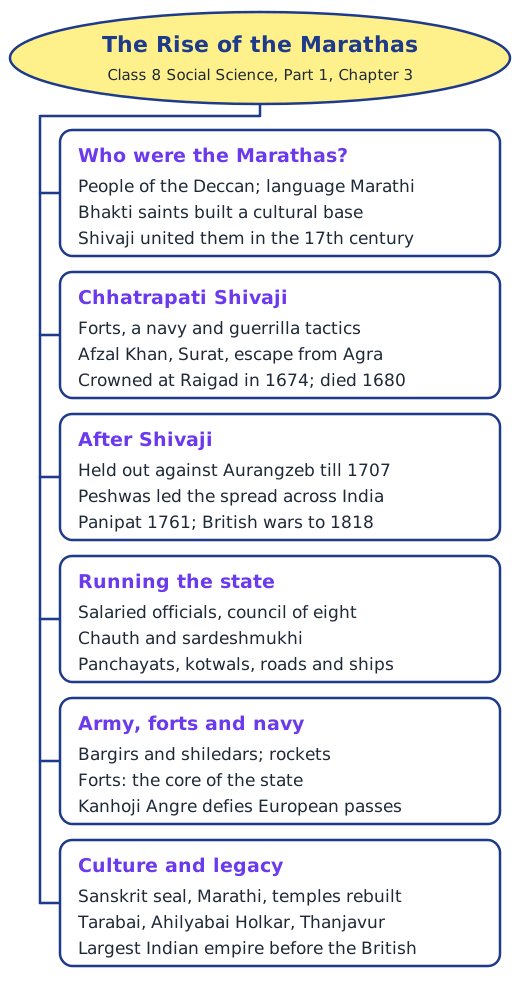
The Rise of the Marathas tells how a people of the Deccan became the largest Indian power before the British. Chhatrapati Shivaji built a kingdom with forts, a navy and guerrilla tactics, and was crowned in 1674. His successors outlasted Aurangzeb and spread across India, until the British ended Maratha power in 1818.
What is this chapter about?
This is the second chapter of Theme B of Part 1, Tapestry of the Past. It follows the Marathas from a people of the Deccan to the largest Indian power of the 18th century. Its Big Questions ask who the Marathas were and how they rose, how they governed, and what they left behind. The chapter opens with a warning written in 1715 by Ramachandrapant Amatya, one of Shivaji’s ministers: the European traders on India’s coasts wanted land and power, not just trade. For the Mughal side of the same years, see Chapter 2, Reshaping India’s Political Map.
Who were the Marathas?
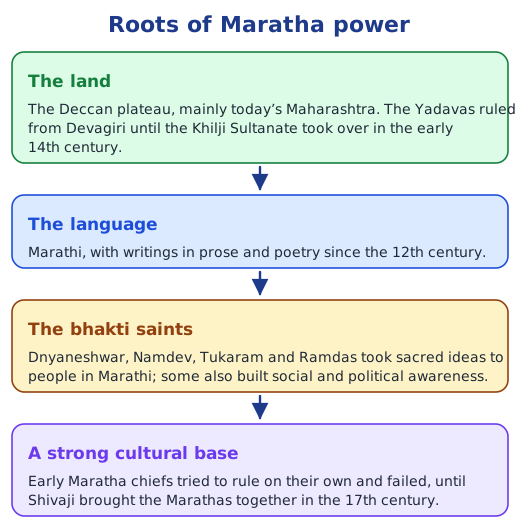
The Marathas are a people native to the Deccan plateau, mainly today’s Maharashtra. They are known by their language, Marathi, which has a long written tradition going back to the 12th century. In the 13th century the Yadava dynasty ruled most of the region from Devagiri, today’s Daulatabad, until the Khilji Sultanate of Delhi defeated it early in the 14th century.
Culture lived on through these changes, above all through bhakti, or devotion. Saints such as Dnyaneshwar, Namdev, Tukaram and Ramdas brought the ideas of texts like the Bhagavad Gita and the Upanishads to ordinary people in Marathi, and some also stirred social and political awareness. This shared culture later helped the Marathas come together.
How did Chhatrapati Shivaji build a kingdom?
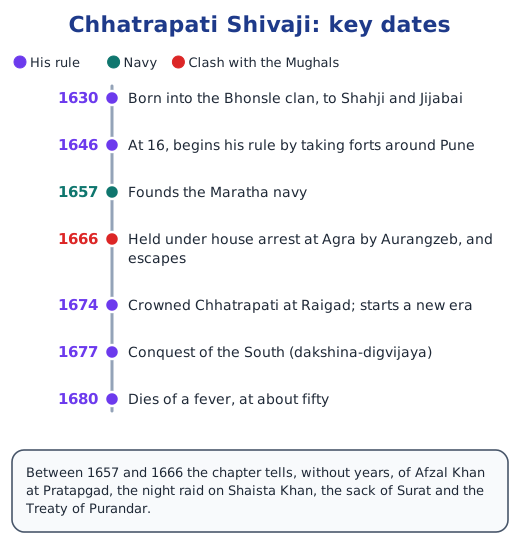
Shivaji was born in 1630 into the Bhonsle clan. His father Shahji was usually away in the service of the Deccan sultanates, so Shivaji grew up in the family jagir at Pune, guided by his mother Jijabai and trusted officials. At just 16 he began taking neglected forts around Pune and making them stronger. His dream of Swarajya, a sovereign kingdom of his own people, grew from there. In 1657 he founded a navy to protect the west coast; the Bijapur Sultanate had no full-time navy, and the Mughals made little use of one. Against bigger armies he relied on guerrilla warfare: small, fast groups who knew every hill and path. Read Chhatrapati Shivaji Maharaj.
How did Shivaji deal with Bijapur and the Mughals?
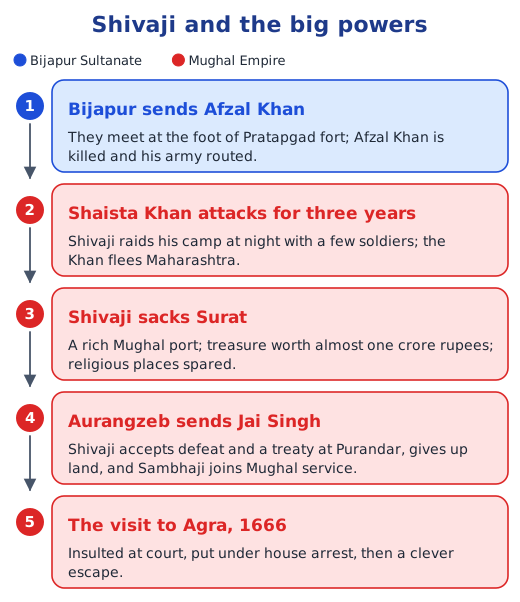
Bijapur sent its veteran general Afzal Khan. At a meeting below Pratapgad fort, Shivaji killed him, and Maratha troops hidden in the hills scattered his army. The Mughal noble Shaista Khan then attacked for three years, until Shivaji raided his camp at night with a handful of men. In reply, Shivaji sacked Surat, a rich Mughal port, though he left its places of worship alone. Aurangzeb sent the Rajput general Jai Singh, and this time Shivaji had to accept defeat and a treaty at Purandar. At Agra in 1666 he was insulted at court and kept under house arrest, but he escaped hidden in a basket. In 1674 he was crowned Chhatrapati at Raigad, in 1677 he conquered lands in the South, and in 1680 a fever ended his life.
What happened after Shivaji?
His son Sambhaji became Chhatrapati. Aurangzeb came to the Deccan, conquered the Bijapur and Golconda sultanates, captured and executed Sambhaji, and took Raigad. The next Chhatrapati, Rajaram, moved to Gingee in the far south, and the war followed him there. The Marathas held their forts so well that Aurangzeb died in the Deccan without beating them. Led by Tarabai, Rajaram’s queen, they then went on the attack into Mughal lands.
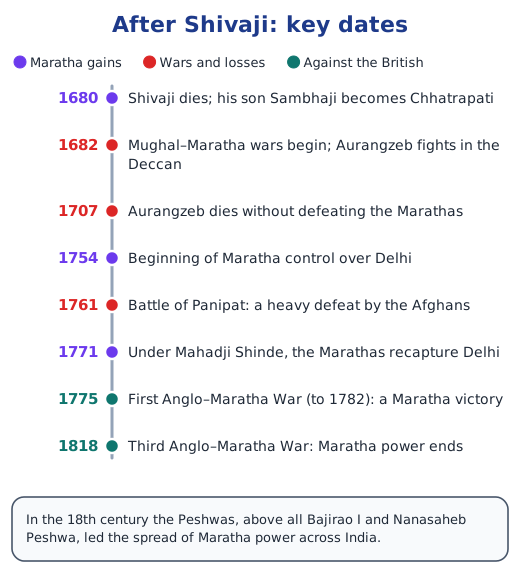
In the 18th century, power shifted from the Chhatrapati to the chiefs, above all the Peshwa, or prime minister. Two Peshwas, Bajirao I and then his son Nanasaheb, led the Maratha spread across India. The Marathas lost badly to the Afghans at Panipat in 1761, but they recovered, and under Mahadji Shinde they recaptured Delhi in 1771. Three Anglo–Maratha wars, from 1775 to 1818, finally ended their power. Read Maratha administration and expansion.
How did the Marathas govern?
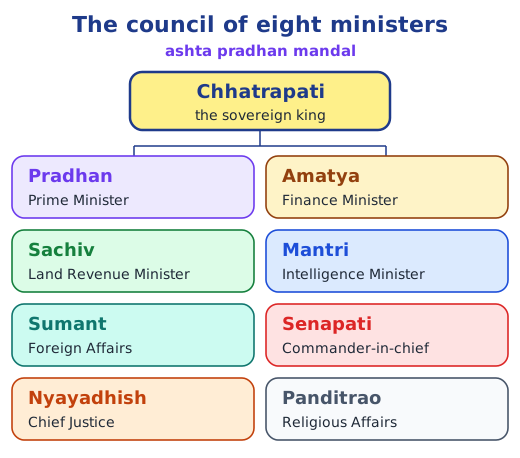
Shivaji ran a fairly centralised state. He ended hereditary posts, paid every official a salary from the treasury and moved officials from post to post, and he gave pensions to the widows of soldiers killed in battle. A council of eight ministers, the ashta pradhan mandal, helped him rule. The Marathas took chauth (25 per cent) and sardeshmukhi (a further 10 per cent) from provinces outside their direct rule, in return for protecting them. The army had infantry, cavalry and a navy. Local panchayats settled disputes, kotwals kept order in towns such as Pune and Indore, and roads, bridges and ferries helped trade.
Why were forts and the navy so important?
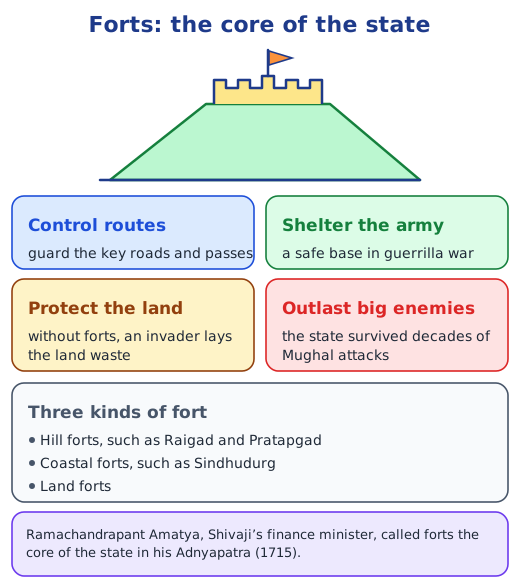
Forts guarded key routes and sheltered the army during guerrilla war. In his Adnyapatra, Ramachandrapant Amatya called forts the core of the state and said that they kept it alive through decades of Mughal attacks. At sea, Kanhoji Angre led the Marathas to many victories in the 18th century, though their ships were less advanced than European ones. Europeans forced Indian ships to buy sea passes, called cartaz; the Marathas turned this round and demanded passes from European ships.
What was the Maratha cultural revival?
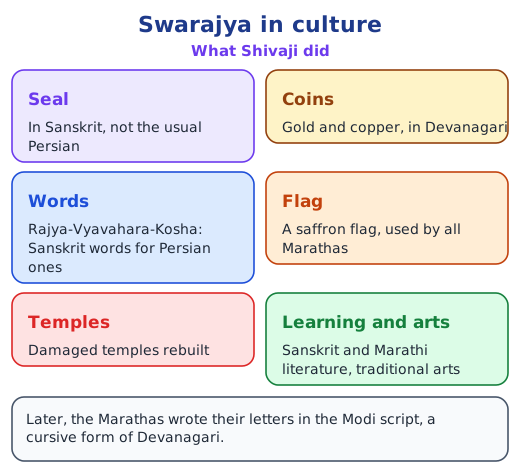
Shivaji’s seal carried a Sanskrit inscription instead of the usual Persian, his coins used Devanagari, and he had a word list, the Rajya-Vyavahara-Kosha, prepared so that Sanskrit words could replace Persian ones in state letters. A devout Hindu who respected other faiths, he rebuilt damaged temples and supported Sanskrit and Marathi writing. Later, Tarabai led the push north, and Ahilyabai Holkar of Indore built or repaired hundreds of temples, wells, ghats and roads across India. In Thanjavur, where Shivaji’s half-brother Ekoji began Maratha rule, Serfoji II supported music, dance, medicine and printing. Read Maratha culture and legacy.
What is the Maratha legacy?
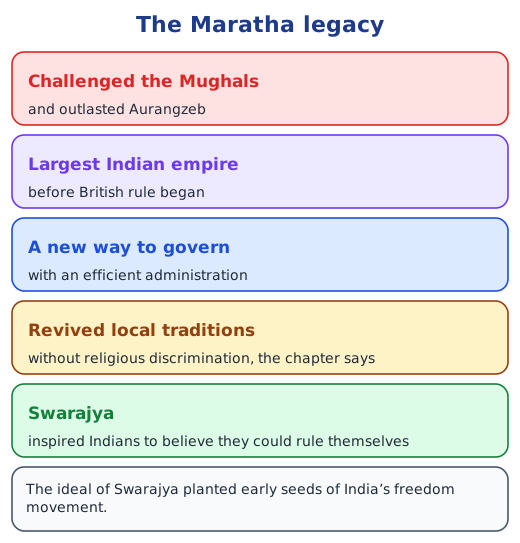
The chapter says the Marathas challenged Mughal power, built the largest Indian empire before the British, ran an efficient government and revived local traditions without religious discrimination. Their ideal of Swarajya later gave Indians the belief that they could rule themselves, and so helped plant the early seeds of the freedom movement. Answers to every question are in the NCERT solutions for Chapter 3.
Key terms
| Term | Meaning |
|---|---|
| Swarajya | Self-rule: Shivaji’s idea of a sovereign kingdom of his own people, in politics, the economy and culture. |
| Chhatrapati | Lord of the royal umbrella, that is, a sovereign king; the title Shivaji took when he was crowned. |
| Jagir | Land a ruler gave as a reward for service; the holder collected its taxes for his own needs and the ruler’s. |
| Bhakti | Devotion to the divine or to a chosen deity, often sung in the people’s own languages. |
| Guerrilla warfare | Fighting in small groups that use speed, surprise and knowledge of the land to beat bigger armies. |
| Surgical strike | An attack aimed only at a chosen target, with little or no harm to anyone or anything else. |
| Ashta pradhan mandal | Shivaji’s council of eight ministers, from the prime minister to the head of religious affairs. |
| Peshwa | A Persian word for prime minister; in the 18th century the Peshwas held great power, even over the Chhatrapati. |
| Chauth | A 25 per cent tax the Marathas took from provinces not directly under them, in return for protection. |
| Sardeshmukhi | A further 10 per cent the Marathas collected on top of chauth. |
| Bargir | A cavalry soldier who got his horse and equipment from the state. |
| Shiledar | A cavalry soldier who paid for his own horse and equipment. |
| Cartaz | The Portuguese word for the sea pass Europeans made Indian ships buy; a ship without one was seized. |
| Panchayat | In Maratha times, a local gathering of officials and leading men that gave justice; not today’s elected Panchayat. |
| Modi script | A running (cursive) form of Devanagari that the Marathas used for their letters. |
Topics in this chapter
Practice
-
In which year was Chhatrapati Shivaji crowned at Raigad?
Show answer
Answer: (c) 1674
-
Which general did the Bijapur Sultanate send against Shivaji?
Show answer
Answer: (b) Afzal Khan
-
‘Peshwa’ is a Persian word for:
Show answer
Answer: (b) prime minister
-
Chauth was a tax of:
Show answer
Answer: (b) 25 per cent
-
Who rebuilt the Kashi Vishwanath temple in Varanasi?
Show answer
Answer: (b) Ahilyabai Holkar
-
Which ruler of Thanjavur set up the Dhanwantari Mahal, a centre of medicine?
Show answer
Answer: (b) Serfoji II
Questions students ask
What are the main topics of Class 8 Social Science Chapter 3?
Who the Marathas were; Chhatrapati Shivaji’s rise, with his forts, navy and battles; the Marathas after him, from the wars with Aurangzeb to the Peshwas and the Anglo–Maratha wars; Maratha government, army, navy, justice and trade; and their cultural revival and legacy.
Is The Rise of the Marathas in the new NCERT Class 8 book?
Yes. It is Chapter 3 of Exploring Society: India and Beyond, Grade 8 Part 1 (Reprint 2026-27), on pages 61 to 82, in the theme Tapestry of the Past. It follows Chapter 2, Reshaping India’s Political Map, which ends with the Mughals.
Why is Shivaji called Chhatrapati?
Chhatrapati means lord of the royal umbrella, a sign of a sovereign king. When he was crowned at Raigad in 1674, Shivaji took the title ‘Shri Raja Shiva Chhatrapati’ and started his own era, the Rajyabhisheka shaka.
Why did the Maratha Empire come to an end?
The chapter gives two reasons: growing disunity among the Maratha chiefs, and the better organisation and technology of the British. After three Anglo–Maratha wars, Maratha power ended in 1818.
Stuck on a question?
Take a photo and Lagnever AI explains it step by step. Try it for 7 days for ₹2.
Get it on Google Play Open in browser
For parents: after the trial, the plan renews monthly by UPI or card autopay. You can cancel anytime in the app.