
How did the Marathas govern and expand?
Answer in short
After Shivaji, the Marathas outlasted Aurangzeb and, under the Peshwas, spread across much of India, until the British ended their power in 1818. Shivaji’s state paid its officials salaries and had a council of eight ministers. The Marathas collected chauth and sardeshmukhi, relied on forts, cavalry and a navy, and gave justice through panchayats.
Stuck on a question? Take a photo and Lagnever AI explains it step by step. Try it for 7 days for ₹2. Get it on Google Play
How did the Marathas fight on after Shivaji?
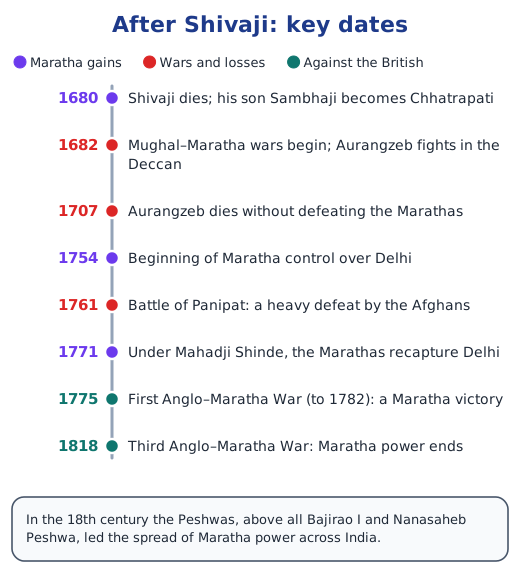
Shivaji left two sons, Sambhaji and Rajaram. When he died in 1680, Sambhaji became Chhatrapati. The Marathas were now the only power standing between the Mughals and full control of the Deccan. Aurangzeb came south and conquered the Bijapur and Golconda sultanates, then captured and executed Sambhaji and took Raigad, the Maratha capital.
Rajaram, the next Chhatrapati, moved to Gingee in today’s Tamil Nadu, so the war spread to south India. The Marathas defended their forts stubbornly and often had the better of the Mughals in battles and raids. Aurangzeb could not leave the Deccan, and he died there without defeating them. The Marathas then went on the attack: led by Tarabai, Rajaram’s queen, they marched deep into Mughal lands.
How did the Peshwas spread Maratha power?
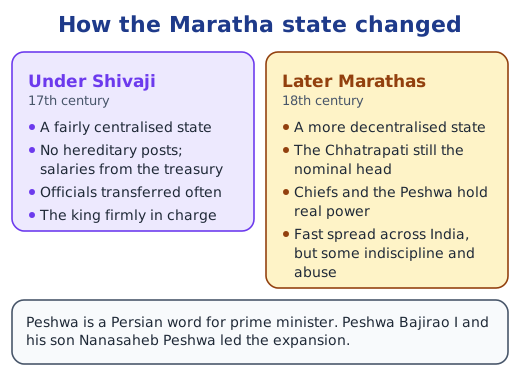
As the Marathas grew, their state changed. Shivaji’s centralised rule gave way to a looser structure. The Chhatrapati stayed at the centre in name, but the chiefs held more power, especially the Peshwa, a Persian word for prime minister. Two Peshwas, Bajirao I and then his son Nanasaheb, led the spread of Maratha power across India. The chapter says the Marathas generally ruled their lands well, but powerful regional chiefs sometimes acted with indiscipline and abuse, far from Shivaji’s values.
In the north the Marathas reached as far as Lahore, Attock and even Peshawar, in today’s Pakistan, for a short time. They suffered a heavy defeat against the Afghans at Panipat in 1761, but recovered under Peshwa Madhavrao I. Led by Mahadji Shinde (Scindia), they recaptured Delhi in 1771 and held it until the British took it three decades later.
How did the Marathas lose to the British?
By the late 18th century the Marathas were the main rivals of the British in India. Nana Phadnavis, an influential official in the Peshwas’ service, is said to have formed the first alliance against the British across India, even with old enemies such as Mysore’s Hyder Ali and the Nizam of Hyderabad. Three Anglo–Maratha wars were fought between 1775 and 1818. The Marathas won the first, but disunity among their chiefs and the better organisation and technology of the British ended Maratha power in 1818. The chapter concludes that India passed to the British mainly from Maratha hands, not Mughal ones.
How did Shivaji run his government?
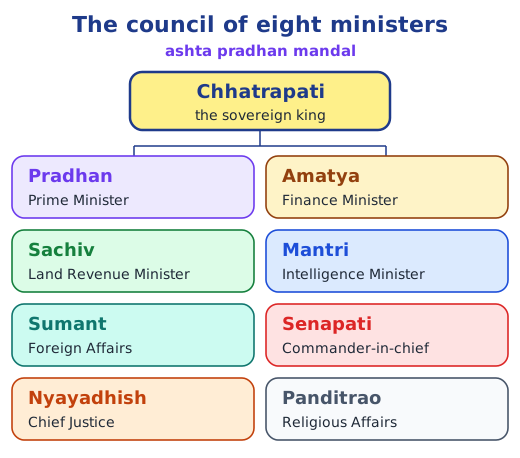
Shivaji’s government was fairly centralised. He did away with hereditary posts and land grants, which were common under the sultans and the Mughals, and paid every official a salary from the treasury. Many officials were transferred from time to time, so that none grew strong enough to challenge the king. Widows of soldiers killed in battle received pensions, and their sons were offered posts in the army. Gold and copper coins were struck in his own name, a sign that he was a sovereign ruler. A council of eight ministers, the ashta pradhan mandal, helped him govern.
What were chauth and sardeshmukhi?
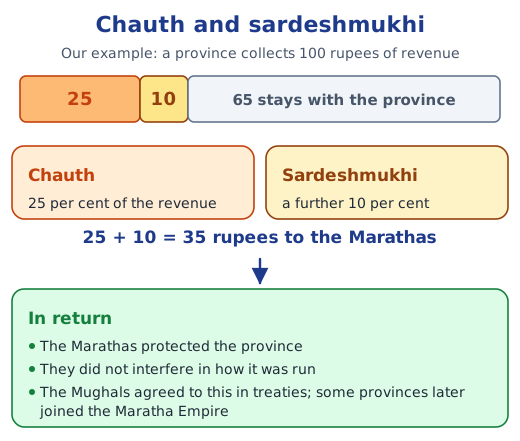
From provinces outside their direct rule, in the Deccan and the north, the Marathas often collected chauth, 25 per cent, and sardeshmukhi, a further 10 per cent. In exchange, the Marathas kept those provinces safe and left their internal affairs alone. The Mughals agreed to it in several treaties, and in time some of those provinces joined the Maratha Empire.
How was the Maratha army organised?
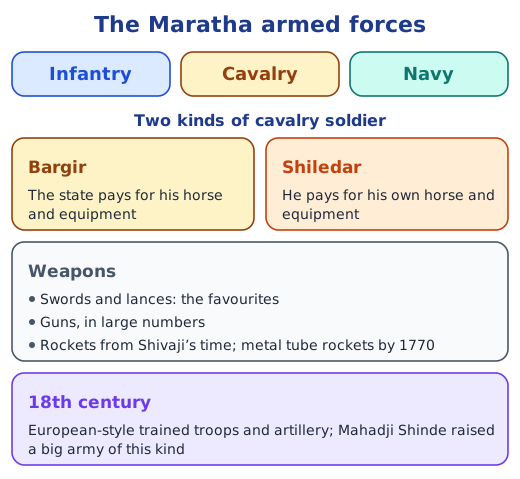
The armed forces had three parts: infantry, cavalry and navy. In the cavalry, bargirs got their horses and equipment from the state, while shiledars paid for their own. Swords and lances were the favourite weapons, but guns were also used in large numbers. Rockets were used from Shivaji’s time, and by 1770 metal tube rockets too. In the 18th century the Marathas saw the strength of disciplined European-style troops and artillery and raised some of their own; Mahadji Shinde had a large army of this kind.
Why were forts and the navy so important?
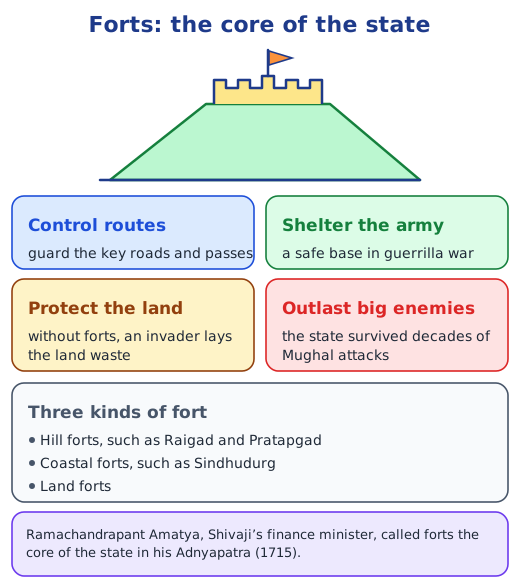
Shivaji held and built a large number of forts. They controlled important routes and gave the army shelter during guerrilla war. Ramachandrapant Amatya, his finance minister, wrote in the Adnyapatra that forts were the core of the state, and that the kingdom survived decades of Mughal attacks because of them.
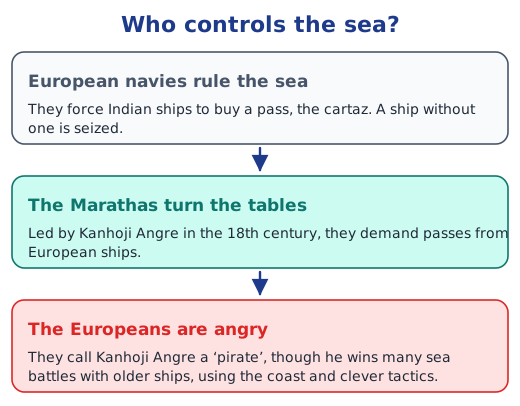
At sea, Kanhoji Angre led the Marathas to many victories in the 18th century, using the coast and clever tactics, though their ships were less advanced than European ones. The Europeans’ main strength in India was their navies. They forced Indian ships to buy passes, called cartaz in Portuguese, and seized ships that had none. The Marathas challenged this and began demanding passes from European ships instead.
How were justice and trade managed?
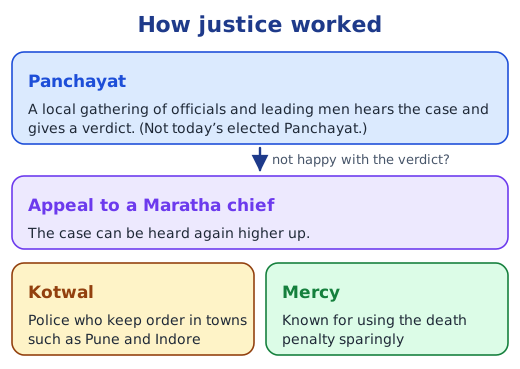
Justice was given mainly by the panchayat, a local gathering of officials and leading men, not to be confused with today’s Panchayat. Anyone unhappy with its verdict could appeal to a Maratha chief, and in towns such as Pune and Indore the kotwal, or police, kept order. The chapter notes that the system used the death penalty sparingly. Shivaji also encouraged trade: he and his officials sent ships as far as Mocha (Yemen), Muscat (Oman) and Malacca (Malaysia). On land, roads and bridges were built, and in places such as Odisha river ferries ran in the 18th century.
Read on: Chhatrapati Shivaji Maharaj, Maratha culture and legacy, the chapter notes and the NCERT solutions.
Practice
-
Where did Rajaram go after he became Chhatrapati?
Show answer
Answer: (b) Gingee
-
Which Maratha leader recaptured Delhi in 1771?
Show answer
Answer: (b) Mahadji Shinde
-
A cavalry soldier who paid for his own horse was a:
Show answer
Answer: (b) shiledar
-
What were chauth and sardeshmukhi?
Show answer
Answer: Taxes the Marathas collected from provinces not directly under them: chauth was 25 per cent and sardeshmukhi a further 10 per cent. In exchange, the Marathas kept those provinces safe and stayed out of their internal affairs.
-
Why did Europeans call Kanhoji Angre a ‘pirate’?
Show answer
Answer: Because he turned their own system against them. Europeans forced Indian ships to buy passes, but the Marathas under Kanhoji Angre began demanding passes from European ships instead.
Questions students ask
Who were the Peshwas?
Peshwa is a Persian word for prime minister. In the 18th century the Peshwas became very powerful, even over the Chhatrapati. Bajirao I and, after him, his son Nanasaheb led the Maratha expansion across India as Peshwas.
What was the ashta pradhan mandal?
Shivaji’s council of eight ministers: the Pradhan (prime minister), Amatya (finance), Sachiv (land revenue), Mantri (intelligence), Sumant (foreign affairs), Senapati (commander-in-chief), Nyayadhish (chief justice) and Panditrao (religious affairs).
What happened at Panipat in 1761?
The Marathas, who had pushed as far north as Lahore, Attock and Peshawar, suffered a heavy defeat against the Afghans at Panipat. They recovered quickly under Peshwa Madhavrao I and recaptured Delhi in 1771.
How did the British end Maratha power?
Through three Anglo–Maratha wars between 1775 and 1818. The Marathas won the first, but growing disunity among their chiefs and the better organisation and technology of the British let the British end Maratha power in 1818.
Stuck on a question?
Take a photo and Lagnever AI explains it step by step. Try it for 7 days for ₹2.
Get it on Google Play Open in browser
For parents: after the trial, the plan renews monthly by UPI or card autopay. You can cancel anytime in the app.