
What did the Marathas give to Indian culture?
Answer in short
The Marathas revived Indian culture. Shivaji used a Sanskrit seal and Devanagari coins, promoted Marathi and Sanskrit and rebuilt damaged temples. Ahilyabai Holkar built and restored temples, ghats and wells across India, and Serfoji II of Thanjavur supported music, dance, medicine and printing. Their ideal of Swarajya later inspired India’s freedom movement.
Stuck on a question? Take a photo and Lagnever AI explains it step by step. Try it for 7 days for ₹2. Get it on Google Play
What cultural base did the Marathas start from?
Long before Shivaji, Maharashtra had a rich culture. Marathi had a continuous tradition of prose and poetry from the 12th century. Between the 7th and the 17th centuries, saints in many parts of India chose bhakti, loving devotion, over mere outward ritual, and sang in the languages people spoke. In Maharashtra, saints such as Dnyaneshwar, Namdev, Tukaram and Ramdas made the ideas of texts like the Upanishads and the Bhagavad Gita available in Marathi. Some, like the Sikh Gurus in Punjab, also worked to organise society and build political awareness. This gave the Marathas a firm cultural footing for the kingdom that came later.
How did Shivaji promote Indian culture?
The chapter sees Shivaji’s idea of Swarajya in his culture as well as his politics:
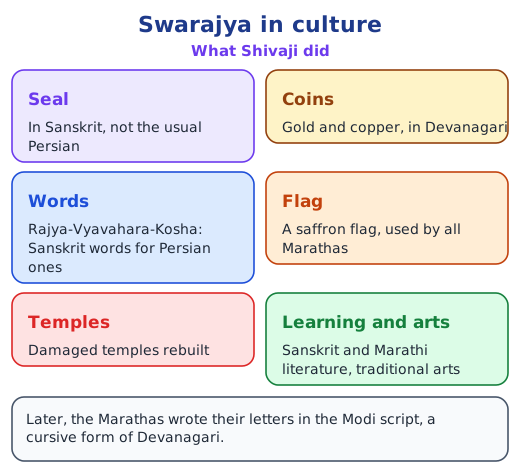
- Seal: his official seal carried a Sanskrit inscription, a clear break from the Persian seals common at the time. It says his authority grows like the new moon and works for the welfare of the people.
- Coins: his gold and copper coins carried his own name, written in Devanagari.
- Words: he had a treatise made, the Rajya-Vyavahara-Kosha, which gave Sanskrit words for the Persian ones used in state letters, so far fewer foreign words appeared in Maratha diplomacy.
- Faith and arts: a devout Hindu who respected other religions, he rebuilt damaged temples and backed literature in Sanskrit and Marathi, religious institutions and the traditional arts. His saffron flag was adopted by all Marathas.
The chapter adds that his greatest gift may have been confidence: he showed that mighty empires could be defeated, and that the Marathas could build and run an empire of their own.
Who were the mighty Maratha women?
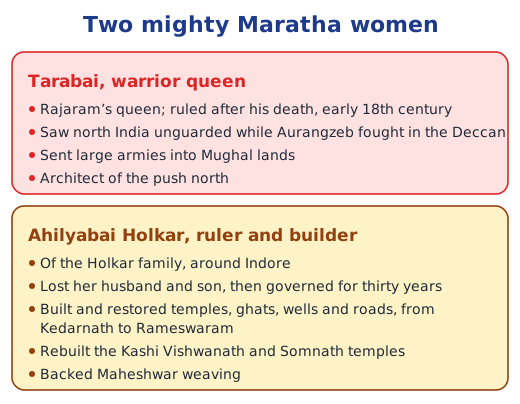
Tarabai was a fearless warrior queen who took charge early in the 18th century when her husband, Rajaram, died. She saw that while Aurangzeb and his army were busy in the Deccan, north India lay unprotected, so she raised big Maratha armies and sent them north into Mughal lands. The chapter calls her the architect of the Maratha push north; her strategy and determination kept the Marathas independent at a difficult time.
Ahilyabai Holkar came from the Holkar family, which ruled a large kingdom around today’s Indore in the 18th century. After losing her husband and her son, she governed the state for thirty years, wisely and with care for ordinary people. She built or repaired hundreds of temples, wells, ghats and roads, all the way from Kedarnath to Rameswaram. In Varanasi she rebuilt the Kashi Vishwanath temple, which Aurangzeb had destroyed, and in Gujarat the Somnath temple, which Mahmud of Ghazni had destroyed. She is also credited with reviving the handloom weaving of Maheshwar in Madhya Pradesh, which still thrives.
How did later Marathas carry this forward?
Shivaji’s example kept inspiring his successors. The Bhonsles of Nagpur supported local culture and traditions, and with Maratha help, Puri’s worship of Lord Jagannath in Odisha, often disrupted under the Mughals, was restored. The Marathas wrote their letters in the Modi script, a cursive form of Devanagari. In the 18th century they often followed the popular Mughal style of coins but added their own symbols. One rare early 19th-century rupee, minted by the Patwardhans, generals under the Peshwa, has writing in both Devanagari and Persian: one side calls on Ganapati, and the other declares loyalty to the Peshwa.
What did the Marathas do in Thanjavur?
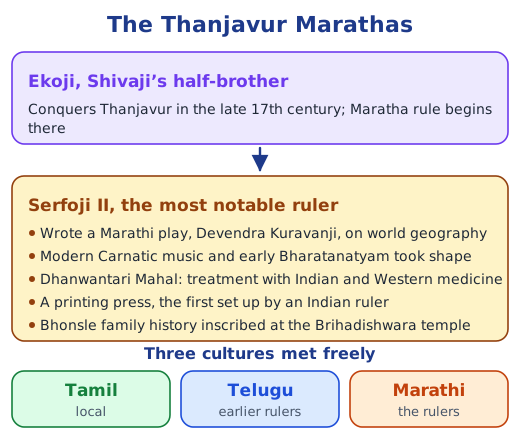
Ekoji, Shivaji’s half-brother, conquered the Thanjavur region in today’s Tamil Nadu in the late 17th century. The Thanjavur Marathas created a rich, mixed culture full of new ideas, and several rulers were poets and playwrights themselves. The most notable was Serfoji II. He was at home in several Indian and European languages, and his Marathi play, Devendra Kuravanji, describes the world’s geography as people then knew it. Modern Carnatic music took shape in his time, as did the early form of Bharatanatyam. He set up the Dhanwantari Mahal, where patients were treated at no charge with both Indian and Western medicine, and a printing press, the first in India set up by an Indian ruler. He also had the history of the Bhonsle family carved on the walls of the Brihadishwara temple, among the largest single inscriptions anywhere in India. In Thanjavur, local Tamil ways, the Telugu traditions of the earlier rulers and the rulers’ own Marathi culture met and mixed freely.
What is the Maratha legacy?
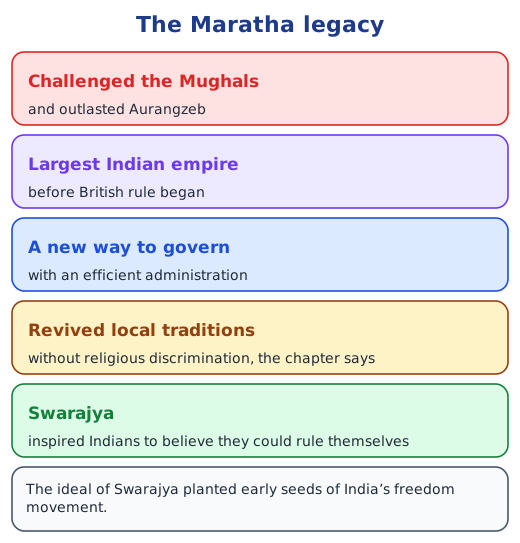
The chapter sums up the legacy this way. The Marathas challenged Mughal dominance and built the largest Indian empire before the British, controlling much of the centre and north of India. They also created an efficient new administration and revived local Hindu traditions without religious discrimination. Their fight was driven by the ideal of Swarajya, which later inspired Indians to believe they could rule themselves and planted early seeds of the freedom movement.
Read on: Chhatrapati Shivaji Maharaj, Maratha administration and expansion, the chapter notes and the NCERT solutions.
Practice
-
Shivaji’s seal carried an inscription in:
Show answer
Answer: (b) Sanskrit
-
The Modi script is a cursive form of:
Show answer
Answer: (b) Devanagari
-
Who wrote the Marathi play Devendra Kuravanji?
Show answer
Answer: (b) Serfoji II
-
Name two temples that Ahilyabai Holkar rebuilt.
Show answer
Answer: The Kashi Vishwanath temple in Varanasi and the Somnath temple in Gujarat.
-
Why is Tarabai called the architect of the Maratha push north?
Show answer
Answer: With Aurangzeb and his army tied down in the Deccan, she saw that north India was unprotected and sent large Maratha armies into Mughal lands there.
Questions students ask
How did Shivaji promote Indian culture?
His seal was in Sanskrit instead of Persian, and his coins used Devanagari. He had Sanskrit words listed to replace Persian ones in state letters, rebuilt damaged temples and backed writing in Sanskrit and Marathi, religious bodies and the traditional arts.
What did Ahilyabai Holkar do?
After losing her husband and son, she governed the Holkar kingdom around Indore for thirty years. She built or repaired hundreds of temples, wells, ghats and roads, all the way from Kedarnath to Rameswaram, and supported the Maheshwar weaving industry.
What did the Marathas do in Thanjavur?
Ekoji, Shivaji’s half-brother, began Maratha rule there in the late 17th century. Under Serfoji II, modern Carnatic music and the early form of Bharatanatyam took shape, and he set up a centre of medicine and a printing press.
What is the Maratha legacy?
According to the chapter, the Marathas challenged Mughal power, built the largest Indian empire before the British, set up an efficient administration and revived local traditions. Their ideal of Swarajya later helped plant the seeds of the freedom movement.
Stuck on a question?
Take a photo and Lagnever AI explains it step by step. Try it for 7 days for ₹2.
Get it on Google Play Open in browser
For parents: after the trial, the plan renews monthly by UPI or card autopay. You can cancel anytime in the app.