
Who was Chhatrapati Shivaji Maharaj?
Answer in short
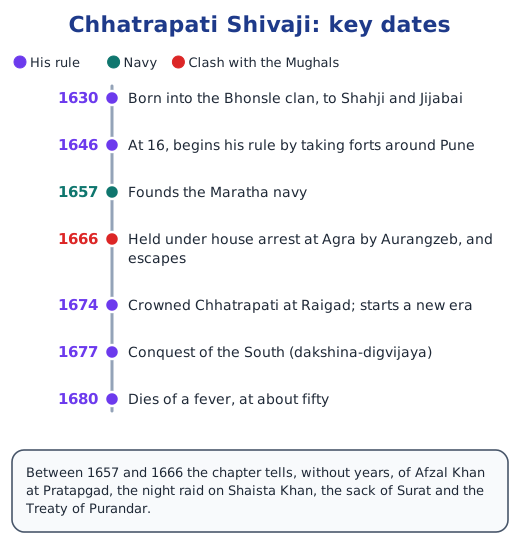
In the 17th century, Chhatrapati Shivaji Maharaj founded the kingdom of the Marathas. Born in 1630, he began taking forts near Pune at 16, built a navy and used guerrilla warfare against bigger armies. He escaped from house arrest at Agra in 1666, was crowned at Raigad in 1674 and died in 1680.
Stuck on a question? Take a photo and Lagnever AI explains it step by step. Try it for 7 days for ₹2. Get it on Google Play
Who were the Marathas before Shivaji?
The Marathas are a people of the Deccan plateau, mainly today’s Maharashtra, known by their language, Marathi. Bhakti saints such as Dnyaneshwar, Namdev, Tukaram and Ramdas had given the region a strong shared culture. By the 17th century some Maratha chiefs had tried to set up kingdoms of their own, but they failed. Most Marathas served the Deccan sultans, who kept fighting one another, and ordinary people suffered from these wars. Shivaji was the one who brought the Marathas together.
How did Shivaji grow up?
Shivaji was born in 1630 into the Bhonsle clan. His father, Shahji, was usually away, serving the Deccan sultanates. So Shivaji grew up in the family jagir at Pune, land given to Shahji for his service. His mother, Jijabai, and some trusted officials looked after him, gave him a good education and taught him strong values.
How did Shivaji begin building Swarajya?
At just 16, in 1646, Shivaji began his campaigns. He first made his hold over the Pune region firm by taking forts that were neglected or empty, and making their defences stronger. Over the years his idea of Swarajya, a sovereign kingdom of his own people, grew to cover politics, the economy and culture.
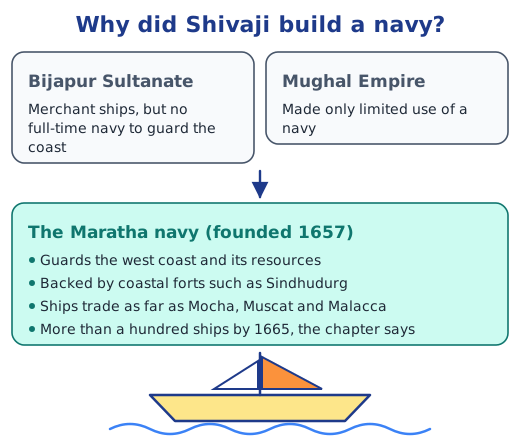
His kingdom soon reached the west coast. To use the riches of the coast and keep them safe, he founded a navy in 1657. The chapter calls this a revolutionary step: the Bijapur Sultanate had merchant ships but no full-time navy to guard the coast, and the Mughals made little use of one. Sea forts such as Sindhudurg, near today’s Maharashtra–Goa border, were built to support it.
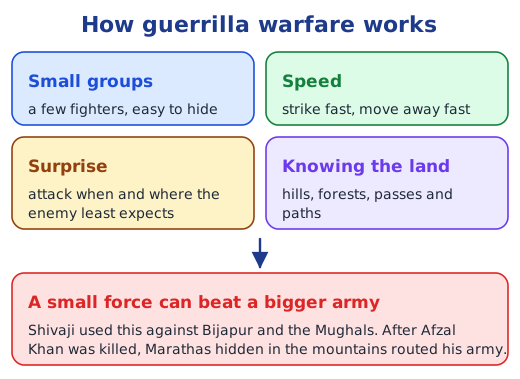
To protect his people from stronger enemies, Shivaji used guerrilla warfare. Small groups of fighters struck with speed and surprise, using their knowledge of the hills and forests, and so could defeat much bigger armies.
How did Shivaji face Bijapur and the Mughals?
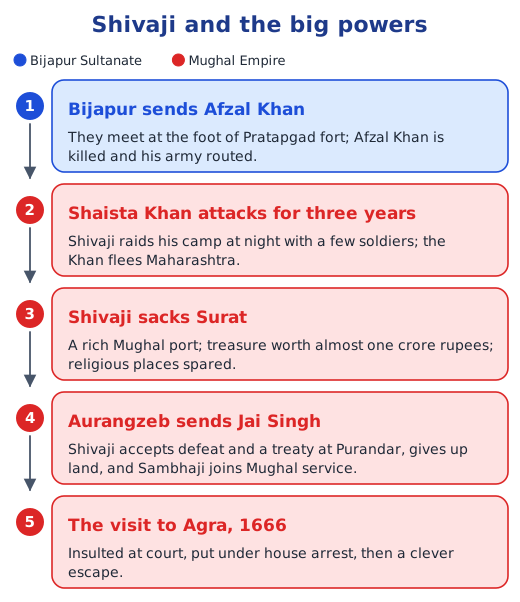
Afzal Khan. Shivaji’s success angered the Bijapur Sultanate, which sent its experienced general Afzal Khan against him. Shivaji and his advisers persuaded Afzal Khan to meet him alone at the foot of Pratapgad fort, deep in the forest. At that meeting Shivaji killed Afzal Khan with a wagh nakh, the small ‘tiger’s claw’ weapon, and Marathas hidden in the hills routed the Khan’s army.
Shaista Khan. Next, the Mughal noble Shaista Khan attacked Shivaji’s lands with a large army for three years. One night, Shivaji raided his camp with only a few soldiers. The Khan barely escaped, wounded, and left Maharashtra. The chapter compares this raid to a modern surgical strike.
Surat. To hit back for those three years of attacks, Shivaji sacked Surat, a wealthy Mughal port in today’s Gujarat, and took treasure worth almost one crore rupees. He did not attack religious places, and he spared the house of Mohandas Parekh, a man known for his charity. He raided Surat again a few years later, and the London Gazette, an English newspaper, reported his demands to the European agents in the city.
Purandar. Surat was a blow to Mughal pride, so Aurangzeb sent Jai Singh, a famous Rajput general. This time Shivaji had to accept defeat at Purandar Fort, near Pune, and sign a treaty. He lost a large part of his kingdom, and Sambhaji, his son, was made to serve the Mughals.
How did Shivaji escape from Agra?
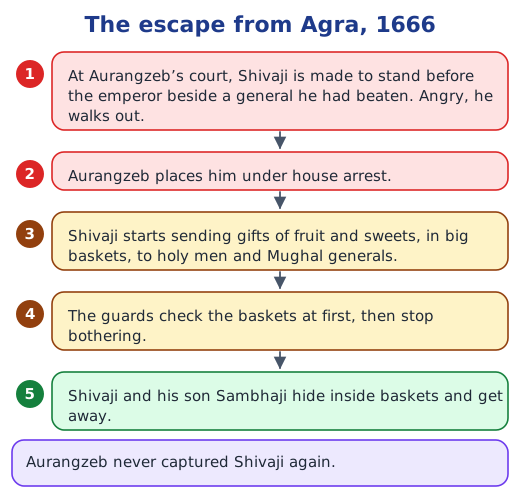
Jai Singh persuaded Shivaji to visit Aurangzeb’s court at Agra in 1666. There he was made to stand before the emperor beside a Mughal general he had once defeated. Insulted, he walked out of the court, and Aurangzeb put him under house arrest. Shivaji then began sending gifts of fruit and sweets in big baskets to holy men and Mughal generals. The guards checked the baskets at first but soon stopped. Shivaji and Sambhaji hid inside baskets and got away, and Aurangzeb never caught Shivaji again.
How did Shivaji become Chhatrapati?
In 1674 Shivaji was crowned with full Vedic rites at Raigad, a strong mountain fort. His formal title became ‘Shri Raja Shiva Chhatrapati’, and he began his own era, the Rajyabhisheka shaka. In 1677 he set out on his conquest of the South, the dakshina-digvijaya, which took in parts of today’s northern Tamil Nadu and Karnataka. These lands later gave the Marathas room to fall back when the Mughals invaded. While in the South, he stopped the Dutch from trading in slaves, at a time when Europeans were capturing and selling Indians.
A fever ended Shivaji’s life in 1680, when he was about fifty. Even in his lifetime his deeds were famous. Europeans compared him with great generals of the past such as Alexander; the Bundela prince Chhatrasal was inspired to set up his own kingdom of Bundelkhand; and the Hindi poet Bhushan travelled to Maharashtra to meet him and wrote poems in his praise.
Read on: Maratha administration and expansion, Maratha culture and legacy, the chapter notes and the NCERT solutions.
Practice
-
Shivaji’s parents were:
Show answer
Answer: (a) Shahji and Jijabai
-
Where did Shivaji meet Afzal Khan?
Show answer
Answer: (b) At the foot of Pratapgad fort
-
What was Shivaji’s formal title after his coronation?
Show answer
Answer: (a) Shri Raja Shiva Chhatrapati
-
Why was founding a navy a big step for Shivaji?
Show answer
Answer: Few Indian powers then had a full-time navy: Bijapur kept only merchant ships and the Mughals made little use of one. A navy let Shivaji guard the west coast and its resources.
-
How did Shivaji escape from Agra?
Show answer
Answer: He began sending gifts of fruit and sweets in big baskets. The guards soon stopped checking them, so he and his son Sambhaji hid in the baskets and slipped away.
Questions students ask
When was Chhatrapati Shivaji born?
The chapter gives 1630. He was born into the Bhonsle clan to Shahji, who served the Deccan sultanates, and Jijabai, who brought him up in the family jagir at Pune.
What is Swarajya?
Swarajya means self-rule. For Shivaji it meant a sovereign kingdom of his own people, and the idea grew to cover politics, the economy and culture. It later inspired India’s freedom movement.
Why did Shivaji sack Surat?
To hit back after Shaista Khan’s three years of attacks. Surat was a rich Mughal port, and he took treasure worth almost one crore rupees, but spared its religious places. The raid badly hurt Mughal prestige.
How old was Shivaji when he died?
About fifty. A fever ended his life in 1680, six years after his coronation. By then his deeds were famous across India and beyond.
Stuck on a question?
Take a photo and Lagnever AI explains it step by step. Try it for 7 days for ₹2.
Get it on Google Play Open in browser
For parents: after the trial, the plan renews monthly by UPI or card autopay. You can cancel anytime in the app.