
NCERT Solutions Class 8 Social Science Chapter 4: The Colonial Era in India
Answers to the Big Questions, every Let’s Explore and Think About It box, and all ten Questions and activities in Chapter 4, The Colonial Era in India, of Exploring Society: India and Beyond, Grade 8 Part 1. Page numbers follow the book (pages 83–116). Short notes: Chapter 4 notes.
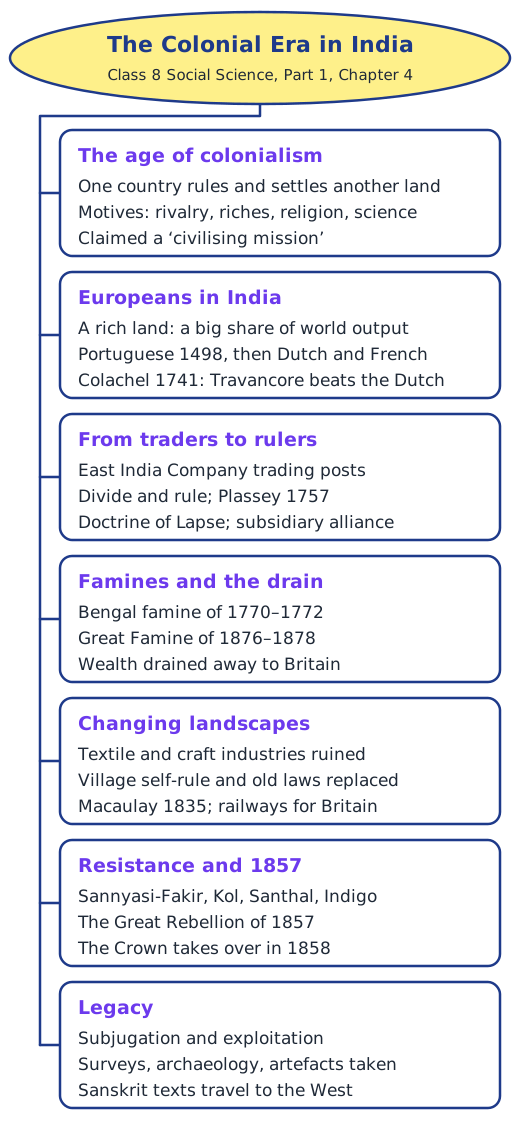
The Big Questions (page 83)
1. What does colonialism mean? Colonialism is when one country takes control of another region, settles some of its own people there and imposes its own political, economic and cultural systems. It is very old, going back to the great empires of the 1st millennium BCE, but the ‘Age of Colonialism’ usually means Europe’s expansion from the 15th century, when Spain, Portugal, Britain, France and the Netherlands built colonies across much of the world. Colonisers often claimed to be on a ‘civilising mission’; the chapter says the reality was lost independence, exploited resources and destroyed ways of life. Most colonies won their independence in the mid-20th century, after World War II.
2. Why were European powers drawn to India? Mainly by India’s wealth. Its spices, cotton, ivory, gems, sandalwood, teak and wootz steel had been sought abroad since Greek and Roman times, and European travellers described a flourishing land with skilled manufacturing, varied farming and wide trade networks. Behind this lay the wider motives of the age: rivalry between European powers, the hope of new resources, markets, trade routes and plunder, the wish to convert people to Christianity, and some scientific curiosity.
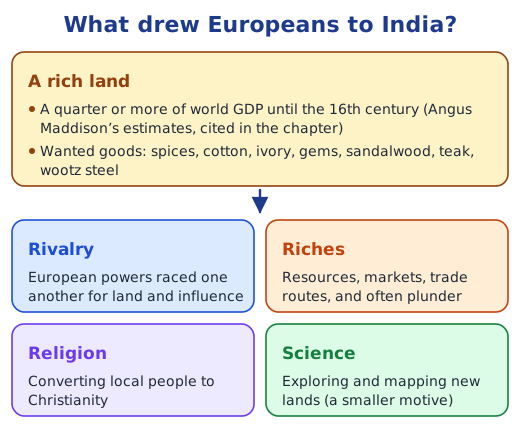
3. How strong was India’s economy and its place in the world before and during colonial rule? Before: estimates by the economist Angus Maddison, which the chapter cites, suggest that until the 16th century India produced at least a quarter of the world’s GDP, so that India and China were the world’s two largest economies. Its textiles were in demand around the world, and Indian powers could still beat Europeans, as Travancore did against the Dutch at Colachel in 1741. During: India became the largest colony of the British Empire, its ‘jewel in the crown’, supplying wealth, raw materials and soldiers. Famines, the drain of wealth and the ruin of its industries cut India’s share of world GDP to hardly 5 per cent by Independence; in the chapter’s words, one of the richest lands had become one of the poorest in less than two centuries.
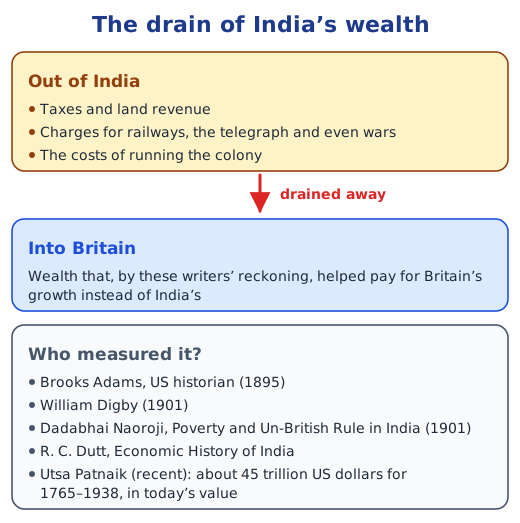
4. What did British rule do to India? The chapter describes deep harm. Harsh revenue demands made famines far deadlier; wealth was drained to Britain; textiles and other industries were ruined; village self-government and customary law were replaced by a tax-collecting bureaucracy and costly courts; Macaulay’s education policy pushed aside traditional schools; and the economy was turned into a supplier of raw materials and a market for British goods, even the railways being paid for by Indians. Tribes, peasants and sepoys rose up and were harshly put down. The chapter also notes some largely unintended results: surveys, archaeology, Sanskrit translations and Indian ideas reaching the West, alongside the loss of thousands of artefacts.
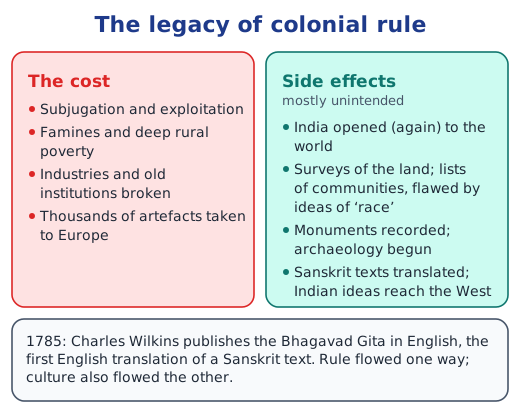
Let’s Explore and Think About It (pages 87–112)
The cartoon of a giant across Africa (page 87). The cartoon, from Punch magazine in 1892, shows a British businessman as a giant, one foot at the top of Africa and one at the bottom, holding a telegraph wire stretched across the continent. The giant: the coloniser is huge and the continent small under his feet, so it shows Europeans treating a whole continent as theirs to own. The telegraph wire: the newest technology, which allowed instant messages for the first time, is being used to bind Africa together for its rulers, not for Africans. The pose: he stands proud and confident, with no Africans in sight, as if the people living there did not count. So the cartoon expresses the confidence, greed and ambition of the colonial age. Extra: the businessman is usually identified as Cecil Rhodes, who dreamed of a telegraph and railway line from Cape Town to Cairo.
What does the painting say? (page 92). A sample group answer for the painting ‘The East offering its riches to Britannia’ (1778): Britannia, the symbol of Britain, sits high above everyone, with a lion beside her for power. Below her, figures standing for India and other Eastern lands bend and hold out pearls, jewels, cotton and a precious jar. Ships and a river god stand for British sea power and London. The message is that the East willingly gives its wealth to a superior Britain, which is how the Company wanted to see itself. Our group would ask: did these lands really give their riches, or were they taken? The chapter’s own reading is on page 99.
What did Naoroji mean by ‘un-British rule’? (page 98). Dadabhai Naoroji was a member of the British House of Commons in 1892, so he knew the values the British claimed for themselves at home: fairness, the rule of law and government for the good of the people. By calling British rule in India ‘un-British’, he meant that in India the British broke their own ideals: they drained India’s wealth, kept Indians poor and gave them no real say. The title was a clever way to shame the British by their own standards.
The painting’s symbols (pages 98–99). Once we know the symbols, the painting shows a power order: Britannia sits higher, the colonies kneel or bend below her, and the darker skin given to the Indians reflects the belief, common then, that white people were superior. The title says the East ‘offers’ its riches, but the rest of the chapter, from Plassey to the famines and the drain, suggests that Britain took the wealth by force or by trickery. So the painting is propaganda for the Company, not a true picture.
Words used for Indian textiles (page 100). Cotton, silk and wool come from the cotton plant, the silkworm’s cocoon and sheep’s hair. Extra: jute is a coarse plant fibre used for sacks and ropes; hemp is another strong plant fibre for ropes and rough cloth; coir is fibre from the husk of the coconut, used for mats and ropes. Muslin is a very fine, light cotton cloth; embossed cloth has a design stamped on it so that it stands out in relief. Ask your teacher to help the groups compare what they find.
Macaulay’s claims (pages 102–103). Macaulay meant that all the writing of India and Arabia, in Sanskrit, Arabic and other languages, was worth less than one shelf of European books, though he admitted he could read neither Sanskrit nor Arabic. He wanted Indians who were English in taste, opinions, morals and intellect so that they would think like the British, work for them as clerks and officials, and support their rule. This is the ‘civilising mission’ in action: it assumed that Indian culture was inferior and needed replacing, which the chapter rejects, since India’s civilisation was older than Europe’s. In a class debate, one side could argue that English opened new doors; the other that it cut many Indians off from their own heritage and divided society.
The sun that never set (page 104). The saying meant that Britain’s colonies were spread so widely around the globe that, at every hour, the sun was shining on some part of the empire. It was true at the empire’s height as a fact of geography. But the boast that India would remain British for ever was wrong: Indians resisted from the start, and India won its independence in 1947, as did most other colonies in the mid-20th century.
The map of 1909 (page 105). Borders: British India then included what are now Pakistan and Bangladesh, and also Burma (now Myanmar) in the east. Inside it, red and pink areas were ruled directly by the British, and yellow areas were princely states; today there are no princely states, and India is divided into states and union territories. Names: many places had colonial names or spellings: Madras (now Chennai), Calcutta (Kolkata) and Bangalore (Bengaluru), as the chapter itself notes; Extra: Bombay (now Mumbai), the United Provinces (roughly today’s Uttar Pradesh), Rajputana (roughly Rajasthan) and Ceylon (Sri Lanka). Many old provinces have since been reshaped into new states.
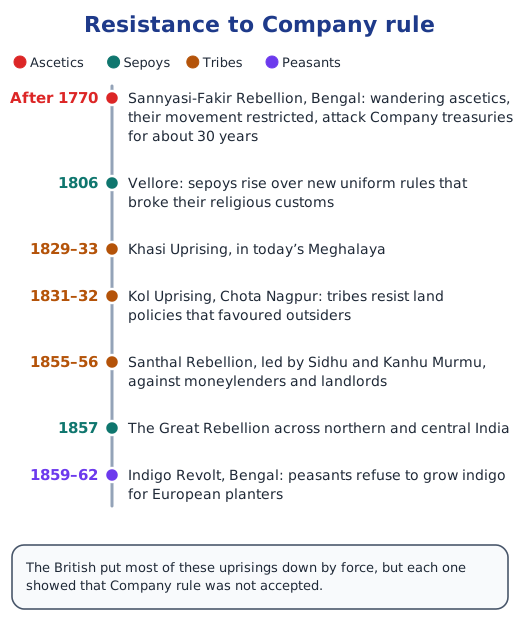
How the Santhals are shown (page 107). The sketch, drawn from the artist’s imagination, shows the Santhals as dark-skinned, almost unclothed figures fighting with bows and arrows, while the sepoys in the distance have guns. Readers in Britain would come away thinking of the Santhals as wild, ‘primitive’ people, easily outmatched by a modern army. This supported the colonial claim that such people needed to be ‘civilised’, and hid the real reasons for their revolt: the loss of their land and their harsh treatment.
Natural dyes (page 108). Extra: many plants and natural substances have been used in India to dye cloth: turmeric (yellow), madder or manjistha root (red), henna leaves (orange to brown), pomegranate rind (yellow), marigold flowers (yellow), catechu or kattha (brown), lac from insects (red), and iron-rich mud or iron with jaggery for black. Indigo itself gives blue.
Why was ‘Sepoy Mutiny’ rejected? (page 108). A sample paragraph: The name ‘Sepoy Mutiny’ makes 1857 sound like a small act of indiscipline by soldiers against their officers. In fact, as the chapter shows, the anger came from years of land revenue hardship, annexations and attacks on religious customs, and rulers such as Rani Lakshmibai and Begum Hazrat Mahal, and ordinary people across northern and central India, joined in. Calling it a mutiny was the British way of making it look less serious and their own rule more legitimate. After Independence, Indian historians wanted a name that showed its true size, so ‘Great Rebellion’ and similar terms were used instead. Extra: some call it India’s First War of Independence.
‘Re-opened’, and the question of returning heritage (page 112). Re-opened: India was not cut off from the world before the Europeans came; it had traded with the Greeks and Romans more than two thousand years earlier, so colonial rule re-opened old links as much as it opened new ones. Repatriation: one view is that museums abroad have the money and skills to preserve fragile objects and show them to millions. The other view is that these objects were taken without consent, belong to India’s history and should come home, where Indian museums can look after them and Indians can see them. A sample view: objects taken by force or theft should be returned, with India and the museums working together on their care. Extra: the Koh-i-Noor diamond, now among the British Crown Jewels, is often named in this debate.
Questions and activities (pages 114–115)
Q1. “What is colonialism? Give three different definitions based on the chapter or on your knowledge.” (1) Political: the practice of one country taking control of another region, settling its people there and imposing its own government, economy and culture (the chapter’s definition). (2) Economic: a system in which a powerful country uses another land’s resources, markets and labour mainly for its own profit, as Britain did with India’s revenue, raw materials and market. (3) Cultural: rule by outsiders who look down on the local culture and try to replace it with their own, claiming a ‘civilising mission’, as Macaulay’s education policy did.
Q2. “Colonial rulers often claimed that their mission was to ‘civilise’ the people they ruled. Based on the evidence in this chapter, do you think this was true in the case of India? Why or why not?” The evidence in the chapter says no. (1) India’s civilisation was much older than Europe’s, so it had no need to be ‘civilised’. (2) British revenue policies made famines deadlier and killed millions, while grain went on being exported. (3) Wealth was drained to Britain and India’s industries were ruined, so India grew poorer, falling to hardly 5 per cent of world GDP. (4) Macaulay’s plan aimed to produce clerks who thought like the English, not to educate all Indians. (5) As the chapter points out, the 1778 painting reflects a belief that white people were superior. Some changes, such as railways, surveys and archaeology, were real, but the chapter says they were largely unintended or built for British interests. So the ‘civilising mission’ was mainly a justification for rule and profit.
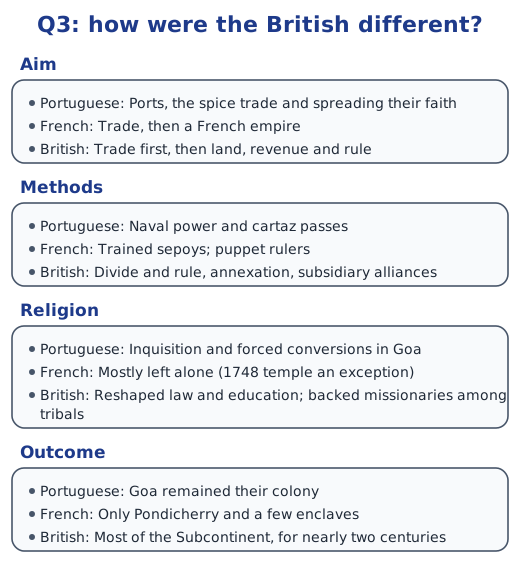
Q3. “How was the British approach to colonising India different from earlier European powers like the Portuguese or the French?” The Portuguese relied on naval power, forcing ships to buy the cartaz, held coastal ports such as Goa, and combined trade with religious persecution and forced conversions through the Goa Inquisition. The French trained sepoys and set up puppet rulers under Dupleix, and mostly stayed out of Indians’ religious life, but they lost to Britain and kept only Pondicherry and a few enclaves. The British began as harmless-looking traders, then took over gradually and with calculation: they used French methods on a much larger scale, made themselves kingmakers through divide and rule, as at Plassey, and added land through the Doctrine of Lapse and subsidiary alliances. Unlike the others, they took over the collection of revenue, reshaped India’s economy, laws and education, and ruled most of the Subcontinent for nearly two centuries.
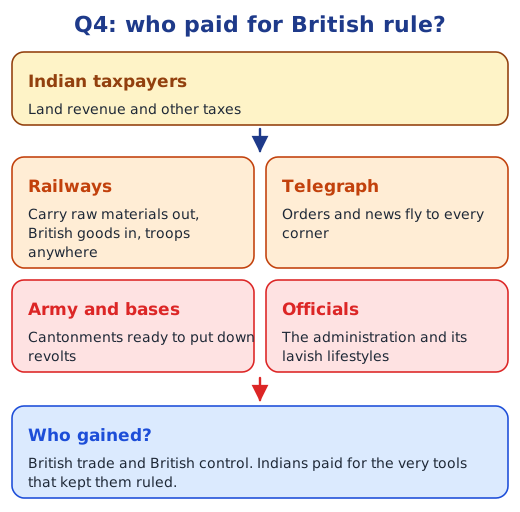
Q4. “‘Indians funded their own subjugation.’ What does this mean in the context of British infrastructure projects in India like the railway and telegraph networks?” It means that Indians paid for the very things that kept them under British control. Railways and the telegraph were not a gift: most of the cost came from Indian tax revenue. Yet they were planned mainly for British needs: railways carried raw materials from the interior to the ports, spread British goods across India and moved troops quickly to put down rebellions; the telegraph let officials send orders and news instantly. Indians were even charged for these projects as part of the drain of wealth. The same was true of the army, the administration and British officials’ lavish lifestyles. So Indian money built and ran the system that ruled them.
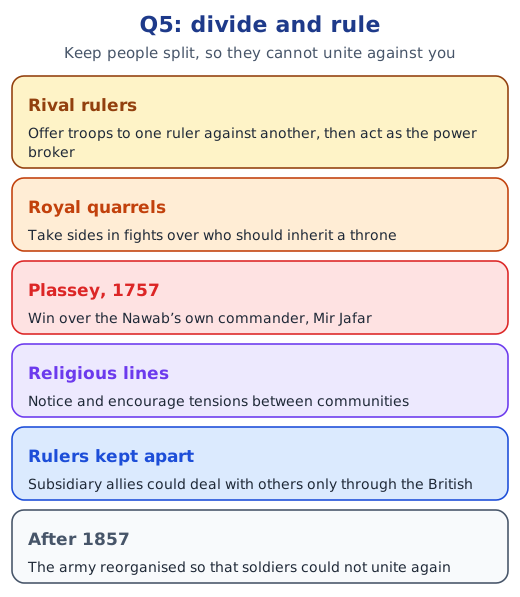
Q5. “What does the phrase ‘divide and rule’ mean? Give examples of how this was used by the British in India?” ‘Divide and rule’ means keeping people split so that they cannot unite against you, and using their quarrels to gain power. Examples from the chapter: (1) the Company offered military help to some rulers against their rivals and so became the power broker; (2) it took sides in disputes over succession within royal families; (3) at Plassey in 1757, Clive won over the Nawab’s own commander, Mir Jafar; (4) the British noticed and often encouraged tensions between religious communities; (5) subsidiary allies could deal with other states only through the British, which kept rulers apart; (6) after 1857, the army was reorganised so that soldiers could not unite again.
Q6. “Choose one area of Indian life, such as agriculture, education, trade, or village life. How was it affected by colonial rule? Can you find any signs of those changes still with us today? Express your ideas through a short essay, a poem, a drawing, or a painting.” A sample short essay on education: Before British rule, India had many kinds of learning: pathshalas, madrasas, viharas and apprenticeships, and British reports counted lakhs of village schools teaching reading, writing and arithmetic at low cost. After Macaulay’s Minute of 1835, English education was promoted, traditional schools slowly disappeared, and English became the language of prestige and of good jobs in government. The new schools mainly trained clerks for the colonial administration. Signs remain today: English is still often linked with status and better jobs, and there is still a gap between those educated in English and those who are not, the lasting division the chapter describes.
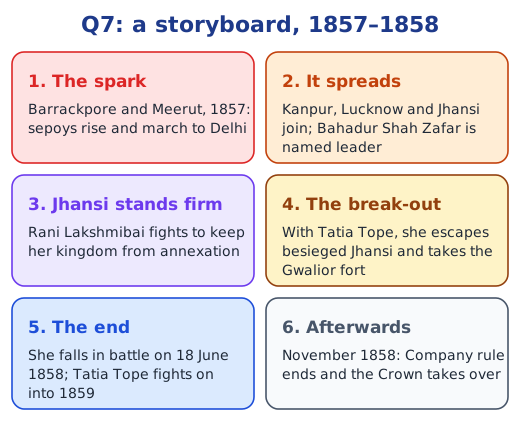
Q7. “Imagine you are a reporter in 1857. Write a brief news report on Rani Lakshmibai’s resistance at Jhansi. Include a timeline or storyboard showing how the rebellion began, spread, and ended, highlighting key events and leaders.” A sample report (the rebellion began in 1857; the Rani’s last battles came in 1858, so the report carries that date):
THE RANI OF JHANSI FALLS FIGHTING. Gwalior, June 1858. Rani Lakshmibai of Jhansi, who refused to let her kingdom be swallowed by the British, has been killed on the battlefield on 18 June. When the rising of the sepoys reached Jhansi last year, the Rani stood firm against annexation. Extra: the British had already claimed her state under the Doctrine of Lapse, refusing to accept her adopted son as heir. When British troops besieged Jhansi, she broke out of the city and, with Tatia Tope, Nana Saheb’s military adviser, captured the fort of Gwalior with its treasury and arsenal. Even the British officer who led the attack on Jhansi has called her the bravest of the rebel leaders. Tatia Tope is still in the field.
Storyboard: (1) The spark, 1857: Mangal Pandey at Barrackpore; sepoys rise at Meerut and march to Delhi. (2) It spreads: Bahadur Shah Zafar is proclaimed leader; Kanpur (Nana Saheb), Lucknow (Begum Hazrat Mahal) and Jhansi (Rani Lakshmibai) join. (3) Jhansi stands firm. (4) The break-out and the capture of Gwalior. (5) The end: Delhi retaken in September 1857, the Rani killed on 18 June 1858, Tatia Tope betrayed and hanged in 1859. (6) Afterwards: in November 1858 Queen Victoria’s proclamation ends Company rule.
Q8. “Imagine an alternate history where India was never colonised by European powers. Write a short story of about 300 words exploring how India might have developed on its own path.” A sample story, The Weaver’s Granddaughter:
In the year 1850, in a busy port on the Bengal coast, twelve-year-old Meera watched ships load bales of fine cotton cloth. Her grandmother’s muslin was so light that traders from Persia, China and Europe paid in silver to carry it home. No European company ruled here. The Europeans who came were merchants like any others, paying fees and following the laws of the Indian kingdoms.
Meera went to the village pathshala, where she learnt arithmetic, Sanskrit verses, the local language and the stars used by sailors. In the evenings the village council met under the banyan tree to plan the new irrigation channel and settle a quarrel over a boundary stone. When the rains failed one year, the raja opened the royal granaries and stopped grain from leaving the region, so nobody starved.
As Meera grew up, she heard of new machines in faraway lands that could spin thread faster than a hundred hands. Instead of being ruined by them, the weavers’ guild of her town sent young people to study them, and soon Indian workshops built their own spinning machines, run on water power. Railways came too, but they were planned by Indian engineers to join market towns, not just to carry raw cotton to the ports.
By the time Meera was an old woman, her town had a printing press, a college that taught both Indian and foreign sciences, and a council elected by its people. Her granddaughter, a young engineer, asked her, “Were we always this rich?” Meera smiled. “We were rich before, and we stayed rich because we kept our wealth at home.”
The story imagines what the chapter suggests: had India’s wealth stayed at home, India would have reached Independence as a very different country.
Q9. “Role-play: Enact a historical discussion between a British official and an Indian personality like Dadabhai Naoroji on the British colonial rule in India.” A sample script (London, about 1895):
Official: Mr Naoroji, Britain has given India peace, railways and the telegraph. Surely that is progress. Naoroji: Railways built with Indian taxes, sir, and planned to carry our raw cotton to your ports and your cloth to our markets. Indians are even charged for them. Official: But India is better governed than ever before. Naoroji: Then why do famines kill millions while grain is shipped abroad? Your own reports show the wealth that leaves India every year. I have added it up. Official: That is the cost of good administration. Naoroji: A cost Indians pay for a government in which they have almost no voice. That is not the British way you practise here in Parliament. That is why I call it un-British rule. Official: What would you have us do? Naoroji: Spend India’s money in India, open the services to Indians, and let Indians share in governing their own country.
Groups can swap roles and add points on textiles, education or the famines.
Q10. “Explore a local resistance movement (tribal, peasant, or princely) from your state or region during the colonial period. Prepare a report or poster describing: What was the specific trigger, if any? Who led the movement? What were their demands? How did the British respond? How is this event remembered today (e.g., local festivals, songs, monuments)?” Choose a movement from your own state. A sample report on the Santhal Rebellion (1855–1856), from today’s Jharkhand, Bihar and West Bengal. Trigger: moneylenders and landlords, supported by the British, were taking away the Santhals’ ancestral lands, trapping them in debt. Leaders: the brothers Sidhu and Kanhu Murmu. Demands: an end to the seizure of their land and to exploitation by moneylenders, and the right to govern themselves; they declared their own government. British response: after some early losses, the British crushed the revolt very harshly, killing thousands of Santhals and, in the end, the leaders. Remembered today (Extra): the rising is called the Santhal Hul; it began on 30 June 1855 at Bhognadih, in today’s Sahibganj district of Jharkhand, and 30 June is marked every year as Hul Diwas, with gatherings, songs and tributes to Sidhu and Kanhu. For a poster: a title, a simple timeline, a box for each of the five points and a small drawing of a bow and arrow, the Santhals’ weapon in the 1856 sketch.
Practice
-
Which painting was made to order for the East India Company’s headquarters in London?
Show answer
Answer: (b) The East offering its riches to Britannia
-
In which year did Charles Wilkins publish the first English translation of a Sanskrit text, the Bhagavad Gita?
Show answer
Answer: (b) 1785
-
Which Viceroy ordered that the government must not act to bring food prices down during the famine of 1876–1878?
Show answer
Answer: (a) Lord Lytton
-
What was the cartaz?
Show answer
Answer: A pass that the Portuguese made every ship in the Arabian Sea buy. Ships without one were seized, which let the Portuguese control the spice trade for nearly a century.
-
Who was Begum Hazrat Mahal?
Show answer
Answer: The queen of Awadh, who joined the rebels in 1857 after her kingdom was annexed, led the defence of Lucknow, refused British offers of safe passage and later took refuge in Nepal.
Stuck on a question?
Take a photo and Lagnever AI explains it step by step. Try it for 7 days for ₹2.
Get it on Google Play Open in browser
For parents: after the trial, the plan renews monthly by UPI or card autopay. You can cancel anytime in the app.