
Class 8 Social Science Chapter 4: The Colonial Era in India Notes
This chapter in five lines
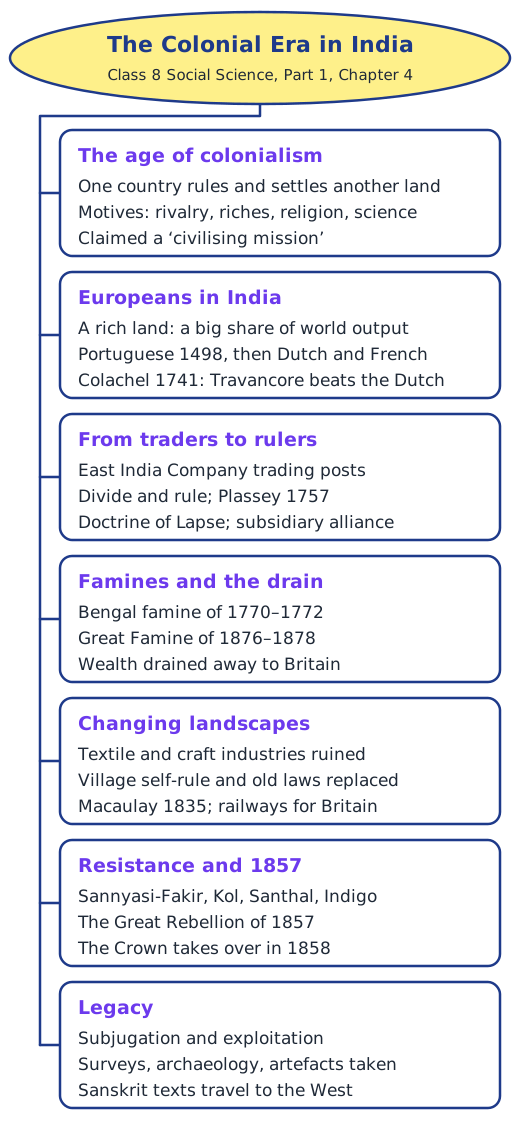
The Colonial Era in India explains how European powers, drawn by India’s wealth, came as traders, and how the British East India Company turned into India’s ruler. The chapter shows what British rule did to India’s people, economy, schools and villages, how Indians resisted up to the rebellion of 1857, and what the colonial era left behind.
What is this chapter about?
This is the third chapter of Theme B of Part 1, Tapestry of the Past. It explains how India, once one of the richest lands in the world, became the largest colony of the British Empire. It opens with the words of William Digby, a British writer of 1901, who accused the British in India of plundering the country and said that India’s wealth had made modern England great. Its four Big Questions ask what colonialism is, what drew Europeans to India, how India’s economy and place in the world changed, and what British rule did to the country. For the Marathas, the last big Indian power the British defeated, see Chapter 3, The Rise of the Marathas.
What is colonialism?
Colonialism is when one country takes control of another region, settles its own people there and imposes its own government, economy and culture. Empires have done this since ancient times, but the ‘Age of Colonialism’ usually means Europe’s expansion from the 15th century. Spain, Portugal, Britain, France and the Netherlands built colonies in Asia, Africa, the Americas, Australia and on many Pacific islands, often through brutal conquest.
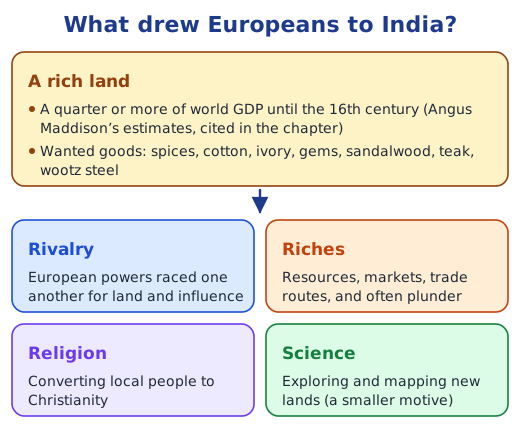
They were driven by rivalry with one another, by the hope of resources, markets, trade routes and plunder, by the wish to spread Christianity and, to a lesser degree, by scientific curiosity. Colonisers claimed a ‘civilising mission’, calling the people they ruled ‘primitive’ or ‘savage’. The chapter says the reality was loss of freedom, exploitation and the destruction of traditional ways of life, with most of the benefits going to the colonisers.
Why did Europeans come to India?
India had traded with the Greeks and Romans more than two thousand years ago, and its spices, cotton, gems, sandalwood, teak and wootz steel were prized abroad. Estimates by the economist Angus Maddison, which the chapter cites, suggest that until the 16th century India produced a quarter or more of the world’s GDP, as much as China. This wealth made India a target.
How did the Portuguese, Dutch and French fare?
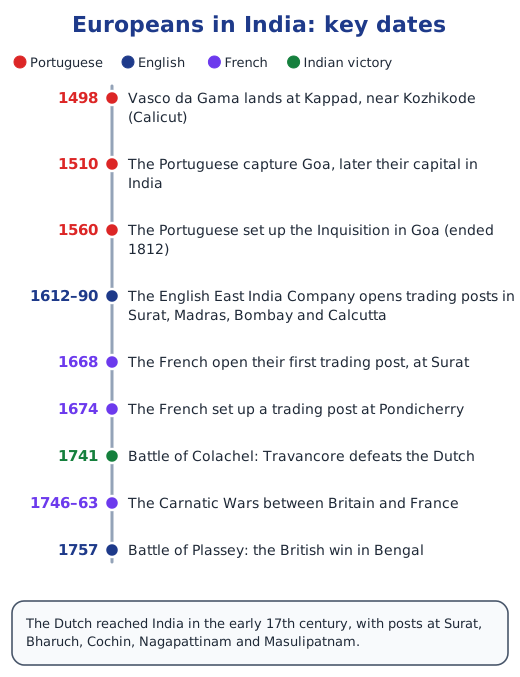
The Portuguese came first: Vasco da Gama reached Kappad, near Kozhikode, in May 1498. They took Goa in 1510, forced ships to buy a pass called a cartaz, and controlled the spice trade for nearly a century. In Goa they set up the Inquisition in 1560, which persecuted people of many faiths, forced conversions and destroyed temples. At Ullal, Rani Abbakka I and her successor Rani Abbakka II resisted them. The Dutch came for the spice trade, but Travancore, under King Marthanda Varma, defeated them decisively at Colachel in 1741. The French, based at Pondicherry, trained Indian sepoys and set up puppet rulers under Dupleix, but lost the Carnatic Wars (1746–1763) to Britain.
How did a trading company become India’s ruler?
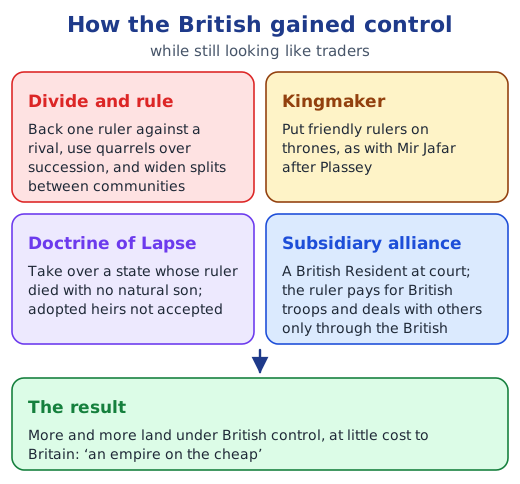
The English East India Company had a royal charter from Queen Elizabeth I that even let it keep an army. In the 17th century it set up trading posts in Surat, Madras, Bombay and Calcutta while acting as mere traders. It then took sides in quarrels between rulers, a policy of divide and rule. At Plassey in 1757, Robert Clive won over Mir Jafar, the Nawab of Bengal’s commander, whose troops stood aside. The Doctrine of Lapse and the subsidiary alliance brought still more states under British control. Read How did the British gain power in India?
What did British rule do to India’s people and economy?
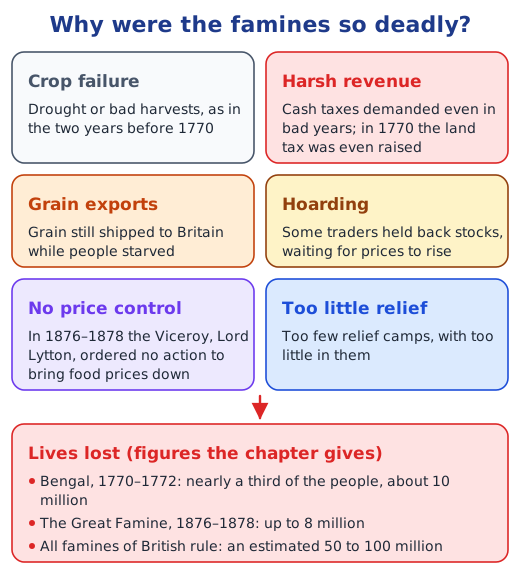
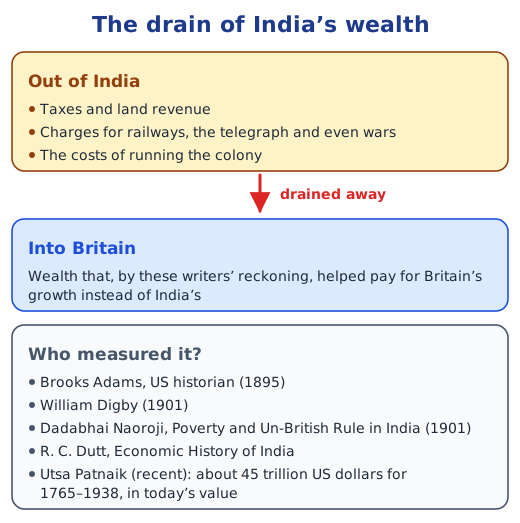
After Plassey the Company won the right to gather the revenue of Bengal, Bihar and Odisha. Harsh revenue demands turned crop failures into terrible famines: the chapter estimates that the Bengal famine of 1770–1772 killed nearly a third of the population, and the Great Famine of 1876–1878 up to 8 million people. Writers such as Brooks Adams, William Digby, Dadabhai Naoroji and R. C. Dutt described a drain of wealth from India to Britain. Read What was the impact of colonial rule?
How did India’s industries, villages and schools change?
British duties and trade rules ruined India’s famous textile industry, and many weavers had to turn to farming. Village councils and customary laws gave way to a central bureaucracy and costly British courts. After Thomas B. Macaulay’s Minute on Indian Education (1835), English schooling spread and traditional schools faded. Railways and the telegraph, paid for mostly by Indian taxes, were built mainly to serve British trade and control.
How did Indians resist?
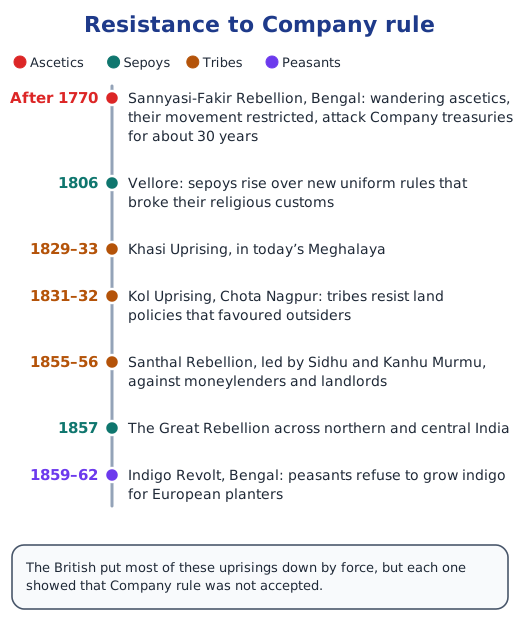
Resistance began almost at once. The Sannyasi-Fakir rebellion followed the Bengal famine of 1770; tribes rose in the Kol Uprising (1831–1832) and the Santhal Rebellion (1855–1856); and peasants rose in the Indigo Revolt (1859–1862). The biggest challenge was the Great Rebellion of 1857, which spread from Meerut to Delhi, Kanpur, Lucknow and Jhansi, with leaders such as Rani Lakshmibai and Begum Hazrat Mahal. It failed, and in 1858 the British Crown took over from the Company. Read How did Indians resist British rule?
What did colonial rule leave behind?
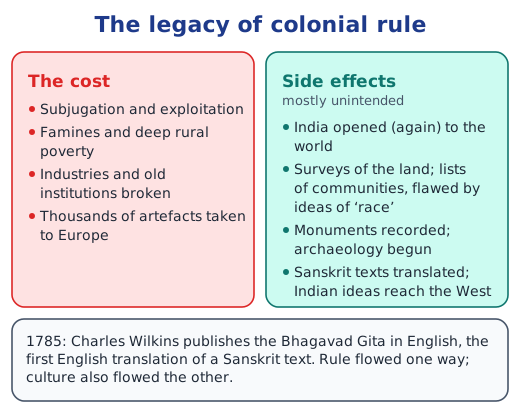
The chapter calls British rule a process of subjugation and exploitation, not a civilising mission. It also notes some largely unintended results: the British surveyed the land, recorded monuments and began archaeology in India, though they also carried thousands of artefacts off to Europe. Translations of Sanskrit texts took Indian ideas to the West. The freedom struggle that grew after 1857 is the subject of Part 2, Chapter 2, India’s Long Road to Independence. Answers to every question are in the NCERT solutions for Chapter 4.
Key terms
| Term | Meaning |
|---|---|
| Colonialism | One country taking control of another land, settling there and imposing its own political, economic and cultural ways. |
| Civilising mission | The colonisers’ claim that they were bringing ‘progress’ to the people they ruled; the chapter says the reality was very different. |
| East India Company | An English trading company, chartered by Queen Elizabeth I and allowed to keep its own army, that went on to rule much of India. |
| Cartaz | A Portuguese pass that ships in the Arabian Sea had to buy; a ship without one was seized. |
| Inquisition | A Catholic Church tribunal that tried people accused of wrong beliefs; the Portuguese set one up in Goa in 1560. |
| Sepoy | An Indian soldier trained in European methods and serving under European, mostly British, officers. |
| Divide and rule | Keeping people split, for example by playing rulers or communities against one another, so that they cannot unite against you. |
| Princely state | A state left under its Indian ruler, who accepted British protection and kept control of its internal affairs. |
| Doctrine of Lapse | A 19th-century British rule: a state whose ruler died without a natural son was annexed, and an adopted heir was not accepted. |
| Subsidiary alliance | A deal that put a British Resident and British troops, paid for by the ruler, in an Indian state, and let it deal with others only through the British. |
| Drain of wealth | The flow of India’s wealth to Britain through taxes and charges, as measured by writers such as Dadabhai Naoroji and R. C. Dutt. |
| Deindustrialisation | The ruin of a country’s industries; in India, above all its textile industry under British trade policy. |
| Indigo | A plant that gives a deep blue dye; European planters forced Bengal’s peasants to grow it. |
| Great Rebellion of 1857 | The largest uprising against British rule in the 19th century; the British called it the ‘Sepoy Mutiny’. |
| British Raj | Direct rule of India by the British Crown, which began in 1858 when it took over from the East India Company. |
Topics in this chapter
Practice
-
In which year did Vasco da Gama arrive near Kozhikode?
Show answer
Answer: (b) 1498
-
Which kingdom defeated the Dutch at the Battle of Colachel in 1741?
Show answer
Answer: (b) Travancore
-
At Plassey, whose troops stood aside and so helped the British win?
Show answer
Answer: (c) Mir Jafar’s
-
Under the Doctrine of Lapse, a state was annexed if its ruler died:
Show answer
Answer: (b) without a natural male heir
-
Who wrote ‘Poverty and Un-British Rule in India’?
Show answer
Answer: (c) Dadabhai Naoroji
-
Who led the Santhal Rebellion of 1855–1856?
Show answer
Answer: (b) Sidhu and Kanhu Murmu
Questions students ask
What are the main topics of Class 8 Social Science Chapter 4?
What colonialism is and why Europeans came to India; the Portuguese, Dutch and French; how the East India Company became a ruler; famines and the drain of wealth; changes to industry, village government, law, education and the economy; resistance up to 1857; and the legacy of colonial rule.
Is The Colonial Era in India in the new NCERT Class 8 book?
Yes. It is Chapter 4 of Exploring Society: India and Beyond, Grade 8 Part 1 (Reprint 2026-27), on pages 83 to 116, in the theme Tapestry of the Past. It follows Chapter 3, The Rise of the Marathas.
Why was India called the ‘jewel in the crown’?
Because, as the chapter explains, India gave the British Empire enormous wealth and natural and human resources. It was the empire’s largest colony, and the British claimed it would remain theirs for ever.
Why did the Great Rebellion of 1857 fail?
According to some historians, the rebels had no unified command and no consistent plan, despite brave leaders. The British struck back very harshly, and in 1858 the Crown took over India from the East India Company.
Stuck on a question?
Take a photo and Lagnever AI explains it step by step. Try it for 7 days for ₹2.
Get it on Google Play Open in browser
For parents: after the trial, the plan renews monthly by UPI or card autopay. You can cancel anytime in the app.