
What was the impact of colonial rule on India?
Answer in short
The chapter shows that British rule harmed India deeply. Harsh revenue demands turned crop failures into famines that killed millions, and India’s wealth was drained to Britain. Its textile industry was ruined, village self-government and old laws were replaced, Macaulay’s plan reshaped education, and railways built with Indian taxes served British trade and control.
Stuck on a question? Take a photo and Lagnever AI explains it step by step. Try it for 7 days for ₹2. Get it on Google Play
How did British revenue policy lead to famines?
A few years after Plassey, the East India Company won the right to gather the revenue of Bengal, Bihar and Odisha, among India’s richest regions. Robert Clive called Bengal ‘the paradise of the earth’. The chapter says the Company took as much revenue as it could and spent very little on the people.
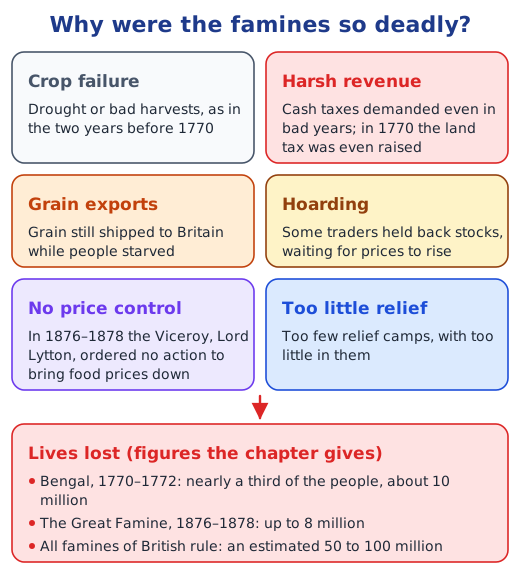
In 1770–1772, after two years of failed crops, farmers still had to pay heavy cash taxes, whatever the harvest. The result was a catastrophic famine that, by the chapter’s estimate, killed nearly a third of Bengal’s people, about 10 million. The Company even raised the land tax during the famine. Later, some British officials and writers condemned this, among them W. W. Hunter and William Digby.
Famines kept returning. In the Great Famine of 1876–1878, mostly in the Deccan, up to 8 million people died. Grain was still shipped to Britain, some traders held back stocks, and the Viceroy, Lord Lytton, ordered that the government must not act to bring food prices down. In 1876, at the height of the famine, he held a grand durbar in Delhi with a week-long feast for 68,000 guests. Relief camps were few and poorly supplied. The chapter cites estimates of 50 to 100 million deaths in all the famines of British rule, and says rural India sank into a poverty it never recovered from.
What was the drain of wealth?
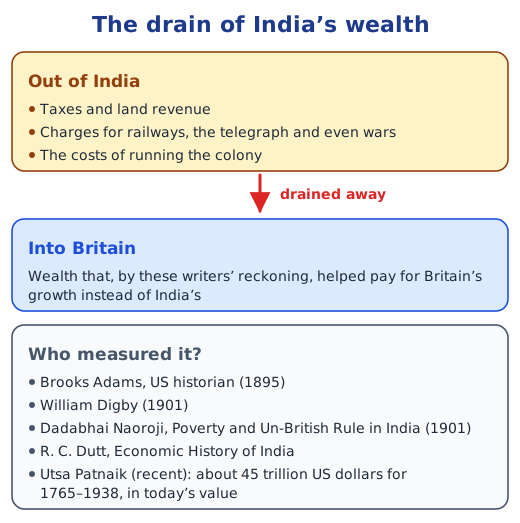
In 1895 the US historian Brooks Adams argued that money taken from Bengal after Plassey helped start Britain’s Industrial Revolution. Building on such work, Dadabhai Naoroji, the first Indian elected to the British House of Commons, wrote Poverty and Un-British Rule in India (1901), adding up from British reports the wealth taken out of India. The historian R. C. Dutt did the same in his Economic History of India. A recent estimate the chapter cites, by Utsa Patnaik, puts the drain from 1765 to 1938 at 45 trillion US dollars in today’s money. Indians were even charged for British spending on railways, the telegraph and wars.
What happened to India’s industries?
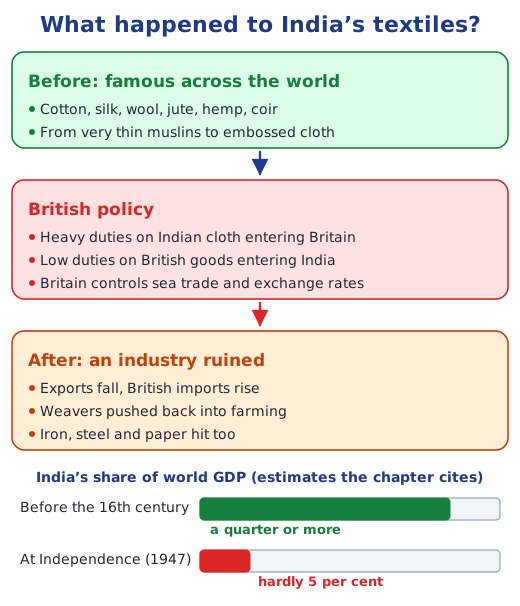
Before the 18th century, Indian cloth, from very fine muslins to richly embossed fabrics, sold all over the world. Britain then taxed Indian textiles heavily when they entered Britain, while British goods entered India at low duties. Britain also controlled sea trade and exchange rates. Indian exports fell and British imports rose, and skilled weavers were reduced to poverty and pushed back into farming. In 1834, William Bentinck, the Governor-General himself, spoke of their tragic fate. Iron, steel and paper suffered too. By Independence, says the chapter, India’s share of world GDP had fallen to hardly 5 per cent.
How did village government and law change?
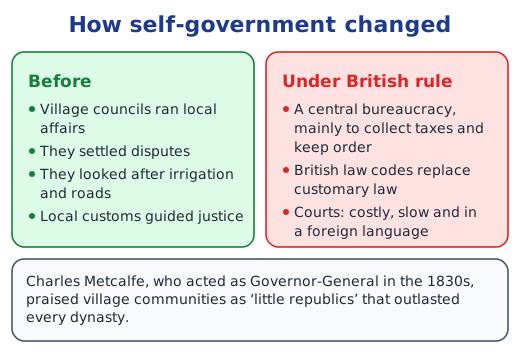
Indian villages once ran their own affairs through councils that settled disputes and looked after irrigation and roads. Charles Metcalfe, who acted as Governor-General in the 1830s, praised these village communities as ‘little republics’ that survived the fall of dynasty after dynasty. The British replaced them with a central bureaucracy built mainly to collect taxes and keep order. British law codes pushed aside local customs, and courts became costly, slow and run in a foreign language.
How did Macaulay change Indian education?
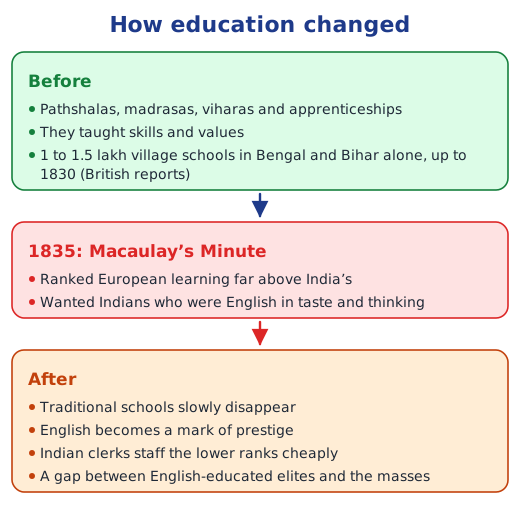
India had many kinds of schools: pathshalas, madrasas, viharas and apprenticeships. British reports counted 100,000 to 150,000 village schools in Bengal and Bihar alone, up to 1830. In 1835, Thomas B. Macaulay wrote his Minute on Indian Education. Though he admitted he knew neither Sanskrit nor Arabic, he ranked European learning far above India’s and wanted Indians who would be English in taste and thinking. His view won. Traditional schools slowly disappeared, English became a mark of prestige, and the new schools trained clerks for the lower ranks of government at low cost.
Who really gained from the railways?
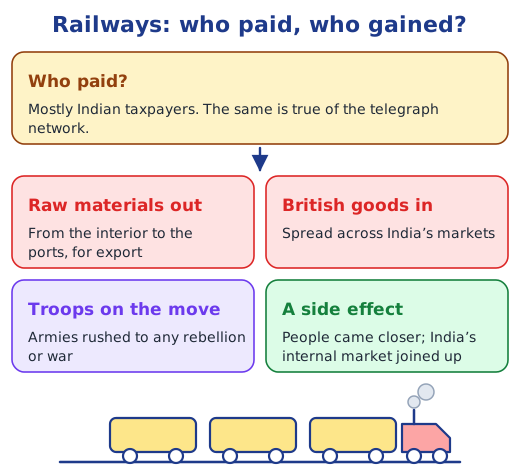
Railways did bring people closer and join up India’s internal market. But the chapter says they were planned mainly to carry raw materials to the ports, spread British goods inland and move troops fast. Most of the cost was paid from Indian taxes, and the same was true of the telegraph, the army and the lifestyles of British officials. As the chapter puts it, Indians funded their own subjugation.
Read on: How did Indians resist British rule?, How did the British gain power in India?, the chapter notes and the NCERT solutions.
Practice
-
Who described Bengal as ‘the paradise of the earth’?
Show answer
Answer: (a) Robert Clive
-
Who was the first Indian elected to the British House of Commons?
Show answer
Answer: (b) Dadabhai Naoroji
-
In which year did Macaulay write his Minute on Indian Education?
Show answer
Answer: (c) 1835
-
Give two reasons the chapter gives for the severity of the famines.
Show answer
Answer: Any two of: farmers had to pay high cash taxes whatever the harvest; grain was still exported to Britain; some traders hoarded stocks; prices were left uncontrolled; relief camps were too few and poorly supplied.
-
Why did India’s textile industry decline under British rule?
Show answer
Answer: Britain put heavy duties on Indian cloth entering Britain but let British goods into India at low duties, and it controlled sea trade and exchange rates. Indian exports fell, British imports rose, and many weavers were pushed into farming.
Questions students ask
How many people died in the Bengal famine of 1770?
The chapter says the famine of 1770–1772 killed nearly a third of Bengal’s population, an estimated 10 million people. Even then, the Company kept its revenue targets and even raised the land tax.
What is meant by the drain of wealth?
It is the flow of India’s wealth to Britain through taxes and through charges on Indians for things like railways, the telegraph and even wars. Dadabhai Naoroji and R. C. Dutt worked out how much was taken, using British reports.
What did Macaulay want from Indian education?
In his 1835 Minute, Macaulay ranked European learning far above India’s and wanted a class of Indians who were Indian by birth but English in taste and thinking. The chapter says this served the colonial need for low-cost clerks.
Did colonial rule bring anything good?
The chapter mentions some largely unintended results: the British surveyed India, recorded monuments, began archaeology and translated Sanskrit texts. It adds that railways brought people closer, though they were built mainly for British interests.
Stuck on a question?
Take a photo and Lagnever AI explains it step by step. Try it for 7 days for ₹2.
Get it on Google Play Open in browser
For parents: after the trial, the plan renews monthly by UPI or card autopay. You can cancel anytime in the app.