
How did the British gain power in India?
Answer in short
The British came to India as traders of the East India Company, chartered in England. They set up coastal trading posts, beat their European rivals and took sides in Indian quarrels. After winning at Plassey in 1757 through Mir Jafar’s betrayal, they used divide and rule, the Doctrine of Lapse and subsidiary alliances to take control.
Stuck on a question? Take a photo and Lagnever AI explains it step by step. Try it for 7 days for ₹2. Get it on Google Play
What drew Europeans to India?
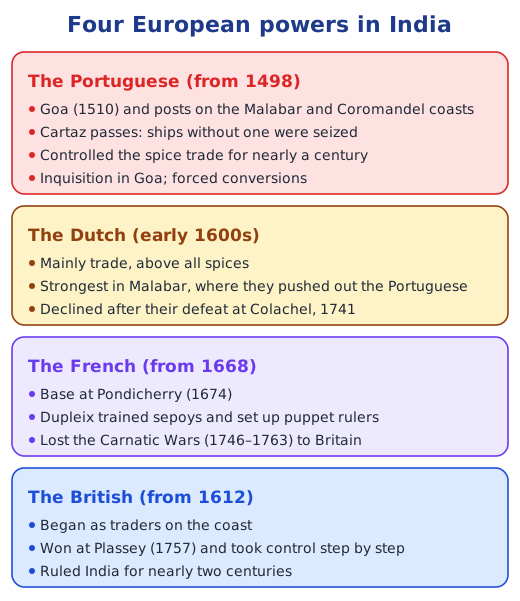
From the 15th century, European powers raced one another for land and trade across the world. India was one of the richest prizes. Its spices, cotton, gems, sandalwood and wootz steel were famous, and estimates the chapter cites give it a quarter or more of the world’s GDP before the 16th century. Four European powers came in turn: first the Portuguese, then the Dutch, the French and finally the British.
What did the Portuguese do in India?
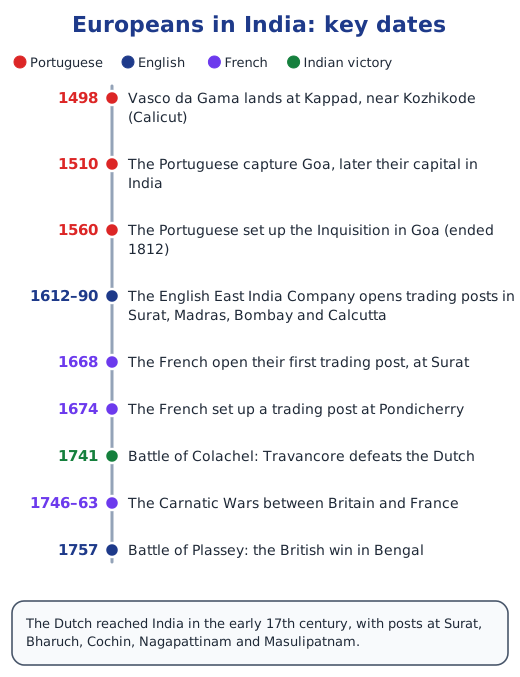
The Portuguese navigator Vasco da Gama reached Kappad, near Kozhikode (Calicut), in May 1498. He was welcomed, but his aggressive ways made enemies of local rulers. On his next voyage he attacked Indian merchants and fired on Calicut from the sea.
The Portuguese captured Goa in 1510 and made it their capital, along with trading posts on the Malabar and Coromandel coasts. Every ship in the Arabian Sea had to buy their pass, the cartaz, or be seized, and so for nearly a century they controlled the spice trade with Europe. In Goa they also set up the Inquisition in 1560. It persecuted Hindus, Muslims, Jews and converts suspected of keeping their old faith, and was not ended until 1812; forced conversions and the destruction of many temples went with it.
Not everyone gave in. At Ullal, in today’s southern Karnataka, Rani Abbakka I made alliances with neighbouring kingdoms and blocked Portuguese attempts to take the port. Her successor, Rani Abbakka II, is said to have set Portuguese ships on fire with burning coconut shells. Yakshagana dance-dramas still tell their stories.
How did the Dutch and the French fare?
The Dutch arrived early in the 17th century, mainly for the spice trade. Their Dutch East India Company had posts at Surat, Bharuch and Cochin in the west and Nagapattinam and Masulipatnam in the east, and was strongest in Malabar. In 1741, King Marthanda Varma of Travancore defeated them on land and at sea at Colachel, and Dutch power in India faded.
The French set up their first post at Surat in 1668 and moved their base to Pondicherry in 1674. Dupleix, who governed French India from 1742 to 1754, trained Indian soldiers, called sepoys, in European methods, and placed puppet rulers on thrones by stepping into quarrels over succession. The British later copied both ideas. The French took Madras in 1746, but they lost the Carnatic Wars (1746–1763) to Britain and kept only Pondicherry and a few small enclaves.
How did English traders become rulers?
The English East India Company had a royal charter from Queen Elizabeth I granting it unusual powers, even the right to raise its own army. In the 17th century its agents opened trading posts in Surat, Madras, Bombay and Calcutta. Local rulers did not mind, because India had always welcomed foreign trade. The chapter says the Company hid its bigger plans behind this trading face.
Slowly the Company moved into Indian politics. It offered troops to one ruler against a rival, took sides in fights over succession and encouraged tensions between religious communities. This is divide and rule.
What happened at Plassey in 1757?
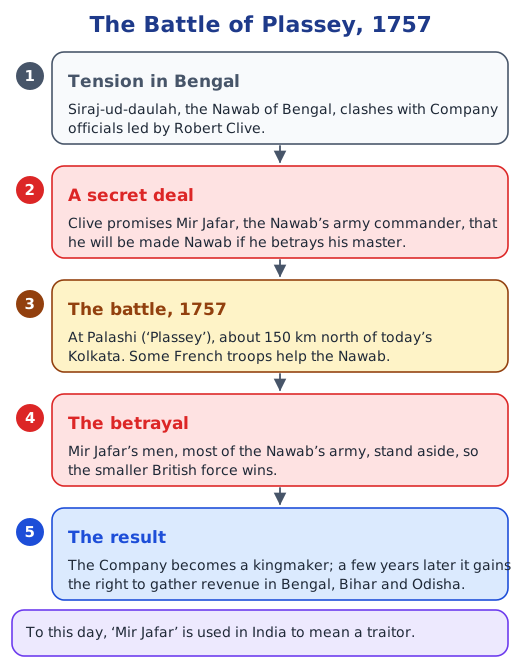
When Siraj-ud-daulah, the Nawab of Bengal, clashed with Company officials, Robert Clive made a secret deal with Mir Jafar, the Nawab’s army commander, promising him the throne. At Palashi, about 150 km north of today’s Kolkata, Mir Jafar’s troops, most of the Nawab’s army, stood aside, and the smaller British force won. The chapter notes that ‘Mir Jafar’ still means ‘traitor’ in India.
What were the Doctrine of Lapse and the subsidiary alliance?
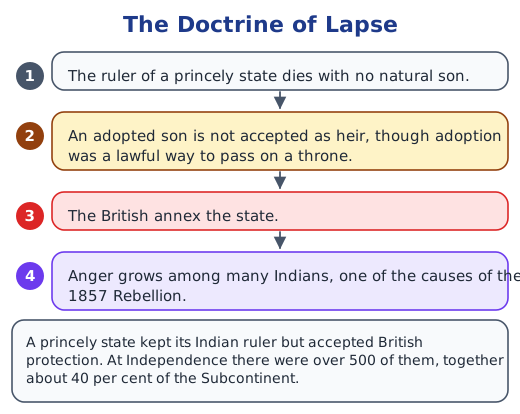
Acting as a kingmaker, the Company kept adding land. In the 19th century it brought in the Doctrine of Lapse: if the ruler of a princely state died without a natural son, the state was annexed. Adoption, an accepted way to pass on a throne in Indian royal families, was ignored. Many states were taken this way, and the anger it caused fed into the rebellion of 1857.
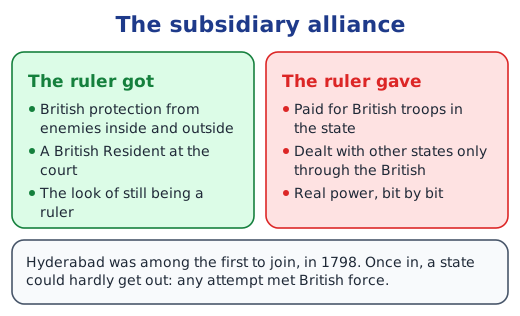
Under a subsidiary alliance, a British ‘Resident’ was placed at an Indian court. The ruler had to pay for British troops in his state and deal with other states only through the British. Hyderabad joined in 1798, among the first. The ruler kept his title, but real power passed to the British, and leaving the alliance was almost impossible.
Read on: What was the impact of colonial rule?, How did Indians resist British rule?, the chapter notes and the NCERT solutions.
Practice
-
Which city became the capital of the Portuguese colony in India?
Show answer
Answer: (b) Goa
-
Who was the French Governor-General who trained Indian sepoys and set up puppet rulers?
Show answer
Answer: (c) Dupleix
-
Which ruler was among the first to accept a subsidiary alliance, in 1798?
Show answer
Answer: (a) The ruler of Hyderabad
-
Why was the Battle of Colachel important?
Show answer
Answer: In 1741 Travancore, under King Marthanda Varma, beat the Dutch on land and at sea. The chapter calls it a rare case of an Asian power driving back a European colonial force, and Dutch power in India declined after it.
-
How did the British win at Plassey despite having fewer soldiers?
Show answer
Answer: Robert Clive secretly promised Mir Jafar, the Nawab’s army commander, that he would be made Nawab. On the day, Mir Jafar’s troops, most of the army, stood aside, so the smaller British force won.
Questions students ask
Who was the first European to reach India by sea?
The chapter names the Portuguese explorer Vasco da Gama, who reached Kappad, a beach near Kozhikode in Kerala, in May 1498. His arrival opened the way for European colonisation of India.
What is meant by ‘divide and rule’?
It means keeping people divided so that they cannot unite against you. The British helped one ruler against another, took sides in quarrels over succession and encouraged tensions between communities.
What was a princely state?
A state that kept its Indian ruler, prince, maharaja or nawab, but accepted British protection in return for running its own internal affairs. The chapter says there were over 500 at Independence, together making up about 40 per cent of the Subcontinent.
Why was the subsidiary alliance called ‘an empire on the cheap’?
Because it let the British control huge areas without paying to govern them. The Indian rulers paid for the British troops stationed in their states, while real power passed to the British.
Stuck on a question?
Take a photo and Lagnever AI explains it step by step. Try it for 7 days for ₹2.
Get it on Google Play Open in browser
For parents: after the trial, the plan renews monthly by UPI or card autopay. You can cancel anytime in the app.