
How did Indians resist British rule up to 1857?
Answer in short
Resistance began soon after the British conquest. Ascetics in Bengal, tribes such as the Kols and Santhals, and indigo peasants rose against unfair taxes, land loss and abuse. The biggest challenge was the Great Rebellion of 1857, led by sepoys and rulers such as Rani Lakshmibai. It was crushed, and the British Crown took over in 1858.
Stuck on a question? Take a photo and Lagnever AI explains it step by step. Try it for 7 days for ₹2. Get it on Google Play
Why did resistance begin so early?
The British called India ‘the jewel in the crown’ of their empire, because it gave them so much wealth and so many resources. They claimed it would stay theirs for ever, in an empire ‘on which the sun never sets’. Yet from the early years of British conquest, Indians fought back against this uninvited ‘guest’.
What was the Sannyasi-Fakir rebellion?
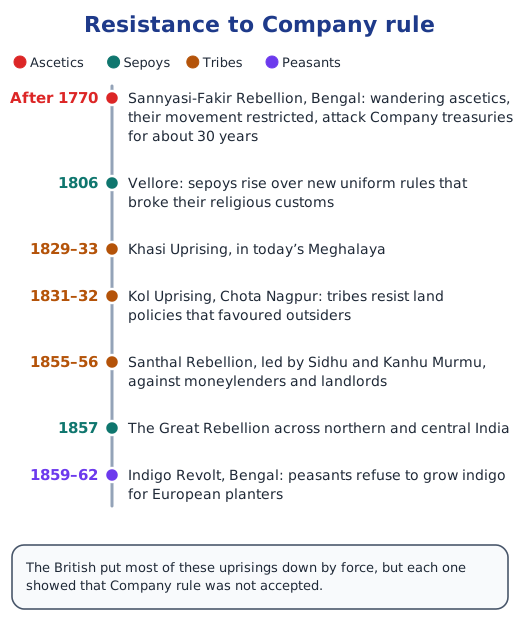
It was one of the earliest organised revolts, and began in Bengal after the famine of 1770. Sannyasis (Hindu ascetics) and fakirs (Muslim ascetics) had always travelled freely on pilgrimage and for charity, but new Company land and tax rules hemmed them in. For about three decades they raided Company treasuries and attacked tax collectors. The British, who called them bandits, put some of them to death and finally defeated them. The rebellion later inspired Bankim Chandra Chattopadhyay’s novel Anandamath (1882), whose song ‘Vande Mataram’ inspired freedom fighters and became India’s national song after Independence.
Why did tribal communities rise up?
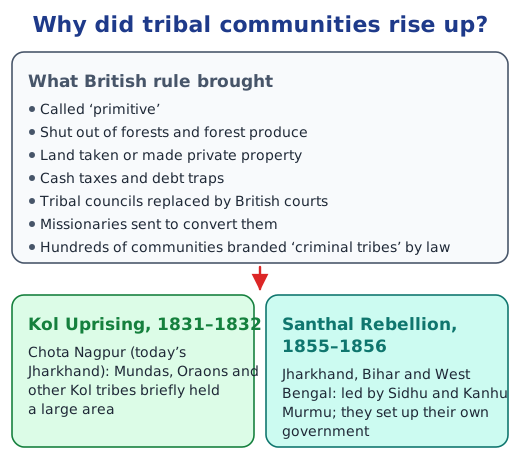
As the British pushed into forests and hills, tribal life was turned upside down. Tribes were called ‘primitive’, shut out of forests, burdened with cash taxes and trapped in debt. Their land was taken or turned into private property, their councils were replaced by British courts, and missionaries were encouraged to convert them. A colonial law even branded hundreds of tribal communities as ‘criminal tribes’.
In the Kol Uprising of 1831–1832 in Chota Nagpur (today’s Jharkhand), the Mundas, Oraons and other Kol tribes rose against land policies that favoured outsiders, and held a large area for a while before being defeated. In the Santhal Rebellion of 1855–1856, across parts of today’s Jharkhand, Bihar and West Bengal, the brothers Sidhu and Kanhu Murmu led the Santhals against moneylenders and landlords who, backed by the British, were taking their ancestral lands. The Santhals declared their own government. The British crushed the revolt very harshly and killed thousands, including the leaders, but the rebellion inspired other tribes to resist.
What was the Indigo Revolt?
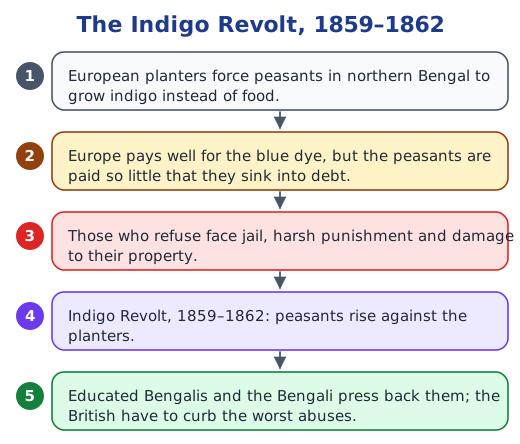
In northern Bengal, European planters forced peasants to grow indigo, a plant that gives a blue dye then in great demand in Europe, instead of food crops. Everyone profited except the peasants, who were paid so little that they fell into debt. Those who refused were jailed, harshly punished or had their property destroyed. In the Indigo Revolt (1859–1862) the peasants rose against the planters. Educated Bengalis and the Bengali press backed them, and the British had to curb the worst abuses.
What caused the Great Rebellion of 1857?
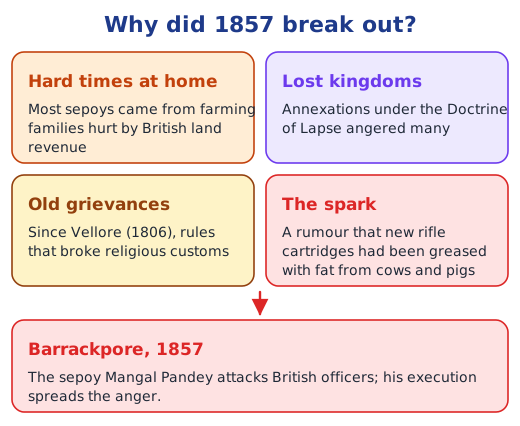
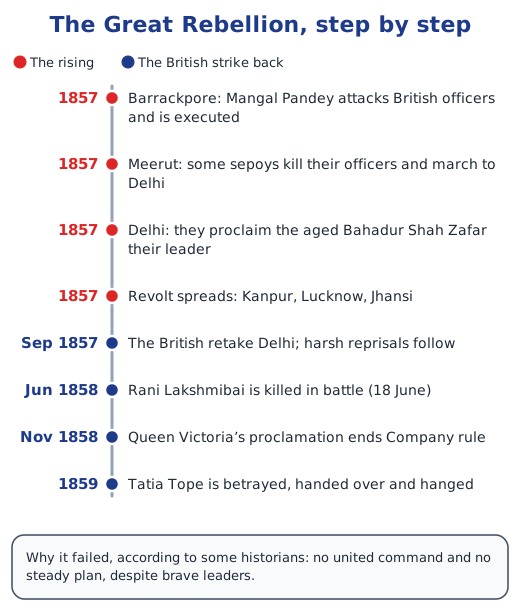
To the British it was the ‘Sepoy Mutiny’, but after Independence historians rejected that name; the chapter calls it the Great Rebellion of 1857. Sepoys, the Indian soldiers of the Company’s army, had long been unhappy. In 1806 at Vellore, new uniform rules banned religious marks on the forehead and made soldiers shave their beards; the sepoys seized the fort, and the British crushed the revolt. Most sepoys also came from farming families hurt by British land revenue. In 1857 a rumour spread that new rifle cartridges had been greased with fat from cows and pigs. At Barrackpore, the sepoy Mangal Pandey attacked British officers, and his execution spread the anger.
How did the rebellion spread and end?
At Meerut, some sepoys killed their British officers and marched to Delhi, where they proclaimed the aged Mughal emperor Bahadur Shah Zafar their leader, though the commanders took the military decisions. The revolt spread across northern and central India, to Kanpur, Lucknow and Jhansi. At Kanpur, forces under Nana Saheb killed over 200 British civilians after first promising them safe passage, for reasons still debated. The British recaptured Delhi in September 1857, and their long campaign of reprisals, the chapter says, killed far more people than the rebels had. Some historians say the rebellion failed because it had no unified command or steady plan.
Who were the heroines of 1857?
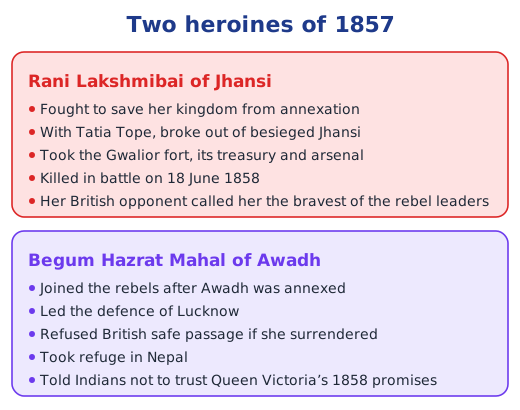
Rani Lakshmibai of Jhansi fought to save her kingdom from annexation. Helped by Tatia Tope, she escaped from besieged Jhansi and captured the Gwalior fort. She was killed in battle on 18 June 1858, and the British officer who led the attack on Jhansi called her the bravest of the rebel leaders. Begum Hazrat Mahal of Awadh led the defence of Lucknow, refused British offers of safe passage and took refuge in Nepal. When Queen Victoria promised in November 1858 not to interfere in religion, the Begum warned Indians not to trust such promises.
What changed after 1857?
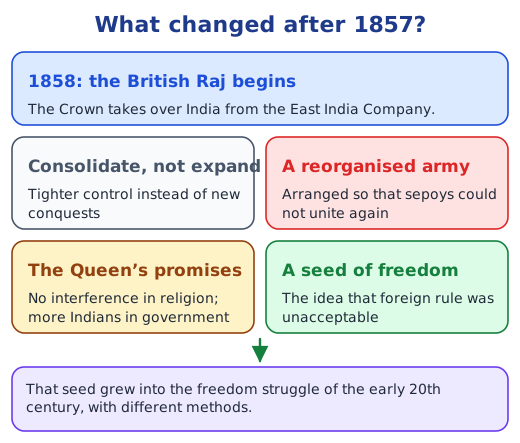
In 1858 the British Crown took over the government of India from the East India Company, beginning the British Raj. The British stopped grabbing new land and tightened their hold instead, and they reorganised the army to prevent united resistance. The rebellion failed, but it planted the idea that foreign rule was unacceptable, which grew into the freedom struggle of the 20th century.
Read on: How did the British gain power in India?, What was the impact of colonial rule?, the chapter notes and the NCERT solutions.
Practice
-
Which novel by Bankim Chandra Chattopadhyay contained the song ‘Vande Mataram’?
Show answer
Answer: (b) Anandamath
-
Where did the sepoy Mangal Pandey attack British officers in 1857?
Show answer
Answer: (b) Barrackpore
-
Whom did the rebels proclaim their leader in Delhi?
Show answer
Answer: (c) Bahadur Shah Zafar
-
Why did the Santhals rebel in 1855?
Show answer
Answer: Moneylenders and landlords, backed by the British, were taking away their ancestral lands. Led by Sidhu and Kanhu Murmu, they declared their own government and fought the British.
-
Name two heroines of 1857 and the places they defended.
Show answer
Answer: Rani Lakshmibai of Jhansi, who defended Jhansi and then took the Gwalior fort, and Begum Hazrat Mahal of Awadh, who led the defence of Lucknow.
Questions students ask
What was the immediate cause of the revolt of 1857?
In 1857 a rumour spread that new rifle cartridges had been greased with fat from cows and pigs, which offended both Hindu and Muslim sepoys. Behind it lay years of anger over land revenue, annexations and rules that broke religious customs.
Why did the British call the tribals ‘criminal tribes’?
A colonial law branded hundreds of tribal communities as ‘criminal tribes’. The chapter says this was unjust and led to decades of harassment, one of many abuses that pushed tribes to rebel.
Why did the Great Rebellion of 1857 fail?
According to some historians, the rebels had no single command and no steady strategy, though they had brave leaders. The British also had stronger forces and struck back very harshly.
What happened after 1857?
In 1858 the British Crown took India over from the East India Company, starting the British Raj. The army was reorganised to prevent another united revolt, and the idea that foreign rule was unacceptable grew into the 20th-century freedom struggle.
Stuck on a question?
Take a photo and Lagnever AI explains it step by step. Try it for 7 days for ₹2.
Get it on Google Play Open in browser
For parents: after the trial, the plan renews monthly by UPI or card autopay. You can cancel anytime in the app.