
Class 10 Maths Chapter 12 NCERT Solutions Hinglish mein: Surface Areas and Volumes
Chapter 12, Surface Areas and Volumes, ke andar ke sawalon, saaton worked examples, aur Exercises 12.1 aur 12.2 ke har sawal ke jawab, Class 10 ki NCERT textbook Mathematics se. Page numbers 2026-27 reprint ke hain (pages 161–170). Exercise ke sawal yahan Hinglish anuvaad mein hain (English page par book ke shabdon mein quote kiye gaye hain); examples aur chapter ke andar ke sawal chhote mein, number aur page ke saath likhe gaye hain. Book ki figures copy nahi ki gayi: har figure hamari apni drawing hai, sawal ke data se banayi gayi aur naap likhe hue. Har jawab exact fractions se dobara calculate kiya gaya aur book ke end ki answer key se milta hai. Jab tak sawal alag na kahe, π = 22/7. Chhote notes: Chapter 12 notes.
Chapter ke andar ke sawal (pages 161–163)
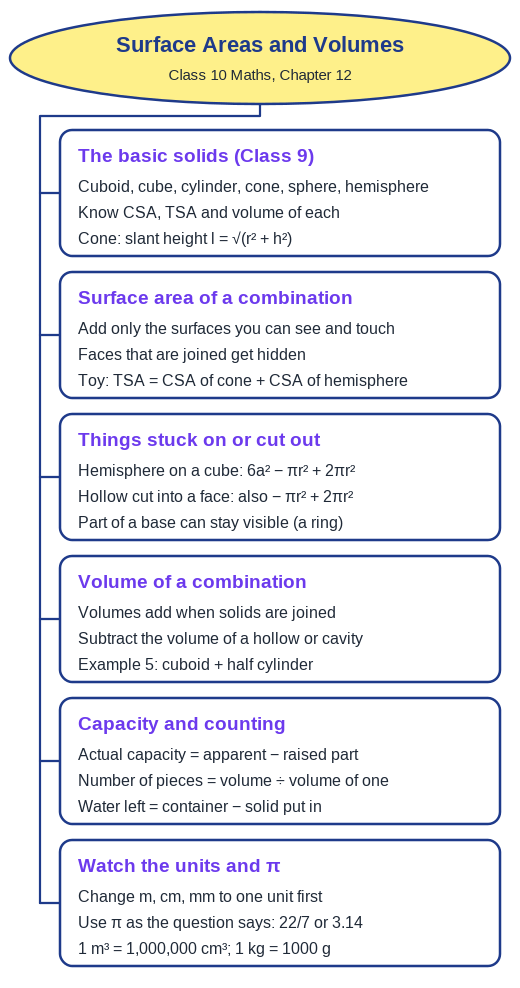
Page 161: kya paani ke tanker ke peeche laga container basic solids mein se koi ek hai? Koi ek basic solid us par fit nahi hota. Ye ek cylinder hai jiske har sire ko hemisphere band karta hai, isliye uski surface cylinder ka curved surface aur dono hemispheres ke curved surfaces hain.
Page 162: neeche se gol, cylinder jaisi cheez ka naam batao. Test tube: cylinder se juda hemisphere.
Page 163: hemisphere par cone wale toy par kitna paint lagega, ye jaanne ke liye kya pata hona chahiye? Uska surface area, jo hemisphere ka curved surface aur cone ka curved surface hai. Dono flat circles toy ke andar dabe hue hain aur unhe paint nahi chahiye.
Examples 1 se 4: surface area (pages 163–166)
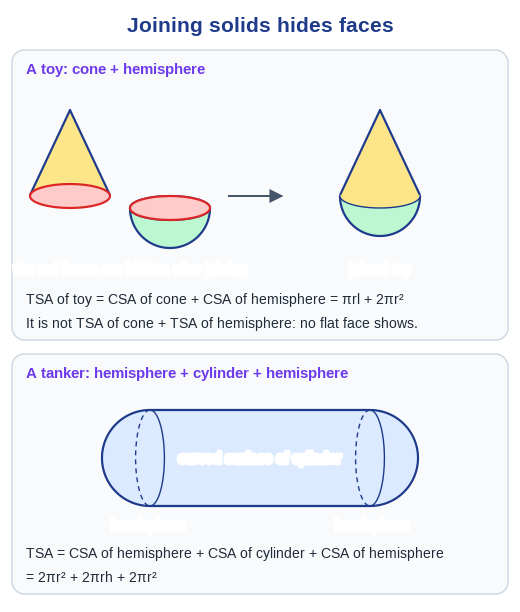
Example 1 (pages 163–164): ek lattu cone par hemisphere hai; kul height 5 cm, diameter 3.5 cm; rangne wala area nikaalo (π = 22/7).
- Radius r = 3.5/2 = 1.75 cm. Hemisphere height ka 1.75 cm leta hai, isliye cone 5 − 1.75 = 3.25 cm ooncha hai.
- Slant height l = √(1.75² + 3.25²) = √13.625 ≈ 3.7 cm.
- Hemisphere ka CSA = 2πr² = 2 × (22/7) × 1.75 × 1.75 = 19.25 cm².
- Cone ka CSA = πrl ≈ (22/7) × 1.75 × 3.7 = 20.35 cm².
- Rangne wala area ≈ 19.25 + 20.35 = 39.6 cm² (lagbhag). Bina round ki slant height se ye lagbhag 39.55 cm² aata hai.
Area dono total surface areas ka jod nahi hai: flat faces jude hue aur chhupe hain.
Example 2 (page 164): 5 cm edge ke cube ke upar 4.2 cm diameter ka hemisphere laga hai; total surface area nikaalo.
Cube ka TSA = 6 × 5² = 150 cm². Hemisphere upar πr² area ka circle dhakta hai par apna curved surface 2πr² jodta hai. Isliye area = 150 − πr² + 2πr² = 150 + πr² = 150 + (22/7) × 2.1 × 2.1 = 150 + 13.86 = 163.86 cm².
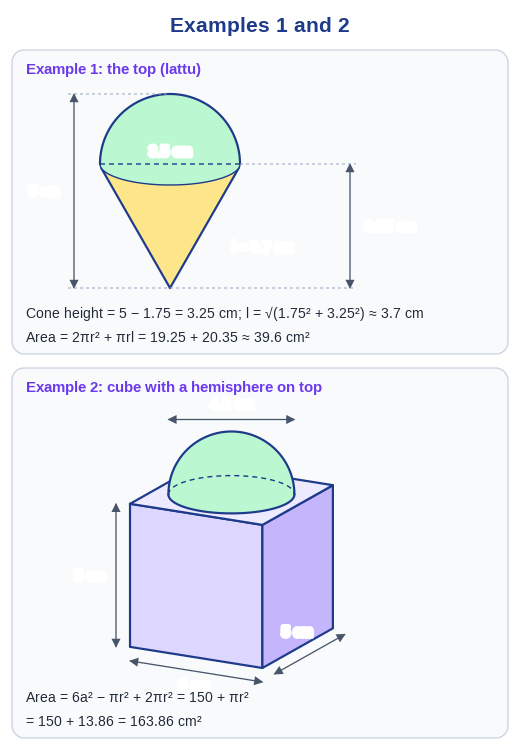
Example 3 (page 165): ek rocket cylinder (diameter 3 cm) par cone (height 6 cm, base diameter 5 cm) hai, kul height 26 cm; cone orange aur cylinder yellow rangna hai (π = 3.14).
Cone: r = 2.5 cm, h = 6 cm, l = √(2.5² + 6²) = √42.25 = 6.5 cm. Cylinder: r′ = 1.5 cm, h′ = 26 − 6 = 20 cm.
Cylinder cone ke base ka sirf beech ka hissa dhakta hai, isliye base ka ek ring khula rehta hai aur orange rangta hai.
- Orange = πrl + πr² − π(r′)² = π(2.5 × 6.5 + 2.5² − 1.5²) = π × 20.25 = 3.14 × 20.25 = 63.585 cm².
- Yellow = 2πr′h′ + π(r′)² (cylinder ki side aur neeche ka circle) = πr′(2h′ + r′) = 3.14 × 1.5 × 41.5 = 4.71 × 41.5 = 195.465 cm².
Example 4 (page 166): bird-bath 1.45 m ooncha aur 30 cm radius ka cylinder hai jiske upar hemispherical gaddha hai; total surface area nikaalo.
h = 145 cm aur r = 30 cm lo. Surface cylinder ki curved side aur hemisphere ka andar ka hissa hai (book neeche ka face nahi ginti): TSA = 2πrh + 2πr² = 2πr(h + r) = 2 × (22/7) × 30 × 175 = 33000 cm² = 3.3 m².
Exercise 12.1 (pages 166–167)
Book kehti hai: jab tak alag na kaha jaaye, π = 22/7 lo.
Neeche ek shabd: CSA yaani curved surface area (sirf mudi hui satah), aur TSA yaani total surface area (bahar ki saari satah).
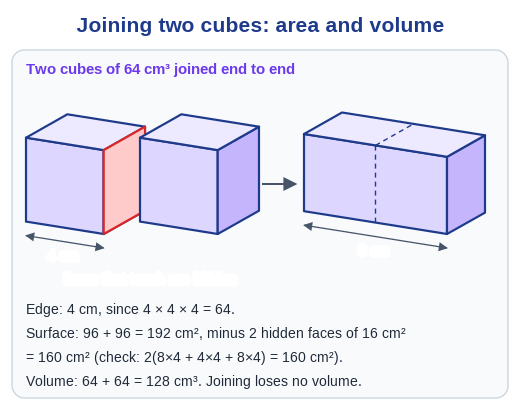
1. 64 cm³ volume wale 2 cubes ko siron se joda gaya hai. Bane cuboid ka surface area nikaalo.
Diya hai: 2 cubes, har ek ka volume 64 cm³, siron se jode gaye.
Nikaalna hai: bane cuboid ka surface area.
- Har cube ki edge: a³ = 64, to a = 4 cm.
- Jodne par cuboid l = 8 cm, b = 4 cm, h = 4 cm ka banta hai.
- Cuboid ka surface area = 2(lb + bh + hl) = 2(8 × 4 + 4 × 4 + 4 × 8) = 2(32 + 16 + 32) = 160 cm².
- Check: do cubes ka 2 × 6 × 16 = 192 cm² tha. Jude hue do face (2 × 16 = 32 cm²) chhip jaate hain, aur 192 − 32 = 160.
Answer: cuboid ka surface area = 160 cm².
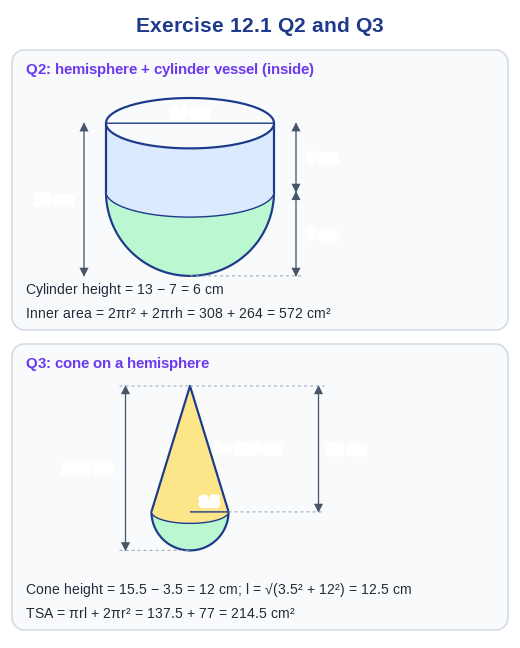
2. Ek bartan khokhle hemisphere ke roop mein hai jiske upar khokhla cylinder laga hai. Hemisphere ka diameter 14 cm hai aur bartan ki kul height 13 cm hai. Bartan ka andar ka surface area nikaalo.
Diya hai: hemisphere ka diameter = 14 cm, yaani r = 7 cm; kul height = 13 cm.
Nikaalna hai: bartan ka andar ka surface area.
- Hemisphere 7 cm gehra hai (uska radius). To cylinder ki height h = 13 − 7 = 6 cm.
- Andar ki satah = hemisphere ka andar + cylinder ka andar = 2πr² + 2πrh.
- 2πr² = 2 × (22/7) × 7 × 7 = 308 cm².
- 2πrh = 2 × (22/7) × 7 × 6 = 264 cm².
- Andar ka surface area = 308 + 264 = 572 cm².
Answer: andar ka surface area = 572 cm².
3. Ek toy 3.5 cm radius ke cone ke roop mein hai jo same radius ke hemisphere par laga hai. Toy ki kul height 15.5 cm hai. Toy ka total surface area nikaalo.
Diya hai: cone aur hemisphere dono ka r = 3.5 cm; kul height = 15.5 cm.
Nikaalna hai: toy ka total surface area.
- Hemisphere ki height r = 3.5 cm hai. To cone ki height h = 15.5 − 3.5 = 12 cm.
- Cone ki slant height l = √(r² + h²) = √(3.5² + 12²) = √156.25 = 12.5 cm.
- Flat faces jude hain aur chhip jaate hain. To TSA = cone ka CSA + hemisphere ka CSA = πrl + 2πr².
- πrl = (22/7) × 3.5 × 12.5 = 137.5 cm².
- 2πr² = 2 × (22/7) × 3.5 × 3.5 = 77 cm².
- TSA = 137.5 + 77 = 214.5 cm².
Answer: toy ka total surface area = 214.5 cm².
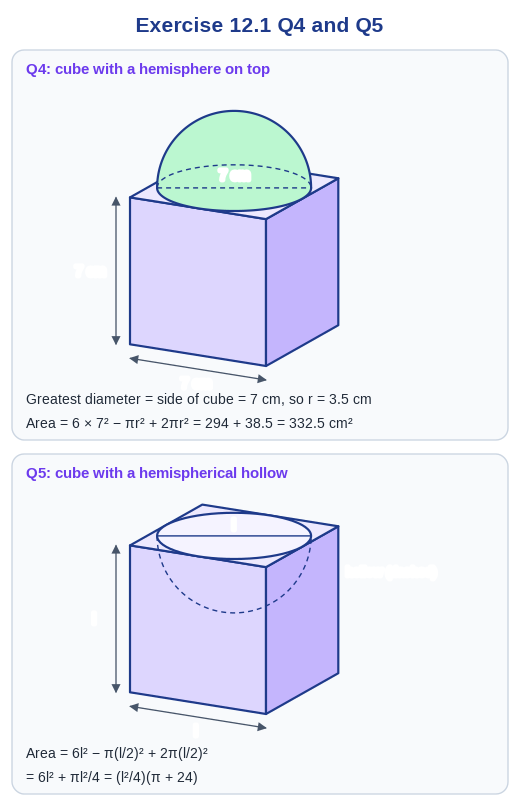
4. 7 cm side ke cubical block ke upar ek hemisphere laga hai. Hemisphere ka zyada se zyada diameter kitna ho sakta hai? Solid ka surface area nikaalo.
Diya hai: 7 cm side ka cube, upar hemisphere.
Nikaalna hai: hemisphere ka sabse bada diameter, aur solid ka surface area.
- Hemisphere ka flat face cube ke upar wale face (7 cm side ka square) par fit hona chahiye. Usme sabse bada circle 7 cm diameter ka aata hai. To sabse bada diameter 7 cm hai, aur r = 3.5 cm.
- Cube ki satah = 6 × 7² = 294 cm².
- Hemisphere upar wale face par πr² area ka circle dhak deta hai, par apni curved satah 2πr² jod deta hai.
- Surface area = 294 − πr² + 2πr² = 294 + πr² = 294 + (22/7) × 3.5 × 3.5 = 294 + 38.5 = 332.5 cm².
Answer: sabse bada diameter = 7 cm; solid ka surface area = 332.5 cm².
5. Lakdi ke cubical block ke ek face se hemispherical gaddha aise kaata gaya hai ki hemisphere ka diameter l cube ki edge ke barabar hai. Bache solid ka surface area nikaalo.
Diya hai: cube ki edge = l; hemispherical gaddhe ka diameter = l, yaani radius = l/2.
Nikaalna hai: bache solid ka surface area.
- Cube ke chhe faces ka area 6l² hai.
- Gaddha upar wale face se π(l/2)² = πl²/4 area ka circle hata deta hai.
- Gaddhe ki andar ki satah 2π(l/2)² = πl²/2 jod deti hai.
- Surface area = 6l² − πl²/4 + πl²/2 = 6l² + πl²/4 = (l²/4)(π + 24).
Answer: surface area = (l²/4)(π + 24) square units.
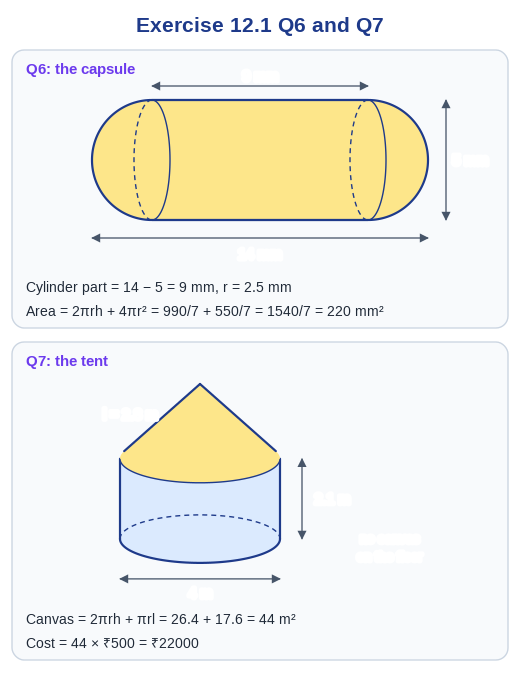
6. Dawa ka capsule ek cylinder ke aakaar ka hai jiske dono siron par hemisphere chipke hain (Fig. 12.10 dekho). Poore capsule ki lambai 14 mm aur diameter 5 mm hai. Uska surface area nikaalo.
Diya hai: kul lambai = 14 mm, diameter = 5 mm, yaani r = 2.5 mm.
Nikaalna hai: capsule ka surface area.
- Do hemispheres lambai ka 2.5 + 2.5 = 5 mm lete hain. To cylinder ki lambai h = 14 − 5 = 9 mm.
- Cylinder ka CSA = 2πrh = 2 × (22/7) × 2.5 × 9 = 990/7 mm².
- Do hemispheres ka CSA = 2 × 2πr² = 4 × (22/7) × 2.5 × 2.5 = 550/7 mm².
- Surface area = 990/7 + 550/7 = 1540/7 = 220 mm².
Answer: capsule ka surface area = 220 mm².
7. Ek tent cylinder ke aakaar ka hai jiske upar conical top hai. Agar cylinder wale hisse ki height aur diameter kramash 2.1 m aur 4 m hain, aur top ki slant height 2.8 m hai, to tent banane mein laga canvas ka area nikaalo. ₹500 per m² ki dar se tent ke canvas ki keemat bhi nikaalo. (Dhyaan do ki tent ka base canvas se nahi dhaka jaayega.)
Diya hai: cylinder h = 2.1 m, diameter 4 m (yaani r = 2 m); cone ki slant height l = 2.8 m; dar ₹500 per m².
Nikaalna hai: canvas ka area aur uski keemat.
- Canvas sirf cylinder ki side aur cone ko dhakta hai. Farsh aur jude hue circle par canvas nahi lagta.
- Cylinder ka CSA = 2πrh = 2 × (22/7) × 2 × 2.1 = 26.4 m².
- Cone ka CSA = πrl = (22/7) × 2 × 2.8 = 17.6 m².
- Canvas = 26.4 + 17.6 = 44 m².
- Keemat = 44 × ₹500 = ₹22000.
Answer: canvas = 44 m²; keemat = ₹22000.
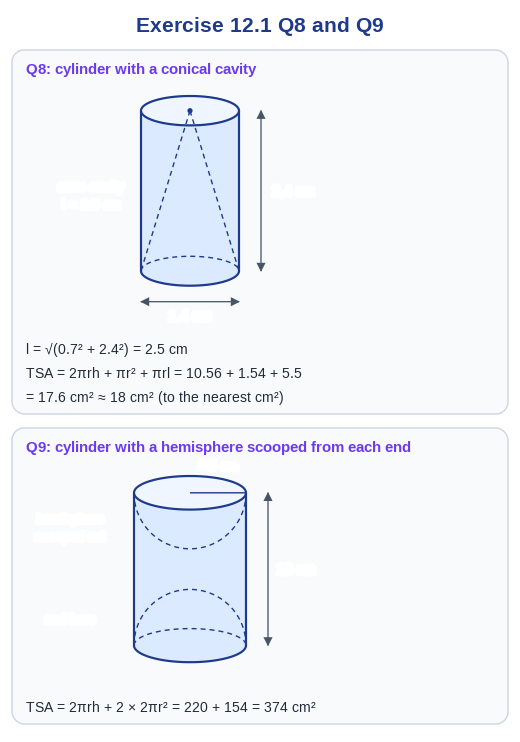
8. 2.4 cm height aur 1.4 cm diameter ke solid cylinder mein se same height aur same diameter ki conical cavity khodi gayi hai. Bache solid ka total surface area nearest cm² tak nikaalo.
Diya hai: cylinder h = 2.4 cm, diameter 1.4 cm (yaani r = 0.7 cm); same r aur h ka cone khoda gaya.
Nikaalna hai: bache solid ka TSA, nearest cm² tak.
- Cavity ki slant height l = √(0.7² + 2.4²) = √6.25 = 2.5 cm.
- Bache solid ki teen satah hain: cylinder ki curved side, upar ka circle, aur cone ki andar ki satah. (Neeche ka circle ab cavity ka munh hai.)
- 2πrh = 2 × (22/7) × 0.7 × 2.4 = 10.56 cm².
- πr² = (22/7) × 0.7 × 0.7 = 1.54 cm².
- πrl = (22/7) × 0.7 × 2.5 = 5.5 cm².
- TSA = 10.56 + 1.54 + 5.5 = 17.6 cm², jo nearest cm² tak 18 cm² hai.
Answer: total surface area ≈ 18 cm².
9. Lakdi ki ek cheez solid cylinder ke har sire se ek hemisphere khod kar banayi gayi hai, jaisa Fig. 12.11 mein dikhaya hai. Agar cylinder ki height 10 cm hai aur uske base ka radius 3.5 cm hai, to cheez ka total surface area nikaalo.
Diya hai: cylinder h = 10 cm, r = 3.5 cm; har sire se 3.5 cm radius ka hemisphere khoda gaya.
Nikaalna hai: cheez ka total surface area.
- Dono flat sire khod diye gaye. To satah = cylinder ki curved side + do hemispheres ki andar ki satah.
- 2πrh = 2 × (22/7) × 3.5 × 10 = 220 cm².
- Do hemispheres = 2 × 2πr² = 4 × (22/7) × 3.5 × 3.5 = 154 cm².
- TSA = 220 + 154 = 374 cm².
Answer: total surface area = 374 cm².
Examples 5 se 7: volume (pages 167–169)
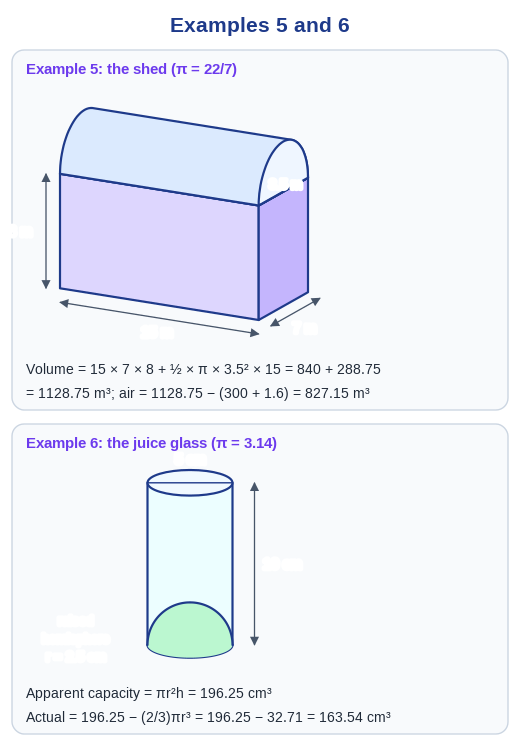
Example 5 (pages 167–168): ek shed ka base 7 m × 15 m hai, cuboid hissa 8 m ooncha hai aur upar aadha cylinder hai; usme kitni hawa aati hai, aur machinery 300 m³ aur 20 workers har ek lagbhag 0.08 m³ lein to kitni hawa bachti hai?
Aadhe cylinder ka diameter 7 m (radius 3.5 m) aur lambai 15 m hai. Volume = 15 × 7 × 8 + ½ × (22/7) × 3.5 × 3.5 × 15 = 840 + 288.75 = 1128.75 m³. Bhari jagah = 300 + 20 × 0.08 = 301.6 m³, isliye bachi hawa 1128.75 − 301.6 = 827.15 m³.
Example 6 (page 168): 5 cm andar ke diameter aur 10 cm height ke glass ke talle par ubhra hua hemisphere hai; uski apparent aur actual capacity nikaalo (π = 3.14).
Apparent capacity = πr²h = 3.14 × 2.5 × 2.5 × 10 = 196.25 cm³. Ubhra hemisphere (2/3)πr³ = (2/3) × 3.14 × 2.5³ ≈ 32.71 cm³ jagah leta hai. Actual capacity = 196.25 − 32.71 = 163.54 cm³.
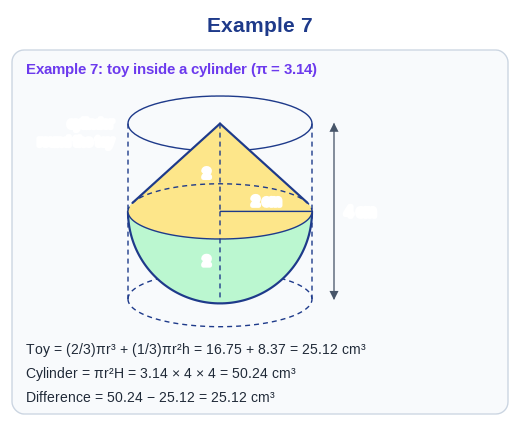
Example 7 (page 169): ek toy hemisphere par cone hai; cone 2 cm ooncha hai aur base ka diameter 4 cm hai. Toy ka volume, aur use theek gherne wale cylinder se farak nikaalo (π = 3.14).
Dono hisson ke liye r = 2 cm. Toy = (2/3)πr³ + (1/3)πr²h = (2/3) × 3.14 × 8 + (1/3) × 3.14 × 4 × 2 = 16.75 + 8.37 ≈ 25.12 cm³. Gherne wale cylinder ka radius 2 cm aur height 2 + 2 = 4 cm hai: volume = 3.14 × 2² × 4 = 50.24 cm³. Farak = 50.24 − 25.12 = 25.12 cm³.
Exercise 12.2 (pages 169–170)
Book kehti hai: jab tak alag na kaha jaaye, π = 22/7 lo.
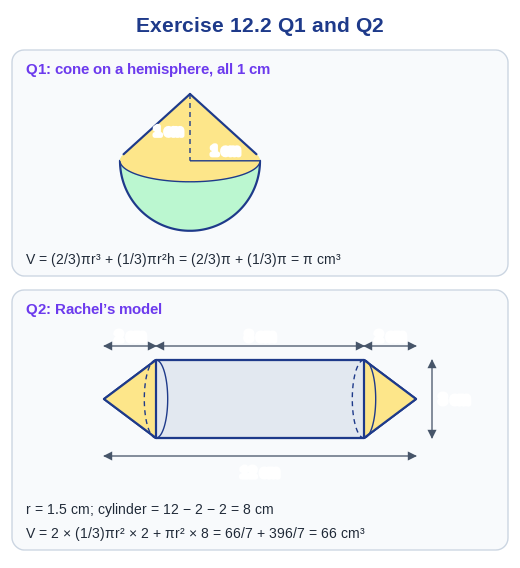
1. Ek solid hemisphere par khade cone ke aakaar ka hai, dono ke radius 1 cm hain aur cone ki height uske radius ke barabar hai. Solid ka volume π ke roop mein nikaalo.
Diya hai: cone aur hemisphere dono ka r = 1 cm; cone ki height h = 1 cm.
Nikaalna hai: solid ka volume, π ke roop mein.
- Volume = hemisphere ka volume + cone ka volume = (2/3)πr³ + (1/3)πr²h.
- = (2/3)π × 1 + (1/3)π × 1 × 1 = (2/3)π + (1/3)π = π.
Answer: volume = π cm³.
2. Engineering ki student Rachel ko patli aluminium sheet se aisa model banana tha jo cylinder ke aakaar ka ho aur uske dono siron par cones lage hon. Model ka diameter 3 cm aur lambai 12 cm hai. Agar har cone ki height 2 cm hai, to Rachel ke banaye model mein hawa ka volume nikaalo. (Maan lo ki model ke bahari aur andar ke naap lagbhag barabar hain.)
Diya hai: diameter = 3 cm (yaani r = 1.5 cm), kul lambai = 12 cm, har cone h₁ = 2 cm.
Nikaalna hai: model mein hawa ka volume.
- Cylinder ki lambai h₂ = 12 − 2 − 2 = 8 cm.
- Volume = cone + cylinder + cone = (1/3)πr²h₁ + πr²h₂ + (1/3)πr²h₁ = (1/3)πr²(h₁ + 3h₂ + h₁).
- = (1/3) × (22/7) × 1.5 × 1.5 × (2 + 24 + 2).
- = (1/3) × (22/7) × 2.25 × 28 = 66 cm³.
Answer: hawa ka volume = 66 cm³.
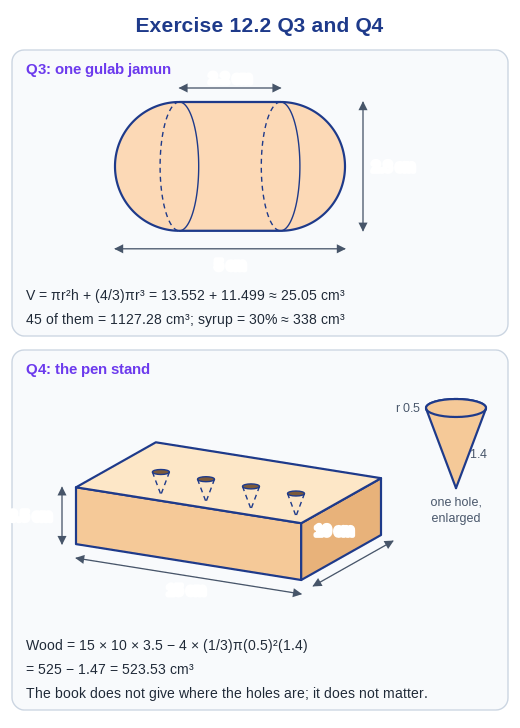
3. Ek gulab jamun mein uske volume ka lagbhag 30% chashni (sugar syrup) hoti hai. 45 gulab jamuns mein lagbhag kitni chashni hogi, agar har ek dono siron par hemisphere wale cylinder ke aakaar ka hai, lambai 5 cm aur diameter 2.8 cm (Fig. 12.15 dekho)?
Diya hai: 45 gulab jamun; har ek dono siron par hemisphere wala cylinder, lambai 5 cm, diameter 2.8 cm (yaani r = 1.4 cm); chashni = volume ka 30%.
Nikaalna hai: kul chashni.
- Do hemispheres 1.4 + 1.4 = 2.8 cm lete hain. To cylinder hissa h = 5 − 2.8 = 2.2 cm lamba hai.
- Do hemispheres milkar ek sphere bante hain.
- Ek gulab jamun ka volume = πr²h + (4/3)πr³ = (22/7) × 1.4 × 1.4 × 2.2 + (4/3) × (22/7) × 1.4³ = 13.552 + 11.499 ≈ 25.05 cm³.
- 45 ka volume = 45 × 25.0507 ≈ 1127.28 cm³.
- Chashni = 1127.28 ka 30% = 0.3 × 1127.28 ≈ 338.18 cm³.
Answer: chashni ≈ 338 cm³.
4. Lakdi ka pen stand cuboid ke aakaar ka hai jisme pen rakhne ke liye chaar conical gaddhe hain. Cuboid ke naap 15 cm × 10 cm × 3.5 cm hain. Har gaddhe ka radius 0.5 cm aur gehraai 1.4 cm hai. Poore stand mein lakdi ka volume nikaalo (Fig. 12.16 dekho).
Diya hai: cuboid 15 cm × 10 cm × 3.5 cm; 4 conical gaddhe, har ek r = 0.5 cm aur gehraai h = 1.4 cm.
Nikaalna hai: lakdi ka volume.
- Cuboid ka volume = 15 × 10 × 3.5 = 525 cm³.
- Ek cone ka volume = (1/3)πr²h = (1/3) × (22/7) × 0.5 × 0.5 × 1.4 = 11/30 cm³.
- Chaar cones = 4 × 11/30 = 22/15 ≈ 1.47 cm³.
- Lakdi = 525 − 1.47 = 523.53 cm³.
Answer: lakdi ka volume = 523.53 cm³.
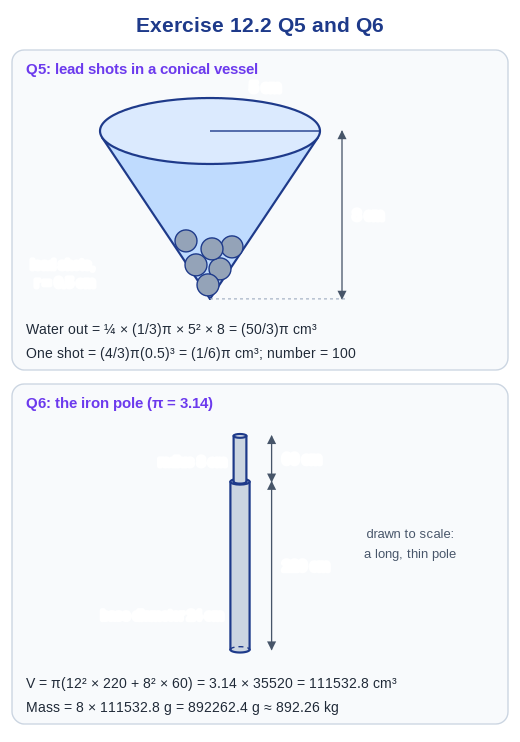
5. Ek bartan ulte cone ke aakaar ka hai. Uski height 8 cm hai aur uske khule top ka radius 5 cm hai. Ye munh tak paani se bhara hai. Jab 0.5 cm radius ke sphere jaise lead shots isme daale jaate hain, to chauthai paani bahar beh jaata hai. Bartan mein daale gaye lead shots ki sankhya nikaalo.
Diya hai: cone h = 8 cm, r = 5 cm, paani se bhara; har lead shot 0.5 cm radius ka sphere; ¼ paani bahar behta hai.
Nikaalna hai: lead shots ki sankhya.
- Paani ka volume = cone ka volume = (1/3)π × 5² × 8 = (200/3)π cm³.
- Bahar beha paani = ¼ × (200/3)π = (50/3)π cm³. Ye saare shots ke volume ke barabar hai.
- Ek shot ka volume = (4/3)π × 0.5³ = (4/3)π × (1/8) = (1/6)π cm³.
- Shots ki sankhya = (50/3)π ÷ (1/6)π = (50/3) × 6 = 100.
Answer: lead shots ki sankhya = 100.
6. Lohe ka ek solid pole 220 cm height aur 24 cm base diameter ke cylinder ka hai, jiske upar 60 cm height aur 8 cm radius ka doosra cylinder laga hai. Pole ka mass nikaalo, agar 1 cm³ lohe ka mass lagbhag 8 g hai. (π = 3.14 lo)
Diya hai: neeche wala cylinder h = 220 cm, diameter 24 cm (yaani r = 12 cm); upar wala cylinder h = 60 cm, r = 8 cm; 1 cm³ lohe ≈ 8 g; π = 3.14.
Nikaalna hai: pole ka mass.
- Volume = π × 12² × 220 + π × 8² × 60 = 3.14 × (31680 + 3840) = 3.14 × 35520 = 111532.8 cm³.
- Mass = 111532.8 × 8 = 892262.4 g.
- 1 kg = 1000 g, to mass = 892.2624 kg ≈ 892.26 kg.
Answer: pole ka mass ≈ 892.26 kg.
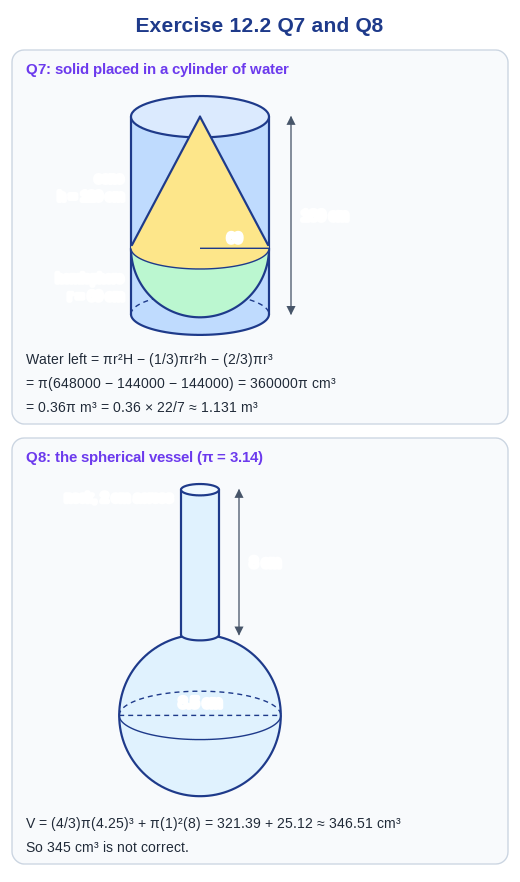
7. Ek solid, jo 60 cm radius ke hemisphere par khade 120 cm height aur 60 cm radius ke right circular cone se bana hai, paani se bhare right circular cylinder mein seedha aise rakha jaata hai ki wo talle ko chhoota hai. Cylinder mein bache paani ka volume nikaalo, agar cylinder ka radius 60 cm aur height 180 cm hai.
Diya hai: cone h = 120 cm, r = 60 cm, 60 cm radius ke hemisphere par; cylinder r = 60 cm, h = 180 cm, paani se bhara.
Nikaalna hai: cylinder mein bacha paani.
- Solid ki height = 60 + 120 = 180 cm, cylinder jitni. To solid poora paani mein doob jaata hai aur apne volume jitna paani bahar nikaal deta hai.
- Cylinder = π × 60² × 180 = 648000π cm³.
- Cone = (1/3)π × 60² × 120 = 144000π cm³.
- Hemisphere = (2/3)π × 60³ = 144000π cm³.
- Bacha paani = 648000π − 144000π − 144000π = 360000π cm³.
- 1 m³ = 1000000 cm³, to ye 0.36π m³ = 0.36 × 22/7 ≈ 1.131 m³ hai.
Answer: bacha paani ≈ 1.131 m³.
8. Kaanch ke ek sphere jaise bartan ki cylindrical gardan 8 cm lambi aur 2 cm diameter ki hai; sphere wale hisse ka diameter 8.5 cm hai. Usme aane wale paani ko naap kar ek bachchi uska volume 345 cm³ paati hai. Upar ke naapon ko andar ke naap maan kar, aur π = 3.14 lekar, check karo ki kya wo sahi hai.
Diya hai: sphere ka diameter 8.5 cm (yaani r = 4.25 cm); gardan: 8 cm lamba, 2 cm diameter ka cylinder (yaani r = 1 cm); bachchi ka jawab 345 cm³; π = 3.14.
Nikaalna hai: kya 345 cm³ sahi hai.
- Sphere ka volume = (4/3) × 3.14 × 4.25³ ≈ 321.39 cm³.
- Gardan ka volume = 3.14 × 1² × 8 = 25.12 cm³.
- Kul = 321.39 + 25.12 ≈ 346.51 cm³. (Book ki tarah, gardan ko sphere ke upar poora cylinder maana hai.)
Answer: wo sahi nahi hai; bartan mein lagbhag 346.51 cm³ aata hai, 345 cm³ nahi.
Chapter ka summary (page 170)
Book do points ke summary se khatam hoti hai: basic solids (cuboid, cone, cylinder, sphere aur hemisphere) mein se kinhi do ko jod kar bani cheez ka surface area nikaalna, aur uska volume nikaalna. Dono points upar aur chapter notes mein cover hain.
Practice karo
-
7 cm radius aur 10 cm height ke cylinder ke dono siron par 7 cm radius ka hemisphere hai. π = 22/7 lekar uska surface area hai:
Jawab dekho
Jawab: (c) 1056 cm²
-
Ek toy 3 cm radius ke hemisphere par 3 cm radius aur 4 cm height ka cone hai. π ke roop mein uska volume hai:
Jawab dekho
Jawab: (c) 30π cm³
-
4 cm edge ke cube ke upar 2 cm radius ka hemisphere laga hai. π = 3.14 lekar uska surface area hai:
Jawab dekho
Jawab: (b) 108.56 cm²
-
6 cm radius aur 8 cm height ka conical bartan paani se bhara hai. Aadha paani bahar nikaalne ke liye 1 cm radius ke kitne spheres daalne honge? Paani ke upar reh gaye spheres ko chhod do.
Jawab dekho
Jawab: Aadha paani = ½ × (1/3)π × 6² × 8 = 48π cm³. Ek sphere = (4/3)π × 1³ = (4/3)π cm³. Sankhya = 48π ÷ (4/3)π = 36 spheres.
-
5 cm radius aur 12 cm height ke cylinder mein se same radius aur 12 cm height ka cone khoda gaya. Bache solid ka total surface area π ke roop mein nikaalo.
Jawab dekho
Jawab: Slant height = √(5² + 12²) = 13 cm. Bache solid mein cylinder ki curved side, upar ka circle aur cone ki andar ki surface hai: 2π × 5 × 12 + π × 5² + π × 5 × 13 = 120π + 25π + 65π = 210π cm².
Koi sawal atak gaya?
Photo lo, Lagnever AI step-by-step samjhayega. 7 din ka trial sirf ₹2.
Google Play se app lo Browser mein kholo
Parents ke liye: trial ke baad plan har mahine UPI ya card autopay se renew hota hai. App mein kabhi bhi cancel kar sakte hain.