
NCERT Solutions Class 10 Maths Chapter 12: Surface Areas and Volumes
Answers to the questions inside Chapter 12, Surface Areas and Volumes, the seven worked examples, and every question of Exercises 12.1 and 12.2, from Mathematics, the Class 10 NCERT textbook. Page numbers follow the 2026-27 reprint (pages 161–170). The exercise questions are quoted from the book; the examples and in-chapter questions are restated in short and labelled by number and page. The book’s figures are not copied: every figure here is our own drawing, made from the data in the question with the dimensions labelled. Every answer was recalculated with exact fractions and matches the answer key at the end of the book. Unless a question says otherwise, π = 22/7. Short notes: Chapter 12 notes.
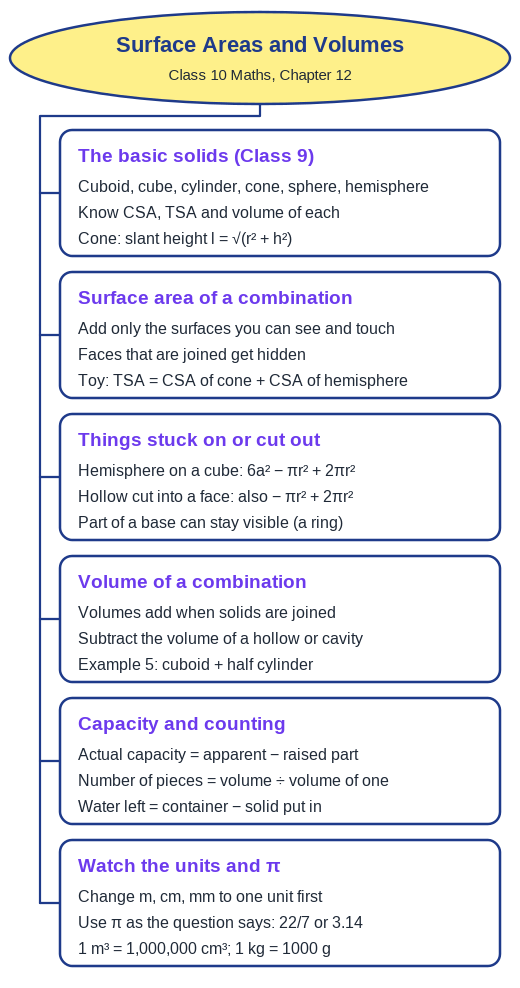
Questions inside the chapter (pages 161–163)
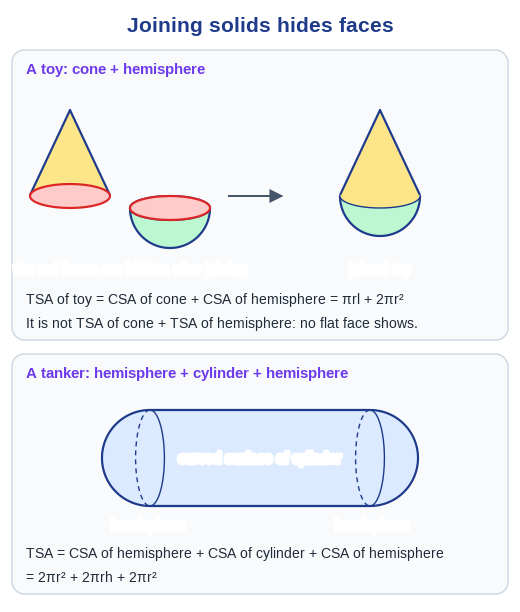
Page 161: is the container on the back of a water tanker one of the basic solids? No single basic solid fits it. It is a cylinder with a hemisphere closing each end, so its surface is the curved surface of the cylinder plus the curved surfaces of the two hemispheres.
Page 162: name the object shaped like a cylinder with a rounded bottom. A test tube: a cylinder joined to a hemisphere.
Page 163: to know how much paint a toy made of a cone on a hemisphere needs, what must we know? Its surface area, which is the curved surface of the hemisphere plus the curved surface of the cone. The two flat circles are pressed together inside the toy and need no paint.
Examples 1 to 4: surface area (pages 163–166)
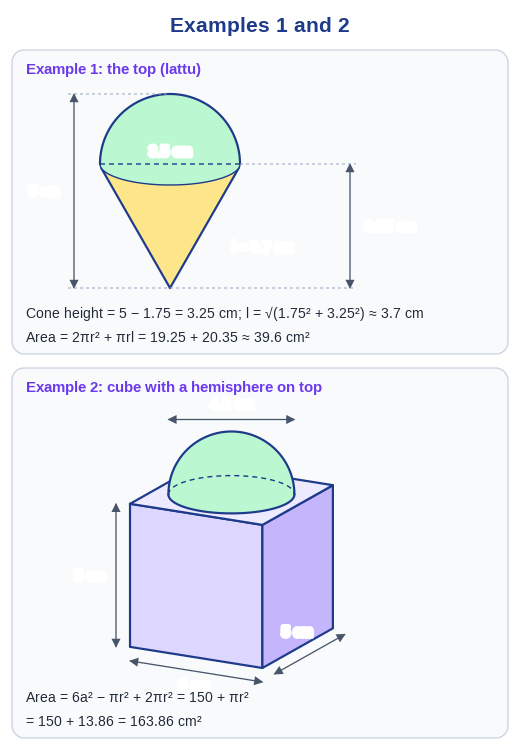
Example 1 (pages 163–164): a top (lattu) is a hemisphere on a cone; total height 5 cm, diameter 3.5 cm; find the area to colour (π = 22/7).
- Radius r = 3.5/2 = 1.75 cm. The hemisphere takes 1.75 cm of the height, so the cone is 5 − 1.75 = 3.25 cm high.
- Slant height l = √(1.75² + 3.25²) = √13.625 ≈ 3.7 cm.
- CSA of hemisphere = 2πr² = 2 × (22/7) × 1.75 × 1.75 = 19.25 cm².
- CSA of cone = πrl ≈ (22/7) × 1.75 × 3.7 = 20.35 cm².
- Area to colour ≈ 19.25 + 20.35 = 39.6 cm² (approx.). With the unrounded slant height it is about 39.55 cm².
The area is not the sum of the two total surface areas: the flat faces are joined and hidden.
Example 2 (page 164): a cube of edge 5 cm with a hemisphere of diameter 4.2 cm fixed on top; find the total surface area.
TSA of the cube = 6 × 5² = 150 cm². The hemisphere covers a circle of area πr² on top but adds its curved surface 2πr². So area = 150 − πr² + 2πr² = 150 + πr² = 150 + (22/7) × 2.1 × 2.1 = 150 + 13.86 = 163.86 cm².
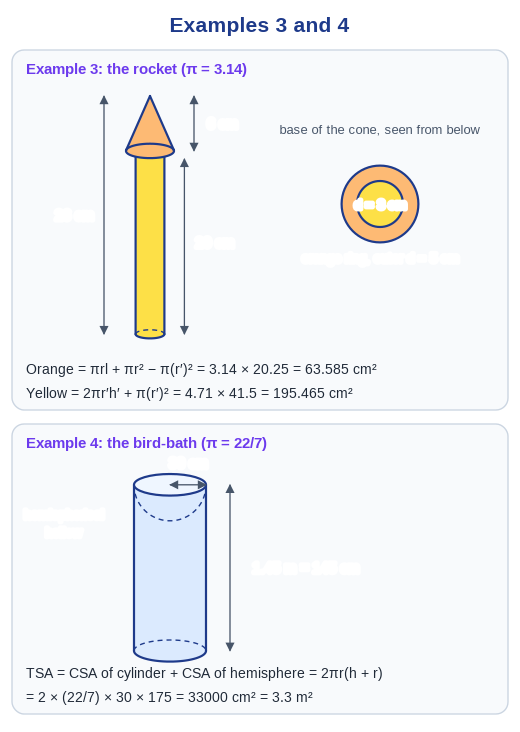
Example 3 (page 165): a rocket is a cone (height 6 cm, base diameter 5 cm) on a cylinder (diameter 3 cm), total height 26 cm; the cone is painted orange and the cylinder yellow (π = 3.14).
Cone: r = 2.5 cm, h = 6 cm, l = √(2.5² + 6²) = √42.25 = 6.5 cm. Cylinder: r′ = 1.5 cm, h′ = 26 − 6 = 20 cm.
The cylinder covers only the middle of the cone’s base, so a ring of the base is left showing and is painted orange.
- Orange = πrl + πr² − π(r′)² = π(2.5 × 6.5 + 2.5² − 1.5²) = π × 20.25 = 3.14 × 20.25 = 63.585 cm².
- Yellow = 2πr′h′ + π(r′)² (side and bottom of the cylinder) = πr′(2h′ + r′) = 3.14 × 1.5 × 41.5 = 4.71 × 41.5 = 195.465 cm².
Example 4 (page 166): a bird-bath is a cylinder of height 1.45 m and radius 30 cm with a hemispherical hollow at the top; find its total surface area.
Take h = 145 cm and r = 30 cm. The surface is the curved side of the cylinder and the inside of the hemisphere (the book leaves out the bottom face): TSA = 2πrh + 2πr² = 2πr(h + r) = 2 × (22/7) × 30 × 175 = 33000 cm² = 3.3 m².
Exercise 12.1 (pages 166–167)
The book says: “Unless stated otherwise, take π = 22/7.”
A word used below: CSA means curved surface area (only the curved part), and TSA means total surface area (every outside face).
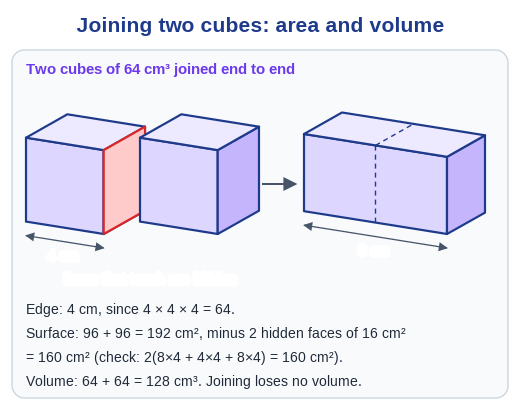
1. “2 cubes each of volume 64 cm³ are joined end to end. Find the surface area of the resulting cuboid.”
Given: 2 cubes, each of volume 64 cm³, joined end to end.
To find: surface area of the cuboid formed.
- Edge of each cube: a³ = 64, so a = 4 cm.
- Joined end to end, the cuboid is l = 8 cm, b = 4 cm, h = 4 cm.
- Surface area of a cuboid = 2(lb + bh + hl) = 2(8 × 4 + 4 × 4 + 4 × 8) = 2(32 + 16 + 32) = 160 cm².
- Check: the two cubes had 2 × 6 × 16 = 192 cm². The two joined faces (2 × 16 = 32 cm²) are hidden, and 192 − 32 = 160.
Answer: surface area of the cuboid = 160 cm².
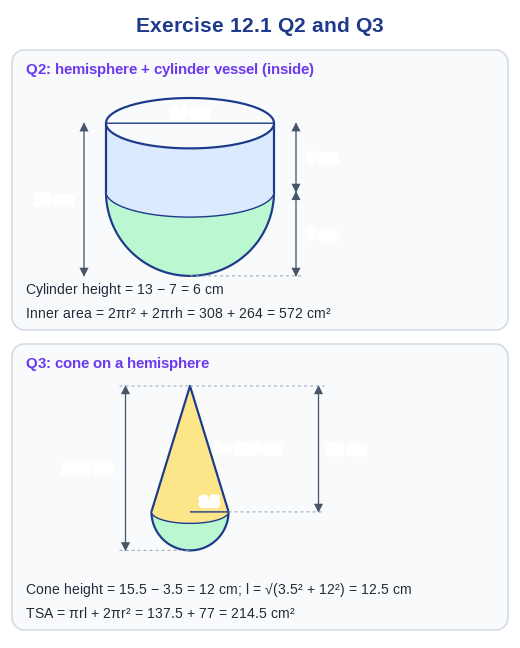
2. “A vessel is in the form of a hollow hemisphere mounted by a hollow cylinder. The diameter of the hemisphere is 14 cm and the total height of the vessel is 13 cm. Find the inner surface area of the vessel.”
Given: diameter of the hemisphere = 14 cm, so r = 7 cm; total height = 13 cm.
To find: inner surface area of the vessel.
- The hemisphere is 7 cm deep (its radius). So the cylinder’s height h = 13 − 7 = 6 cm.
- Inner surface = inside of the hemisphere + inside of the cylinder = 2πr² + 2πrh.
- 2πr² = 2 × (22/7) × 7 × 7 = 308 cm².
- 2πrh = 2 × (22/7) × 7 × 6 = 264 cm².
- Inner surface area = 308 + 264 = 572 cm².
Answer: inner surface area = 572 cm².
3. “A toy is in the form of a cone of radius 3.5 cm mounted on a hemisphere of same radius. The total height of the toy is 15.5 cm. Find the total surface area of the toy.”
Given: r = 3.5 cm for the cone and the hemisphere; total height = 15.5 cm.
To find: total surface area of the toy.
- The hemisphere’s height is r = 3.5 cm. So the cone’s height h = 15.5 − 3.5 = 12 cm.
- Slant height of the cone l = √(r² + h²) = √(3.5² + 12²) = √156.25 = 12.5 cm.
- The flat faces are joined and hidden. So TSA = CSA of cone + CSA of hemisphere = πrl + 2πr².
- πrl = (22/7) × 3.5 × 12.5 = 137.5 cm².
- 2πr² = 2 × (22/7) × 3.5 × 3.5 = 77 cm².
- TSA = 137.5 + 77 = 214.5 cm².
Answer: total surface area of the toy = 214.5 cm².
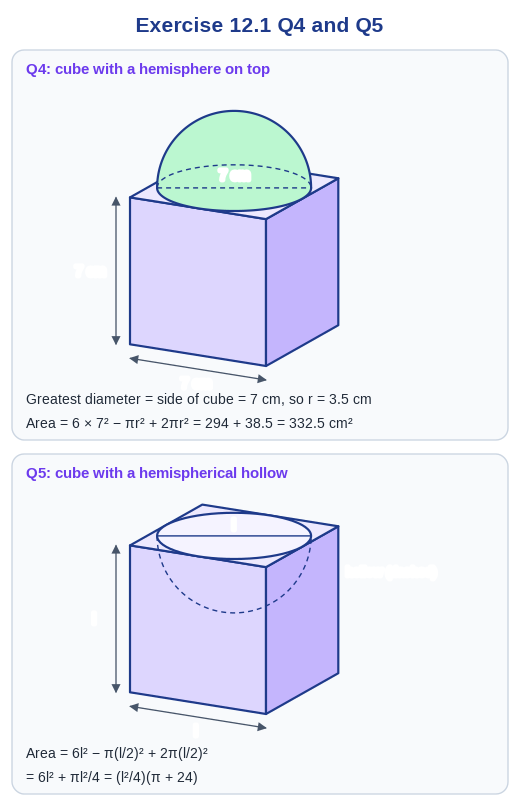
4. “A cubical block of side 7 cm is surmounted by a hemisphere. What is the greatest diameter the hemisphere can have? Find the surface area of the solid.”
Given: cube of side 7 cm with a hemisphere on top.
To find: greatest diameter of the hemisphere, and surface area of the solid.
- The flat face of the hemisphere must fit on the top face of the cube, a square of side 7 cm. The biggest circle that fits in it has diameter 7 cm. So the greatest diameter is 7 cm, and r = 3.5 cm.
- Surface of the cube = 6 × 7² = 294 cm².
- The hemisphere hides a circle of area πr² on the top face, but adds its curved surface 2πr².
- Surface area = 294 − πr² + 2πr² = 294 + πr² = 294 + (22/7) × 3.5 × 3.5 = 294 + 38.5 = 332.5 cm².
Answer: greatest diameter = 7 cm; surface area of the solid = 332.5 cm².
5. “A hemispherical depression is cut out from one face of a cubical wooden block such that the diameter l of the hemisphere is equal to the edge of the cube. Determine the surface area of the remaining solid.”
Given: edge of the cube = l; diameter of the hemispherical hollow = l, so its radius = l/2.
To find: surface area of the remaining solid.
- The six faces of the cube have area 6l².
- The hollow removes a circle of area π(l/2)² = πl²/4 from the top face.
- The inside of the hollow adds a curved surface 2π(l/2)² = πl²/2.
- Surface area = 6l² − πl²/4 + πl²/2 = 6l² + πl²/4 = (l²/4)(π + 24).
Answer: surface area = (l²/4)(π + 24) square units.
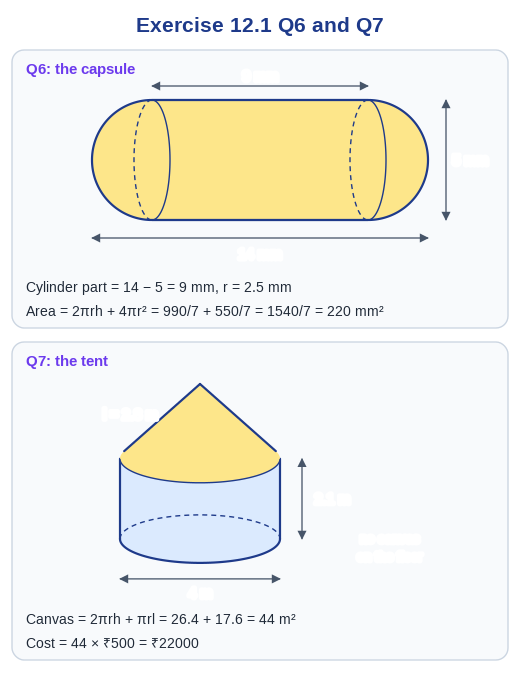
6. “A medicine capsule is in the shape of a cylinder with two hemispheres stuck to each of its ends (see Fig. 12.10). The length of the entire capsule is 14 mm and the diameter of the capsule is 5 mm. Find its surface area.”
Given: total length = 14 mm, diameter = 5 mm, so r = 2.5 mm.
To find: surface area of the capsule.
- The two hemispheres take 2.5 + 2.5 = 5 mm of the length. So the cylinder’s length h = 14 − 5 = 9 mm.
- CSA of the cylinder = 2πrh = 2 × (22/7) × 2.5 × 9 = 990/7 mm².
- CSA of the two hemispheres = 2 × 2πr² = 4 × (22/7) × 2.5 × 2.5 = 550/7 mm².
- Surface area = 990/7 + 550/7 = 1540/7 = 220 mm².
Answer: surface area of the capsule = 220 mm².
7. “A tent is in the shape of a cylinder surmounted by a conical top. If the height and diameter of the cylindrical part are 2.1 m and 4 m respectively, and the slant height of the top is 2.8 m, find the area of the canvas used for making the tent. Also, find the cost of the canvas of the tent at the rate of ₹500 per m². (Note that the base of the tent will not be covered with canvas.)”
Given: cylinder h = 2.1 m, diameter 4 m (so r = 2 m); cone slant height l = 2.8 m; rate ₹500 per m².
To find: area of canvas, and its cost.
- Canvas covers only the side of the cylinder and the cone. The floor and the joined circle are not covered.
- CSA of the cylinder = 2πrh = 2 × (22/7) × 2 × 2.1 = 26.4 m².
- CSA of the cone = πrl = (22/7) × 2 × 2.8 = 17.6 m².
- Canvas = 26.4 + 17.6 = 44 m².
- Cost = 44 × ₹500 = ₹22000.
Answer: canvas = 44 m²; cost = ₹22000.
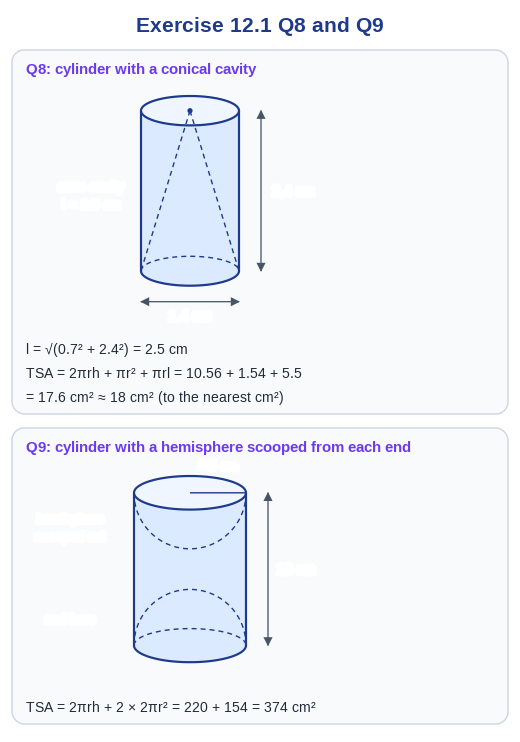
8. “From a solid cylinder whose height is 2.4 cm and diameter 1.4 cm, a conical cavity of the same height and same diameter is hollowed out. Find the total surface area of the remaining solid to the nearest cm².”
Given: cylinder h = 2.4 cm, diameter 1.4 cm (so r = 0.7 cm); cone of the same r and h is hollowed out.
To find: TSA of the remaining solid, to the nearest cm².
- Slant height of the cavity l = √(0.7² + 2.4²) = √6.25 = 2.5 cm.
- The remaining solid has three surfaces: the curved side of the cylinder, its top circle, and the inside of the cone. (The bottom circle is now the mouth of the cavity.)
- 2πrh = 2 × (22/7) × 0.7 × 2.4 = 10.56 cm².
- πr² = (22/7) × 0.7 × 0.7 = 1.54 cm².
- πrl = (22/7) × 0.7 × 2.5 = 5.5 cm².
- TSA = 10.56 + 1.54 + 5.5 = 17.6 cm², which is 18 cm² to the nearest cm².
Answer: total surface area ≈ 18 cm².
9. “A wooden article was made by scooping out a hemisphere from each end of a solid cylinder, as shown in Fig. 12.11. If the height of the cylinder is 10 cm, and its base is of radius 3.5 cm, find the total surface area of the article.”
Given: cylinder h = 10 cm, r = 3.5 cm; a hemisphere of radius 3.5 cm scooped out at each end.
To find: total surface area of the article.
- Both flat ends are scooped out. So the surface is the curved side of the cylinder plus the insides of two hemispheres.
- 2πrh = 2 × (22/7) × 3.5 × 10 = 220 cm².
- Two hemispheres = 2 × 2πr² = 4 × (22/7) × 3.5 × 3.5 = 154 cm².
- TSA = 220 + 154 = 374 cm².
Answer: total surface area = 374 cm².
Examples 5 to 7: volume (pages 167–169)
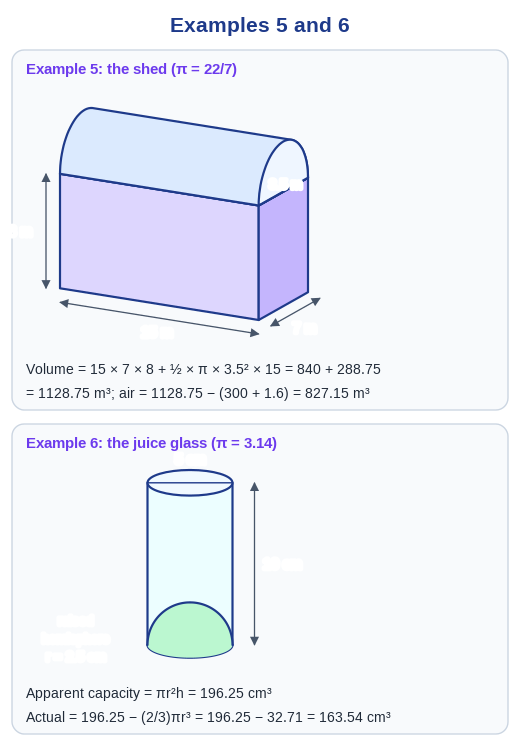
Example 5 (pages 167–168): a shed has a base 7 m × 15 m, a cuboid part 8 m high and a half cylinder on top; find the volume of air it holds, and the air left when machinery takes 300 m³ and 20 workers take about 0.08 m³ each.
The half cylinder has diameter 7 m (radius 3.5 m) and length 15 m. Volume = 15 × 7 × 8 + ½ × (22/7) × 3.5 × 3.5 × 15 = 840 + 288.75 = 1128.75 m³. Space taken = 300 + 20 × 0.08 = 301.6 m³, so the air left is 1128.75 − 301.6 = 827.15 m³.
Example 6 (page 168): a glass of inner diameter 5 cm and height 10 cm has a raised hemisphere at the bottom; find its apparent and actual capacity (π = 3.14).
Apparent capacity = πr²h = 3.14 × 2.5 × 2.5 × 10 = 196.25 cm³. The raised hemisphere takes (2/3)πr³ = (2/3) × 3.14 × 2.5³ ≈ 32.71 cm³. Actual capacity = 196.25 − 32.71 = 163.54 cm³.
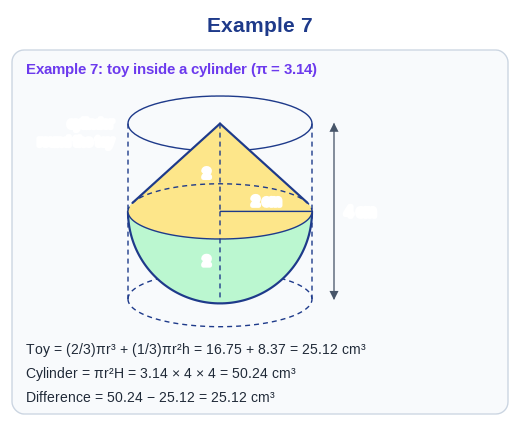
Example 7 (page 169): a toy is a hemisphere with a cone on it; the cone is 2 cm high and the base diameter is 4 cm. Find the volume of the toy, and the difference between it and a cylinder that just encloses it (π = 3.14).
r = 2 cm for both parts. Toy = (2/3)πr³ + (1/3)πr²h = (2/3) × 3.14 × 8 + (1/3) × 3.14 × 4 × 2 = 16.75 + 8.37 ≈ 25.12 cm³. The enclosing cylinder has radius 2 cm and height 2 + 2 = 4 cm: volume = 3.14 × 2² × 4 = 50.24 cm³. Difference = 50.24 − 25.12 = 25.12 cm³.
Exercise 12.2 (pages 169–170)
The book says: “Unless stated otherwise, take π = 22/7.”
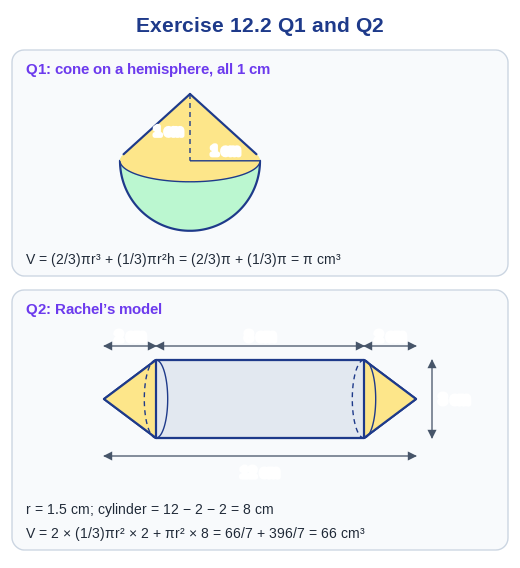
1. “A solid is in the shape of a cone standing on a hemisphere with both their radii being equal to 1 cm and the height of the cone is equal to its radius. Find the volume of the solid in terms of π.”
Given: r = 1 cm for the cone and the hemisphere; height of the cone h = 1 cm.
To find: volume of the solid in terms of π.
- Volume = volume of the hemisphere + volume of the cone = (2/3)πr³ + (1/3)πr²h.
- = (2/3)π × 1 + (1/3)π × 1 × 1 = (2/3)π + (1/3)π = π.
Answer: volume = π cm³.
2. “Rachel, an engineering student, was asked to make a model shaped like a cylinder with two cones attached at its two ends by using a thin aluminium sheet. The diameter of the model is 3 cm and its length is 12 cm. If each cone has a height of 2 cm, find the volume of air contained in the model that Rachel made. (Assume the outer and inner dimensions of the model to be nearly the same.)”
Given: diameter = 3 cm (so r = 1.5 cm), total length = 12 cm, each cone h₁ = 2 cm.
To find: volume of air in the model.
- Length of the cylinder h₂ = 12 − 2 − 2 = 8 cm.
- Volume = cone + cylinder + cone = (1/3)πr²h₁ + πr²h₂ + (1/3)πr²h₁ = (1/3)πr²(h₁ + 3h₂ + h₁).
- = (1/3) × (22/7) × 1.5 × 1.5 × (2 + 24 + 2).
- = (1/3) × (22/7) × 2.25 × 28 = 66 cm³.
Answer: volume of air = 66 cm³.
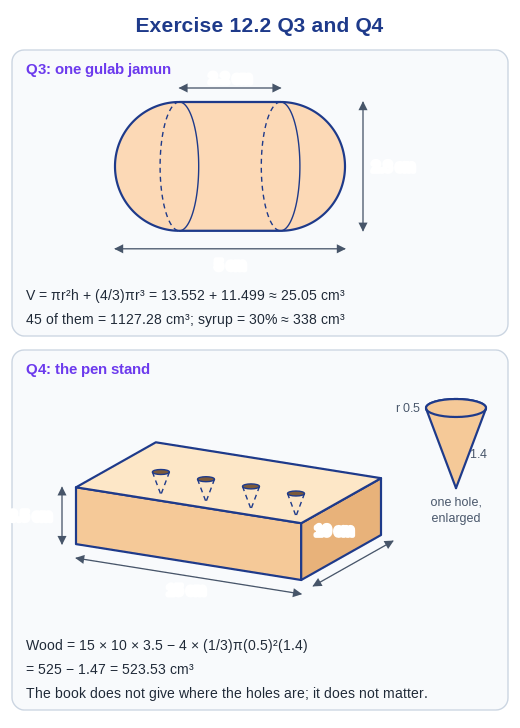
3. “A gulab jamun, contains sugar syrup up to about 30% of its volume. Find approximately how much syrup would be found in 45 gulab jamuns, each shaped like a cylinder with two hemispherical ends with length 5 cm and diameter 2.8 cm (see Fig. 12.15).”
Given: 45 gulab jamuns; each is a cylinder with two hemispherical ends, length 5 cm, diameter 2.8 cm (so r = 1.4 cm); syrup = 30% of the volume.
To find: total syrup.
- The two hemispheres take 1.4 + 1.4 = 2.8 cm. So the cylinder part is h = 5 − 2.8 = 2.2 cm long.
- The two hemispheres together make one sphere.
- Volume of one gulab jamun = πr²h + (4/3)πr³ = (22/7) × 1.4 × 1.4 × 2.2 + (4/3) × (22/7) × 1.4³ = 13.552 + 11.499 ≈ 25.05 cm³.
- Volume of 45 = 45 × 25.0507 ≈ 1127.28 cm³.
- Syrup = 30% of 1127.28 = 0.3 × 1127.28 ≈ 338.18 cm³.
Answer: syrup ≈ 338 cm³.
4. “A pen stand made of wood is in the shape of a cuboid with four conical depressions to hold pens. The dimensions of the cuboid are 15 cm by 10 cm by 3.5 cm. The radius of each of the depressions is 0.5 cm and the depth is 1.4 cm. Find the volume of wood in the entire stand (see Fig. 12.16).”
Given: cuboid 15 cm × 10 cm × 3.5 cm; 4 conical holes, each r = 0.5 cm and depth h = 1.4 cm.
To find: volume of wood.
- Volume of the cuboid = 15 × 10 × 3.5 = 525 cm³.
- Volume of one cone = (1/3)πr²h = (1/3) × (22/7) × 0.5 × 0.5 × 1.4 = 11/30 cm³.
- Four cones = 4 × 11/30 = 22/15 ≈ 1.47 cm³.
- Wood = 525 − 1.47 = 523.53 cm³.
Answer: volume of wood = 523.53 cm³.
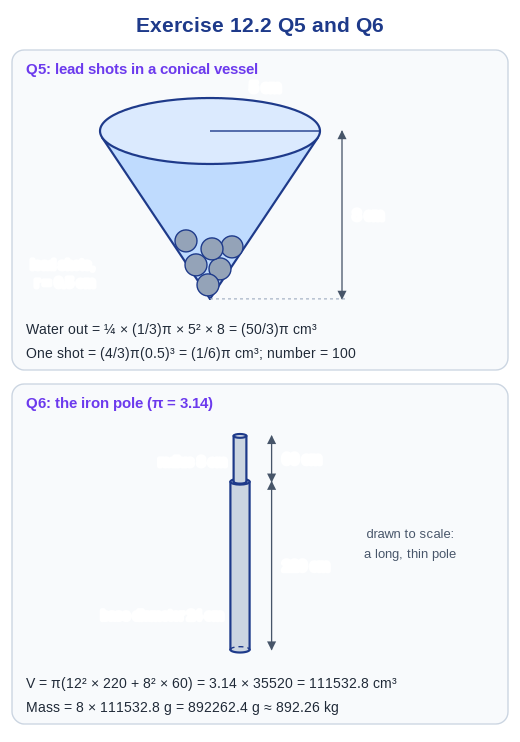
5. “A vessel is in the form of an inverted cone. Its height is 8 cm and the radius of its top, which is open, is 5 cm. It is filled with water up to the brim. When lead shots, each of which is a sphere of radius 0.5 cm are dropped into the vessel, one-fourth of the water flows out. Find the number of lead shots dropped in the vessel.”
Given: cone h = 8 cm, r = 5 cm, full of water; each lead shot is a sphere of radius 0.5 cm; ¼ of the water flows out.
To find: number of lead shots.
- Volume of water = volume of the cone = (1/3)π × 5² × 8 = (200/3)π cm³.
- Water that flows out = ¼ × (200/3)π = (50/3)π cm³. This is equal to the volume of all the shots.
- Volume of one shot = (4/3)π × 0.5³ = (4/3)π × (1/8) = (1/6)π cm³.
- Number of shots = (50/3)π ÷ (1/6)π = (50/3) × 6 = 100.
Answer: number of lead shots = 100.
6. “A solid iron pole consists of a cylinder of height 220 cm and base diameter 24 cm, which is surmounted by another cylinder of height 60 cm and radius 8 cm. Find the mass of the pole, given that 1 cm³ of iron has approximately 8g mass. (Use π = 3.14)”
Given: lower cylinder h = 220 cm, diameter 24 cm (so r = 12 cm); upper cylinder h = 60 cm, r = 8 cm; 1 cm³ of iron ≈ 8 g; π = 3.14.
To find: mass of the pole.
- Volume = π × 12² × 220 + π × 8² × 60 = 3.14 × (31680 + 3840) = 3.14 × 35520 = 111532.8 cm³.
- Mass = 111532.8 × 8 = 892262.4 g.
- 1 kg = 1000 g, so mass = 892.2624 kg ≈ 892.26 kg.
Answer: mass of the pole ≈ 892.26 kg.
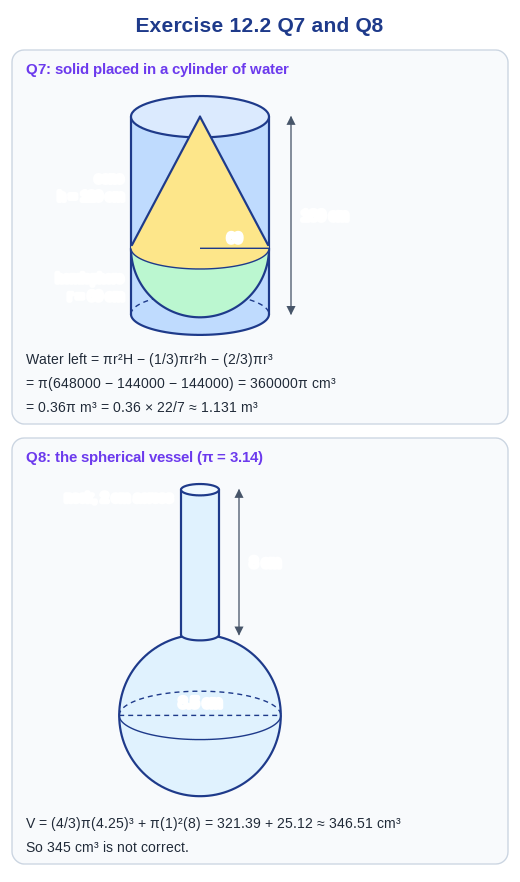
7. “A solid consisting of a right circular cone of height 120 cm and radius 60 cm standing on a hemisphere of radius 60 cm is placed upright in a right circular cylinder full of water such that it touches the bottom. Find the volume of water left in the cylinder, if the radius of the cylinder is 60 cm and its height is 180 cm.”
Given: cone h = 120 cm, r = 60 cm on a hemisphere of r = 60 cm; cylinder r = 60 cm, h = 180 cm, full of water.
To find: volume of water left in the cylinder.
- Height of the solid = 60 + 120 = 180 cm, the same as the cylinder. So the solid is fully under water and pushes out water equal to its own volume.
- Cylinder = π × 60² × 180 = 648000π cm³.
- Cone = (1/3)π × 60² × 120 = 144000π cm³.
- Hemisphere = (2/3)π × 60³ = 144000π cm³.
- Water left = 648000π − 144000π − 144000π = 360000π cm³.
- 1 m³ = 1000000 cm³, so this is 0.36π m³ = 0.36 × 22/7 ≈ 1.131 m³.
Answer: water left ≈ 1.131 m³.
8. “A spherical glass vessel has a cylindrical neck 8 cm long, 2 cm in diameter; the diameter of the spherical part is 8.5 cm. By measuring the amount of water it holds, a child finds its volume to be 345 cm³. Check whether she is correct, taking the above as the inside measurements, and π = 3.14.”
Given: sphere diameter 8.5 cm (so r = 4.25 cm); neck: cylinder of length 8 cm and diameter 2 cm (so r = 1 cm); child’s answer 345 cm³; π = 3.14.
To find: whether 345 cm³ is correct.
- Volume of the sphere = (4/3) × 3.14 × 4.25³ ≈ 321.39 cm³.
- Volume of the neck = 3.14 × 1² × 8 = 25.12 cm³.
- Total = 321.39 + 25.12 ≈ 346.51 cm³. (Like the book, we treat the neck as a full cylinder on top of the sphere.)
Answer: she is not correct; the vessel holds about 346.51 cm³, not 345 cm³.
The summary of the chapter (page 170)
The book ends with a two-point summary: finding the surface area, and finding the volume, of an object built from two of the basic solids (cuboid, cone, cylinder, sphere and hemisphere) put together. Both points are covered above and in the chapter notes.
Practice
-
A cylinder of radius 7 cm and height 10 cm has a hemisphere of radius 7 cm on each end. Taking π = 22/7, its surface area is:
Show answer
Answer: (c) 1056 cm²
-
A toy is a cone of radius 3 cm and height 4 cm on a hemisphere of radius 3 cm. Its volume, in terms of π, is:
Show answer
Answer: (c) 30π cm³
-
A cube of edge 4 cm has a hemisphere of radius 2 cm fixed on top. Taking π = 3.14, its surface area is:
Show answer
Answer: (b) 108.56 cm²
-
A conical vessel of radius 6 cm and height 8 cm is full of water. How many spheres of radius 1 cm must be dropped in to spill half the water? Ignore any spheres that stay above the water.
Show answer
Answer: Half the water = ½ × (1/3)π × 6² × 8 = 48π cm³. One sphere = (4/3)π × 1³ = (4/3)π cm³. Number = 48π ÷ (4/3)π = 36 spheres.
-
A solid is a cylinder of radius 5 cm and height 12 cm with a cone of the same radius and height 12 cm hollowed out of it. Find the total surface area of what remains, in terms of π.
Show answer
Answer: Slant height = √(5² + 12²) = 13 cm. The remaining solid has the curved side of the cylinder, the top circle and the inner surface of the cone: 2π × 5 × 12 + π × 5² + π × 5 × 13 = 120π + 25π + 65π = 210π cm².
Stuck on a question?
Take a photo and Lagnever AI explains it step by step. Try it for 7 days for ₹2.
Get it on Google Play Open in browser
For parents: after the trial, the plan renews monthly by UPI or card autopay. You can cancel anytime in the app.