
Class 10 Maths Chapter 12: Surface Areas and Volumes Notes
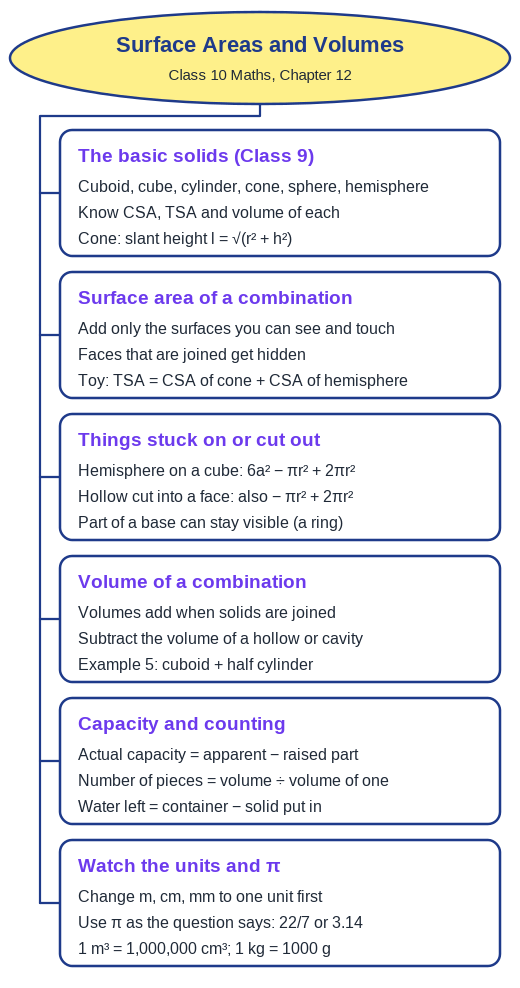
This chapter in five lines
Many real objects are two or more basic solids joined together. To find the surface area of such an object, add only the surfaces that can still be seen: the faces pressed together are hidden. To find its volume, simply add the volumes of the parts, and subtract any part that has been hollowed out.
What is this chapter about?
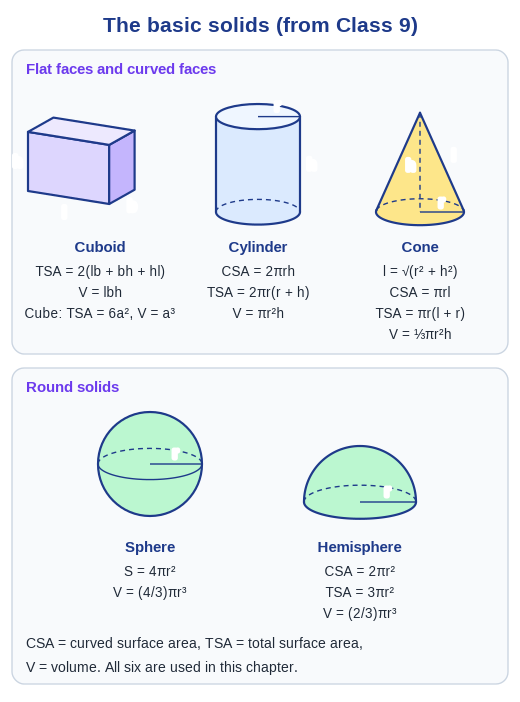
In Class 9 you found the surface area and volume of single solids: a cuboid, a cube, a cylinder, a cone, a sphere and a hemisphere. Real things are rarely that simple. A water tanker is a cylinder closed by two half-spheres, a test tube is a cylinder with a rounded bottom, and a toy may be a cone resting on a hemisphere. This chapter shows how to work with such combinations of solids.
The idea is always the same: break the object into basic solids you already know, then decide carefully what to add and what to leave out. The chapter is short, 10 pages, with seven worked examples and two exercises.
How do you find the surface area of a combination?
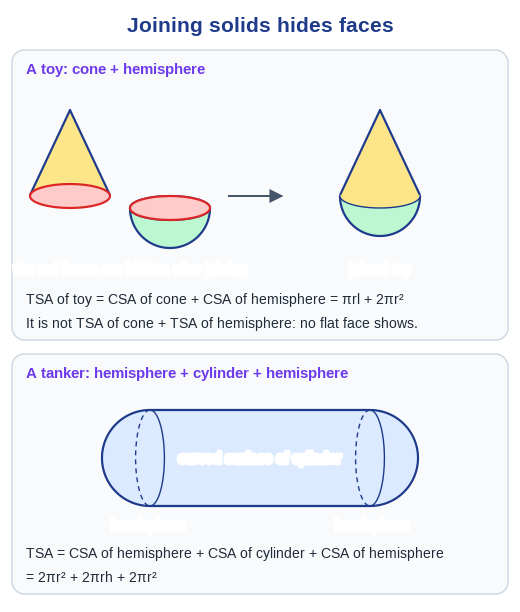
Ask which surfaces you could touch or paint on the finished object. When two solids are joined, the faces that press together disappear inside, so they are not part of the surface. For a toy made of a cone on a hemisphere of the same radius:
TSA of the toy = CSA of the cone + CSA of the hemisphere = πrl + 2πr²
This is not the sum of the two total surface areas, because neither flat circle shows. In the same way, a capsule or a tanker (a cylinder with a hemisphere at each end) has TSA = 2πrh + 4πr².
Two more situations need care:
- Something fixed on a face. A hemisphere of radius r on a cube covers a circle of area πr² on the top face, but adds its own curved surface 2πr². Area = 6a² − πr² + 2πr².
- Something scooped out. A hemispherical hollow cut into a face removes the same circle πr² but exposes an inner curved surface 2πr², so the change is again +πr².
- A smaller solid on a bigger face. In the book’s toy rocket, the cylinder under the cone is narrower than the cone’s base, so a ring of that base is left uncovered and must be painted.
Details and worked examples are on the surface area of combined solids page.
How do you find the volume of a combination?
Volume behaves more simply than area. Joining solids does not destroy any space, so the volume of the combination is the sum of the volumes of its parts. A shed shaped like a cuboid with a half cylinder on top holds the cuboid’s volume plus half the cylinder’s volume.
When something is removed, subtract its volume. A glass with a raised hemisphere at its bottom holds less than a plain cylinder of the same size: actual capacity = πr²h − (2/3)πr³.
Volume questions also come in a few useful patterns:
- Water left over: volume of the container − volume of the solid put in.
- Counting: number of small objects = volume to be filled ÷ volume of one object.
- Mass: mass = volume × mass of 1 cm³ (the density given in the question).
See the volume of combined solids page for these with full working.
Before we move on
Keep the Class 9 formulas handy and draw a rough sketch for every question: mark which faces are hidden and which parts are hollow. Change all lengths to the same unit before you start, and use the value of π the question asks for. Every example and both exercises are solved in the NCERT solutions for Chapter 12.
Key terms
| Term | Meaning |
|---|---|
| Solid | A shape in space with length, breadth and height, such as a cuboid, cylinder, cone or sphere. |
| Combination of solids | An object made by joining two or more basic solids, or by cutting one solid out of another. A capsule is a cylinder with a hemisphere at each end. |
| Curved surface area (CSA) | The area of only the curved part of a solid, such as the side of a cylinder or a cone, or the round part of a hemisphere. |
| Total surface area (TSA) | The area of the whole outer surface: the curved part plus any flat faces. |
| Slant height (l) | The length from the tip of a cone to any point on the edge of its base: l = √(r² + h²). |
| Hemisphere | Half of a sphere. Its curved surface is 2πr², its flat face is a circle of area πr², and its volume is (2/3)πr³. |
| Surmounted by | Having another solid fixed on top. A cube surmounted by a hemisphere has the hemisphere sitting on its top face. |
| Hollow, depression or cavity | A part scooped out of a solid. It removes volume, but its inner surface becomes part of the surface area. |
| Capacity | The amount a container can hold, found from the volume of the space inside it. |
| Volume | The space a solid takes up, measured in cubic units such as cm³ or m³. |
Topics in this chapter
Practice
-
A toy is a cone on a hemisphere of the same radius. Its total surface area is:
Show answer
Answer: (b) CSA of cone + CSA of hemisphere
-
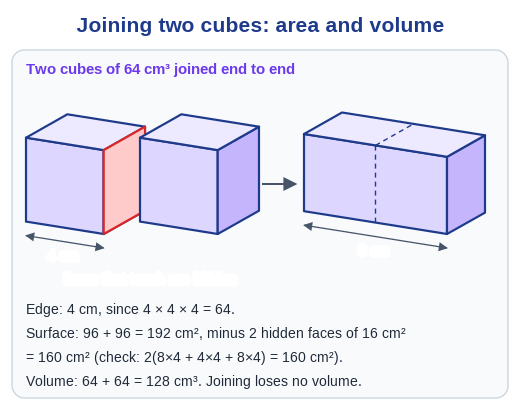
Two cubes of edge 3 cm are joined end to end. The surface area of the cuboid formed is:
Show answer
Answer: (a) 90 cm²
-
A solid is made of a cylinder of volume 50 cm³ and a cone of volume 12 cm³ joined base to base. Its volume is:
Show answer
Answer: (c) 62 cm³
-
A hemisphere of radius 2 cm is fixed on top of a cube of edge 6 cm. Taking π = 3.14, the surface area of the solid is:
Show answer
Answer: (b) 228.56 cm²
-
A solid cylinder of radius 7 cm and height 10 cm has a hemispherical hollow of radius 7 cm at one end. Taking π = 22/7, its volume is:
Show answer
Answer: (b) 821.33 cm³
Questions students ask
What are the main topics of Class 10 Maths Chapter 12?
Two: the surface area of a combination of solids (12.2) and the volume of a combination of solids (12.3), after a short introduction and before a two-point summary. The chapter is 10 pages long, pages 161 to 170.
How many exercises does Chapter 12 have?
Two. Exercise 12.1 has 9 questions on surface area and Exercise 12.2 has 8 questions on volume. With the seven worked examples, all of them are solved step by step on the NCERT solutions page.
Are conversion of solids and the frustum of a cone in the 2026-27 book?
No. The current (rationalised) chapter has only the two sections above. Older editions had sections on converting one solid into another and on the frustum of a cone; they are not in the 2026-27 book.
Which value of π should I use?
The one the question gives. Both exercises say to take π = 22/7 unless stated otherwise, and some questions and examples ask for 3.14. Some answers are left in terms of π.
Stuck on a question?
Take a photo and Lagnever AI explains it step by step. Try it for 7 days for ₹2.
Get it on Google Play Open in browser
For parents: after the trial, the plan renews monthly by UPI or card autopay. You can cancel anytime in the app.