
How do you find the surface area of a combination of solids?
Answer in short
Break the object into basic solids and add the areas of only those surfaces that are still exposed. Faces that press against each other are hidden, so the total surface area of a combination is usually less than the sum of the parts' total surface areas. For a cone on a hemisphere, TSA = πrl + 2πr².
Stuck on a question? Take a photo and Lagnever AI explains it step by step. Try it for 7 days for ₹2. Get it on Google Play
Why can’t we just add the surface areas?
Take two cubes and stick them together face to face. Each cube had six faces on the outside, but now one face of each is pressed against the other. Those two faces are inside the new solid: you cannot see them, touch them or paint them. So the surface area of the new solid is less than the two surface areas added together.
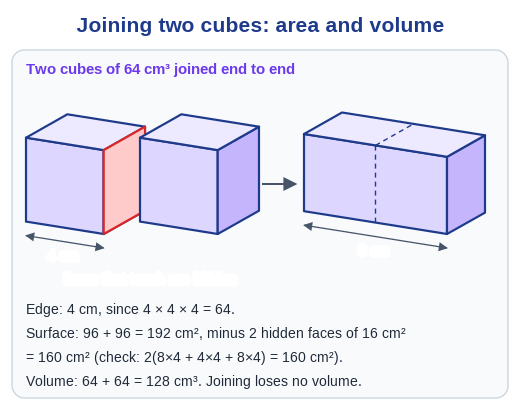
This is the one rule of the topic: the surface area of a combination is the sum of only the surfaces that are still exposed. Before calculating, picture the finished object and list its visible surfaces.
The common combinations
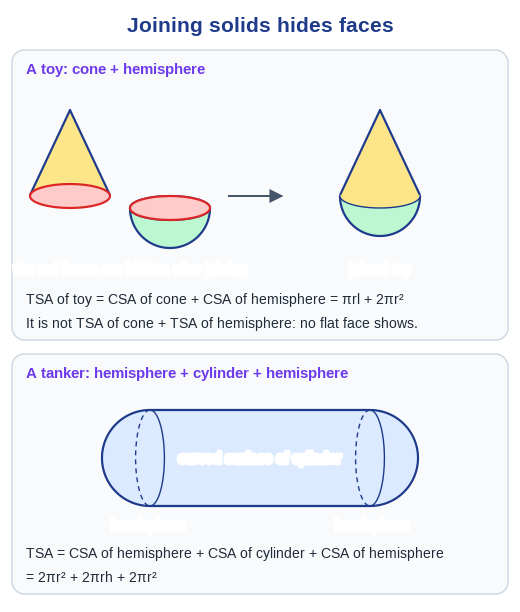
Cone on a hemisphere (a toy or a top). Put the flat base of a cone on the flat face of a hemisphere of the same radius. Both circles disappear. What is left is the curved surface of the cone and the curved surface of the hemisphere:
TSA = πrl + 2πr², where l = √(r² + h²).
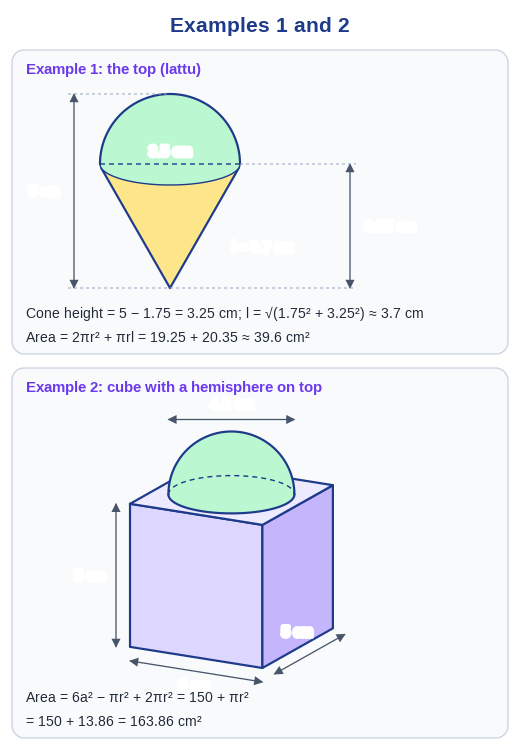
If the question gives the total height, first find the height of the cone: total height − r.
Cylinder with a hemisphere at each end (a tanker, a capsule). The two ends of the cylinder are covered by the hemispheres, so:
TSA = 2πr² + 2πrh + 2πr² = 2πrh + 4πr², with h = total length − 2r.
Cylinder with a cone on top (a tent). The top circle of the cylinder is hidden under the cone. If the floor is not covered (as with canvas for a tent), leave out the bottom circle too: canvas = 2πrh + πrl.
Something stuck on, or something cut out
A hemisphere fixed on a cube. The hemisphere covers a circle of area πr² on the top face, so subtract it. But the curved surface of the hemisphere, 2πr², is now part of the outside, so add it:
Area = 6a² − πr² + 2πr² = 6a² + πr².
In Example 2 of the book, a cube of edge 5 cm carries a hemisphere of diameter 4.2 cm: area = 150 + (22/7) × 2.1 × 2.1 = 150 + 13.86 = 163.86 cm².
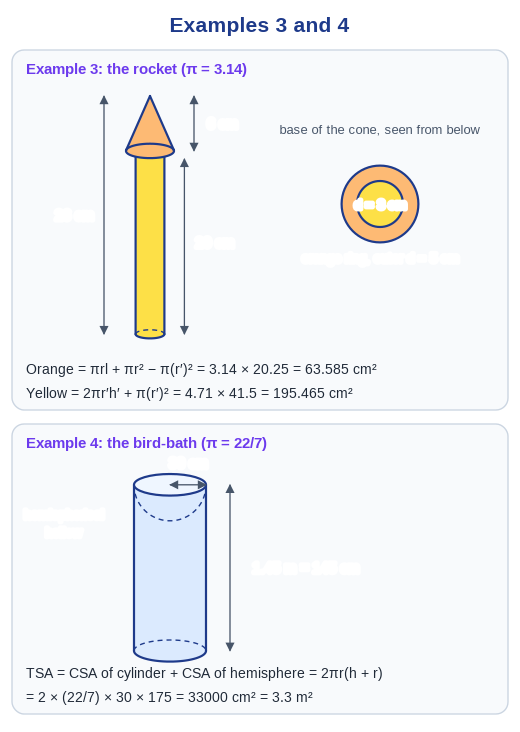
A hollow scooped out of a face. This looks like the opposite case, yet the area changes in the same way. The flat circle πr² is removed, and the inner curved surface 2πr² of the hollow becomes part of the surface. So again the area changes by +πr². The bird-bath of Example 4 (a cylinder with a hemispherical hollow at the top) has area 2πrh + 2πr²: the top circle is gone, replaced by the inside of the bowl.
When part of a flat face still shows
In Example 3, a toy rocket is a cone of base diameter 5 cm standing on a cylinder of diameter 3 cm. The cylinder is narrower, so it covers only the middle of the cone’s base. A ring is left showing underneath, and it is painted with the cone. So:
orange area = πrl + πr² − π(r′)²,
where r is the radius of the cone and r′ that of the cylinder. With π = 3.14 this gives 63.585 cm² orange and 195.465 cm² yellow (the cylinder’s curved surface and its bottom).
A step-by-step method
- Sketch the object and name each basic solid in it.
- For each solid, list which of its surfaces are still outside.
- Write each visible surface as a formula, then add them up.
- Put in the numbers with the π the question asks for, and give the unit in square units.
Read next: volume of combined solids, where nothing is hidden and the volumes simply add. All the questions are solved in the NCERT solutions, and the chapter notes give the full picture.
Practice
-
A capsule is a cylinder 6 mm long with a hemisphere of radius 2 mm at each end. Its surface area, in terms of π, is:
Show answer
Answer: (b) 40π mm²
-
A hemisphere of diameter 7 cm is cut out of the top face of a cube of edge 10 cm. Taking π = 22/7, the surface area of the remaining solid is:
Show answer
Answer: (b) 638.5 cm²
-
A cone of radius 3 cm and height 4 cm stands on a hemisphere of radius 3 cm. Its surface area, in terms of π, is:
Show answer
Answer: (c) 33π cm²
-
A tent is a cylinder of radius 3 m and height 2 m with a cone of slant height 5 m on top. Find the canvas needed, in terms of π, if the floor is not covered.
Show answer
Answer: Canvas = CSA of cylinder + CSA of cone = 2π × 3 × 2 + π × 3 × 5 = 12π + 15π = 27π m², about 84.86 m² with π = 22/7.
-
Why is the surface area of a cube with a hemisphere on top more than 6a², even though the hemisphere covers part of the cube?
Show answer
Answer: The hemisphere hides a circle of area πr² on the top face, but its own curved surface, 2πr², is now on the outside. The net change is 2πr² − πr² = +πr², so the area goes up.
Questions students ask
What is the difference between CSA and TSA?
The curved surface area (CSA) is only the curved part of a solid. The total surface area (TSA) adds the flat faces too. In a combination, the TSA of the whole object is usually made of the CSAs of its parts plus any flat faces left showing.
Is the surface area of two joined solids ever equal to the sum of their TSAs?
No, unless they only touch at a point or along a line. Whenever two faces press together, both faces are hidden and their area is lost from the total.
Why does the cone of a toy need the same radius as the hemisphere?
So that the edges match and the surface is smooth. That is why the book picks a cone whose base matches the hemisphere exactly.
Where are the exercise questions on this topic?
Exercise 12.1 (9 questions) is all on surface area. Every question and Examples 1 to 4 are worked out on the NCERT solutions page.
Stuck on a question?
Take a photo and Lagnever AI explains it step by step. Try it for 7 days for ₹2.
Get it on Google Play Open in browser
For parents: after the trial, the plan renews monthly by UPI or card autopay. You can cancel anytime in the app.