
How do you find the volume of a combination of solids?
Answer in short
Add the volumes of the basic solids that make up the object. Unlike surface area, no volume is lost when solids are joined, so nothing has to be left out. If a part has been hollowed out, or something takes up space inside a container, subtract its volume instead.
Stuck on a question? Take a photo and Lagnever AI explains it step by step. Try it for 7 days for ₹2. Get it on Google Play
Why do volumes simply add?
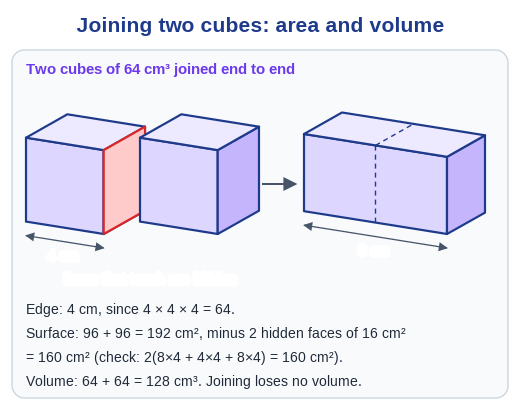
When two solids are joined, a face of one presses against a face of the other. For surface area, those faces are lost. For volume, nothing is lost: the space filled by the first solid and the space filled by the second are both still filled. So:
Volume of a combination = sum of the volumes of the parts.
Two cubes of volume 64 cm³ joined end to end make a cuboid of volume 128 cm³. Its surface area, though, is 160 cm², not 192 cm².
The volume formulas you need
| Solid | Volume |
|---|---|
| Cuboid l × b × h | lbh |
| Cube of edge a | a³ |
| Cylinder | πr²h |
| Half cylinder (cut along its length) | ½πr²h |
| Cone | (1/3)πr²h |
| Sphere | (4/3)πr³ |
| Hemisphere | (2/3)πr³ |
Adding parts: a shed and a toy
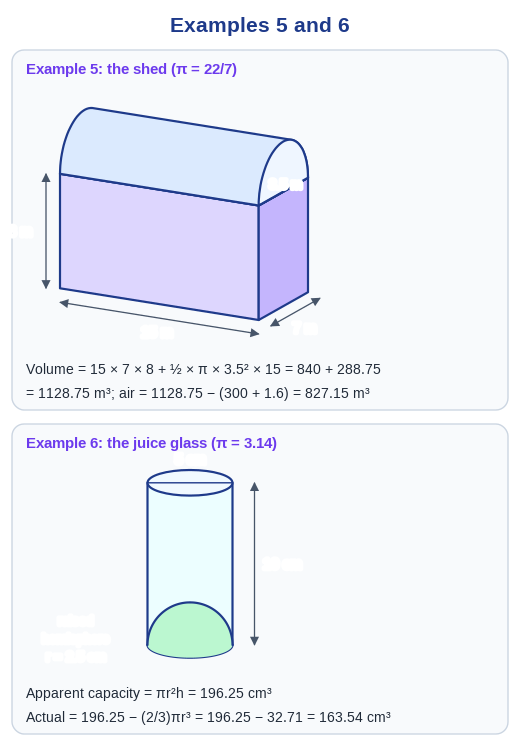
In Example 5, a shed is a cuboid 15 m long, 7 m wide and 8 m high, with a half cylinder of diameter 7 m lying along its length as the roof. The air inside is
15 × 7 × 8 + ½ × (22/7) × 3.5² × 15 = 840 + 288.75 = 1128.75 m³.
The machinery takes 300 m³ and 20 workers take about 0.08 m³ each, so the air left is 1128.75 − 301.6 = 827.15 m³.
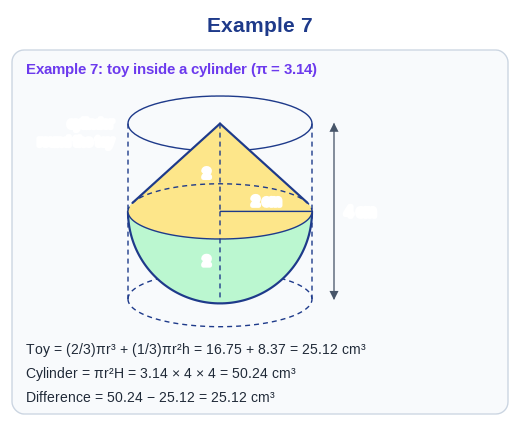
In Example 7, a toy is a cone 2 cm high on a hemisphere of radius 2 cm. Its volume is (2/3)π × 2³ + (1/3)π × 2² × 2 = 25.12 cm³ with π = 3.14. The cylinder that just encloses it has radius 2 cm and height 4 cm, volume 50.24 cm³, so the space between them is 25.12 cm³.
Taking parts away
When a part is removed, subtract its volume.
- Raised bottom of a glass (Example 6). A glass of inner diameter 5 cm and height 10 cm seems to hold πr²h = 196.25 cm³. A raised hemisphere of radius 2.5 cm at its bottom takes up (2/3)πr³ ≈ 32.71 cm³, so it actually holds 163.54 cm³.
- Holes in a pen stand (Exercise 12.2, Question 4). Wood = volume of the cuboid − volume of the four conical holes.
- Water left in a container (Exercise 12.2, Question 7). A solid lowered into a cylinder full of water pushes out its own volume, so water left = cylinder − solid.
Counting and mass
Two more patterns use volume as a measuring tool.
- Counting. If small objects fill (or push out) a known volume, their number = that volume ÷ volume of one object. In Exercise 12.2, Question 5, lead shots push a quarter of the water out of a conical vessel: (50/3)π ÷ (1/6)π = 100 shots.
- Mass. Mass = volume × mass of one unit of volume. In Exercise 12.2, Question 6, an iron pole of 111532.8 cm³ at 8 g per cm³ weighs about 892.26 kg.
A step-by-step method
- Sketch the object and split it into basic solids.
- Decide for each part whether to add it (joined on) or subtract it (hollow, cavity, something inside).
- Write the volume formula for each part, using radius, not diameter.
- Calculate with the π the question gives, in one unit, and answer in cubic units.
Read next: surface area of combined solids, where joined faces must be left out. All the questions are solved in the NCERT solutions, and the chapter notes give the full picture.
Practice
-
A solid is a cylinder of radius 3 cm and height 5 cm with a hemisphere of radius 3 cm on top. Its volume, in terms of π, is:
Show answer
Answer: (b) 63π cm³
-
A cone of radius 2 cm and height 6 cm is hollowed out of a cylinder of the same radius and height. The volume left, in terms of π, is:
Show answer
Answer: (b) 16π cm³
-
How many spherical balls of radius 1 cm are needed to fill a hemispherical bowl of radius 4 cm, ignoring the gaps?
Show answer
Answer: (b) 32
-
A cuboidal tank 2 m × 1 m × 1 m is full of water. A solid cube of edge 0.5 m is lowered into it until it is fully under water. How much water is left in the tank?
Show answer
Answer: Tank volume = 2 × 1 × 1 = 2 m³. Cube volume = 0.5³ = 0.125 m³. The cube pushes out its own volume of water, so 2 − 0.125 = 1.875 m³ is left.
-
Why is the volume of a cone on a hemisphere equal to the sum of their volumes, while its surface area is not the sum of their surface areas?
Show answer
Answer: Joining hides the two flat faces, so that area is lost. But no space is lost: every bit of the cone and of the hemisphere is still inside the toy. So volumes add fully, while surface areas do not.
Questions students ask
What is the difference between apparent and actual capacity?
Apparent capacity is what a container seems to hold from its outer shape, for example πr²h for a cylindrical glass. Actual capacity is less if part of the inside is filled by something, such as a raised bottom. In Example 6 the glass seems to hold 196.25 cm³ but actually holds 163.54 cm³.
Why does a solid placed in water push some water out?
Two things cannot take up the same space. A solid lowered into a full container takes the place of an equal volume of water, which flows out. That is why water left = container − solid.
Do I need to remember the formula for a half cylinder?
No. It is just half the volume of the full cylinder, ½πr²h. Example 5 uses it for the roof of a shed.
Where are the exercise questions on this topic?
Exercise 12.2 (8 questions) is all on volume. Every question and Examples 5 to 7 are worked out on the NCERT solutions page.
Stuck on a question?
Take a photo and Lagnever AI explains it step by step. Try it for 7 days for ₹2.
Get it on Google Play Open in browser
For parents: after the trial, the plan renews monthly by UPI or card autopay. You can cancel anytime in the app.